- 1 Key Takeaways
- 2 Why tambaqui bones hold back its industrialization
- 3 Not just business: children, older adults, and school cafeterias
- 4 How gene editing in fish works
- 5 What the first edited tambaqui show
- 6 The missing step: breeding the fish and evaluating the meat
- 7 A path of trial and error born from an industry request
- 8 China holds the lead, but Brazil is closing the gap
- 9 From the Rondônia accident to a designed tambaqui
- 10 Entradas relacionadas:
Key Takeaways
- Embrapa Pesca e Aquicultura used CRISPR/Cas9 gene editing to switch off genes linked to the formation of Y-shaped bones in tambaqui. Some edited fish no longer have them, others have very few, and some still retain them.
- A patent application for the methodology was filed on November 6, 2026, with Brazil’s National Institute of Industrial Property (INPI).
- There is no commercial boneless line yet. The edited specimens must mature and reproduce; the first generation of offspring is expected in 2027.
- Currently, filleting tambaqui wastes nearly 10% of the meat and leaves an irregular cut. Without these bones, it would be possible to obtain two clean fillets per fish.
- Starting in 2027, the technique will be extended to other native species, including caranha (Piaractus brachypomus), matrinxã (Brycon amazonicus), and pacu (Piaractus mesopotamicus).
Around 2014, a fingerling producer in Rondônia, in the Brazilian Amazon, sold several batches of tambaqui to fish farmers in Manaus. Nothing out of the ordinary. The fish grew, were harvested, and when the buyers cut them open, they noticed something unexpected: they lacked the troublesome Y-shaped bones that run through the back of this species.
The Manaus producers called back immediately. They wanted more fingerlings “like those.” The supplier had no idea what they were talking about. Once he realized the value of what he had sold, he tried to buy the specimens back to study and breed them, even inviting a professor from São Paulo to help. They were unsuccessful. Those boneless tambaqui were lost, but they left a lingering question across the entire industry: what if that fish could be produced at will?
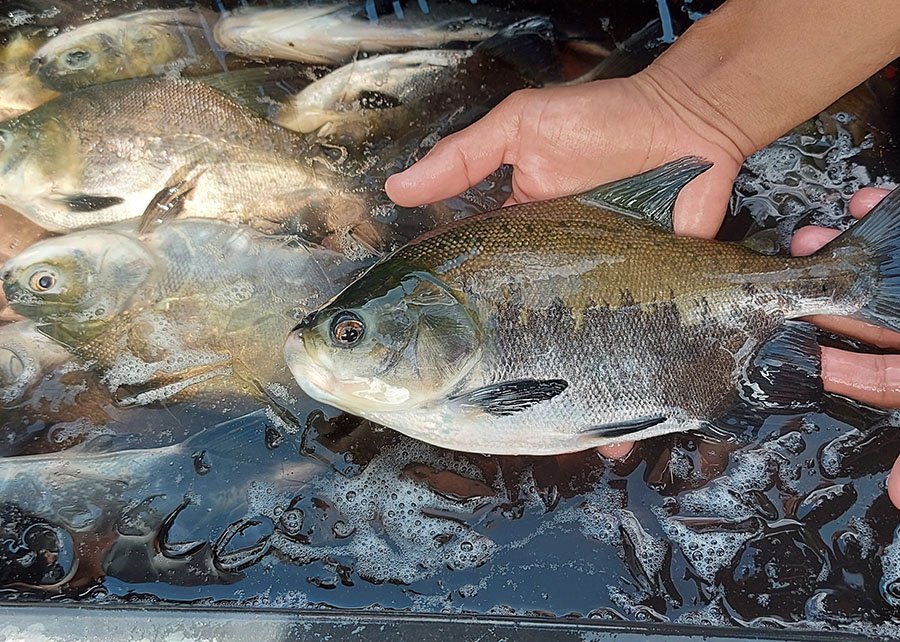
Twelve years later, the answer is beginning to materialize in a laboratory. Embrapa Pesca e Aquicultura, the fisheries research center of the Brazilian Agricultural Research Corporation, announced preliminary results in reducing and completely eliminating intermuscular bones in tambaqui (Colossoma macropomum) through gene editing.
For producers, processing plants, and exporters, the breakthrough tackles a long-standing bottleneck: tambaqui (also known as gamitana or cachama) is the leading Amazonian species farmed in Brazil, yet its bones prevent it from being turned into a clean fillet—one that can compete with tilapia and meet the demands of discerning markets, school cafeterias, and older adults. While no commercial line exists yet, the roadmap is set, and the methodology has been protected through a patent application.
Why tambaqui bones hold back its industrialization
Anyone who has worked in a tambaqui processing plant knows the problem. The Y-shaped bone sits right in the loin, the most valuable cut of the fish. To extract a fillet, the worker has to cut around it. The result: nearly 10% of the meat goes to waste, and the fillet is left misshapen, with an appearance consumers might mistake for spoiled product.
For this reason, despite being Brazil’s flagship native fish, tambaqui has been unable to replicate the success of Nile tilapia (Oreochromis niloticus), which is available in clean fillets at virtually any supermarket. The numbers bear this out. According to the 2026 Peixe BR Brazilian Fish Farming Yearbook, Brazil produced 257,070 metric tons of native fish in 2025. That same year, it exported 257 metric tons of tambaqui—primarily to Peru—a 14% increase over 2024.
The U.S. market is a different story. There, tilapia accounts for 92% of the fish Brazil exports, while native species make up barely 1% of North American purchases. “For Brazil to increase its share of the North American market, making the filleting of Amazonian fish viable is crucial, because consumers there are accustomed to eating boneless fish,” explains Eduardo Varela, the researcher leading the project.
Compounding this is an additional technical hurdle well known to many producers: industrial machines designed to separate bones and produce mechanically separated meat (MSM) do not work with native Amazonian species.
Not just business: children, older adults, and school cafeterias
The bones also pose a public health challenge. In Brazil, there have been previous initiatives to include Amazonian fish in school meal programs, but they were halted due to the choking hazard they pose to children. Older adults face a similar risk. For reference, in China, 60% of foreign-body choking incidents are attributed to Y-shaped fish bones.
Mantente siempre informado
Stay Informed
Únete a nuestras comunidades para recibir al instante las noticias, informes y análisis más importantes del sector acuícola.
Join our communities to get instant access to the most important news, reports, and analysis from the aquaculture industry.
Patricia Chicrala, Head of Research and Development at Embrapa Pesca e Aquicultura, sums up the dual benefit of the breakthrough: safer consumption for vulnerable populations and greater industrial efficiency. “Once the head, viscera, and backbone are removed, it will be possible to obtain two boneless fillets,” she states.
How gene editing in fish works
The key lies in a fundamental biological detail: Y-shaped bones are not true bones like the skull or ribs. In reality, they are tendons located between muscle blocks that calcify over time, much like a hose that builds up mineral scale until it hardens.
Because they have a different origin from the rest of the skeleton, it is possible to target the genes that regulate this calcification without altering those that form the other bones. This drastically reduces the risk of malformations or unintended effects in the animal.
To achieve this, the team used CRISPR/Cas9, a tool that operates like guided molecular scissors: it locates an exact point in the DNA and cuts it to “turn off” a specific gene. The intervention is performed at the egg stage, leaving the egg intact so the tambaqui can develop normally.
However, gene editing should not be mistaken for magic. The ultimate goal is to find a gene responsible exclusively for forming the Y-shaped bone—something that has not yet been identified in either Brazil or China. “There are very strong candidate genes, but it is not the ‘Holy Grail’ of an exclusive gene. The challenge lies in identifying a gene that can be deactivated without affecting other functions of the fish,” Varela clarifies.
What the first edited tambaqui show
So far, researchers have evaluated the specimens using various techniques, including ultrasounds on live animals. This allows them to observe the bones without sacrificing the fish, as it is essential to keep them alive to monitor their growth and ensure they reproduce.
“We have already been able to visualize via ultrasound that some fish have no bones, others have very few, and the rest still have them,” Varela explains. This heterogeneous result is not a failure: according to the researcher, it is to be expected in a first edited generation, since not all cells in the organism assimilate the change uniformly. The exact percentage of reduction in each fish still remains to be measured.
Definitive confirmation will come from a high-resolution micro-CT scanner, a device capable of generating three-dimensional images of the inside of the fish. The equipment is being imported from Germany and is expected to arrive at the research center in 2027.
The missing step: breeding the fish and evaluating the meat
High expectations rest on the fingerlings that will hatch in 2027, when the edited specimens reach sexual maturity and reproduce. They will be the first tambaqui from a heritable line. “Those will indeed be the animals completely devoid of bones. Those that are not will be removed from the program,” previews Fernanda O’Sullivan, a researcher on the project.
With thousands of offspring available, the team will be able to count the bones, quantify the reduction, and analyze the overall performance of the fish. Varela notes that they will evaluate potential variations in meat quality, protein content, growth rate, reproduction, and overall production yield. For any fish farmer, this stage will be decisive in confirming that the technology is viable in the pond and not just in the laboratory.
A path of trial and error born from an industry request
The project emerged directly from a demand by producers. In 2017, the Brazilian Fish Farming Association (Peixe BR) brought the concern to Embrapa Pesca e Aquicultura, which at the time lacked the laboratories, personnel, and equipment to edit genes. The initial studies on the morphology and structure of the bones were carried out under Aquavitae, an international consortium of research institutions.
In 2021, Varela devoted himself full-time to the challenge with funding from CNPq, the Brazilian Innovation Agency (Finep), and parliamentary amendments. That same year, he brought O’Sullivan—then at Embrapa Amazônia Ocidental—onto the team, drawing on her previous experience in salmon gene editing in Norway.
The first proof of concept arrived in 2023, with the birth of an albino tambaqui produced through gene editing. “It was a huge joy when the first albino tambaqui was born. That gave us confirmation that it was possible to apply the CRISPR technique to the species,” O’Sullivan recalls. Today, the team has also produced ornamental black-and-white tambaqui that are displayed at trade shows for demonstration purposes, though their large adult size prevents them from being sold in the aquarium trade.
China holds the lead, but Brazil is closing the gap
The quest for boneless fish is not new. In 1995, European and U.S. researchers demonstrated for the first time that intermuscular bones have a different origin from ribs and vertebrae. China began investing in this line of research in 2005, driven by its massive consumption of carp and a domestic market that, with globalization, adopted a preference for fillets.
Early Chinese trials ran into an obstacle well known to aquaculture geneticists: crossing boneless specimens did not guarantee boneless offspring, and some species take up to three years to reach maturity. Starting in 2016, the use of zebrafish as a laboratory model and the advent of CRISPR accelerated results. “They are a decade ahead and currently have at least three species with intermuscular bones eliminated via CRISPR/Cas9,” Varela acknowledges. In China, the fourth generation of boneless fish has already been studied, and current research is focused on consumer acceptance and grow-out performance.
With this milestone, Brazil joins China among the leading countries in gene editing applied to aquaculture. And the roadmap does not end with tambaqui: starting in 2027, in partnership with Bioparque Pantanal in Campo Grande, the team will replicate the technique in caranha, matrinxã, and pacu.
From the Rondônia accident to a designed tambaqui
That fingerling producer in Rondônia held in his hands, by sheer chance, the fish the industry had dreamed of for years, yet he could not replicate it. What serendipity delivered and then took away, science is now seeking to reproduce deliberately, gene by gene.
Decisive milestones still remain: getting the edited fish to reproduce, confirming that the trait is inherited, and verifying that meat quality, growth, and animal health remain intact. If everything checks out, the next time a fish farmer in Manaus asks for “those boneless fingerlings,” someone will very likely know exactly what they mean—and be able to sell them.

Editor at the digital magazine AquaHoy. He holds a degree in Aquaculture Biology from the National University of Santa (UNS) and a Master’s degree in Science and Innovation Management from the Polytechnic University of Valencia, with postgraduate diplomas in Business Innovation and Innovation Management. He possesses extensive experience in the aquaculture and fisheries sector, having led the Fisheries Innovation Unit of the National Program for Innovation in Fisheries and Aquaculture (PNIPA). He has served as a senior consultant in technology watch, an innovation project formulator and advisor, and a lecturer at UNS. He is a member of the Peruvian College of Biologists and was recognized by the World Aquaculture Society (WAS) in 2016 for his contribution to aquaculture.