- 1 Key Takeaways
- 2 Why Biofloc Success Rests on Bacterial Nutrition
- 3 Critical Parameters and Monitoring Frequency in Biofloc Culture
- 4 How to Fertilize a Biofloc System: The Carbon-to-Nitrogen Ratio Step by Step
- 5 Aeration Dynamics and Dissolved Oxygen: The Operational Core of Biofloc
- 6 Correcting pH and Alkalinity in Biofloc Systems
- 7 Probiotics and Solids Management: Microbial and Physical Equilibrium
- 8 Strategic Feeding: Weekly Biometry and Precise Rations
- 9 From Intuition to Technical Precision: An Indispensable Operational Tool
- 10 Entradas relacionadas:
Key Takeaways
- The first week is governed by a 15:1 C:N ratio. Carbon fertilization is applied three to five times to activate the heterotrophic bacteria that assimilate ammonia; subsequently, the ratio is reduced to 6:1, and carbon is supplemented only when total ammonia nitrogen (TAN) reaches or exceeds 1 mg/L.
- Given a TAN concentration of 3.1 mg/L in a 5,000-liter tank, 93 g of net carbon is required, equivalent to 248 g of molasses at a 37.5% carbon concentration.
- During system maturation, ammonia increases first, followed by a sharp rise in nitrite, eventually stabilizing as nitrate. Reusing 25% mature water substantially accelerates this colonization process.
- To raise pH from 6.1 to 7.5 in a 30 m³ culture volume, 3.6 kg of sodium carbonate is required; in parallel, increasing alkalinity from 100 to 150 mg/L in 50 m³ demands exactly 5 kg of sodium bicarbonate.
- Total suspended solids (TSS) concentrations exceeding 500 mg/L depress dissolved oxygen, increase carbon dioxide, and clog shrimp branchial epithelium; in the absence of mechanical clarifiers, preventive water exchange must not exceed 30%.
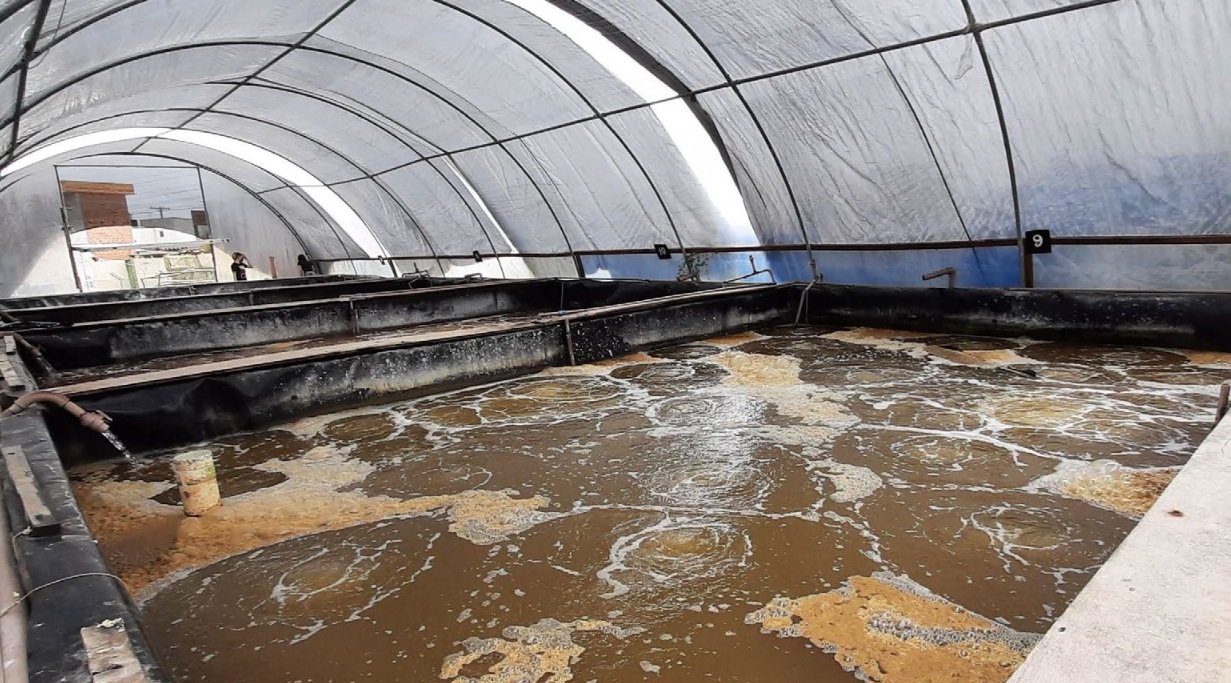
It is six o’clock in the morning, and the greenhouse still holds the dense scent of humidity and molasses. The technician walks along the tank rim, observes the café-au-lait biofloc propelled by diffuser hoses, and draws a sample for routine analysis. The ammonia reading triggers alarms: 3.1 mg/L in a 5,000-liter volume.
He knows that organic carbon dosing is urgent, but he lacks the exact dosage: a third of a bucket, half a bucket? The previous day, nitrite was already on an upward curve, the pH dropped by a couple of tenths, and the field myth persists that “more sugar compensates for everything.” Thus, between intuitive approximations and empirical habits, numerous intensive facilities worldwide operate.
For this operator—and for any producer engaged in the transition toward super-intensive aquaculture—a consortium of researchers from Brazil and the United States has published a vital technical reference for the sector: an operational guide featuring formulations, parametric tables, and resolved models for Pacific white shrimp (Penaeus vannamei) production in biofloc systems.
The manual, published by Virginia Cooperative Extension, synthesizes the expertise of the Federal University of Rio Grande, the Federal Rural University of Pernambuco, and the Virginia Seafood Agricultural Research and Extension Center of Virginia Tech. Its primary merit lies in its direct applicability: translating decades of research into standardized operational protocols defined in grams, exact volumes, and sampling frequencies.
Why Biofloc Success Rests on Bacterial Nutrition
The Pacific white shrimp (Penaeus vannamei) leads aquaculture production on a global scale. As shrimp farming intensifies, the sector faces the challenge of maximizing yields with a reduced water footprint. Biofloc technology addresses this challenge through an efficient biological principle: rather than conducting water exchanges to flush waste, it leverages a microbial community that assimilates metabolites directly within the culture tank.
The characteristic aggregates that impart a brown coloration to the water—the “flocs”—are composed of uneaten feed particles, feces, microalgae, protozoa, rotifers, and bacterial biomass. This complex functions simultaneously as a bioremediation system and a complementary nutritional source: it recycles nitrogenous compounds while providing in situ protein available for shrimp consumption. Consequently, the system accommodates high stocking densities with minimal or zero water exchange, reinforcing biosecurity by restricting external water intake and the potential ingress of pathogens.
Nevertheless, higher stocking density increases the nitrogen load derived from aquafeed and branchial and fecal excretion. Total ammonia nitrogen (TAN) and nitrite exert cytotoxic effects: they induce physiological stress, depress growth, and increase mortality. At this juncture, operational management becomes critical. Heterotrophic bacteria—microorganisms that require assimilable carbon sources—immobilize this ammonia and convert it into cellular biomass, provided that the carbon-to-nitrogen ratio is precise. A carbon deficit leads to ammonia accumulation; an excess triggers the unchecked proliferation of suspended solids.
Critical Parameters and Monitoring Frequency in Biofloc Culture
Prior to calculating organic carbon doses, the technical guide establishes baseline operational thresholds. For marine water systems, the recommended physicochemical and biological ranges comprise:
| Parameter | Recommended Range | Sampling Frequency |
| Temperature | 28–30 °C (operational tolerance: 26–31 °C) | Daily |
| Dissolved Oxygen | 4–8 mg/L | Daily |
| pH | 7.5–8.2 | Daily |
| Salinity | 20–35 g/L | Weekly |
| Total Ammonia Nitrogen (TAN) | < 3 mg/L | Daily until nitrifying colonization; then twice weekly |
| Nitrite () | < 10 mg/L | Daily until nitrifying colonization; then twice weekly |
| Nitrate () | < 150 mg/L | Weekly |
| Alkalinity | 140–180 mg/L | Twice weekly |
| Total Suspended Solids (TSS) | 200–500 mg/L | Weekly |
| Settleable Solids | 5–14 mL/L | Weekly |
The rationale behind this schedule is strategic: total ammonia nitrogen and nitrite demand daily monitoring exclusively during the biological maturation phase of the water. Once the nitrifying bacterial consortium—chemoautotrophic microorganisms that oxidize ammonia to nitrite and subsequently to nitrate, a substantially less toxic compound—colonizes the medium, biogeochemical dynamics achieve stability, and analytical control intervals can be spaced out.
Mantente siempre informado
Stay Informed
Únete a nuestras comunidades para recibir al instante las noticias, informes y análisis más importantes del sector acuícola.
Join our communities to get instant access to the most important news, reports, and analysis from the aquaculture industry.
How to Fertilize a Biofloc System: The Carbon-to-Nitrogen Ratio Step by Step
The First Week: 15:1 C:N Ratio
To initiate culture, the technical guide recommends stocking shrimp and fertilizing during the first seven days by applying a 15:1 carbon-to-nitrogen (C:N) ratio. In operational terms: for every gram of nitrogen introduced via aquafeed, 15 grams of organic carbon are dosed. This high substrate availability stimulates heterotrophic bacteria, which are responsible for the primary assimilation of ammonia nitrogen. During this induction phase, carbon addition is distributed across three to five applications throughout the week.
Regarding carbon sources, feedstocks rich in simple sugars or fermentable carbohydrates are utilized, most notably:
- Dextrose: 50.0% carbon
- Wheat bran: 43.4% carbon
- Rice bran: 43.36% carbon
- Refined sugar: 42.1% carbon
- Sugarcane molasses: 37.5% carbon
The authors highlight a determining factor that is frequently overlooked in the field: verifying the actual analytical carbon percentage of the purchased batch is indispensable, as supplier variability directly alters the final dosage calculation.
Operational Phase: 6:1 C:N Ratio on Ammonia Demand
Once the acclimation and startup phase concludes, the operational strategy shifts substantially. The ratio is reduced to 6:1 (six grams of carbon per gram of total ammonia nitrogen, TAN), and fertilization is performed exclusively when TAN reaches or exceeds 1.0 mg/L. Prophylactic or empirical addition proves counterproductive, as it overstimulates bacterial biomass and induces a critical accumulation of suspended solids.
The analytical procedure consists of three standardized steps:
- Calculation of dissolved nitrogen in the system (g):
- Determination of required net carbon (g):
- Conversion to commercial molasses weight (g):
The result indicates exactly 248 g of molasses—no estimated dosages or arbitrary sugar additions. If molasses were replaced with dextrose, the requirement would drop to 186 g due to its higher purity and elemental carbon concentration.
Biological Maturation Criteria of Biofloc
During water maturation, the microbial consortium undergoes a defined ecological succession. Initial-phase evaluations documented by Pimentel et al. (2024) describe the classic dynamic: ammonia rises first to reach a moderate peak within the first 10 days; subsequently, a pronounced increase in nitrite () manifests, exceeding 15 mg/L by the first month; finally, both fractions drop sharply as nitrate () steadily accumulates, surpassing 100 mg/L by day 52.
This temporary nitrite peak often causes operational concern; however, it indicates the active colonization of nitrite-oxidizing bacteria rather than a systemic failure. Biofloc achieves functional maturity when TAN and nitrite stabilize at minimal or undetectable levels and metabolic nitrogen is sequestered as nitrate. In this steady state, dosing carbon lacks justification, as no free ammonia is available for heterotrophic assimilation.
To optimize this process, Krummenauer et al. (2014) demonstrated that inoculating 25% of the total volume with mature water from a previous cycle accelerates bacterial colonization, stabilizes physicochemical parameters, and enhances shrimp growth rates, emulating the fertility of an edaphically mature soil compared to an inert substrate.
Aeration Dynamics and Dissolved Oxygen: The Operational Core of Biofloc
In biofloc culture systems, oxygen supply transcends the physiological requirements of the shrimp. The bacterial community responsible for water bioremediation maintains a continuous respiration rate, while aeration turbulence keeps the flocs in constant suspension, preventing anaerobic settlement at the pond bottom. The most commercially widespread diffusers comprise micro-perforated hoses (Aero-Tube type) and Venturi-type air injectors; this technological selection proves decisive, as it modulates both floc particle size and microbial community structure.
Microbubbles substantially enhance system efficiency: they maximize the gas-liquid contact surface area and extend residence time in the water column, optimizing the dissolved oxygen transfer rate. The technical guide synthesizes operational decision-making into three critical response thresholds:
- Below 1.0 mg/L: Critical lethal concentration if exposure persists even for short periods.
- Equal to or below 3.0 mg/L: Operational alert range demanding immediate corrective intervention.
- Equal to or above 5.0 mg/L: Target zootechnical comfort concentration and ecosystem stability.
Correcting pH and Alkalinity in Biofloc Systems
A gradual decline in pH within a biofloc system does not necessarily signify an adverse imbalance: nitrification continuously consumes alkalinity and releases hydrogen ions, making this drop an indicator of active bacterial metabolism. However, should pH fall below 7.0, shrimp growth rates decrease markedly, and fluctuations directly alter the toxic un-ionized ammonia fraction. Consequently, alkalinity—which functions as a buffer system and plays a central role in crustacean osmoregulation and molting—must be maintained between 140 and 180 mg/L.
The technical guide adopts parameters reported by Furtado et al. (2011), who evaluated three reference neutralizing agents:
| Chemical Neutralizer | Reference Dose | pH Increase | Alkalinity Increase |
| Sodium Carbonate () | 0.06 g/L | 0.70 ± 0.10 | 20 ± 10 mg/L |
| Calcium Hydroxide () | 0.15 g/L | 0.80 ± 0.15 | 110 ± 10 mg/L |
| Sodium Bicarbonate () | 0.20 g/L | 0.25 ± 0.05 | 100 ± 10 mg/L |
The chemical strategy dictates specific applications: sodium carbonate is the preferred agent for elevating pH; sodium bicarbonate primarily adjusts the alkaline reserve; and calcium hydroxide (hydrated lime) shifts both parameters simultaneously. Dosimetric calculations follow a standardized principle: the target differential is divided by the response capacity of the baseline dose, multiplied by that dose and the total operational volume.
- pH Adjustment Case: A 30 m³ (30,000 L) pond records a pH of 6.1 and requires an increase to 7.5 (a 1.4-unit differential). Utilizing sodium carbonate:
- Alkalinity Adjustment Case: A 50 m³ (50,000 L) volume measures 100 mg/L and targets 150 mg/L (a 50 mg/L deficit). Utilizing sodium bicarbonate:
Probiotics and Solids Management: Microbial and Physical Equilibrium
The use of probiotics—beneficial microorganisms belonging to genera such as Bacillus, Lactobacillus, and Saccharomyces—enhances organic matter degradation, optimizes nitrogenous metabolite removal, and colonizes the shrimp digestive tract, thereby improving nutrient assimilation and bolstering the immune system. Furthermore, these agents exert competitive exclusion against pathogenic Vibrio strains through ecological niche occupation and the synthesis of antimicrobial peptides. While adhering to manufacturer specifications remains paramount, Hostins et al. (2017) demonstrated effective enteric colonization and a substantial reduction in pathogenic bacteria by dosing a commercial probiotic at 0.5 g/m³ every 48 hours.
However, intensive bacterial proliferation entails an operational trade-off: solids accumulation. Higher metabolic activity accelerates microbial reproduction, and an uncontrolled floc density depletes dissolved oxygen, increases carbon dioxide (), and clogs crustacean branchial epithelium. Technical guidelines recommend maintaining total suspended solids (TSS) below 500 mg/L. The ideal strategy involves integrating a settling chamber or mechanical clarifier: a decantation unit where dense particles settle before purified supernatant returns to the culture tank. In facilities lacking this equipment, corrective management entails partial water exchanges restricted to a maximum of 30% volume.
Strategic Feeding: Weekly Biometry and Precise Rations
Nutritional management represents the factor exerting the greatest direct impact on operational cost structure. The technical guide standardizes a weekly biometry protocol: sampling a representative cohort of shrimp, determining individual mean weight, and calibrating daily feed rates against total biomass using reference zootechnical growth curves.
The feeding matrix, adapted from Jory et al. (2001), stratifies feed allowances according to mean water temperature averaged between 06:00 and 16:30 h readings:
- In thermally optimal water (> 28.5 °C): Newly stocked postlarvae (0.01 g) start at a daily feeding rate equivalent to 250% of their biomass; by week 10, at an approximate weight of 10 g, the ration decreases to 3.0%; reaching a 2.3% biomass allowance by week 20 (mean weight of 22 g).
- In water below 28.5 °C: Metabolic rate and growth decelerate—reaching approximately 13.8 g by week 20—demanding proportionally lower feeding percentages.
While feed charts formulated by commercial aquafeed manufacturers are equally reliable, the essential technical principle requires auditing rations weekly, preventing financial waste and avoiding overloading the aquatic medium with residual nitrogen.
From Intuition to Technical Precision: An Indispensable Operational Tool
The authors do not position this manual as a disruptive innovation, but rather frame it around a pragmatic premise of immediate practical utility: a rigorous effort to dispel recurrent misinterpretations and standardize critical management variables often lost in day-to-day routines. Behind every stated parameter lie years of experimental validation in the ponds of southern Brazil, where research teams led by Wilson Wasielesky and Dariano Krummenauer evaluated stocking densities, carbon source dynamics, aeration regimes, and water reuse protocols, discarding inefficient configurations. Nonetheless, the challenge remains ongoing: operational ranges represent baseline reference values, and each production unit responds to distinct water quality conditions, local climate, and available feedstocks, rendering analytical monitoring an irreplaceable practice.
Back in the greenhouse, the technician on duty foregoes guesswork. With an analytical kit in one hand and a calculator in the other, he resolves the stoichiometric balance and weighs out exactly 248 grams of molasses. The following day, he will quantify total ammonia nitrogen (TAN) again, and if the reading sits below 1.0 mg/L, he will hold off on carbon dosing. That methodological gap—between an estimated bucket scooped by intuition and a quarter-kilogram grounded in scientific protocol—delineates the boundary between a biofloc system vulnerable to collapse and an efficient biotechnological operation that maximizes producer profitability.
Reference (open access)
Pimentel, O. A. L. F., Ramiro, B. O., Krummenauer, D., Wasielesky, W., van Senten, J., McAlhaney, E., Urick, S., y Schwarz, M. H. “Practical Guide for Rearing Pacific White Shrimp, Penaeus vannamei, in Biofloc Systems“. Virginia Cooperative Extension, AREC-314P.

Editor at the digital magazine AquaHoy. He holds a degree in Aquaculture Biology from the National University of Santa (UNS) and a Master’s degree in Science and Innovation Management from the Polytechnic University of Valencia, with postgraduate diplomas in Business Innovation and Innovation Management. He possesses extensive experience in the aquaculture and fisheries sector, having led the Fisheries Innovation Unit of the National Program for Innovation in Fisheries and Aquaculture (PNIPA). He has served as a senior consultant in technology watch, an innovation project formulator and advisor, and a lecturer at UNS. He is a member of the Peruvian College of Biologists and was recognized by the World Aquaculture Society (WAS) in 2016 for his contribution to aquaculture.