- 1 Key Takeaways
- 2 The Antimicrobial Challenge in Aquaculture: Production Growth and Biological Risks
- 3 The Limitations of Commercial Figures: The Data Gap in Aquaculture Antibiotic Use
- 4 The Global Scientific Panel Behind the New Aquaculture Monitoring Standard
- 5 What Data Must an Aquaculture Farm Document for Every Treatment?
- 6 Antimicrobial Monitoring in Aquaculture: Three Measurement Methodologies
- 7 Cost-Effective Strategies for Field-Level Antimicrobial Monitoring
- 8 Lessons from Global Salmon Farming: How Norway, Chile, and Canada Validated Antimicrobial Governance
- 9 What Does the Aquaculture Producer Gain by Quantifying Treatments?
- 10 Back to the Pond: From Emergency Reaction to Clinical Decision-Making
- 11 Entradas relacionadas:
Key Takeaways
- In 2026, the World Organisation for Animal Health (WOAH) presented the first global guideline to quantify antimicrobial use directly on farms, moving beyond reliance on commercial distribution figures.
- Sales and import statistics provide an overarching overview; however, the operational reality of the pond, cage, or raceway lies in daily records and veterinary prescriptions.
- The document proposes three progressive monitoring tiers: treatment prevalence per epidemiological unit, milligrams of active ingredient per kilogram harvested, and the estimation of defined daily doses.
- It integrates practical case studies applied to salmonids and Pacific white shrimp (Litopenaeus vannamei), highlighting scenarios where oxytetracycline use reached up to 357 mg/kg harvested in a single production cycle.
- Far from a punitive approach, the tool provides technical benchmarks to assess efficiency against the sector, rectify ineffective protocols, and support sanitary compliance before demanding markets and international certification schemes.
It is five in the morning. At a shrimp farm, the technician inspects the perimeter dikes with a flashlight beam over the water. In pond twelve, feeding rates have declined over the past 48 hours, and the margins are beginning to show the first mortalities. Following a quick phone call and coordination with the feed manufacturer, the bags of medicated feed are dispatched before noon.
Ten days later, mortality rates stabilize, and the emergency appears under control. However, no consolidated log documented the net volume of antibiotic dispensed, the estimated biomass at the time of administration, or the clinical efficacy of the initial intervention. Months later, the cycle repeats in another module using a different molecule.
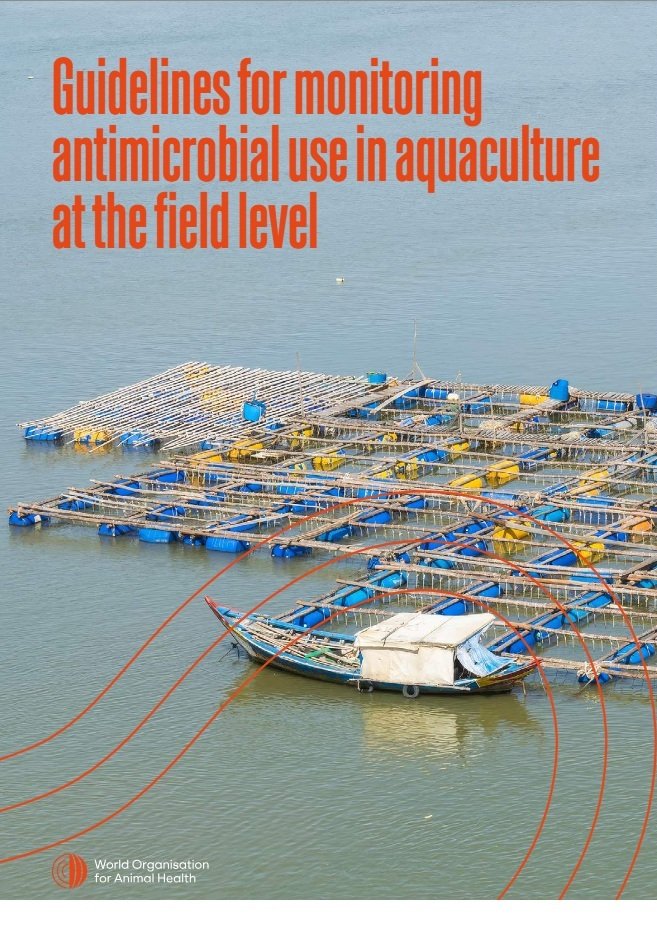
This scenario—commonplace in shrimp farming as well as in tilapia, trout, or salmon operations worldwide—represents the operational bottleneck that WOAH’s new publication seeks to transform: Guidelines for monitoring antimicrobial use in aquaculture at the field level. The initiative proposes a common methodological standard enabling farms, industry associations, and veterinary authorities to quantify antimicrobial use under standardized criteria by species, route of administration, and therapeutic intent. For the aquaculture producer, the premise is clear: replace empirical management with objective metrics that optimize operational expenditures, refine treatments, and demonstrate biosecurity to international markets.
The Antimicrobial Challenge in Aquaculture: Production Growth and Biological Risks
Aquaculture has long ceased to be a secondary activity relative to capture fisheries. According to FAO data cited in the guidance, global aquaculture production reached approximately 141.6 million tonnes in 2024, surpassing wild capture fisheries by accounting for 52.8% of total aquatic animal production, with a first-sale value estimated at USD 371.3 billion.
Nevertheless, this sustained expansion amplifies disease incidence, particularly in intensive culture systems with high stocking densities. In the absence or insufficiency of comprehensive preventative strategies—such as robust vaccination schedules, early molecular diagnostics, or stringent biosecurity protocols—antimicrobial therapy frequently becomes the primary default intervention.
The core challenge lies in the aquatic medium, which magnifies pharmacological dissemination. The document highlights an estimate indicating that up to 75% of antimicrobials administered in aquaculture can end up dispersed into the aquatic ecosystems adjacent to farming facilities. Within this environment, bacterial communities encounter favorable conditions to develop antimicrobial resistance, losing susceptibility to historically effective compounds. This phenomenon is already linked to therapeutic failures within the production sector; concurrently, the alignment between resistance profiles identified on farms and those observed in wider epidemiological contexts suggests cross-transmission pathways connecting the aquatic environment, animals, and human health.
The Limitations of Commercial Figures: The Data Gap in Aquaculture Antibiotic Use
Since 2015, the World Organisation for Animal Health (WOAH) has managed the global ANIMUSE platform to collect antimicrobial data across animal health. Historically, this platform has relied on commercial sales, import records, and wholesale distribution data. While these metrics illustrate general national trends, they carry a structural limitation: a commercial batch does not specify the target species, actual dosage applied, duration of therapy, or whether the administration targeted a confirmed etiology rather than prophylactic application.
Consequently, during the 2018 WOAH Global Conference in Marrakesh, member countries committed to prioritizing data collection at the field level. Nonetheless, surveillance initiatives predominantly targeted swine, poultry, and cattle supply chains, leaving aquaculture largely sidelined.
A 2022 global assessment across member states confirmed this disparity: despite widespread technical interest in monitoring direct consumption at the farm level, the lack of standardized methodologies and operational toolkits fragmented national efforts, precluding cross-country comparability.
Mantente siempre informado
Stay Informed
Únete a nuestras comunidades para recibir al instante las noticias, informes y análisis más importantes del sector acuícola.
Join our communities to get instant access to the most important news, reports, and analysis from the aquaculture industry.
This methodological void intersects with a challenging operational reality. The spectrum of veterinary medicines officially labeled for aquatic organisms remains narrow, fostering widespread off-label or extra-label usage. Furthermore, over-the-counter access to antimicrobials, constrained diagnostic infrastructure, and an acute scarcity of certified aquatic animal health professionals persist across multiple production regions. In small- and medium-scale operations, these constraints frequently translate into underdosing, unwarranted prophylactic interventions, and suboptimal compound selection.
The Global Scientific Panel Behind the New Aquaculture Monitoring Standard
To resolve this methodological void, WOAH convened a multidisciplinary ad hoc group of international experts in 2023. The working group integrated specialists from WorldFish, the African Union–Inter-African Bureau for Animal Resources, Nitte University, the Centre for Antimicrobial Stewardship on Aquaculture (CASA) in Chile, Ludwig-Maximilians-Universität München, City University of Hong Kong, and the Public Health Agency of Canada. Furthermore, the draft was reviewed by an international scientific panel featuring contributions from the Norwegian Veterinary Institute, the Chinese Academy of Sciences, Can Tho University, and the FAO; the definitive version was finalized in early 2026 under the financial sponsorship of the UK Fleming Fund.
The technical and editorial scope was complex. The aquaculture sector encompasses the farming of finfish, crustaceans, mollusks, and amphibians across divergent rearing infrastructures, including earthen ponds, marine cages, flow-through tanks, and recirculating aquaculture systems (RAS), spanning freshwater, brackish, and marine environments with production cycles ranging from a few weeks to well over a year. Given this structural heterogeneity, a rigid, uniform model is unfeasible. In response, the guideline rejects prescriptive mandates in favor of a phased, scalable roadmap: initiating surveillance with a high-priority species within a designated regional cluster and progressively expanding coverage.
What Data Must an Aquaculture Farm Document for Every Treatment?
The technical guidance outlines five core indicators that must be documented for every therapeutic event:
- Active pharmaceutical ingredient: precise identification of the active substance utilized.
- Target population: total count or estimated biomass of organisms receiving the therapeutic intervention.
- Route of administration: delivered via medicated feed, oral gavage, systemic injection, therapeutic immersion, or topical baths.
- Dosing regimen: quantitative specification of the administered dose rate and duration of therapy.
- Reason for use: distinguishing between therapeutic treatment (animals exhibiting overt clinical signs), metaphylactic control (treating clinically affected populations while protecting cohorts at imminent risk), or targeted prophylaxis during documented high-risk periods.
For aquaculture production facilities lacking dedicated farm management software, the guidance provides an operational reference questionnaire. This instrument examines critical traceability indicators: the treating prescriber (licensed veterinarian, corporate technical representative, feed mill specialist, or informal consultant), prior execution of antimicrobial susceptibility testing (AST), strict adherence to mandatory withdrawal periods before harvest, inventory management of leftover or expired drugs, and the regulatory authenticity and integrity of commercial labeling. These parameters systematically capture daily operational realities in the field.
Antimicrobial Monitoring in Aquaculture: Three Measurement Methodologies
Evaluating antimicrobial consumption shares a close analogy with monitoring dissolved oxygen in a culture unit: one can deduce hypoxia by observing surface piping, using a colorimetric field test kit, or deploying an optical probe. All three options yield operational insight; the distinction lies in their measurement resolution. The same principle of progressive precision applies to antibiotic stewardship.
Frequency and Presence (Count-Based)
This represents the foundational tier and evaluates qualitative occurrence: the proportion of production units administering antimicrobials or the gross tally of treatment interventions over a defined window. For instance, in a field survey across freshwater farms in Vietnam cited within the guidance, out of a sample cohort of 94 facilities, sulfamethoxazole was identified in 39 operations, whereas trimethoprim and oxytetracycline were documented in 29 facilities each. Although this metric does not quantify the physical mass of active substance administered, it clearly delineates which molecules are active and their operational prevalence in the field.
Biomass-Adjusted Metric (Weight-Based)
This volumetric indicator divides the milligrams of active pharmaceutical ingredient—the pure substance exerting the pharmacological effect, excluding formulation carriers and premix excipients—by the total kilograms of biomass harvested. This represents the reference standard adopted across leading global epidemiological surveillance frameworks.
The document illustrates this through an intensive Pacific white shrimp (Litopenaeus vannamei) operation comprising 20 one-hectare ponds stocked at a density of 75 post-larvae per square meter. Each production unit received 1.125 tonnes of medicated feed formulated with an oxytetracycline premix containing 44% active ingredient over 10 days, when the population averaged 5 grams live weight. Yielding a final survival rate of 70% and a harvest weight of 20 grams, the facility produced 210 tonnes of finished product while administering approximately 75 kilograms of net active ingredient. This yields a consumption index of 357 mg of oxytetracycline per kilogram harvested.
At this stage, an essential accounting standard applies: calculations must consolidate the active substances administered strictly to animal cohorts actually harvested within the reporting year, regardless of whether treatments were applied during the preceding reporting period. In a multiareal field audit cited in the guide, a facility treated a cohort that remained in the grow-out phase at year-end; this volume was excluded from that annual index to prevent distortion in the absence of verified final harvest biomass. Applying this standard accounting convention, the evaluated cluster averaged 73.74 mg/kg of shrimp produced in 2024.
Defined Daily Dose for Animals (Dose-Based Metric)
This represents the most analytically rigorous approach by calculating the number of technical daily doses administered (quantified as the nDDDvet indicator). This metric standardizes comparisons between therapeutic compounds characterized by divergent dosing regimens: while oxytetracycline is typically formulated at 100 mg/kg biomass daily, florfenicol is routinely dosed at 15 mg/kg/day. Assessed exclusively by crude mass, tetracycline therapies appear disproportionately impactful, even when both interventions treated an identical volume of live biomass.
The salmonid case study featured in the guidance demonstrates this with clarity: a marine facility stocks 1.1 million smolts and harvests 1,012,000 fish averaging 5.5 kg following a 16-month production cycle. Over this duration, the site executed one course of oxytetracycline and two courses of florfenicol, consuming a combined 2,592 kilograms of active substance, equivalent to 480 mg per kilogram of net biomass gained. When calculated via nDDDvet, both florfenicol interventions required comparable kilograms of raw product; however, the second course represented half the total dose exposure, as it targeted a smaller population of larger individual body weight. This physiological reality remains obscured when auditing gross kilograms alone.
The guidance transparently acknowledges the operational boundaries of this method: it demands granular tracking of mean body weights during therapeutic windows and loses standardization robustness when evaluating unapproved extra-label regimens or responding to revised pharmacopeial guidelines (such as documented oxytetracycline dosing adjustments shifting from 75 to 100 mg/kg in specific jurisdictions).
Cost-Effective Strategies for Field-Level Antimicrobial Monitoring
One of the most consequential conclusions of the document is technical demystification: rigorous data acquisition does not require sophisticated digital architectures or prohibitive enterprise software licenses. During initial deployment phases, a standard spreadsheet in Excel or Google Sheets is fully sufficient to structure baseline databases prior to transitioning toward automated enterprise systems. For direct field data logging, the guidance recommends open-source or cost-effective mobile tools including Epicollect5, KoboToolbox, and ODK (Open Data Kit), which run reliably offline. Nevertheless, maintaining hard-copy paper farm logs remains an essential contingency given connectivity deficits or device availability constraints in small-scale aquaculture.
Likewise, achieving epidemiological representativeness does not require auditing every individual farming concession. As a methodological benchmark, within a target population of 400 shrimp farms exhibiting an estimated 20% prevalence rate of oxytetracycline use, a probabilistic sample of roughly 150 facilities provides statistically robust data at a ±5% margin of error.
Lastly, technical confidentiality serves as the bedrock of the entire operational framework. The guideline stresses data anonymization protocols, explicit statutory boundaries concerning data ownership, and a tangible value proposition for participating farmers, ensuring every operator receives individual benchmarking analyses compared against regional averages. This strict guarantee of privacy represents the decisive catalyst for securing honest, voluntary field-level participation.
Lessons from Global Salmon Farming: How Norway, Chile, and Canada Validated Antimicrobial Governance
The document highlights an industry milestone often cited as definitive evidence of the effectiveness of quantitative farm-level monitoring. In Norway, systematic auditing of veterinary prescriptions between 1980 and 1994 revealed marked fluctuations in prescribed molecules and potencies, driven substantially by emerging bacterial resistance against oxytetracycline and trimethoprim/sulfadiazine therapies. Crucially, the index of active doses administered per unit of biomass dropped precipitously following the enactment of the comprehensive 1992 regulatory framework, coordinated fallowing protocols across concessions, and the commercial rollout of effective oil-adjuvanted vaccines.
In Latin America, Chile’s National Fisheries and Aquaculture Service (SERNAPESCA) validates marine site prescriptions against computerized dispatch logs from aquafeed manufacturing mills, guaranteeing end-to-end traceability and consistency across declared farm-level volumes. Simultaneously, Canada employs a triangulation protocol cross-referencing commercial wholesale sales with veterinary prescriptions issued across freshwater hatcheries and marine grow-out concessions. When two independent data streams converge, analytical precision and institutional governance are firmly established.
What Does the Aquaculture Producer Gain by Quantifying Treatments?
The cornerstone concept of the WOAH guidance is industry benchmarking. Establishing an objective baseline quantified in milligrams of active substance per kilogram harvested and comparing it against regional or national averages transforms farm logs into a valuable management dashboard. Operations maintaining reduced consumption rates secure immediate commercial advantages, including streamlined access to eco-certifications and preferential terms on aquaculture insurance underwriting, as outlined in the publication. Conversely, facilities exhibiting elevated metrics receive an actionable early warning to audit internal biosecurity and sanitary protocols.
Furthermore, the expert panel identifies strategic positive externalities: strengthened epidemiological surveillance, precise financial accounting of actual disease intervention costs, expanded access to high-value export markets, and regulatory impetus for the formal approval of newer therapeutic molecules tailored to aquatic species. At the same time, the authors caution that field monitoring programs must be stratified according to operational scale, infrastructure, and local realities, preventing methodological biases that inadvertently penalize smallholder farmers facing restricted diagnostic support and veterinary oversight.
Nevertheless, operational boundaries remain. The guideline specifically excludes passive environmental exposure stemming from contaminated intake water or medicated feed ingredients, which must be addressed via dedicated residue testing frameworks. As the authors acknowledge, universal templates do not exist: every national authority must tailor the framework in alignment with its institutional and technical capabilities.
Back to the Pond: From Emergency Reaction to Clinical Decision-Making
Let us return to the opening scene at the shrimp farm. During the next clinical event in pond twelve, the immediate operational response may appear identical on the surface, but a foundational shift will have taken place: prior to the dispatch of medicated feed, the etiological diagnosis, chosen therapeutic agent, estimated standing biomass, daily dosage, and planned course duration will all be methodically logged. Following harvest, that treatment history will resolve into a transparent, traceable metric (mg/kg harvested), directly comparable across past production cycles and regional benchmarks.
That metric alone will not eradicate pathogens. However, it will substantiate whether the treatment was clinically effective, whether therapeutic expenditures exceeded industry norms, or whether the underlying cause of the outbreak stemmed from water quality parameters, stocking density, or biosecurity vulnerabilities. That is the core objective of the WOAH guideline: ensuring that antimicrobial administration transitions from a reactive measure into a clinically grounded, data-driven decision.
Reference (open access)
World Organisation for Animal Health (2026). Guidelines for monitoring antimicrobial use in aquaculture at the field level. Paris, 116 pp. https://doi.org/10.20506/woah.3781

Editor at the digital magazine AquaHoy. He holds a degree in Aquaculture Biology from the National University of Santa (UNS) and a Master’s degree in Science and Innovation Management from the Polytechnic University of Valencia, with postgraduate diplomas in Business Innovation and Innovation Management. He possesses extensive experience in the aquaculture and fisheries sector, having led the Fisheries Innovation Unit of the National Program for Innovation in Fisheries and Aquaculture (PNIPA). He has served as a senior consultant in technology watch, an innovation project formulator and advisor, and a lecturer at UNS. He is a member of the Peruvian College of Biologists and was recognized by the World Aquaculture Society (WAS) in 2016 for his contribution to aquaculture.