It is five in the morning at a salmon farm in southern Chile. The health manager reviews the logs of the latest vaccination campaign against Piscirickettsia salmonis, the bacterium responsible for SRS—one of the salmon industry’s most costly diseases. The protocol was identical to that of the neighboring cage: the same vaccine, the same batch, and fish from the same generation. Yet, one cage shows minimal mortality, while the other suffers an unexpected surge in deaths.
What went wrong? For decades, the honest answer has been: we do not fully know.
This scene—or variations of it involving tilapia in the Philippines, trout in Europe, or sea bass in the Mediterranean—constantly recurs in global aquaculture. This is precisely the issue a team of Czech and German researchers recently addressed in an extensive scientific paper published in Reviews in Aquaculture.
Jiří Kyslík, Mikolaj Adamek, and Tomáš Korytář, from the Institute of Parasitology of the Biology Centre CAS, the University of Veterinary Medicine Hannover, and the University of South Bohemia, have given a name to something many producers experience firsthand but rarely manage to explain precisely: fish vaccines operate as a ‘black box’.
- 1 We see the outcome, but we do not understand the process
- 2 The laboratory says one thing, while the farm says another
- 3 Four Factors Sabotaging Your Fish Vaccines
- 4 The Billion-Dollar Question: How Do We Know a Vaccine Actually Protects?
- 5 The Roadmap: From Black Box to White Box
- 6 What This Means for Your Next Vaccination Campaign
- 7 Entradas relacionadas:
We see the outcome, but we do not understand the process
We know which vaccine we administer and whether the fish survives or dies, but we rarely understand what happened in between. That ‘in-between’—how the fish’s immune system processes the vaccine, how effectively it remembers it, or how water temperature and handling stress alter that response—remains largely a mystery.
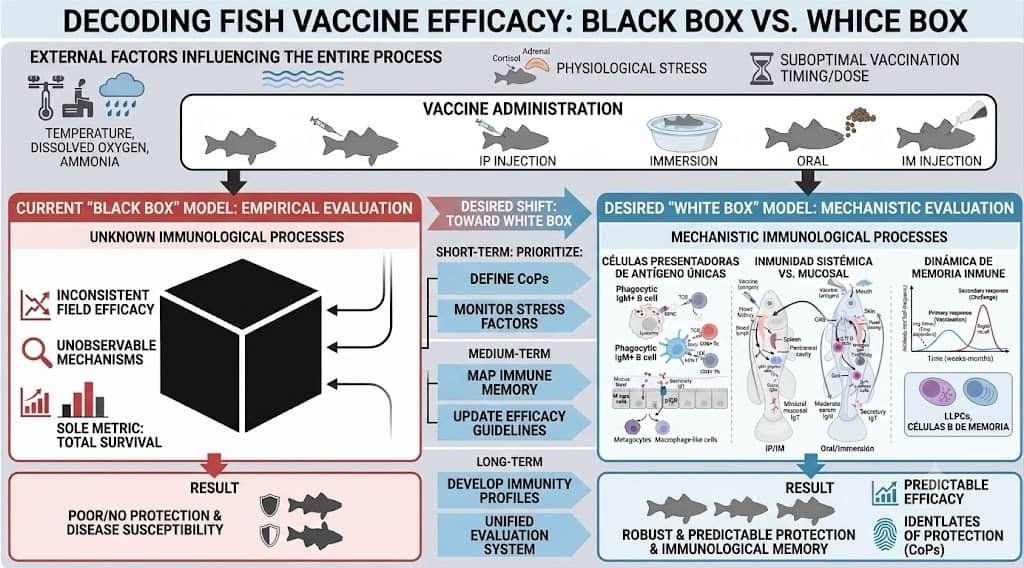
The study’s authors borrowed a software engineering concept: ‘black box’ versus ‘white box’ models. In a black box, you only observe the inputs (the vaccine) and the outputs (survival or mortality), with no access to the internal code. Conversely, a white box allows you to understand exactly which gears are moving and why. According to Kyslík’s team, fish vaccinology remains almost entirely trapped in the black box model, whereas human and terrestrial animal vaccines have been advancing toward transparency for decades.
This is not a mere academic detail; the global market for fish vaccines is already valued at approximately 410 million dollars and is growing at nearly 10% annually. As we increasingly rely on these tools to replace antibiotics and chemicals, our failure to understand why they succeed on one farm yet fail on another becomes costlier.
The laboratory says one thing, while the farm says another
In the lab, vaccine trials typically yield spectacular results, as researchers strictly control temperature, water quality, pathogen dosage, and fish stress within a near-pharmaceutical environment.
However, the reality of a commercial aquaculture farm is a completely different story: water conditions fluctuate, stocking density is far higher, fish co-exist with multiple pathogens, and daily handling—such as crowding and transferring—induces constant stress that laboratory settings never replicate. This gap between ‘paper’ and ‘practice’ explains much of the industry’s frustration.
Mantente siempre informado
Stay Informed
Únete a nuestras comunidades para recibir al instante las noticias, informes y análisis más importantes del sector acuícola.
Join our communities to get instant access to the most important news, reports, and analysis from the aquaculture industry.
The study highlights a telling case: two commercial vaccines against P. salmonis that performed well in controlled trials offered virtually no protection when tested against two distinct bacterial strains under conditions that better mimicked a natural outbreak. The vaccine was not inherently flawed; it was simply designed using a strain that did not match the one actually circulating in the area.
Four Factors Sabotaging Your Fish Vaccines
Here is where the study becomes truly actionable for any aquaculture producer managing daily farm operations. The researchers identify four major “filters” that dictate whether a vaccine succeeds or fails—factors that are rarely monitored with the rigor they deserve.
Water Is Not Just the Environment: It Is Part of the Immune System
Think of a fish’s gills, skin, and gut as the valves in a pond filtration system: they are in constant contact with the environment, and any abrupt shift in water quality directly alters how they respond to a threat. When temperature fluctuates outside the species’ optimal range, dissolved oxygen drops, or ammonia accumulates, these mucosal surfaces undergo structural changes that impair the fish’s ability to utilize the vaccine.
The study gathers compelling examples. In hybrid red tilapia, an immersion vaccine against Francisella noatunensis performed perfectly at 30°C but lost all efficacy at 25°C or under unstable temperatures. In Japanese flounder, a vaccine against viral hemorrhagic septicemia provided strong protection only at 20°C, failing at both 12°C and 28°C. Temperature, in other words, is not just a management factor—it is an integral part of the vaccine mechanism itself.
The Stress of Vaccination Can Sabotage the Solution
There is an uncomfortable paradox here: the very act of vaccinating induces stress, and that stress can weaken the immune response the vaccine is meant to trigger. Intraperitoneal injection (the industry standard) causes higher cortisol spikes than immersion or oral vaccines. This elevated cortisol can suppress the immune system precisely when it needs to be active.
The researchers highlight practical solutions currently being tested, such as plant-based sedatives before injection or handling protocols that minimize unnecessary disturbance before and after vaccination. These are not science-fiction solutions; they are operational adjustments any farm can evaluate.
Genetics Matter More Than You Think
Here is a finding that surprises many producers: not all fish of the same species respond equally to the same vaccine. The study cites research on Atlantic salmon where different genetic families showed massive variances in protection achieved with the same vaccine against SRS. Some families benefited immensely, while others saw almost no protection.
This carries a strong practical implication: selective breeding programs should not only focus on growth rates or general resilience, but also on the specific capacity to respond well to available vaccines.
Age Is a Window of Opportunity, Not a Fixed Number
A young fish’s immune system is not entirely offline, but it is not fully developed either. Vaccinating too early can be just as ineffective—or even counterproductive—as vaccinating too late. The study shows that in gilthead seabream (Sparus aurata), vaccinating very young larvae via immersion actually increased susceptibility to infection rather than protecting them, likely due to an immature or dysregulated immune response.
Every species, such as tilapia, has its own immunological “window of opportunity,” and understanding it can mean the difference between a successful vaccination campaign and a waste of time and money.
The Billion-Dollar Question: How Do We Know a Vaccine Actually Protects?
One of the study’s most valuable contributions is highlighting a methodological issue rarely discussed outside academic circles: the industry measures vaccine efficacy almost exclusively by survival. Did the fish live or die? Period.
The problem is that this metric, while useful, is rather broad; it does not tell us if the fish remains a carrier shedding the pathogen, whether protection will last six months or six years, or which specific immune mechanism sustains it. It is like evaluating car safety solely by asking if the driver survived the crash, without checking if the airbags deployed, if the chassis crumpled correctly, or if the braking system failed prior to impact.
To move past simple survival rates, the researchers propose looking at “correlates of protection”—measurable biological markers, such as specific antibodies or immune cells, that reliably predict if a fish is genuinely protected. While these markers exist for many human vaccines, they are practically non-existent in aquaculture.
A notable example highlighted in the paper involves Nile tilapia vaccinated against Streptococcus agalactiae: key antibody (IgM) levels dropped over time while protection remained high, suggesting that other immune mechanisms—likely specialized cells—were doing the heavy lifting undetected by standard monitoring tools.
The Roadmap: From Black Box to White Box
The study’s true value lies not just in diagnosing the problem, but in proposing a realistic path forward structured across three strategic horizons:
- In the short term (under 5 years), the focus is on standardizing field protocols, establishing baseline correlates of protection, and systematically monitoring environmental factors like temperature and dissolved oxygen during vaccination campaigns; this demands operational discipline rather than technological breakthroughs.
- Over the medium term (5–15 years), the goal is to integrate infection, vaccination, and environmental data into centralized platforms while updating regulatory guidelines to recognize environmental factors as key determinants rather than background noise.
- In the long term (beyond 15 years), the ultimate objective is to develop predictive models to anticipate field efficacy through validated immune markers, thereby reducing reliance on costly and time-consuming lethal challenge trials.
What This Means for Your Next Vaccination Campaign
Returning to those two salmon cages with contrasting outcomes, the explanation likely stems from a cumulative effect rather than a single factor: perhaps one cage contained a genetic line with lower immune responsiveness, experienced slightly lower water temperatures during critical post-vaccination days, or suffered higher handling stress during application.
Fortunately, we are no longer completely in the dark, as we now know that water temperature during the initial post-vaccination days is critical, handling stress can neutralize vaccine efficacy, broodstock genetics matter, and vaccination timing represents a strict biological window rather than an arbitrary age. While none of these elements solves the puzzle independently, together they illuminate what was once a literal black box, providing producers with a significant step toward reclaiming operational control.
Contact
Tomáš Korytář
The Faculty of Fisheries and Protection of Waters, University of South Bohemia
Ceske Budejovice, Czechia
Email: tkorytar@paru.cas.cz
Reference (open access)
Kyslík, J., Adamek, M., & Korytář, T. (2026). Decoding the Black Box of Fish Vaccines Efficacy in Basic and Applied Contexts. Reviews in Aquaculture, 18(4), e70185. https://doi.org/10.1111/raq.70185

Editor at the digital magazine AquaHoy. He holds a degree in Aquaculture Biology from the National University of Santa (UNS) and a Master’s degree in Science and Innovation Management from the Polytechnic University of Valencia, with postgraduate diplomas in Business Innovation and Innovation Management. He possesses extensive experience in the aquaculture and fisheries sector, having led the Fisheries Innovation Unit of the National Program for Innovation in Fisheries and Aquaculture (PNIPA). He has served as a senior consultant in technology watch, an innovation project formulator and advisor, and a lecturer at UNS. He is a member of the Peruvian College of Biologists and was recognized by the World Aquaculture Society (WAS) in 2016 for his contribution to aquaculture.