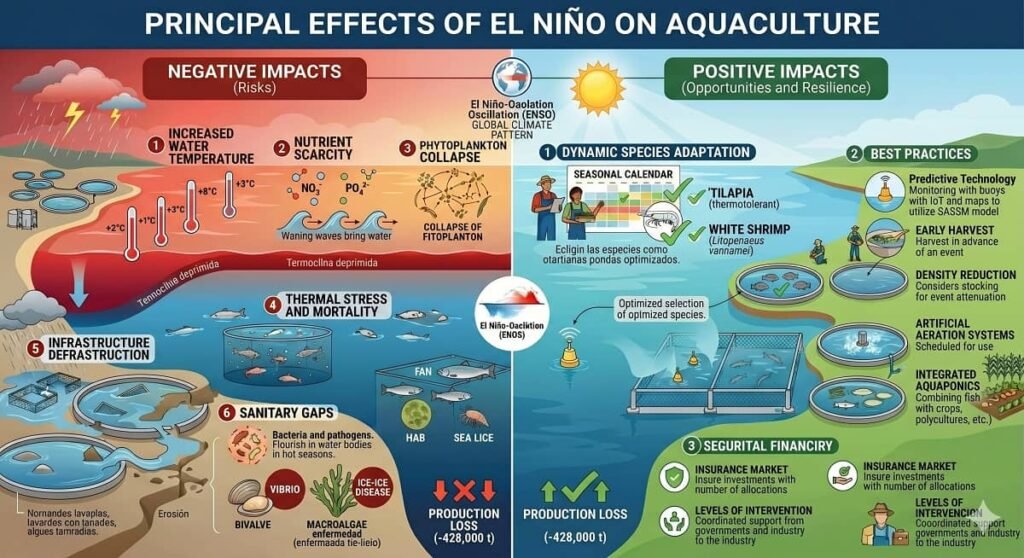
The blue economy sector—which integrates marine fisheries, inland fisheries, and aquaculture—currently faces an unprecedented climate crossroads. Among interannual climate variables, no phenomenon possesses the capacity to disrupt global oceanographic, biological, and economic dynamics as drastically as the El Niño-Southern Oscillation (ENSO).
As we progress through 2026, international scientific warnings regarding a potential ‘Super El Niño’ have sounded alarms among fishing communities, aquaculture producers, and government agencies worldwide. This article provides a strategic analysis of the phenomenon: from its meteorological foundations and oceanographic classifications to its quantitative impacts on production, emerging sanitary gaps, and the optimal resilience strategies to mitigate its economic effects.
- 1 Key Takeaways: The Impact of El Niño 2026 on Aquaculture
- 2 What is the El Niño Phenomenon (ENSO) and how does it alter the oceans?
- 3 Impacts of El Niño on Global Aquaculture
- 4 Sectoral Impacts of the El Niño Event
-
5
Adaptation and Mitigation Strategies in Global Aquaculture
- 5.1 Monitoring Systems and Climate Early Warnings
- 5.2 Polyculture and Species Flexibility: Dynamic Crop Adaptation
- 5.3 Climate-Adaptive Management: Operational Resilience Strategies
- 5.4 Technology Utilization and Mechanical Mitigation in Ponds
- 5.5 Spatial Planning and Zoning: Geographic Redesign of the Sector
- 5.6 The Insurance Market: Financial Instruments for Risk Management
- 6 Levels of Intervention: Multilevel Governance and Coordination Faced with ENSO
- 7 Future Projections: El Niño in the Context of Climate Change
- 8 Conclusion: The Future of Aquaculture at the Climate Crossroads
-
9
Frequently Asked Questions (FAQ): The Impact of El Niño 2026 on Aquaculture
- 9.1 What is the literal meaning of the name ‘El Niño’?
- 9.2 What is the fundamental difference between El Niño and La Niña?
- 9.3 Why is the forecast of a ‘Super El Niño 2026’ concerning?
- 9.4 Why is aquaculture more vulnerable to El Niño than traditional fisheries?
- 9.5 How does a country’s geography influence the severity of El Niño’s impact?
- 9.6 What are the primary sanitary risks triggered by El Niño in aquaculture farms?
- 9.7 How does El Niño affect the aquaculture food and aquafeed industry?
- 9.8 How does ENSO affect fishmeal and fish oil production?
- 10 References
- 11 Entradas relacionadas:
Key Takeaways: The Impact of El Niño 2026 on Aquaculture
- Structural Vulnerability: Unlike capture fisheries, aquaculture species cannot migrate due to containment in cages and ponds, leaving the sector critically vulnerable to ENSO thermal and hydrological anomalies.
- Geographic Asymmetry: Damage severity depends on national geography; nations with shorter coastlines or high reliance on specific fishing grounds (such as Japan) face severe declines, whereas continental nations (like the US or Australia) can offset regional losses across other coastal areas.
- Critical Risk in Extreme Events: While moderate events show no significant systematic effects in regions like the Indo-Pacific, extreme El Niño events pose an imminent threat that triggers profound operational disruptions and variations.
- Supply Chain Crisis: The collapse of small pelagics like Peruvian anchoveta due to ocean warming disrupts fishmeal and fish oil availability; since aquaculture consumes over 70% of this input, shortages stall global production at 5 million tons and skyrocket global feed prices.
- Sanitary and Ecological Gaps: Environmental stress acts as a catalyst for lethal pathologies, driving “ice-ice” disease outbreaks in macroalgae, Vibrio proliferation in bivalves, and increases in parasites like sea lice, while triggering Harmful Algal Blooms (HABs) capable of wiping out 12% of national outputs like Chilean salmon.
- Multilevel Governance and Mitigation: Sectoral resilience demands a coordinated three-tiered response: farm-level (oxygenation, early harvesting, and infrastructure), industry-wide (real-time data and information sharing), and national-level (parametric subsidies, insurance, and massive early warning systems).
- Macroeconomic Projections: Next-generation models warn that extreme El Niño events could double this century; under a moderate emissions scenario, cumulative global losses are projected at $84 trillion between 2020 and 2099, directly impacting national macroeconomic indicators like the CPI.
What is the El Niño Phenomenon (ENSO) and how does it alter the oceans?
To understand the sectoral impact of this phenomenon, it is imperative to define El Niño from a geophysical perspective. ENSO is a coupled ocean-atmosphere climate pattern originating in the tropical Pacific Ocean that exerts a dominant influence on global climate.
Understanding the cycle: From La Niña to El Niño
The ENSO cycle oscillates irregularly every two to seven years, fluctuating between a neutral phase and two opposite extreme phases:
- La Niña: Characterized by an anomalous strengthening of the trade winds, which intensifies upwelling in the eastern Pacific, driving sea surface temperatures (SST) below historical averages. While this phase boasts high marine productivity, it frequently triggers extreme droughts in parts of the Americas and severe flooding in Asia.
- El Niño: Occurs when the trade winds weaken significantly or, during extreme events, reverse completely. As wind forcing diminishes, the warm water mass accumulated in the western Pacific flows eastward as Kelvin waves toward the South American coast.
The food web collapse: This displacement of warm water masses depresses the thermocline (the thermal transition layer separating surface waters from deep waters). As the thermocline deepens, upwelling no longer transports essential nutrients, but instead moves warm, biologically poor surface waters. The scarcity of nitrate () and phosphate () salts collapses primary phytoplankton production, triggering a domino effect across the entire marine food web.
The 5 Types of ENSO Events
One of the primary gaps in conventional climate outreach is the oversimplification of this phenomenon. The Food and Agriculture Organization (FAO), through a seminal publication by Bertrand et al. (2020), alongside various international scientific institutions, classifies ENSO into five distinct variants. Each possesses unique oceanographic signatures and differentiated repercussions for global fisheries and aquaculture:
- Extreme El Niño: Characterized by a complete collapse of the trade winds and sea surface temperature (SST) anomalies exceeding or across broad zones of the equatorial Pacific. It triggers catastrophic climate disruptions globally, causing torrential rains in arid regions and severe droughts in key agricultural basins.
- Moderate Eastern Pacific (EP) El Niño: Traditionally known as Canonical El Niño. Warming anomalies are concentrated primarily in the eastern Pacific (Niño 1+2 and Niño 3 zones), exerting a direct, immediate impact on the Humboldt Current and drastically altering pelagic resource availability in South America.
- Moderate Central Pacific (CP) El Niño: Scientifically termed El Niño Modoki. In this scenario, anomalous warming occurs in the central Pacific region (Niño 4 zone) rather than along the American coast, flanked by unusually cold waters to the east and west. Its atmospheric teleconnections alter rainfall patterns in Asia and Australia in ways vastly different from the canonical variant.
- Coastal El Niño: A regional-scale event with high destructive impact. It involves an abrupt, localized warming of waters off the coasts of Peru and Ecuador, without necessarily requiring widespread anomalies across the rest of the ocean. It can generate devastating local torrential rains and severe flooding, transforming coastal ecosystems within weeks.
- Strong La Niña Events: Representing the opposite extreme of the cycle, these feature massive, sustained cooling of the central and eastern Pacific. Although typically correlated with excellent fisheries production due to high nutrient concentrations from upwelling, it exerts extreme hydrological pressures, causing prolonged droughts in the Western Hemisphere and massive flooding in Southeast Asia.
Comparative Analysis: ENSO Ocean Dynamics and Signals
To accurately contrast the behavior of each climate variant based on the criteria by Bertrand et al. (2020), their primary oceanographic and meteorological variables are structured below:
| Event Type | Sea Surface Temperature (SST) | Location of Ocean Signal | Rainfall Impact and Criteria |
| Extreme El Niño | Intense warming across nearly the entire equatorial Pacific. | Eastern part of the basin (strongest footprint). | Rainfall anomalies greater than 4 mm/day in the Niño-3 region (December to February). |
| Moderate El Niño (EP) | Modest warming over most of the equatorial Pacific. | Maintained primarily in the eastern part of the basin. | Rainfall anomalies less than 4 mm/day in the Niño-3 region during its seasonal peak. |
| Moderate El Niño (CP) | Modest warming at the Equator; weak thermal impact on the South American coast. | Centered near the International Date Line (central Pacific). | The thermal anomaly in the Niño-4 region is greater than in the Niño-3 region during the peak. |
| Coastal El Niño | Focalized warm conditions; the rest of the Pacific remains normal or cold. | West coast of South America (far eastern Pacific, such as Peru). | Devastating torrential rains caused by the intensification of the ITCZ and strong northern winds. |
| Strong La Niña | Large-scale cooling over most of the Equator. | The strongest thermal signal is located in the central Pacific. | Classified exclusively if the ONI index is below -1 °C for 5 consecutive months. |
Impacts of El Niño on Global Aquaculture
Unlike capture fisheries—where mobile species migrate to deep or polar thermal refuges—aquaculture relies on confined infrastructures such as floating cages, earthen ponds, and recirculating systems. This containment leaves cultured organisms (fish, crustaceans, and mollusks) critically vulnerable to environmental anomalies triggered by El Niño.
Globally, variations in aquaculture production due to El Niño show limited responses from a statistical perspective; that is, no systematic, large-scale negative impact is observed when aggregating all data (Bertrand et al., 2020).
The El Niño phenomenon disrupts global aquaculture through several interconnected pathways:
Mantente siempre informado
Stay Informed
Únete a nuestras comunidades para recibir al instante las noticias, informes y análisis más importantes del sector acuícola.
Join our communities to get instant access to the most important news, reports, and analysis from the aquaculture industry.
Fluctuations in Global Aquaculture Production
Extreme El Niño events possess the potential to cause significant supply shocks within the sector. Historically, an average reduction of 531,000 tons in global aquaculture production has been recorded, representing a 2.1% contraction relative to long-term average output (Bertrand et al., 2020). The most severe losses—approaching the lower bound—are directly associated with Extreme El Niño and Strong La Niña events, driven by two critical risk factors:
- Thermal Stress and Environmental Anoxia: Rising water temperatures drastically reduce dissolved oxygen solubility while simultaneously accelerating the metabolism of ectothermic organisms, skyrocketing their oxygen demand and causing mass mortalities due to asphyxiation.
- Infrastructure Destruction (Coastal and Inland): Torrential rains overflow rivers and flood earthen ponds, causing total biomass loss through escapes or contamination, while anomalous waves and storms destroy marine cage nets and mooring systems.
The Geographic Factor: Why Country Size Matters
Results from the study by Liu (2024) warn that ocean disruptions derived from El Niño constitute a direct and significant obstacle for aquaculture farms. However, the severity of the impact at a national level depends heavily on the geographic characteristics of each territory:
| Geographic Configuration | Production Impact Dynamics | Sectoral Example |
| Smaller Nations | Possess limited coastlines and high dependence on specific fishing grounds exposed to severe thermal disruptions. | Japan: Records severe contractions in its national production. |
| Continental Nations | Features extensive coastlines; regional losses are offset by production increases in other coastal areas. | US and Australia: Successfully mitigate the macroeconomic impact. |
The Indo-Pacific Facing Extreme Events
Concurrently, Floridi et al. (2025) reported that regular or moderate El Niño events show no statistically significant or systematic effect on general aquaculture across the Indo-Pacific region (India, Indonesia, the Philippines, Malaysia, and Bangladesh). Nevertheless, the research emphasizes that extreme El Niño events do pose a critical and imminent risk, directly linked to profound operational disruptions and severe production contractions in this sector.
Physical and Environmental Disruptions in Culture Systems
Alterations in precipitation patterns and thermal increases drastically modify water quality and availability (Bertrand et al., 2020). Extreme rainfall, flooding, and elevated river discharge trigger massive freshwater pulses, increase turbidity via sedimentation, and sharply reduce salinity, imposing severe physical and physiological stress on coastal crops (Mirera et al., 2026).
Concurrently, the exacerbation of marine heatwaves induced by El Niño elevates water temperatures above optimal thresholds for multiple species (Bertrand et al., 2020). Finally, the increased frequency of storms and cyclones associated with this phenomenon can destroy critical infrastructure—such as floating cages, ponds, and nets—leading to biomass escapes or direct losses (Bertrand et al., 2020).
Asymmetric Impacts: Flooding in the Americas vs. Droughts in Asia
While El Niño manifests as a severe increase in rainfall across the American continent, it generates prolonged droughts and critical degradation of freshwater sources in Southeast Asia. In this regard, Razali et al. (2025) conclude that interactions between El Niño warming and monsoon rains severely disrupt aquatic habitats across three critical fronts:
- Thermal Stress and Anoxia: Increases fish body temperature and depletes dissolved oxygen levels.
- Chemical Toxicity: Elevates the risk of mortality due to exposure to nitrogen compounds.
- Mechanical Damage: Causes severe gill lesions in organisms due to high sediment concentrations.
These extreme climate variations directly compromise the operational viability and sustainability of cage aquaculture in the Pahang River, Malaysia.
The Vulnerability of Inland Aquaculture in China
For their part, Jiang et al. (2025) studied the climate change impacts on freshwater fish farming across 32 provinces in China. Their findings demonstrate how complex climate phenomena like El Niño not only degrade the natural environment through thermal and water stress but also translate directly into structural losses. Furthermore, the study warns that these climate anomalies act as critical barriers, limiting the efficient implementation of technical advancements in inland aquaculture.
Biological and Sanitary Impacts: Emerging Gaps in the Sector
Environmental stress derived from climate anomalies acts as the primary catalyst for lethal pathologies in global aquaculture. Simultaneous alterations in salinity and temperature drive, for instance, the development of ‘ice-ice’ disease in macroalgae crops (Mirera et al., 2026) and promote the proliferation of opportunistic bacterial pathogens, such as the genus Vibrio, in bivalve farming (Wright-LaGreca et al., 2026).
Another critical risk triggered by these hydrological conditions is Harmful Algal Blooms (HABs). A devastating example of their impact occurred during the 2016 austral summer in Chile, where El Niño-induced conditions triggered a massive algal bloom that destroyed nearly 12% of national salmon production, resulting in economic losses exceeding $800 million (León-Muñoz et al., 2018).
Immunosuppression and Susceptibility in Commercial Crops
Extreme fluctuations in water temperature, salinity, and dissolved oxygen levels push organisms beyond their optimal thresholds, slowing growth rates and drastically increasing their immunological vulnerability (FAO, 2024b).
- The Philippine Scenario: Rising temperatures and salinity leave carrageenan-producing red seaweed crops highly susceptible to bacterially induced ‘ice-ice’ disease and severe epiphytic infestations (FAO, 2024a).
- Pathogen Acceleration: In alignment, Zargari et al. (2026) indicate that thermal increases accelerate the growth and reproductive rates of infectious microorganisms while simultaneously weakening host immune systems, multiplying epidemiological outbreaks on farms.
Evidence in Specific Ecosystems (Hawaii and Bivalve Aquaculture)
The impact of these variants is also evident at a local scale; McCoy et al. (2017) reported a direct link between mass mortality events of moi fish (Polydactylus sexfilis) in the traditional Heʻeia Fishpond and prolonged periods of water warming associated with weakening trade winds during El Niño Modoki (2009–2010).
Finally, regarding aquaculture health and public safety, Wright-LaGreca et al. (2026) reported that extreme warming negatively affects oysters by increasing their exposure to Vibrio parahaemolyticus, a lethal pathogen for both cultured bivalves and human consumers.
Supply Chain Impacts: Feeds and Seedstock
Finfish and crustacean aquaculture relies significantly on fishmeal and fish oil, inputs primarily derived from small wild pelagics such as the Peruvian anchoveta (Glencross et al., 2024). Because these species’ populations are critically vulnerable to El Niño-driven ocean warming—suffering population collapses or migrating to deeper waters (Bertrand et al., 2020)—it triggers severe supply instability that drastically drives up aquaculture feed prices on a global scale (Chen et al., 2024).
Concurrently, this climate phenomenon can cause the loss of natural broodstock schools, severely restricting the supply of seedstock (fry or larvae) indispensable for initiating new culture cycles (Bertrand et al., 2020).
The Small Pelagics Crisis and Global Stagnation
El Niño alters ocean currents and weakens the upwelling of nutrient-rich waters, causing the collapse of small fish populations like the Peruvian anchoveta (FAO, 2024a). In this regard, Chen et al. (2024) highlight that this climate phenomenon has negatively impacted the fishmeal supply over recent decades. Specifically, researchers note that due to these anomalies and other climate change impacts, annual global production has fluctuated severely, stagnating at an approximate ceiling of 5 million tons.
In the same vein, Glencross et al. (2024) point out that events like El Niño directly affect fishing activity along the west coast of South America, heavily hitting anchoveta catches between Peru and Chile. The research emphasizes El Niño as the primary environmental factor dictating interannual variability and the availability of critical species for the aquafeed industry.
Price Volatility and Financial Uncertainty
Since the aquaculture industry consumes over 70% of global fishmeal production, the contraction of these catches generates a severe shortage of marine ingredients, leading to immediate operational consequences:
- Surging Costs: Sharply driving up the prices of commercial feeds and aquafeeds worldwide.
- Sectoral Instability: Generating a scenario of profound financial uncertainty and economic vulnerability for producers (FAO, 2024b).
Sectoral Impacts of the El Niño Event
Vulnerability in the Salmon Industry
Analysis of ENSO effects at an industrial scale reveals profound sensitivity within high-commercial-value culture systems, with the salmonid sector being one of the most exposed to these climate anomalies.
The Multiplier Effect of Climate Change
Engler (2024) highlights that natural variability events such as El Niño, when combined with underlying climate change trends, significantly increase the risk of acute and extreme crises for the aquaculture industry. As a consequence of these synergistic impacts—primarily harmful algal blooms and pathogen proliferation—the sector suffered extensive and severe losses during the 2016 event. This scenario illustrates the industry’s high vulnerability to mass biomass loss and productivity contractions when facing future extreme climate shocks.
Early Warning for Sanitary Gaps: The Case of Sea Lice
Concurrently, Montes and Quiñones (2025) utilized Early Warning Indicators (EWIs) to detect sea lice (Caligus rogercresseyi) outbreaks in salmon farming zones across southern Chile. The results demonstrate the efficacy of these predictive tools within sanitary management:
- Anticipation Capacity: Generic indicators successfully detected critical increases in sea lice abundance several months in advance.
- Key Tipping Points: The model successfully anticipated parasitic loads ahead of two decisive oceanographic transitions: the 2016 El Niño phenomenon and the abnormal meteorological and hydrological conditions recorded during the spring and summer of 2019–2020.
Shrimp Industry: Climate Threats and Financial Risks
Analysis of ENSO effects on crustacean production demonstrates that this sector faces some of the highest operational and economic pressures due to the acute ecological sensitivity of the cultured species.
Global Challenges in Shrimp Aquaculture
Campbell et al. (2026) studied the challenges and strategies for global shrimp aquaculture, analyzing the El Niño event within the context of critical climate threats to the sector. The research warns that the intensification of these extreme phenomena severely impacts production through three interconnected pathways:
- Alteration of Hydrological Conditions: Extreme weather events such as hurricanes, cyclones, and torrential rains trigger drastic shifts in water temperature, salinity, and nutrient levels within ponds.
- Proliferation of Epidemiological Outbreaks: These physicochemical alterations create an ideal environment for mass disease outbreaks; shrimp pathogens thrive in warm waters, where temperature spikes shorten incubation periods and increase infection severity.
- Immune System Depression: The shrimp’s immune response is directly compromised by thermal spikes and abrupt salinity fluctuations induced by these meteorological anomalies.
Economic Vulnerability and Competitiveness: The Case of Ecuador
Concurrently, Cedeño Quinto et al. (2025) indicate that climate phenomena, particularly the 2023–2024 El Niño event, represent a primary risk factor for the production stability and profitability of Ecuador’s shrimp industry. The study outlines the following critical impacts on the sector:
- Biological and Operational Effects: Sudden shifts in temperature, salinity, and oxygenation raised larval mortality and reduced feed conversion efficiency, directly increasing operational costs related to management and biosecurity.
- Magnification of Financial Impact: The research highlights that because current production scales are significantly larger, absolute economic losses caused by declines in feed efficiency are much higher than in past decades; this means climate risks have worsened drastically in financial terms, even if biological impacts follow historical patterns.
- Determinant for International Competitiveness: El Niño-related impacts demonstrate that the profitability and market positioning of the shrimp sector depend not only on production volume but on its resilience against interconnected environmental, logistical, and commercial risks.
Bivalve Aquaculture: Production Collapses and Environmental Variability
Analysis of ENSO effects on bivalve mollusks reveals that their limited mobility renders them one of the most vulnerable biological groups to extreme hydrological anomalies.
The 2017 Disaster in Sechura Bay
Kluger et al. (2019) reported that the 2017 Coastal El Niño event in Sechura Bay (northern Peru) drove sea surface temperatures up to and caused a drastic decline in salinity due to torrential rainfall. This environmental synergy caused a massive, near-total mortality of the Peruvian scallop (Argopecten purpuratus) and other benthic organisms, triggering severe socioeconomic consequences:
- Industrial Stagnation: Complete cessation of operational activities within the bay.
- Bankruptcy of the Mariculture Sector: Absolute loss of investments, cultured biomass, and vessels.
- Lingering Financial Crisis: Loss of economic solvency among producers due to outstanding bank debts.
Predictability Constraints along the Chilean Coastline
In the same vein, Lara et al. (2026) established that the predictability of environmental conditions—vital for northern scallop (Argopecten purpuratus) aquaculture in the Tongoy Bay and northern Chiloé regions (Chile)—is severely constrained. The research demonstrates that ENSO-driven variability operates across multiple temporal scales, limiting the planning capacity of aquaculture firms.
Marine Heatwaves and Public Health Risks in Canada
Concurrently, Wright-LaGreca et al. (2026) studied the impact of climate change and marine heatwaves on bivalve aquaculture in Baynes Sound, British Columbia (Canada). The researchers found that ENSO phases significantly alter the profile and intensity of heatwaves; this extreme warming negatively impacts oyster development and increases exposure to the genus Vibrio, a pathogen lethal to both cultured bivalves and human consumers.
Seaweed Farming: Hydrological Impacts and Coastal Vulnerability
Analysis of ENSO variables in phyciculture (seaweed farming) demonstrates that impacts are not always restricted to thermal stress; rather, continental hydroclimatological dynamics play a decisive role in coastal ecosystems.
The Case of the Southern Coast of Kenya
Mirera et al. (2026) studied the impact of the El Niño event (November–December 2023) on seaweed farms along the southern coast of Kenya, revealing how extreme precipitation severely affects local production and the livelihoods of aquaculture communities. Unlike other ENSO-associated events in different oceanographic regions, farm damage in this scenario was not caused by an anomalous rise in sea surface temperature, which remained within biological tolerance ranges. Instead, the losses were driven almost entirely by a complex set of stressors:
- Freshwater Pulses: Extreme rainfall and flooding triggered massive continental discharges, drastically reducing the salinity of the aquatic environment.
- Light Blockage and Asphyxiation: Runoff transport generated high turbidity in the water column and rapidly accelerated sedimentation processes over the crops.
Adaptation and Mitigation Strategies in Global Aquaculture
Faced with the climate uncertainty posed by the advent of El Niño 2026, the global fishing and aquaculture industry has moved away from traditional reactive stances. Currently, the sector prioritizes the implementation of proactive adaptation frameworks grounded in technological innovation and operational resilience.
Monitoring Systems and Climate Early Warnings
The primary line of defense against ENSO is analytical anticipation. Today, the integration of information technologies has revolutionized sectoral risk management: advanced aquaculture producers deploy oceanographic buoy networks equipped with IoT (Internet of Things) sensors that transmit real-time data on sea surface temperature (SST), salinity, pH, and dissolved oxygen levels.
Predictive Innovation: The SASSM Model
Liu et al. (2020) developed an innovative tool known as the Site Aquaculture Suitability Selection Model (SASSM). This system responds to El Niño impacts by incorporating dynamic environmental variables—such as SST, chlorophyll-a concentration, and suspended sediments—whose anomalies are heavily influenced by these extreme climate events.
The SASSM model functions as an early warning system by translating oceanographic and meteorological alterations into visual scoring maps, enabling the accurate prediction of sharp reductions or increases in the availability of optimal zones for marine farming.
Proactive Mitigation and Decision-Making
Cross-referencing local variables with macro-climate models from agencies like NOAA or the World Meteorological Organization (WMO) allows for early warnings months in advance. This empowers aquaculture companies to make critical decisions before the arrival of thermal anomalies, implementing three proactive mitigation strategies:
- Early Harvesting: Allowing biomass extraction before reaching biological risk sizes.
- Stocking Suspension: Avoiding pond saturation and reducing stocking density during critical periods.
- Nutritional Adjustment: Reducing aquafeed rations to mitigate water eutrophication under heat stress conditions.
Polyculture and Species Flexibility: Dynamic Crop Adaptation
Faced with ENSO variability, the sector is transitioning toward adaptive and diversified production strategies. In coastal aquaculture, producers currently design systems capable of rotating species based on seasonal forecasts:
- Cold-Year Scenario (La Niña): Priority is given to stocking temperate-water and high-yielding species that thrive under upwelling conditions.
- Warm-Event Scenario (El Niño): Ponds and infrastructures are agilely retrofitted for rearing thermo-tolerant organisms, such as tilapia or whiteleg shrimp (Litopenaeus vannamei).
Biological and Geographic Diversification
Likewise, Zargari et al. (2026) recommend prioritizing the cultivation of species with greater intrinsic tolerance to extreme temperature fluctuations and drastic shifts in water salinity. Concurrently, the research emphasizes that diversifying both cultured species and geographic production zones acts as a critical mitigation mechanism, significantly reducing the risk of mass losses if an operational area is severely impacted by climate anomalies.
Climate-Adaptive Management: Operational Resilience Strategies
The transition toward climate-smart aquaculture demands a restructuring of governance and operational frameworks across global farming centers. McCoy et al. (2017) recommend that, to ensure future viability, natural resource management must proactively anticipate and adapt to shifting climate scenarios. This includes applying a hierarchical framework to characterize marine heatwaves, identifying thermal vulnerability ‘hotspots,’ and detecting early fluctuations in species abundance.
Mitigation in Phyciculture and Malaciculture: The Shandong Model
In the same vein, Li et al. (2024) evaluated the marine aquaculture suitability for the Pacific oyster in Shandong, China. To counter the impacts of extreme climate events like El Niño and La Niña, the study proposes five strategic management measures:
- Continuous Meteorological Monitoring: Closely tracking abnormal weather conditions, with special emphasis on anomalous summer rainfall occurring post-ENSO events.
- Scale and Stocking Density Reduction: Decreasing oyster culture density and scale within the most susceptible zones (Rongcheng, Rushan, and Jimo) as a direct response to minimize biomass losses.
- Transition to IMTA Systems: Integrating oyster farming into Integrated Multi-Trophic Aquaculture (IMTA) systems in highly suitable yet vulnerable areas, optimizing carrying capacity and ecosystem stability to guarantee long-term sustainability.
- Seasonal Spatial Relocation: Temporarily transferring operations between different regions based on monthly suitability fluctuations, such as leveraging open waters in Changdao during spring and evacuating the Rushan area during summer.
- Expansion into Climate Refugia: Concentrating and scaling up aquaculture activity in highly suitable areas that demonstrated ENSO resilience, such as the Laizhou region (which maintained 100% suitability stability), while progressively scaling back operations in low-aptitude areas.
Spatial Planning and Risk Distribution in South America
Concurrently, Romagnoni et al. (2022) highlight that Peruvian scallop mariculturists face high socioeconomic vulnerability due to their monoculture reliance on a single species. Therefore, the study emphasizes the need to engage in long-term planning to mitigate rising disruptions and mass local mortalities. Under climate change, optimal culture windows are highly likely to shift from the north (Sechura) toward the southern Peruvian coastline. Given this scenario, the researchers strictly recommend:
- The strict conservation of natural broodstock banks.
- The diversification of commercial cultured species.
- The adoption of spatial planning strategies to ‘distribute financial risk.’
Finally, Wright-LaGreca et al. (2026) conclude that monitoring ENSO-driven heatwave patterns is a key tool for refining aquaculture management strategies, enabling the anticipation of unexpected shifts in risk seasons and the establishment of enhanced sanitary biosecurity measures to safeguard global production.
Technology Utilization and Mechanical Mitigation in Ponds
The modernization of inland operations and infrastructure represents an indispensable pillar for countering severe climate effects at a local level. McCoy et al. (2017) state that, given the high vulnerability of pond aquaculture to the absence of trade winds and extreme warming, it is imperative to apply direct technological mitigation measures to protect biomass. The study concludes that companies must prioritize three operational actions:
- Water Flow Optimization: Relocating confinement structures or net pens toward gates with higher dynamic water circulation, facilitating thermal cooling and natural aeration of the environment.
- Induced Artificial Aeration Systems: Installing mechanical oxygenation equipment to actively combat critical dissolved oxygen deficits and prevent environmental hypoxia episodes.
- Flexible Commercial Harvesting: Implementing scheduled, flexible extraction strategies immediately at the onset of an anomalous warming event, avoiding mortality-prone critical sizes.
Spatial Planning and Zoning: Geographic Redesign of the Sector
Land-use planning and the technical delimitation of farming areas constitute the most effective macro strategy to reduce systemic vulnerability against extreme climate shocks. Mirera et al. (2026) recommend strategically re-evaluating aquaculture farm locations by considering their exposure to river plumes, inland floodways, and local marine current dynamics. The research concludes that prioritizing the selection of deeper or geographically sheltered sites is an indispensable criterion to minimize structural storm damage and mitigate mortality events caused by abrupt drops in salinity.
The Insurance Market: Financial Instruments for Risk Management
The development of specialized financial instruments plays a decisive role in environmental risk management and the economic sustainability of companies within the sector. In this regard, Hobday et al. (2025) underscore that, faced with an ocean experiencing increasingly frequent, prolonged, and intense climate crises, the deployment of insurance to mitigate these impacts remains highly underdeveloped in marine sectors. This gap is particularly critical for ‘blue food’ production, such as global capture fisheries and aquaculture. Furthermore, the research emphasizes that continuous attention to the evolving dynamic environment is crucial to ensure underwriters establish appropriate parametric pricing for their products, enabling aquaculture producers to acquire these policies when most needed to safeguard their investments.
Levels of Intervention: Multilevel Governance and Coordination Faced with ENSO
For resilience strategies to have a real impact, the mitigation of extreme climate events cannot be an isolated effort. Hossain et al. (2025) and Zargari et al. (2026) highlight that adaptation to severe crises like El Niño must be coordinated across three political-operational levels:
- Farm Level (Producers): Constitutes the first line of operational and tactical response in rural and coastal environments, focusing on biomass and commercial harvest management (early harvesting to safeguard live inventory), modernization and physical infrastructure (reinforcing pond dykes, installing protective netting, and optimizing drainage), diversification and community resilience (integrated farming systems combining fish with rice, poultry, or fruit trees using stress-tolerant species), and active water quality control (mechanical pumping, technical liming, and induced oxygenation).
- Sectoral Level (Industry): Focused on value chain articulation and technology transfer, prioritizing knowledge management (technical information sharing and local wisdom transfer) and collaborative monitoring (real-time data networks to detect oceanographic or limnological disruptions).
- National Level (Governments and Institutions): The indispensable macroeconomic pillar for long-term blue economy viability, incorporating financial support and risk transfer (parametric subsidies and insurance markets), governance and public policies (regulatory frameworks promoting climate resilience), and multisectoral early warning systems (mass communication channels and national aquaculture extension programs).
Future Projections: El Niño in the Context of Climate Change
The international scientific community maintains a critical debate on how natural ENSO oscillations interact with the underlying trend of anthropogenic global warming.
Will Extreme El Niño Events Double?
Next-generation climate models (CMIP6) suggest complex scenarios for the coming decades. Although uncertainty remains regarding whether the total number of ENSO episodes will increase, multiple studies indicate that the frequency of Extreme El Niño events could double during the 21st century if greenhouse gas (GHG) emissions continue on their current trajectory. Concurrently, Liu et al. (2023) highlight that, due to global warming, climate models predict a steady increase in the variability and amplitude of ENSO cycles, meaning future El Niño events will be significantly more intense, abrupt, and destructive to marine production infrastructure.
The Global Financial Toll: Macroeconomic Impact Models
Quantifying long-term economic damage reveals alarming figures that compromise blue economy stability and global development:
- Moderate Emissions Scenario (SSP2-4.5): Consistent with current emission reduction pledges, Callahan and Mankin (2023) project cumulative global losses with a median of $84 trillion between 2020 and 2099, representing an approximate 1% contraction in global economic output over the century.
- High Emissions Scenario: Conversely, Liu et al. (2023) state that, under a zero-GHG-mitigation model, increased climate variability will inflict an additional $33 trillion loss on the global economy over the remainder of the 21st century.
Teleconnections and National Economic Stability
Furthermore, vulnerability is not limited to farming zones. Park and Byeon (2025) determined that global climate phenomena, particularly the ENSO pattern, exert a direct and statistically significant influence on South Korea’s Consumer Price Index (CPI). This finding underscores that global climate variability not only alters local meteorological and oceanographic conditions but also possesses a profound, transboundary impact on national economic indicators and market inflation.
Conclusion: The Future of Aquaculture at the Climate Crossroads
Scientific and statistical analysis of the El Niño-Southern Oscillation (ENSO) impact on global aquaculture demonstrates that we are not merely facing a simple seasonal meteorological fluctuation, but rather an ecological and macroeconomic shift of planetary scale. From quantitative losses in regional aquaculture production to public health challenges derived from toxins like ciguatera and Harmful Algal Blooms (HABs), the consequences of this phenomenon demand highly sophisticated management approaches.
As 2026 exposes the vulnerability of our food production systems to extreme weather events, the sector’s survival will depend on adopting advanced predictive technologies, operational biological diversification, and developing agile regulatory frameworks. These tools will empower coastal communities to transform crises into orderly processes of climate adaptation and resilience. In alignment with Zargari et al. (2026), the success of these structural mitigation and adaptation strategies depends on an accurate understanding of regional and global ENSO dynamics. Detailed, data-driven knowledge will enable the aquaculture industry to anticipate oceanographic impacts, plan sustainably, and guarantee long-term food security.
Frequently Asked Questions (FAQ): The Impact of El Niño 2026 on Aquaculture
What is the literal meaning of the name ‘El Niño’?
The term was originally coined during the 19th century by fishermen from the port of Paita in northern Peru. They noticed that a warm ocean current typically appeared toward late December, coinciding with the Christmas season; consequently, they named the phenomenon ‘El Niño’ (The Child) in reference to the Baby Jesus. With advancements in climate science, this regional term was adopted to designate the warm phase of the global ENSO climate pattern.
What is the fundamental difference between El Niño and La Niña?
The difference lies in the direction of the sea surface temperature anomaly in the central and eastern Pacific. El Niño represents the anomalous warming phase caused by the weakening of trade winds and the deepening of the thermocline, which suppresses nutrient upwelling. Conversely, La Niña represents the anomalous cooling phase triggered by the strengthening of trade winds, which intensifies the upwelling of cold, nutrient-rich deep waters.
Why is the forecast of a ‘Super El Niño 2026’ concerning?
A ‘Super El Niño’ refers to a meteorological event where ocean thermal anomalies exceed historical thresholds for a prolonged period. The concern regarding a scenario of this magnitude lies in the fact that the buffering capacity and infrastructure of global fisheries and aquaculture industries could be overwhelmed, leading to multi-billion dollar losses in marine protein production, destabilized agricultural feed prices due to fishmeal shortages, and a drastic increase in associated natural disasters such as landslides, floods, and wildfires.
Why is aquaculture more vulnerable to El Niño than traditional fisheries?
Unlike capture fisheries—where mobile species can migrate to deeper or polar thermal refuges—aquaculture relies strictly on confined infrastructure such as floating cages and earthen ponds. This containment prevents the movement of cultured organisms (fish, crustaceans, and mollusks), directly exposing them to environmental anomalies caused by ENSO.
How does a country’s geography influence the severity of El Niño’s impact?
Research demonstrates that territorial extension is a critical factor. Smaller nations with high reliance on specific fishing grounds (such as Japan) record severe contractions in their national production. In contrast, continental countries (such as the United States and Australia) successfully mitigate macroeconomic impacts, as regional losses are offset by production increases across other areas of their extensive coastlines.
What are the primary sanitary risks triggered by El Niño in aquaculture farms?
Environmental stress alters the immune systems of cultured species and accelerates pathogen reproduction. This promotes disease outbreaks across various aquaculture species, increases exposure to bacteria of the genus Vibrio in bivalves, and elevates the parasitic load of sea lice in salmon farming, while also driving Harmful Algal Blooms (HABs) that can cause mass biomass losses.
How does El Niño affect the aquaculture food and aquafeed industry?
The weakening of marine upwelling triggers the collapse or migration of small pelagics such as the Peruvian anchoveta, stagnating the global fishmeal supply at around 5 million metric tons. Given that aquaculture consumes over 70% of the global production of these marine ingredients, the shortage sharply drives up aquafeed prices worldwide and introduces profound financial uncertainty.
How does ENSO affect fishmeal and fish oil production?
As anchovy catches drastically contract in Peru and Chile—the fundamental raw material for the marine ingredients industry—global production of fishmeal and fish oil drops sharply. This shortage triggers an immediate spike in international prices for these essential inputs used in manufacturing aquafeeds (such as for salmon and shrimp farming) and livestock feeds (swine and poultry), forcing the formulation of alternative diets based on plant proteins or insects.
References
Bertrand, A., Lengaigne, M., Takahashi, K., Avadí, A., Poulain, F. & Harrod, C. 2020. El Niño Southern Oscillation (ENSO) effects on fisheries and aquaculture. FAO Fisheries and Aquaculture Technical Paper No. 660. Rome, FAO. https://doi.org/10.4060/ca8348en
Callahan, C. W., & Mankin, J. S. (2023). Persistent effect of El Niño on global economic growth. Science. https://doi.org/adf2983
Campbell, E., Becker, J. A., Bracher, P., Budhiraja, B., Chaiyapechara, S., Chen, W. N., Colyer, L., Karoonuthaisiri, N., Keeffe, G., McKinley, J., Petchkongkaew, A., Rungrassamee, W., & Elliott, C. T. (2026). Challenges and strategies for globally resilient shrimp aquaculture. Npj Science of Food, 10(1), 140. https://doi.org/10.1038/s41538-026-00787-7
Cedeño Quinto, J., Ulloa Noboa, L., Salazar Freire, J., & Claro Pérez, P. (2025). Economic impact of shrimp sector exports in Ecuador. International Journal of Studies in Administrative Sciences STRATEGOS, 5(2). https://doi.org/10.53591/strategos.v5i2.2840
Chen, Y., Mitra, A., Rahimnejad, S., Chi, S., Kumar, V., Tan, B., Niu, J., & Xie, S. (2024). Retrospect of fish meal substitution in Pacific white shrimp (Litopenaeus vannamei) feed: Alternatives, limitations and future prospects. Reviews in Aquaculture, 16(1), 382-409. https://doi.org/10.1111/raq.12843
Engler C (2024) Fit for purpose? Evaluating climate change adaptation laws and policies for marine aquaculture in Chile. Front. Mar. Sci. 11:1386545. doi: 10.3389/fmars.2024.1386545
FAO. 2024a. The State of World Fisheries and Aquaculture 2024 – Blue Transformation in action. Rome.
FAO. 2024b. El Niño impacts and policies for the fisheries sector. FAO Innovation for Blue Transformation. Rome.
https://doi.org/10.4060/cd3812en
Floridi, A., Anda-León, M. D., Kozakiewicz, T., Bhattacharyya, M., Thota, A., Burt, P., Tasciotti, L., Selby, J., Premji, Z., & Shisler, S. (2025). Effects of El Niño and the Positive Indian Ocean Dipole (+IOD) on Health, Food Security, Economics, and Conflict in Low- and Middle-Income Countries in the Indo-Pacific: A Systematic Review. Campbell Systematic Reviews. https://doi.org/10.1002_cl2.70038
Glencross, B., Ling, X., Gatlin, D., Kaushik, S., Øverland, M., Newton, R., & Valente, L. M. P. (2024). A SWOT Analysis of the Use of Marine, Grain, Terrestrial-Animal and Novel Protein Ingredients in Aquaculture Feeds. Reviews in Fisheries Science & Aquaculture, 32(3), 396–434. https://doi.org/10.1080/23308249.2024.2315049
Hobday, A.J., Little, L.R., Watson, J.R. et al. Parametric insurance for climate adaptation in fisheries and aquaculture. Rev Fish Biol Fisheries 35, 175–185 (2025). https://doi.org/10.1007/s11160-025-09920-3
Hossain, M.S., Zaman, B., Khan, M.A. et al. Impact of climate change and adaptation strategy in aquaculture: a systematic review. Aquacult Int 33, 330 (2025). https://doi.org/10.1007/s10499-025-02013-9
Jiang, H., Zhang, Y., Yang, S., & Zhai, L. (2025). Climate Change and Freshwater Aquaculture: A Modified Slack-Based Measure DEA Approach. Fishes, 10(6), 252. https://doi.org/10.3390/fishes10060252
Kluger, L. C., Kochalski, S., Aguirre-Velarde, A., Vivar, I., & Wolff, M. (2019). Coping with abrupt environmental change: the impact of the coastal El Niño 2017 on artisanal fisheries and mariculture in North Peru. ICES Journal of Marine Science, 76(4), 1122-1130.
Lara, C., Muñoz, R., Vásquez, S. I., Torres, F. I., Detoni, A. M., Broitman, B. R., & Cazelles, B. (2026). Climatic forcing modulates non-stationary environmental synchrony in shellfish production regions. Estuarine, Coastal and Shelf Science, 329, 109605. https://doi.org/10.1016/j.ecss.2025.109605
León-Muñoz, J., Urbina, M. A., Garreaud, R., & Iriarte, J. L. (2018). Hydroclimatic conditions trigger record harmful algal bloom in western Patagonia (summer 2016). Scientific Reports, 8(1), 1330. https://doi.org/10.1038/s41598-018-19461-4
Liu, Y., Tian, Y., Saitoh, S.-I., Alabia, I. D., & Mochizuki, K.-I. (2020). Impact of Climate Extremes on Suitability Dynamics for Japanese Scallop Aquaculture in Shandong, China and Funka Bay, Japan. Sustainability, 12(3), 833. https://doi.org/10.3390/su12030833
Li C, Liu Y, Yin Z, Si Z, Li Q and Saitoh S-I (2024) Evaluation of the Pacific oyster marine aquaculture suitability in Shandong, China based on GIS and remote sensing. Front. Mar. Sci. 11:1402528. doi: 10.3389/fmars.2024.1402528
Liu, Y., Cai, W., Lin, X., Li, Z., & Zhang, Y. (2023). Nonlinear El Niño impacts on the global economy under climate change. Nature Communications, 14. https://doi.org/10.1038/s41467-023-41551-9
Liu, X. (2024). Impacts of El Nino on renewable energy industry and fishery and aquaculture industry around the pacific. Theoretical and Natural Science. https://doi.org/10.54254/2753-8818/37/20240218
McCoy, D., McManus, M., Kotubetey, K., Kawelo, A., Young, C., D’Andrea, B., Ruttenberg, K., & Alegado, R. (2017). Large-scale climatic effects on traditional Hawaiian fishpond aquaculture. PLoS ONE, 12. https://doi.org/10.1371/journal.pone.0187951
Mirera, D. O., Holeh, G. M., Kendi, J., Maina, G. W., Kawaka, J., Mondesto, I., Chebet, M., Kwekwe, L., Okemwa, D., Magangi, N., Odhiambo, M., Mwangangi, S. M., Ouma, D., Nelson, A. A., & Considine, E. M. (2026). Impacts of extreme events on community livelihoods: El Niño effects and management of seaweed farms in the south coast of Kenya. Aquaculture, Fish and Fisheries. https://doi.org/10.1002/aff2.70223
Montes, R. M., & Quiñones, R. A. (2025). Early detection of sea lice epidemic transitions and changes in long-term abundance levels in salmon farming areas. Aquaculture, 603, 742385. https://doi.org/10.1016/j.aquaculture.2025.742385
Park, J., & Byeon, S. (2025). The Effect of Climatic Variability on Consumer Prices: Evidence from El Niño–Southern Oscillation Indices. Sustainability, 17(2), 503. https://doi.org/10.3390/su17020503
Razali, M. I., Ramly, R., Abdullah, A., Abdul Hadi, M. S. I., Firdaus-Nawi, M., Afandi, N. S., Zahir-Ramli, M., & Fuad-Miskon, M. (2025). Impacts of El Niño and monsoonal interactions on river water quality and cage aquaculture in the Pahang River, Malaysia. Water Conservation & Management, 707-715. https://doi.org/10.26480/wcm.04.2025.707.715
Romagnoni, G., Kluger, L.C., Tam, J., Wolff, M. (2022). Adaptations to Climate Variability in Fisheries and Aquaculture Social-Ecological Systems in the Northern Humboldt Current Ecosystem: Challenges and Solutions. In: Misiune, I., Depellegrin, D., Egarter Vigl, L. (eds) Human-Nature Interactions. Springer, Cham. https://doi.org/10.1007/978-3-031-01980-7_30
Wright-LaGreca, M. D., Mackenzie, C. L., Pearce, C. M., Cowan, M. W., Leask, K. D., Baker, D. W., & Green, T. J. (2026). Bivalve aquaculture under climate change: A case study of marine heatwaves and shellfish-related Vibrio disease outbreaks in Baynes Sound, British Columbia, Canada. Aquaculture Reports, 49, 103716. https://doi.org/10.1016/j.aqrep.2026.103716
Zargari, A. , Barkhordar, M. and Fazeli Kakhki, S. F. (2026). The Impact of ENSO Phenomena on Sustainable Agricultural Development in the Aquaculture Sector. Journal of Utilization and Cultivation of Aquatics, 15(1), 35-59. doi: 10.22069/japu.2025.23980.1973

Editor at the digital magazine AquaHoy. He holds a degree in Aquaculture Biology from the National University of Santa (UNS) and a Master’s degree in Science and Innovation Management from the Polytechnic University of Valencia, with postgraduate diplomas in Business Innovation and Innovation Management. He possesses extensive experience in the aquaculture and fisheries sector, having led the Fisheries Innovation Unit of the National Program for Innovation in Fisheries and Aquaculture (PNIPA). He has served as a senior consultant in technology watch, an innovation project formulator and advisor, and a lecturer at UNS. He is a member of the Peruvian College of Biologists and was recognized by the World Aquaculture Society (WAS) in 2016 for his contribution to aquaculture.