- 1 Key Takeaways
- 2 The European Paradox: Why High Aquaculture Innovation Fails to Translate into Growth
- 3 How “Patent Stock” Is Measured: The Indicator Revealing True Aquaculture Innovation
- 4 Salmon Takes the Lion’s Share: The Direct Link Between Patents and Export Volume
- 5 The Trout Dilemma: Why Technological Efficiency Fails to Boost Export Volume
- 6 The Warning for European Policy: Innovating Without Room to Scale
- 7 Back to the Farm: Innovating to Survive Versus Innovating to Grow
- 8 Entradas relacionadas:
Key Takeaways
- More innovation does not guarantee higher exports for everyone. On average, a 1% increase in a country’s patent accumulation is associated with a 0.12% rise in export value, a boost primarily driven by higher sales volume and reduced unit prices.
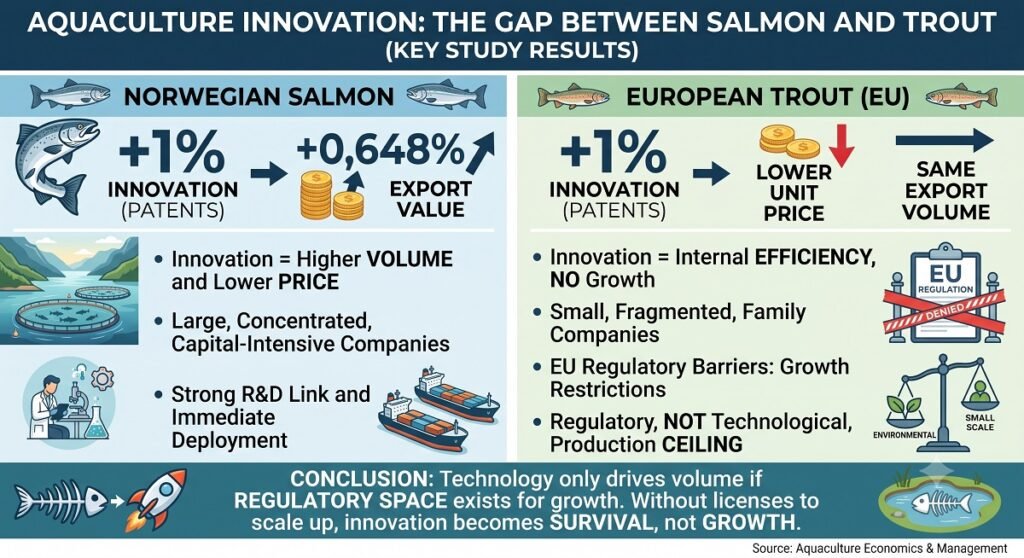
- Salmon yields the highest dividends. In salmon-producing nations, a 1% increase in patents drives a 0.648% increase in export value, demonstrating an impact significantly above the industry average.
- Trout lags in volume. In the trout sector, higher patent density lowers prices but fails to increase export volume: productive efficiency does not translate into market expansion.
- European regulation hinders scaling. Without licenses allowing capacity expansion in the EU, technology only cuts costs without boosting final volume; consequently, European innovations are often deployed more successfully in regions lacking these regulatory barriers.
A rainbow trout producer in northern Italy did everything the industry demands. They upgraded their recirculating aquaculture system to optimize water usage, adjusted feed formulations to improve the feed conversion ratio, and implemented strict sanitary protocols that minimized mortality. On paper, this farm is a paragon of efficiency with reduced per-kilo costs; however, it produces roughly the same volume as it did a decade ago: innovation reached their tanks, but growth never truly materialized.
Hundreds of kilometers away in a Norwegian fjord, the narrative is strikingly different. There, similar technological breakthroughs—such as genetic enhancements, advanced disease control, and precision nutrition—translated into more fish in the water, thousands of exported tons, and the conquering of new markets. The crucial difference between the two scenarios lies not in who innovates more, but in who possesses the tangible capacity to transform that technology into scalable volume.
This is precisely the gap that a study published in Aquaculture Economics & Management by researchers from the University of Copenhagen, BI Norwegian Business School, and the University of Applied Sciences has successfully quantified for the first time. By cross-referencing an unprecedented database of aquaculture patents with international trade records, the researchers demonstrated that technology alone does not guarantee export success. The decisive factor is whether a producer has the technical and regulatory headroom to scale—a conclusion carrying profound implications for the global aquaculture industry.
The European Paradox: Why High Aquaculture Innovation Fails to Translate into Growth
Over recent decades, aquaculture established itself as the world’s fastest-growing food sector, expanding from 2.6 million tons in 1970 to over 94 million in 2022. However, this rollout was far from uniform: while Norway, the United Kingdom, Iceland, and the Faroe Islands multiplied their salmon production, aquaculture within the European Union remained stagnant, failing to achieve meaningful gains in either volume or real value.
The prevailing narrative points to a familiar culprit: strict environmental regulations imposed by the EU to ensure sustainability, which inflated costs and constrained expansion. This raises a critical question: if innovation is meant to reconcile competitiveness with sustainability, why are the most advanced European farms unable to scale their global market presence?

To address this, researchers developed an unprecedented tool: a specialized database tracking aquaculture patents. By analyzing Espacenet records spanning nutrition, production systems, monitoring, animal health, and genetics, they built a comprehensive catalog of 3,762 entries from innovative European organizations—effectively creating the definitive map of technical knowledge generation in the industry.
How “Patent Stock” Is Measured: The Indicator Revealing True Aquaculture Innovation
To interpret the study’s findings, understanding its core methodology is essential. Rather than simply counting annual patent filings, researchers calculated the “patent stock”—an indicator measuring a country’s accumulated reserve of technical knowledge over time.
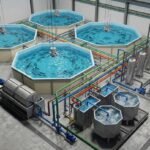
This concept operates much like the biofilter in a recirculating aquaculture system (RAS): it is not enough to measure the inflow of clean water today, but rather the system’s cumulative capacity to maintain equilibrium. Since inventions are not adopted instantly and older technologies become obsolete, the analysis aggregated new patents while applying a 15% annual depreciation rate for obsolescence.
This patent stock metric was then cross-referenced with international trade records from 2012 to 2024. The initial result was striking: the correlation between a nation’s technological reserve and its export value reached 0.49; however, decisive nuances lie beneath this overarching trend.
Mantente siempre informado
Stay Informed
Únete a nuestras comunidades para recibir al instante las noticias, informes y análisis más importantes del sector acuícola.
Join our communities to get instant access to the most important news, reports, and analysis from the aquaculture industry.
Segmenting the data by species reveals a stark divide. In salmon-producing nations, the correlation between innovation and exports is compelling: a 1% increase in patent stock is associated with a 0.648% rise in export value. This growth stems from expanding sales volume rather than price increases, demonstrating that technology enables cost reduction, production scaling, and market share acquisition through more competitive pricing. This dynamic is no coincidence. European salmon farming is heavily concentrated among large-scale, capital-intensive corporations backed by strategic research alliances and sustained R&D budgets; Norway alone accounts for 23% of the aquaculture patents in the study and reached 1.5 million tons of salmon production in 2024, an ecosystem that swiftly translates technical breakthroughs into additional market volume.
The Trout Dilemma: Why Technological Efficiency Fails to Boost Export Volume
In the trout sector, the picture is markedly different. Across producing countries, a higher patent stock correlates with lower unit prices—proving that operational efficiency improves—but fails to yield an increase in export volume. Innovation drives down operational costs without translating into more tons sold abroad. Underlying this technical metric is a structural reality: EU freshwater trout farming is dominated by small family enterprises, fragmented value chains, and tight financial margins, all bounded by regulatory constraints that stifle expansion. When policy prioritizes environmental mitigation over production scaling, technology merely optimizes existing processes rather than boosting final output. Compounding this is a market bias: as salmon remains the most lucrative segment, engineering, biotechnology, and genetics suppliers concentrate their resources there, leaving secondary farmed species with less tailored innovation.
The study further revealed that in non-salmon-raising countries—those focused solely on processing or re-exporting—innovation similarly fails to impact foreign trade. Technology drives growth only when generated by those who farm the species and operate within a framework that allows them to scale.
The Warning for European Policy: Innovating Without Room to Scale
The study’s authors exercise caution, acknowledging that the relationship between innovation and exports may be bidirectional—as thriving industries possess greater R&D resources—and that patents represent an imperfect metric that fails to capture tacit knowledge or unrecorded breakthroughs; thus, the analysis outlines strategic correlations rather than mechanical causalities. Nevertheless, the public policy takeaway is clear and provocative: EU support for aquaculture innovation fulfilled its primary objective of resolving biological bottlenecks and optimizing operational efficiency, yet those gains remained on the internal margin—producing the same volume better—without enabling scale.
Furthermore, the data suggests that European-developed technologies are often deployed more effectively in other regions with lower regulatory barriers, allowing them to capitalize on true economies of scale; in short, Europe funds the innovation, while other markets scale the production. The researchers propose aligning environmental standards with commercial growth by tying new production licenses to measurable sustainability and climate efficiency targets, allowing the sector to expand supply while safeguarding ecosystems—without which technology remains a powerful engine lacking a runway to accelerate.
Back to the Farm: Innovating to Survive Versus Innovating to Grow
Returning to our Italian trout farmer, the study does not imply that innovation has lost its value; in fact, these technological upgrades keep the farm operational, cost-effective, and environmentally sustainable in a fierce market. The real lesson is that their production ceiling is dictated not by technology, but by the regulatory framework defining their expansion capacity: while their Norwegian counterpart turns every breakthrough into export volume, they use theirs merely to survive.
For the global aquaculture sector, the takeaway transcends borders: innovation is necessary, but insufficient on its own. Without an ecosystem that permits scaling—backed by licenses, market access, and integrated value chains—the world’s most advanced technology only helps you run faster without gaining ground, a strategic caution every producer should weigh before their next investment.
Contact
Stine Hach Juul Madsen
Department of Food and Resource Economics, University of Copenhagen
Frederiksberg C, Denmark
Email: shjm@ifro.ku.dk
Reference (open access)
Madsen, S. H. J., Straume, H.-M., Winter, H., Hansen, T., Nielsen, R., & Tsouri, M. (2026). Innovation activity and export performance: Evidence from the European aquaculture sector. Aquaculture Economics & Management. Advance online publication. https://doi.org/10.1080/13657305.2026.2711752

Editor at the digital magazine AquaHoy. He holds a degree in Aquaculture Biology from the National University of Santa (UNS) and a Master’s degree in Science and Innovation Management from the Polytechnic University of Valencia, with postgraduate diplomas in Business Innovation and Innovation Management. He possesses extensive experience in the aquaculture and fisheries sector, having led the Fisheries Innovation Unit of the National Program for Innovation in Fisheries and Aquaculture (PNIPA). He has served as a senior consultant in technology watch, an innovation project formulator and advisor, and a lecturer at UNS. He is a member of the Peruvian College of Biologists and was recognized by the World Aquaculture Society (WAS) in 2016 for his contribution to aquaculture.