Key Takeaways
- Stagnant Wild Supply: Over 90% of the global cyst market relies on wild resources vulnerable to climate change, while aquaculture represents less than 10% of current supply—opening a clear, attractive gap for immediate investment.
- High Profitability and Fast ROI: Asian farming models demonstrate highly competitive production costs ($0.15–$1.40 USD per kg of biomass) with profit margins between 30% and 90%, achieving a payback period of under three years.
- Market Diversification: Beyond hatchery cysts, Artemia biomass powers an emerging $150 million USD market, positioning itself as a vital partial replacement for fishmeal in aquafeeds and livestock feed.
- Sustainable Human Nutrition: Dried biomass delivers 40% to 65% highly digestible protein, omega-3 fatty acids (EPA), and iron, making it an affordable protein alternative to enhance food security in vulnerable regions.
- Environmental Sustainability and Social Impact: Artemia cultivation thrives in hypersaline waters without competing for freshwater or requiring commercial formulated feeds, while boosting seasonal local employment where women make up to 80% of the processing workforce.
Global fish and crustacean aquaculture faces a critical bottleneck during its most vulnerable developmental stages. Over 90% of the world supply of Artemia cysts—the indispensable live feed for shrimp, marine fish, and crustacean hatcheries—relies on wild harvesting from a limited group of hypersaline lakes, such as the Great Salt Lake in the United States and various basins across Russia and Central Asia. However, climate change, overexploitation, and water diversion have reduced wild yields by nearly 40% over the past decade. With projected demand exceeding 5,000 metric tons of cysts by 2035, the sector faces a deficit equivalent to the total production of an additional Great Salt Lake—a natural resource that simply does not exist on Earth.
In response to this structural vulnerability, Artemia aquaculture emerges not merely as a technical solution, but as a highly profitable and climate-smart investment frontier. Integrating its production into existing solar salt works and degraded land generates financial returns of up to 50% without consuming freshwater, while transforming coastal desert zones into vibrant engines of rural development and social inclusion.
The research underpinning this global analysis was funded and spearheaded by PROBLUE, a multi-donor trust fund managed by The World Bank Group (International Bank for Reconstruction and Development / International Development Association) within the AquaInvest Platform, with technical execution by the consultancy team Futurefish and support from the Network of Aquaculture Centres in Asia-Pacific (NACA).
Farming Systems and Scalable Business Models
Field analyses carried out in Asia and Africa demonstrate that Artemia aquaculture does not require hyper-complex technologies, but rather the biological optimization of existing hypersaline infrastructure. The study synthesizes production across highly diversified operating models:
Large-Scale Solar Salt Work Integration (China Model)
In this system, Artemia is cultivated in the intermediate and final evaporation ponds of industrial salt works during months when salt crystallization decreases. Artemia acts as a biological filter, consuming excess microalgae, thereby reducing brine viscosity and elevating commercial salt purity up to 99.6%. This model yields high-quality cysts and biomass at extraordinarily low operating costs ($0.30 USD per kg of biomass), generating annual revenues of $6,000 to $30,000 USD per hectare.
Biomass-Focused Semi-Intensive Cultivation (Thailand Model)
Located in coastal ponds and repurposed former shrimp farms, this model operates year-round thanks to deeper ponds (1.5 meters) that mitigate monsoonal rains. Fertilized with local agricultural by-products (poultry manure, molasses, and cassava waste), it achieves yields of 2 to 4.5 metric tons of fresh biomass per hectare monthly. With production costs ranging from $0.12 to $0.50 USD per kg and local selling prices between $1.50 and $1.78 USD per kg, farmers attain profit margins exceeding 50%.
Smallholder Integrated Artisanal Farming (Bangladesh and Vietnam Models)
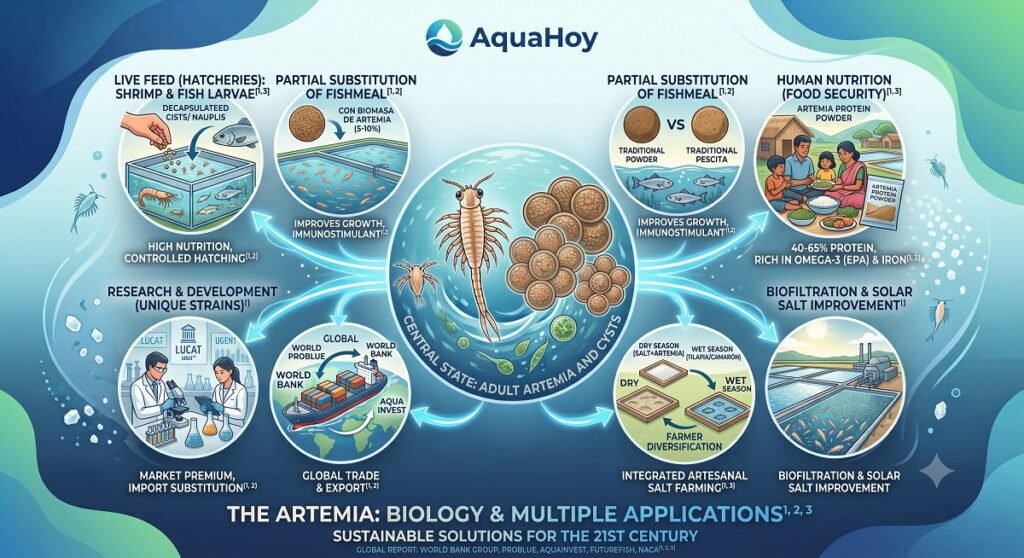
Designed for low-income communities, this model integrates Artemia production into salt ponds during the dry season, rotating with tilapia or shrimp during the rainy season. In Vietnam, the Artemia strain harvested in Vinh Chau produces small-sized, high-EPA cysts that command premium prices of up to $200 USD per kg. In Bangladesh, smallholder farmers have boosted their seasonal income by over 150%, generating an additional $740 USD net per season.
New Frontiers of Application: Feeds and Human Nutrition
While 99% of commercial cysts are currently allocated to shrimp and marine fish larviculture, Artemia biomass is opening exponential opportunities in non-traditional markets.
| Artemia Applications | Usage and Market Detail |
| Traditional Use (99% of the market) | Hatcheries for shrimp, marine fish, ornamental fish, and crustaceans. |
| Aquafeeds and Livestock Feeds | 5% to 10% substitution of fishmeal in grow-out diets. |
| Fortified Human Foods | Protein powders, skewers, biscuits, and high-nutritional-value local dishes. |
Novel Ingredient in Feed Formulation
With a dry-weight protein profile of 50% to 60% and an abundant omega-3 content, processed biomass (dried, frozen, or hydrolyzed) serves as a direct replacement for fishmeal. Field trials show that replacing 5% to 10% of fishmeal in juvenile fish and shrimp diets boosts growth rates by 5% to 8% while enhancing immune response. Such large-scale substitution could unlock a feed ingredients market valued at $150 million USD by 2035.
Mantente siempre informado
Stay Informed
Únete a nuestras comunidades para recibir al instante las noticias, informes y análisis más importantes del sector acuícola.
Join our communities to get instant access to the most important news, reports, and analysis from the aquaculture industry.
Climate-Smart Protein Solution for Human Nutrition
Nutritional studies in Vietnam and Bangladesh demonstrate that 100 grams of dry Artemia powder provides up to 60 grams of protein (surpassing beef, chicken, and shrimp), 250% of the daily iron requirement, and over 400% of the recommended intake for eicosapentaenoic acid (EPA).
At a production cost under $1.00 USD per kilogram of fresh biomass, a single hectare of integrated farming can yield up to 4 metric tons of biomass in a dry season. This is equivalent to 125,000 fortified portions (such as skewers or enriched tortillas) capable of meeting the monthly protein needs of 2,000 people in salinity-affected rural areas facing food insecurity.
Market Analysis, Pricing, and Governance
The total value of the Artemia economy (cysts, biomass, and derivatives) is currently estimated at $350 million to $400 million USD annually, with growth projected to reach $500 million USD by 2035 (8–10% CAGR).
- Market Prices: Bulk wild cysts are quoted between $30 and $100 USD per kg. However, cultured, biofortified, and certified cysts with high hatching rates (>85%) command price premiums of 30% to 50%, reaching quotes of up to $200 USD per kg in specialized export markets.
- Import Deficit: Entire regions such as Africa and South Asia import $80 million to $100 million USD in Artemia annually. Local production by converting just 10% of underutilized salt pans in Africa—where over 2 million hectares of saline ponds exist—could substitute imports by more than $50 million USD per year.
- Governance Challenges: In most countries, Artemia operates in a regulatory vacuum, ambiguously categorized between mining legislation (salt) and general aquaculture. Formal legal recognition of Artemia as an aquaculture activity, the creation of quality control laboratories, and the implementation of a traceable origin certification framework are urgently required.
General Conclusion of the Study
The transition from wild harvesting of Artemia toward controlled aquaculture systems represents a transformative investment opportunity for the blue economy. By capitalizing on marginal lands, shrimp hatchery effluents, and solar salt works, Artemia cultivation offers a unique combination of high commercial profitability, environmental restoration, and social development. Structuring blended finance schemes, public-private partnerships, and strengthening the post-harvest processing chain will serve as the essential pillars to unlock the full potential of this small crustacean in support of global food security.
References (open access)
World Bank. 2026. Scaling Artemia Aquaculture: Synthesis of Global Opportunities (English). Washington, D.C. : World Bank Group.
World Bank. 2026. Scaling Artemia Aquaculture: Emerging Markets and Trade (English). Washington, D.C. : World Bank Group.
World Bank. 2026. Scaling Artemia Aquaculture for Feed and Food Across Geographies (English). Washington, D.C. : World Bank Group.

Editor at the digital magazine AquaHoy. He holds a degree in Aquaculture Biology from the National University of Santa (UNS) and a Master’s degree in Science and Innovation Management from the Polytechnic University of Valencia, with postgraduate diplomas in Business Innovation and Innovation Management. He possesses extensive experience in the aquaculture and fisheries sector, having led the Fisheries Innovation Unit of the National Program for Innovation in Fisheries and Aquaculture (PNIPA). He has served as a senior consultant in technology watch, an innovation project formulator and advisor, and a lecturer at UNS. He is a member of the Peruvian College of Biologists and was recognized by the World Aquaculture Society (WAS) in 2016 for his contribution to aquaculture.