- 1 Key Points on Shrimp Welfare
- 2 The Hidden Signals in the Shrimp’s Body: What to Assess in 20 Seconds
- 3 How to Apply the 0–3 Visual Index in Daily Operations Without Stressing Your Stock
- 4 Commercial Farm Findings: Biofloc Technology Versus Recirculating Aquaculture Systems (RAS)
- 5 The Link Between Visible Physical Damage and Cellular Stress
- 6 The Economic Benefit: Healthy, Whole, High-Value Shrimp
- 7 An Open Call to Producers: Expanding Knowledge from the Field
- 8 Entradas relacionadas:
Key Points on Shrimp Welfare
- Morphology serves as an early indicator prior to water quality shifts: Damage to antennae, pleopods, and uropods represents the primary macroscopic indicator of chronic stress, crowding, or mechanical friction, emerging well before elevated mortality occurs.
- A non-invasive 20-second protocol: Conduct inspection directly in water using clear containers, limiting air exposure to a maximum of 20 seconds to minimize physiological disruption to the stock.
- Standardized 0–3 visual scoring scale: Each anatomical region is scored using an intuitive rubric—ranging from 0 (optimal condition / intact) to 3 (severe lesion or necrosis)—eliminating reliance on laboratory equipment for routine field assessments.
- Validation via molecular biomarkers: The study confirmed that antennal fractures and cuticular erosion correlate directly with the upregulation of heat shock proteins (HSP70) and antioxidant enzymes (GPx).
- Economic return and commercial value: Preserving specimens with intact, unblemished exoskeletons secures access to premium fresh or frozen whole-shrimp markets while avoiding the processing overhead of deheading, deveining, and industrial reprocessing.
It is six in the morning at a shrimp farm. The technician on duty grabs a sampler, sweeps a fine-mesh net through the water, and retrieves a dozen shrimp for routine inspection. To the naked eye, the organisms swim vigorously, while monitoring sensors indicate optimal dissolved oxygen and temperature levels. A closer examination, however, uncovers warning signs: antennae broken midway, eyestalks displaying a subtle whitish opacity, and the distal margins of the telson and uropods bearing small melanic lesions.
For decades, such physical wear was dismissed as a secondary concern—an inevitable cost of intensive farming and high stocking densities. Yet, as these lesions proliferate throughout the biomass, growth rates decelerate, feed conversion ratios deteriorate, and the stock is left vulnerable to opportunistic pathogens. The analogy is apt: it is akin to running a transit fleet with shattered headlights and dented bodywork; the engine may still turn over, but structural fatigue will inevitably take its toll.
To address this early-diagnostic challenge, a team of researchers from the Leibniz Institute of Freshwater Ecology and Inland Fisheries (IGB) and the Alfred Wegener Institute, Helmholtz Centre for Polar and Marine Research (AWI) developed a practical macroscopic assessment manual. The tool establishes a standardized, four-tiered morphological index (ranging from 0 to 3) that enables technicians and farmers to evaluate ten critical anatomical regions in under 20 seconds per specimen, identifying chronic stress well before it manifests as mortalities or economic losses.
In day-to-day farm management, most producers focus on two extremes: physicochemical water quality monitoring and final harvest survival. When ammonia levels remain stable, and no overt mortalities are observed at the pond bottom, it is widely assumed that the stock is thriving; however, an extensive gray area lies between optimal physiological welfare and production collapse—a phase in which shrimp reallocate metabolic energy toward withstanding sub-optimal conditions rather than maximizing weight gain.
To intervene effectively within this critical window, the new manual designed by the Leibniz Institute of Freshwater Ecology and Inland Fisheries (IGB) establishes a macroscopic evaluation protocol for Pacific white shrimp (Litopenaeus vannamei) across five primary body systems, encompassing ten external and internal parameters readily assessable to the naked eye in specimens weighing 3 grams or more.
Sensory System: Antennae and Eyes Under the Microscope

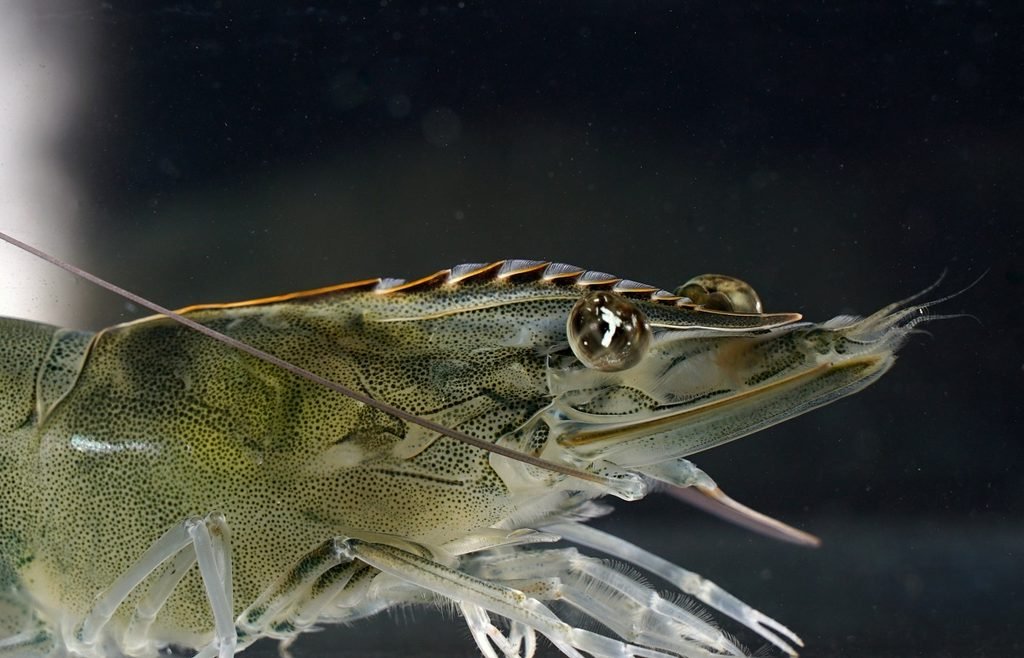
Antennae function as the shrimp’s primary navigational system and biological radar in turbid environments or strong hydrodynamic currents. In commercial facilities, over 95% of analyzed specimens exhibited some degree of antennal breakage, with more than half suffering severe damage that reduced these appendages to stumps. Such trauma stems primarily from intraspecific aggression or chronic abrasive contact against netting, air diffusers, and tank walls, thereby compromising spatial orientation and putting affected individuals at a marked competitive disadvantage during feed acquisition.
Concurrently, healthy eyes should appear intensely black, spherical, and lustrous; the onset of whitish spots, cataract-like opacities, or corneal erosions serves as an early warning of mechanical wear against culture infrastructure or underlying nutritional deficiencies requiring immediate dietary recalibration.
Musculoskeletal System: Rostrum, Telson, and Exoskeleton
The rostrum and telson—the shrimp’s cephalic spine and central tail tip—constitute the organism’s primary mechanical defenses. The presence of fractured, bent, or inflamed apices provides clear evidence of direct trauma sustained during handling transfers or abrupt escape responses triggered by acute stress. Across the exoskeleton, the appearance of rough fouling or localized melanic lesions reveals that the crustacean’s immune response is overexerted in sealing micro-injuries against opportunistic bacteria.
Furthermore, if the abdominal musculature loses its characteristic translucency to adopt a milky or opaque hue, or if specimens exhibit muscle spasms or necrosis, the stock is experiencing severe physicochemical swings or a bacterial proliferation that gravely compromises production.
Mantente siempre informado
Stay Informed
Únete a nuestras comunidades para recibir al instante las noticias, informes y análisis más importantes del sector acuícola.
Join our communities to get instant access to the most important news, reports, and analysis from the aquaculture industry.
Digestive System: Hepatopancreas and Intestine Under Control
The hepatopancreas constitutes the shrimp’s primary metabolic and detoxifying center; under optimal conditions, it appears compact, firm, and displays a deep dark-brown coloration, whereas an atrophic, pale, or watery organ signals a critical depletion of lipid reserves or the onset of severe infectious pathologies.
Concurrently, intestinal tract fullness provides an immediate diagnostic readout of feed intake within the culture system, where a continuous, fully packed, and pigmented gut confirms active consumption. Should routine sampling reveal that over 30% of specimens exhibit empty or fragmented intestines—outside of a synchronized molt event—it becomes imperative to immediately audit feed palatability, broadcast schedules, or potential spikes in un-ionized ammonia throughout the water column.
Respiratory System and Locomotory Appendages: Gills, Pereiopods, and Uropods
Gills must remain entirely unsoiled, intact, and pale—nearly translucent in appearance—as accumulations of suspended solids, sediment, microalgal deposits, or melanic foci drastically impede dissolved oxygen diffusion, inducing severe tissue hypoxia even when aeration systems operate at maximum capacity.
Concurrently, locomotory appendages—pereiopods (walking legs), pleopods (swimming legs), and uropods (tail fans)—warrant meticulous inspection; in production systems, nearly 70% of specimens exhibit pereiopod damage or mutilation, while roughly half display eroded uropods with evident loss of marginal setae. These appendages are indispensable not only for grasping pelleted feed off pond bottoms, but also for coordinating the rapid escape response critical to evading cannibalism during post-molt vulnerability.
How to Apply the 0–3 Visual Index in Daily Operations Without Stressing Your Stock
Assessing physiological welfare in a commercial setting must not become an operational bottleneck that disrupts routine farm labor; to ensure seamless field adoption, any technical methodology must remain agile, standardized, and safe for the biomass.
The protocol outlined by the researchers requires preparing a clean container with approximately 20 centimeters of water drawn directly from the culture pond or tank. Using a fine, soft-mesh dip net to prevent mechanical abrasions to the cuticle and eyestalks, a sample of 30 specimens is collected for small- to mid-scale individual ponds or raceways, or up to 100 shrimp when evaluating multi-unit production systems.
Most parameters are scored while the animal remains submerged; should an inspection of the pereiopods or an extension of the uropods be necessary, the technician gently handles the shrimp by the cephalothorax using clean, moistened gloves, strictly limiting air exposure to a maximum of 20 seconds before carefully returning it to the water.
The scoring scale follows an objective, standardized rubric:
- Score 0 (Optimal condition): Intact antennal flagella extending beyond total body length; eyestalks uniformly black and spherical; straight, sharply pointed rostrum and telson; smooth, translucent exoskeleton; dark-brown, compact hepatopancreas; fully packed, continuous gut tract; clean gill filaments; fully intact locomotory appendages; and uropods with uniform marginal setae.
- Score 1 (Mild alteration): One antenna slightly broken (retaining >50% of body length); faint corneal discoloration; rostral apex displaying minor inflammation or deviation; isolated focal or microscopic melanic lesions; light-brown hepatopancreas with slight watery turgidity; partially discontinuous intestine; or minimal caudal setae loss.
- Score 2 (Moderate damage): Both antennae shortened or at least one severed below half body length; noticeable corneal erosions; deformed rostrum or telson; multiple cuticular melanic foci; pale-brown, atonic hepatopancreas; digestive tract 50% empty; bilaterally discolored gill filaments; or up to four injured pereiopods.
- Score 3 (Severe impairment): Antennal flagella reduced to stumps; anophthalmia or diffuse corneal opacity; structural fractures along the rostrum or telson; extensive cuticular loss with generalized melanosis; milky muscle opacity or tissue necrosis; pale, atrophic hepatopancreas; completely void gut; necrotic or blackened gill filaments; and over four mutilated or missing appendages.
Weekly logging of these metrics generates a reliable trend curve, providing the technical team with an unambiguous trigger to adjust water exchange rates, increase aeration capacity, or recalibrate feed rations whenever the mean batch index climbs from 0.5 to 1.5 within a two-week window—well before critical mortality occurs.
Commercial Farm Findings: Biofloc Technology Versus Recirculating Aquaculture Systems (RAS)
One of the most revealing contributions of the IGB manual emerged from benchmarking laboratory trials against the real-world operations of three intensive commercial farms in Germany, where 129 specimens ranging from 10 to 25 grams were evaluated.
The scientific team identified significant contrasts in shrimp health depending on the production system: in facilities utilizing biofloc technology, shrimp displayed markedly superior eye condition compared to those raised in traditional recirculating systems—only 50% exhibited mild alterations, and none showed severe damage—whereas in conventional closed systems, 80% of the individuals sustained ocular lesions, with a recurrent incidence of severe cataracts.
Although the authors note that dedicated trials are necessary to validate the underlying biological mechanism, the central hypothesis suggests that continuous grazing on microbial flocs and microalgae supplies critical micronutrients and antioxidants that safeguard ocular tissues.
Concurrently, the study revealed an unforeseen operational trade-off: introducing environmental enrichment structures into the tanks—theoretically designed to provide shelter and bolster welfare—actually increased cuticular abrasions due to chronic friction against rigid edges, confirming that any husbandry innovation must be rigorously validated against objective morphological metrics before being deemed beneficial.
The Link Between Visible Physical Damage and Cellular Stress
Does a broken antenna represent a mere cosmetic blemish, or does it signal profound physiological disruption within the crustacean? This core question was investigated under the CrustaWohl scientific project, jointly conducted by the Alfred Wegener Institute, Helmholtz Centre for Polar and Marine Research (AWI) and the Leibniz Institute of Freshwater Ecology and Inland Fisheries (IGB), with funding from the German Federal Environmental Foundation (DBU).
In controlled laboratory trials, researchers evaluated shrimp responses to three common aquaculture stressors: crowding due to excessive stocking density, elevated nitrate concentrations, and magnesium deficiency in artificial seawater.
When correlating macroscopic lesions with gene expression profiles, crowding emerged as the most consistently detrimental factor; under high stocking densities, elevated damage indices in uropods and antennae correlated significantly with the upregulation of cellular defense genes, including heat shock proteins (HSP70 and HSP90), the antioxidant enzyme glutathione peroxidase (GPx), and lysozyme.
Functionally, these biomolecules act as cellular first responders mobilized by tissue injury and oxidative stress, confirming that visible physical wear recorded at the pond bank accurately mirrors the metabolic toll debilitating the organism at a molecular level. An individual with damaged appendages suffers more than just commercial devaluation: its system reallocates vital energy toward mitigating tissue damage and sustaining homeostasis within an environment exceeding its adaptive capacity; maintaining optimal water quality alongside balanced stocking densities thus constitutes the primary preventative barrier against this metabolic drain.
The Economic Benefit: Healthy, Whole, High-Value Shrimp
For farm managers and industry executives, implementing animal welfare protocols only makes sense if it solidifies long-term profitability and operational sustainability; in modern shrimp farming, organismal health and financial returns run in parallel.
A batch reared under conditions that minimize mechanical and environmental stress optimizes daily growth rates and substantially improves the feed conversion ratio, directing every kilogram of compound feed directly toward harvestable muscle biomass rather than squandering metabolic energy on stress responses and continuous cuticle regeneration.
Furthermore, physical integrity and aesthetic quality dictate the final price point: shrimp harvested with intact antennal flagella, lustrous eyestalks, undamaged pereiopods, and a translucent cephalothorax secure entry into premium, high-gastronomy markets (commanding prices between €25/kg and upwards of €100/kg in select European outlets).
Conversely, batches exhibiting severe cuticular melanosis and fractured appendages are relegated to secondary processing for deheading and peeling—which increases shrinkage costs and erodes operating margins—while also falling short of global certifications like the Aquaculture Stewardship Council (ASC) that mandate regular morphological audits; adopting this visual index in daily operations is thus not merely good husbandry, but a direct passport to the world’s most demanding, premium-paying markets.
An Open Call to Producers: Expanding Knowledge from the Field
Animal welfare has historically centered on the “Five Freedoms” (freedom from hunger and thirst; discomfort; pain, injury, and disease; fear and distress; and the freedom to express normal behavior). While formulated primarily for vertebrates, the global aquaculture sector now actively debates their application to decapod crustaceans—particularly regarding operational challenges in hatchery stages, live transport, stocking densities, biosecurity, and humane slaughter protocols. Within this framework, the IGB technical manual is not intended as a rigid directive, but rather as a dynamic blueprint enriched by practical insights from commercial ponds and culture facilities.
“We invite shrimp experts and farmers to share their feedback, submit suggestions, and provide completed morphological score sheets to expand our reference database,” emphasized Dr. Sven Wuertz, co-author of the study and head of the Molecular Fish Physiology Group at the Leibniz Institute of Freshwater Ecology and Inland Fisheries (IGB).
The guide was developed in strategic partnership with researchers from the Alfred Wegener Institute, Helmholtz Centre for Polar and Marine Research (AWI) and Humboldt-Universität zu Berlin, synthesizing key findings from the CrustaWohl project supported by the German Federal Environmental Foundation (DBU). As morning sampling concludes, the technician returns the stock to the culture unit equipped with renewed diagnostic clarity: subtle variations across antennae, eyestalks, and uropods are no longer dismissed as inconsequential details. Through a standardized 20-second assessment per specimen, the shrimp industry now has a reliable predictive methodology to safeguard biomass health, optimize feed efficiency, and secure premium commercial yields.
Contact
Dr. Sven Würtz
Reference (open access)
Gamberoni, P., Slater, M. J., Bierbach, D., Bögner, M., & Wuertz, S. (2026). Health and welfare monitoring in Whiteleg shrimp (Litopenaeus vannamei) aquaculture. IGB Manual, Leibniz-Institut für Gewässerökologie und Binnenfischerei (IGB), Berlin. DOI: 10.4126/FRL01-006529369.

Editor at the digital magazine AquaHoy. He holds a degree in Aquaculture Biology from the National University of Santa (UNS) and a Master’s degree in Science and Innovation Management from the Polytechnic University of Valencia, with postgraduate diplomas in Business Innovation and Innovation Management. He possesses extensive experience in the aquaculture and fisheries sector, having led the Fisheries Innovation Unit of the National Program for Innovation in Fisheries and Aquaculture (PNIPA). He has served as a senior consultant in technology watch, an innovation project formulator and advisor, and a lecturer at UNS. He is a member of the Peruvian College of Biologists and was recognized by the World Aquaculture Society (WAS) in 2016 for his contribution to aquaculture.