-
1
Key Takeaways
- 1.1 Antibiotic Resistance in Aquaculture: Dissemination Mechanisms and Multidrug-Resistance Risks
- 1.2 Bacterial Resistance Reservoirs in Aquaculture Farms: Critical Distribution and Hotspots
- 1.3 The Impact of Uneaten Feed on Antimicrobial Resistance
- 1.4 Diagnosing Resistance Genes in Aquaculture: From Culture-Based Assays to In Situ Field Surveillance
- 1.5 Biological Alternatives to Antibiotics in Aquaculture: Comparative Efficacy and On-Farm Applications
- 1.6 What This Means for Your Farm
- 2 Entradas relacionadas:
Key Takeaways
- Antimicrobials lose operational efficacy due to horizontal gene transfer between pathogens and commensal bacteria. A systematic review of 136 publications (2005–2025) confirms that ponds, raceways, and net pens serve as epicenters for this genetic exchange.
- Benthic sludge and the gastrointestinal tract of cultured organisms constitute the densest reservoirs. Sediment retains a significantly higher gene load than the water column, while the gut microbiota of fish and crustaceans can concentrate resistance determinants two to three times more densely than the surrounding environment.
- Residual nitrogen and phosphorus—derived from feed oversupply and fecal matter—foster a eutrophic environment that accelerates bacterial metabolic activity and the frequency of genetic conjugation.
- Quantification methodologies are transitioning from laboratory-based techniques like qPCR to rapid on-site diagnostic platforms, whose primary contemporary bottleneck lies in protocol standardization.
- Commercial vaccines remain the most solid prophylactic intervention; however, their strategic synergy with selected probiotic strains and specific bacteriophages provides a more robust and sustainable health-management strategy.
At six o’clock in the morning, the field technician spots the initial warning signs before even reaching the culture battery: virtually untouched feeding trays, specimens exhibiting lethargy or piping at the surface, and localized mortalities clustered around mortality collection systems. The production log indicates that a medicated feed treatment was completed with apparent success barely three weeks earlier. Nevertheless, the infectious outbreak resurfaces, and the active ingredient has completely lost its therapeutic responsiveness.
This scenario inflicts severe economic losses on shrimp, tilapia, trout, and marine finfish operations worldwide. The fundamental question—why does a protocol that proved effective during the prior production cycle fail in the current one?—is not answered by drug dosage alone, but rather by the ecological dynamics governing the benthos, the water column, and the host enteric microbiota.
To elucidate this challenge, a research team from Islamic Azad University (Ahvaz, Iran) analyzed 136 peer-reviewed studies published over the past two decades. The review, published in the journal iScience, characterizes the dissemination pathways of antimicrobial resistance across aquaculture systems, evaluates early-warning diagnostic methodologies, and categorizes the most viable biological alternatives. The study provides fish and shrimp farmers with an actionable technical framework: it accurately maps where resistance genes aggregate, identifies which management practices amplify them, and outlines proactive interventions before therapeutic options are fully exhausted.
Antibiotic Resistance in Aquaculture: Dissemination Mechanisms and Multidrug-Resistance Risks
For decades, resistance was interpreted exclusively as a phenomenon stemming from single-cell mutations: a microorganism mutates, survives treatment, and proliferates. While this process does occur, it accounts for only a minor fraction of the actual dynamics. Scientific literature demonstrates that a considerably faster mechanism dominates aquaculture ecosystems: the horizontal transfer of resistance determinants among bacteria, even across taxonomically distant genera.
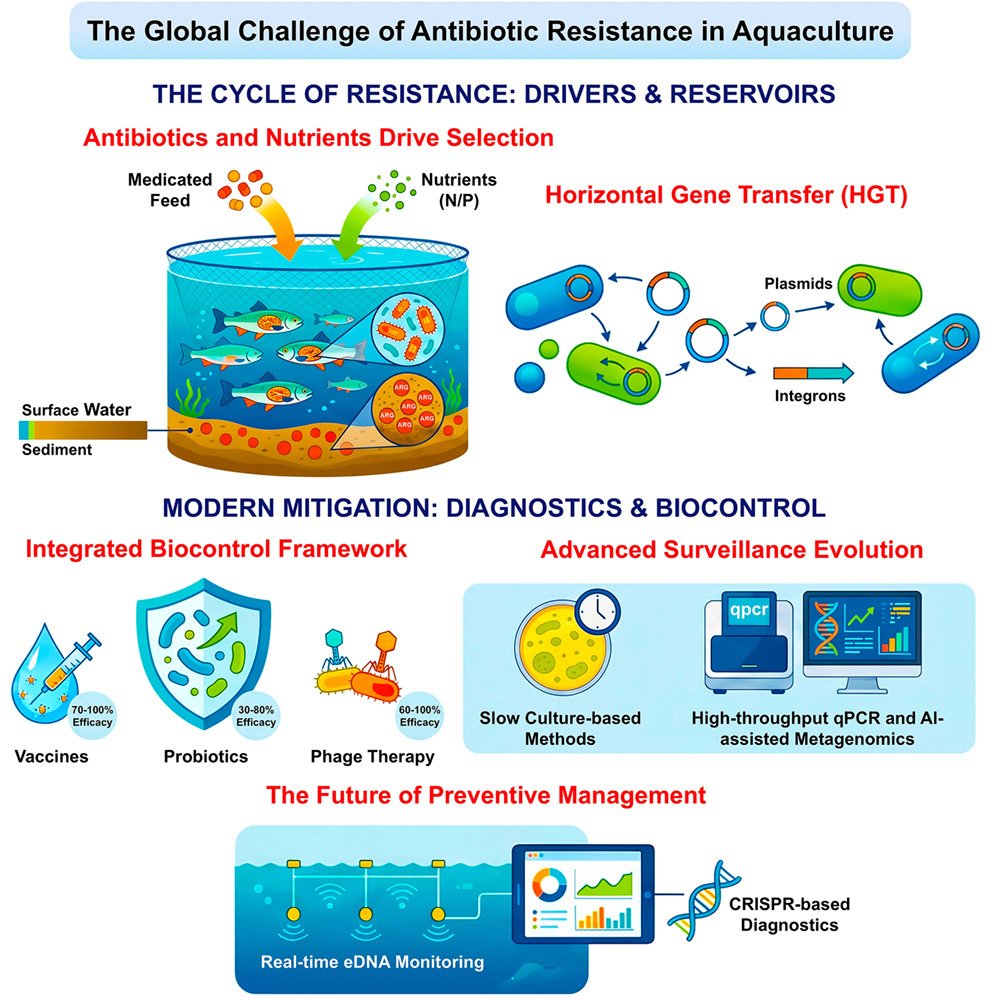
Formally termed horizontal gene transfer (HGT), this phenomenon operates via mobile genetic elements—such as plasmids, transposons, and integrons—that act as information vectors that bacteria replicate and disseminate to neighboring recipient cells.
Within the aquatic environment, this genetic flux takes place through three primary pathways:
- Conjugation (cell-to-cell contact): Represents the predominant route. Two bacteria establish physical contact via specialized structures (pili) to transfer genetic material. Under conditions representative of aquaculture environments, various trials document transfer frequencies ranging between 1 in 100 to 1 in 100,000 recipient bacteria.
- Transformation (uptake of exogenous DNA): Following bacterial lysis, DNA fragments remain suspended in the water column or adhered to biofilms. Key pathogens such as Vibrio and Aeromonas exhibit natural competence to internalize and integrate this genetic material.
- Transduction (bacteriophage-mediated): During viral lytic or lysogenic cycles, phages can accidentally package host genomic sequences—including resistance genes—and transfer them to novel target cells.
The severity of this scenario is exacerbated because these mobile elements frequently harbor multidrug-resistance platforms. Research across finfish and shrimp aquaculture confirms the presence of these complexes in Vibrio, Aeromonas, and Edwardsiella isolates, co-harboring cross-resistance to beta-lactams, quinolones, tetracyclines, and florfenicol, along with co-tolerance to heavy metals and disinfectants. Consequently, administering a single antimicrobial can inadvertently drive co-selection across multiple therapeutic classes.
Bacterial Resistance Reservoirs in Aquaculture Farms: Critical Distribution and Hotspots
The systematic review provides high-value operational insight by demonstrating that antimicrobial resistance is not uniformly distributed throughout production units; on the contrary, it aggregates within specific microenvironments marked by distinct ecological dynamics.
- Benthic Sludge and Sediments: Constitute primary reservoirs for antimicrobial resistance genes (ARGs), typically exhibiting densities 1 to 2 orders of magnitude higher than those detected in the water column. Anoxic benthic layers function as long-term conservation sinks, preserving both resistant bacteria and extracellular DNA over extended periods. Accumulated organic matter loads and clay mineralogical composition directly govern this retention, showing critical persistence of determinants conferring resistance to tetracyclines and sulfonamides.
- Gastrointestinal Tract of Cultured Organisms: The intestinal microbiota of farmed fish and shrimp frequently harbors 2 to 3 times more resistance genes than the surrounding aquatic medium. In biofloc-based systems, gut samples consistently register the highest gene copy counts.
- Feeding Zones and Effluent Outfalls: Within the water column, the highest concentrations aggregate adjacent to feeding stations and effluent discharge points, progressively attenuating toward open waters. Zones with optimal water-exchange rates promote dilution; conversely, stagnant pockets or dead zones accumulate resistant bacterial biomass and free genetic material.
- Hydrodynamic and Intertidal Dynamics: In operations situated within intertidal zones, concentrations fluctuate according to tidal regimes: peak retention coincides with neap tides, which correlate with extended hydraulic retention times.
Collectively, the analyzed studies report loads ranging between and gene copies per gram of sediment or milliliter of water, representing some of the highest densities documented across natural and agro-industrial ecosystems. Geographically, intensive farming basins across East and Southeast Asia emerge as the principal global hotspots, revealing a direct correlation among gene abundance, pond density, and anthropogenic pressure from adjacent agricultural activities.
Mantente siempre informado
Stay Informed
Únete a nuestras comunidades para recibir al instante las noticias, informes y análisis más importantes del sector acuícola.
Join our communities to get instant access to the most important news, reports, and analysis from the aquaculture industry.
The Impact of Uneaten Feed on Antimicrobial Resistance
One of the findings carrying the greatest techno-operational significance is that drug administration alone does not constitute the sole critical variable driving the issue. The scientific review identifies two decisive, synergistic vectors within culture systems: the presence of subinhibitory antimicrobial residues and nutrient overloading within the water column.
While active pharmaceutical ingredients exert direct selective pressure—eliminating susceptible strains and clearing the ecological niche for resistant counterparts—residual nitrogen species (ammonium, nitrates) and phosphorus stemming from feed oversupply and feces act as metabolic catalysts. Elevated macronutrient availability stimulates bacterial biomass, amplifies metabolic activity, and heightens cell-to-cell contact rates, exponentially increasing the probability of horizontal gene transfer. When comparing earthen ponds, cage net pens, and recirculating aquaculture systems (RAS), gene abundance correlated most strongly with the combined impact of antibiotics and nutrients rather than with any individual physicochemical metric analyzed in isolation.
Secondary variables modulate the kinetics of the phenomenon without serving as primary triggers: pH and dissolved oxygen influence rate kinetics, while heavy metals serve as long-term stabilizers, consolidating the persistence of resistance determinants.
The authors underscore a pertinent methodological caveat: the preponderance of evidence derives from observational field surveys rather than controlled challenge trials. While this confirms robust macro-ecological patterns, longitudinal multi-factorial studies are imperative to delineate the direct causality of each individual variable.
Nevertheless, the zootechnical mandate is unequivocal: optimizing feeding regimens and water quality not only maximizes the feed conversion ratio (FCR), but also neutralizes the ecological substrate perpetuating bacterial resistance.
Diagnosing Resistance Genes in Aquaculture: From Culture-Based Assays to In Situ Field Surveillance
For decades, standard diagnostic practice relied upon phenotypic antimicrobial susceptibility testing via disc diffusion and culture plates. Although functional, its extended diagnostic turnaround and inherent inability to evaluate unculturable environmental taxa severely constrain actionable on-farm decision-making.
The scientific review documents a three-stage methodological progression:
- Initial Phase (2000s): Focused on targeted, single-gene screening assays.
- Genomic Consolidation (2010s): Marked by the advent of high-throughput quantitative PCR (HT-qPCR) and next-generation sequencing (NGS), which enabled comprehensive mapping of total sample resistomes.
- In Situ Diagnostic Phase (2020 onward): Characterized by rapid, decentralized analytical platforms engineered for direct on-farm deployment.
Currently, quantitative real-time PCR (qPCR) remains the gold standard for absolute quantification of target resistance determinants. High-throughput variants permit parallel screening of over 100 target genes within 4 to 6 hours, supporting comprehensive epidemiological surveillance programs. Digital PCR (dPCR) achieves detection thresholds of 1 to 10 copies per reaction, albeit at elevated operational costs; shotgun metagenomics deciphers total environmental DNA and uncovers novel variants, though requiring dedicated bioinformatics pipelines and capital investment.
Among emerging technologies, CRISPR-Cas-based diagnostic assays, loop-mediated isothermal amplification (LAMP)—ideal for low-resource settings as it circumvents thermal cyclers—, microfluidics, and real-time biosensors show immense promise. Despite their disruptive potential, the authors caution that most platforms still require field validation against the high turbidity and complex organic matrices typical of aquaculture effluents.
The principal systemic bottleneck remains the lack of methodological standardization: disparities in DNA extraction protocols, primer design, and data normalization workflows continue to hinder inter-laboratory reproducibility.
Biological Alternatives to Antibiotics in Aquaculture: Comparative Efficacy and On-Farm Applications
The most promising section of the review evaluates three biological strategies to counteract bacterial pathologies. The synthesized datasets originate from in vitro trials, in vivo challenge models, pilot studies, and commercial field reports; consequently, the authors caution that reported efficiency ranges should be interpreted as technical benchmarks rather than prescriptive guarantees.
Vaccines
Vaccines represent the intervention with the highest technological readiness and widespread commercial adoption worldwide. The analyzed literature reports reductions in disease incidence or associated mortality ranging from 70% to 100%, contingent upon the target pathogen, host species, and delivery route. Notable documented cases include: a live-attenuated vaccine against Aeromonas hydrophila achieving 83.7% post-challenge survival in common carp; a DNA vaccine in Nile tilapia (Oreochromis niloticus) conferring >80% relative protection against Streptococcus agalactiae; and a recombinant formulation providing 100% protective efficacy against Vibrio alginolyticus in hybrid grouper. Injectable vaccines offer high immunogenicity at the expense of manual handling stress and labor costs; oral in-feed formulations permit seamless zootechnical scaling despite variable individual uptake; and immersion baths facilitate cost-effective mass immunization of fry and fingerlings.
Probiotics
Probiotics function primarily via competitive exclusion: colonizing enteric mucosal surfaces, outcompeting opportunistic pathogens for essential nutrients, synthesizing antimicrobial peptides (bacteriocins), and modulating non-specific host immunity. Empirical studies record 30% to 80% reductions in pathogen loads or clinical morbidity. They stand out for their economic feasibility, flexible delivery via rearing water or feed matrices, and minimal propensity to induce antimicrobial resistance; however, in-field reproducibility remains heavily dictated by the specific strain consortia and water physicochemical stability.
Bacteriophages
Bacteriophages are strictly lytic viruses that infect target bacteria with high taxonomic specificity, thereby preserving beneficial commensal microbiota. In trials targeting Flavobacterium psychrophilum, low multiplicities of infection (MOI) inhibited bacterial adhesion by over 80% and substantially enhanced rainbow trout (Oncorhynchus mykiss) survival rates. While literature cites bacterial reduction ranges between 60% and 100%, these results remain largely confined to experimental and pilot settings. Principal technical bottlenecks include narrow host ranges, vulnerability to thermal and pH fluctuations, and ambiguous regulatory approval frameworks.
Combined Therapies
Synergistic integration—such as priming vaccination schedules with probiotic-supplemented functional diets—yields superior and more durable immune responses than monotherapies alone, although it entails heightened supply-chain complexity, input costs, and a need for longitudinal commercial validation.
What This Means for Your Farm
The study advocates for a paradigm shift: transitioning from reactive interventions once an outbreak has already established to proactive, systematic prevention. This requires quantifying risk, identifying where resistance determinants aggregate, and deploying integrated management tools.
The authors envision aquaculture operations equipped with early-warning surveillance: environmental DNA (eDNA) monitoring, automated sampling, portable on-site diagnostic assays (PCR, LAMP, or CRISPR), and predictive AI models anticipating when and where resistance thresholds will breach. They acknowledge that much of this architecture still demands rigorous ground-truthing under commercial conditions, alongside harmonized regional regulations.
Returning to the introductory scenario—untouched feeding trays and an ineffective antimicrobial—the findings in this paper offer an alternative outcome. The pond bottom, saturated with organic matter across successive cycles, had likely been concentrating resistance genes long before clinical signs emerged. Uneaten feed provided the metabolic fuel. And the prior treatment, rather than resolving the root pathology, simply cleared the ecological niche for bacteria that already held the molecular key to survival. Next time, that technician could oversee a vaccinated stock, supported by system-adapted probiotics, well-managed benthos, and on-site molecular diagnostics before deploying a single therapeutic agent. It is not an absolute guarantee of zero mortality; it is the fundamental difference between guessing and knowing.
Contact
Laleh Roomiani
Department of Fisheries, Ahv.C., Islamic Azad University
Ahvaz, Iran
Email: laleh.roomiani@iau.ac.ir
Reference (open access)
Loveymi H, Roomiani L, Tadayoni M. 2026. Antibiotic resistance genes in aquaculture: Molecular detection, environmental dynamics, and biological control strategies iScience, 2026; 29 117533. https://doi.org/10.1016/j.isci.2026.117533

Editor at the digital magazine AquaHoy. He holds a degree in Aquaculture Biology from the National University of Santa (UNS) and a Master’s degree in Science and Innovation Management from the Polytechnic University of Valencia, with postgraduate diplomas in Business Innovation and Innovation Management. He possesses extensive experience in the aquaculture and fisheries sector, having led the Fisheries Innovation Unit of the National Program for Innovation in Fisheries and Aquaculture (PNIPA). He has served as a senior consultant in technology watch, an innovation project formulator and advisor, and a lecturer at UNS. He is a member of the Peruvian College of Biologists and was recognized by the World Aquaculture Society (WAS) in 2016 for his contribution to aquaculture.