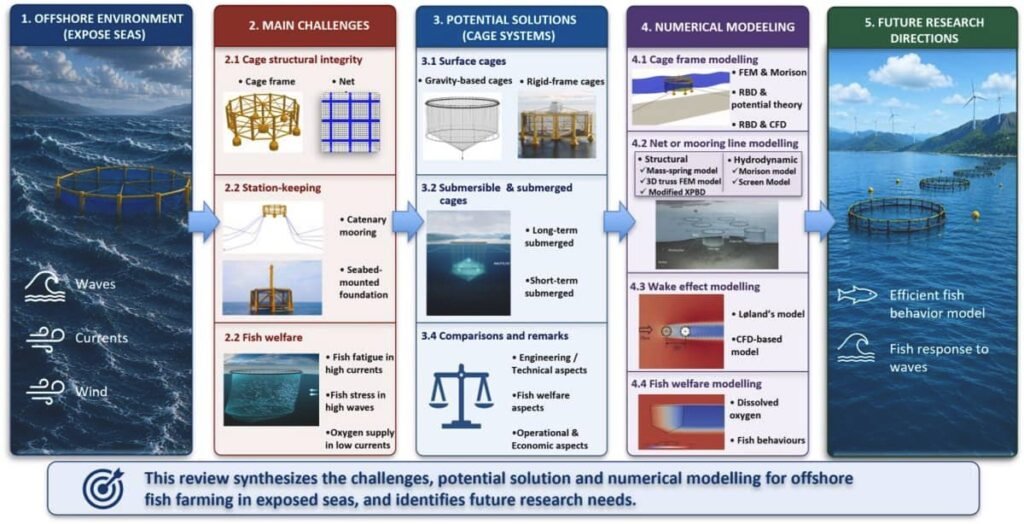
- 1 Key Findings of the Study
- 2 Aquaculture Facing the Thermal Crisis: The Inevitable Move Offshore
- 3 Offshore Aquaculture: The Open Ocean as a Promise and an Extreme Challenge
- 4 Two Offshore Aquaculture Strategies: Surface Resilience vs. Deep Submergence
- 5 From Empiricism to Predictive Engineering: The Role of Numerical Modeling
- 6 Conclusion: Toward Evidence-Based Offshore Aquaculture
- 7 Entradas relacionadas:
Key Findings of the Study
- Strategic Migration: Ocean warming is driving the aquaculture industry to move away from sheltered fjords and bays into colder, open waters, securing higher water exchange rates, lower stocking densities, and a reduced incidence of parasites such as sea lice.
- The Operational Cost of Wave Action: In exposed Norwegian offshore sites, 50-year design waves reach 14.2 meters with currents exceeding 1.6 m/s, subjecting farming facilities to extreme hydrodynamic stress.
- Three Critical Fronts: The primary challenges lie in cage structural integrity, mooring system stability, and fish welfare, as strong currents exhaust the swimming capacity of the fish.
- Competing Technological Paradigms: Rigid steel surface cages (robust but capital-intensive) coexist with submersible systems, which submerge during severe sea states to shelter stock, albeit requiring more intricate offshore operations.
- Financial Impact: Rigid surface installations (Ocean Farm 1) required approximately NOK 1 billion compared to NOK 141 million for submersible designs (Deep Blue 1), representing a 142% higher cost per cubic meter of culture volume.
Aquaculture Facing the Thermal Crisis: The Inevitable Move Offshore
It is August in the Norwegian fjords, and fish farmers recognize the signs well before checking their telemetry: surface water temperatures have surpassed the optimal threshold for Atlantic salmon. Concurrently, algal blooms deplete dissolved oxygen levels precisely when fish metabolic demand peaks due to thermal stress. Sea lice capitalize on this optimal biological window within the net pens; the stock crowds together, suffers chronic stress, and curtails feed intake, making the economic outcome evident—every fractional temperature rise translates directly into financial losses and compromised fish welfare.
With 2024 established as the warmest year on record since 1850 and the second to exceed the critical 1.5°C pre-industrial baseline, this milestone is far from a mere statistical benchmark for coastal aquaculture—it is the operational catalyst compelling the sector to transition offshore in pursuit of deeper, well-oxygenated, and colder waters.
Nevertheless, the open ocean presents severe hydrodynamic conditions marked by aggressive waves and high-energy currents. In a comprehensive review, University of Stavanger researchers Xueliang Wen and Muk Chen Ong systematically analyze the structural, operational, and biological hurdles the industry must overcome to ensure offshore mariculture remains secure, economically viable, and ethical—offering not just an isolated study, but an actionable strategic roadmap.
Offshore Aquaculture: The Open Ocean as a Promise and an Extreme Challenge
For decades, marine finfish farming operated within 500 meters of the coastline in sheltered bays where significant wave heights rarely exceeded 2.8 meters, ensuring predictable and manageable operations. However, these protected nearshore waters now face adverse conditions driven by thermal stress, pathogen proliferation, and reduced water exchange rates.
Relocating sea cages more than three kilometers offshore fundamentally redefines the production paradigm. In strategic areas such as the Norwegian Trench South, extreme oceanographic parameters underscore the magnitude of this challenge: significant wave heights reaching up to 14.19 meters with peak periods near 15 seconds, compounded by current velocities of 1.60 m/s at depths of 15 meters. While tropical and subtropical regions face recurrent typhoons instead, the overarching engineering imperative remains the same: deploying resilient structures capable of withstanding relentless hydrodynamic forcing year after year.

In light of this operational landscape, industry analyses delineate the core challenge across three critical pillars that every operator must address.
Front 1: Ensuring Structural Integrity and Net Resilience
A modern offshore culture cage comprises two essential components: a tubular steel superstructure and a suspended net panel, each exhibiting distinct failure mechanisms. The primary frame is susceptible to material fatigue at welded joints—where localized stress concentrations and millions of wave cycles propagate microcracks over time, even under sub-critical individual loads—demanding significantly higher mechanical stiffness and ultimate strength than sheltered coastal installations.
Conversely, the net assembly represents the most vulnerable element, continually subjected to the hydrodynamic action of waves and currents, predator pressure, operational wear, and biofouling. As fouling organisms colonize the mesh, they constrict the effective aperture and increase the solidity ratio, sharply driving up hydrodynamic drag forces that compromise yarn tensile strength and trigger catastrophic fish escapes, while acidic secretions from certain organisms accelerate polymer degradation.
To mitigate this, researchers highlight integrating interlaced structural ropes into the net body to transfer hydrodynamic loads directly to the rigid framework, thereby decoupling structural tension from biological containment; however, because a localized rope failure can initiate progressive, cascading tears in adjacent meshes, rigorous inspection, preventive maintenance, and timely repairs become the decisive threshold between commercial viability and total stock loss.
Mantente siempre informado
Stay Informed
Únete a nuestras comunidades para recibir al instante las noticias, informes y análisis más importantes del sector acuícola.
Join our communities to get instant access to the most important news, reports, and analysis from the aquaculture industry.
Front 2: Securing Mooring System Stability and Resilience
Maintaining the precise station-keeping of an offshore cage represents a critical ocean engineering challenge, primarily governed by two bathymetric strategies: catenary mooring systems (high-mass suspended lines anchored to the seabed) for deep waters, and seabed-fixed foundations in shallow environments. In Norwegian offshore sites where water depths typically exceed 100 meters, surface structures rely exclusively on their mooring spreads.
The pivotal operational variable lies in structural redundancy analysis. While conventional multi-cage arrays with distributed mooring grids can withstand the failure of one or two lines without compromising overall station-keeping, rigid semisubmersible cages with reduced configurations—typically six to eight lines—operate with minimal safety margins. As synthesized in the review, the loss of merely two lines elevates tension in the surviving moorings to their ultimate breaking limits, triggering progressive, catastrophic system failure.
Front 3: Preserving Fish Welfare and Physiology Under Extreme Conditions
At this juncture, ocean engineering and applied biology converge: fish welfare is not a secondary metric, but the primary driver of commercial productivity. Under optimal conditions, Atlantic salmon optimize feed conversion rates, accelerate somatic growth, and enhance pathogen resistance; offshore, however, their physiological stability is governed by three distinct hydrodynamic regimes.
The first regime involves high-velocity currents. While Atlantic salmon possess notable swimming capabilities—with a 700 g individual sustaining mean speeds near 0.9 m/s—they face strict physiological ceilings. Recommended technical thresholds mandate that flow velocities should not exceed 60% of their critical swimming speed (), equating to 0.585 m/s for a 700 g fish. The operational conflict is immediate: offshore currents often far surpass this limit, forcing continuous counter-current swimming that leads to muscular fatigue and impingement against cage walls or netting.
The second regime occurs during low-velocity, stagnant conditions common in summer, where diminished water exchange triggers critical hypoxia. During the summer grow-out phase in 15–16°C waters, a 4–5 kg salmon demands 109–139 mg just as oxygen solubility drops and microalgal consumption peaks, inducing metabolic stress, stunted growth, and elevated mortality. Crucially, large-scale cage geometry can harbor internal anoxic microzones even under moderate ambient flow, underscoring that cage sizing must be optimized around dissolved oxygen dynamics rather than raw stocking volume alone.
The third factor—the impact of large-amplitude waves—remains the least documented frontier. While fish tolerate moderate orbital motion by utilizing hydrodynamic troughs for transient recovery, their behavioral and physiological responses to severe storms and massive sea states represent a critical research gap.
Two Offshore Aquaculture Strategies: Surface Resilience vs. Deep Submergence
In response to these oceanographic challenges, current research categorizes technological solutions into two main design paradigms. On one hand, rigid steel-frame surface cages—such as Ocean Farm 1 or HENGYI 1—rely on passive structural resistance through a robust framework of columns, pontoons, and bracings that minimize deformation against wave trains; while they represent the most viable pathway for open-ocean surface operations, they require significantly stronger frameworks, reinforced netting, and heavy-duty mooring systems compared to coastal sites, substantially driving up capital expenditure (CAPEX).
Conversely, the second paradigm mitigates hydrodynamic loading via submersible cages that descend into deeper strata to access colder, more stable water masses with low sea lice prevalence (Caligus / Lepeophtheirus). This approach encompasses three distinct operational profiles: systems that remain submerged throughout most of the production cycle and resurface solely for critical husbandry operations (the Deep Farming concept), those alternating seasonally between surface and submerged states based on thermal regimes (Deep Blue 1), and tactical submergence systems deployed temporarily to evade extreme storm events (the Aqualoop Big Dipper concept).
The comparative capital analysis is striking: the surface-based Ocean Farm 1 required approximately NOK 1 billion, compared to NOK 141 million for the submersible Deep Blue 1—representing a 142% higher cost per cubic meter of effective culture volume for the surface design. However, submersible platforms demand more intricate automated feeding systems and advanced mooring dynamics, significantly increasing operational expenditure (OPEX). Ultimately, there is no universal solution; commercial viability hinges on optimizing the trade-offs among initial capital outlay, operating costs, and site-specific fish welfare standards.
From Empiricism to Predictive Engineering: The Role of Numerical Modeling
Much of the research underscores a discipline invisible to the field operator yet decisive in design: numerical modeling and hydrodynamic simulation. Before deployment, engineers simulate structural responses under combined wave and current forcing, utilizing low-cost simplified models for global deformation, mid-fidelity tools that serve as the industry standard, and high-resolution computational fluid dynamics (CFD) capable of resolving complex flow patterns at substantial computational expense.
Concurrently, fish schooling ethological modeling is advancing rapidly to simulate swimming patterns and spatial distribution under varying oceanographic conditions. However, current state-of-the-art algorithms are constrained to cohorts of roughly 100 individuals against commercial cage populations of hundreds of thousands, leaving explicit knowledge gaps regarding physiological and behavioral responses to coupled extreme waves and currents—a methodological transparency that ultimately reinforces the technical rigor of the established findings.
Conclusion: Toward Evidence-Based Offshore Aquaculture
Returning to the initial scenario of the fjord farmer confronting warm summer waters, dissolved oxygen deficits, and seasonal parasite blooms, the promise of the open ocean lies in transforming this summer vulnerability into operational stability through colder water masses, higher flushing rates, and reduced pathogen pressure. However, the review underscores that a successful transition relies not on chance, but on methodically resolving three critical pillars—cage structural integrity, mooring system resilience, and fish welfare preservation—while rigorously evaluating whether surface resistance or deep submergence provides the optimal pathway.
Although the open sea offers no milder conditions, the industry now possesses an evidence-based roadmap to anticipate environmental hazards and optimize engineering solutions, providing a definitive framework to reverse recurrent summer losses and reshape the trajectory of marine aquaculture.
Contact
Muk Chen Ong
Department of Mechanical and Structural Engineering and Materials Science, University of Stavanger
Stavanger, Norway
Email: muk.c.ong@uis.no
Reference (open access)
Wen, X., & Ong, M. C. (2026). Offshore fish farming in exposed seas: A state-of-the-art review of challenges, potential solutions and numerical modelling. Ocean Engineering, 365, 127291. https://doi.org/10.1016/j.oceaneng.2026.127291

Editor at the digital magazine AquaHoy. He holds a degree in Aquaculture Biology from the National University of Santa (UNS) and a Master’s degree in Science and Innovation Management from the Polytechnic University of Valencia, with postgraduate diplomas in Business Innovation and Innovation Management. He possesses extensive experience in the aquaculture and fisheries sector, having led the Fisheries Innovation Unit of the National Program for Innovation in Fisheries and Aquaculture (PNIPA). He has served as a senior consultant in technology watch, an innovation project formulator and advisor, and a lecturer at UNS. He is a member of the Peruvian College of Biologists and was recognized by the World Aquaculture Society (WAS) in 2016 for his contribution to aquaculture.