- 1 Key Study Highlights
- 2 Myostatin: The Genetic Brake on Trout Growth
- 3 Why They Chose the Gene Science Had Dismissed
- 4 Numbers That Transform Fish Farm Profitability
- 5 Technical Considerations and Study Limitations
- 6 What This Breakthrough Represents for the Future of Aquaculture Production
- 7 Entradas relacionadas:
Key Study Highlights
- Researchers from Atatürk University used CRISPR/Cas9 to edit the mstnb1 gene in rainbow trout, which serves as a natural inhibitor of muscle growth.
- The gene-edited trout reached 825 grams at 10 months, compared to 464 grams for conventional trout—representing a 56% increase in body weight.
- These fish reached market size approximately two months earlier than standard individuals, a milestone that directly reduces feed costs.
- A crucial finding: the feed conversion ratio (the amount of feed required per kilogram of fish) remained practically identical between both groups, meaning they grew faster without a proportional increase in intake.
- This marks the first time this gene has been successfully knocked out in a salmonid, laying the groundwork to revolutionize aquaculture operations despite being a first-generation laboratory project.
It is March. A trout farmer in the mountains stares at his pond, running the numbers in his head. The fish he stocked nearly a year ago have yet to reach market weight, and every extra day means more feed purchased, pumps running continuously, and labor feeding the stock four times daily. He knows from experience that over half of his operating costs go toward a single line item: feed—and reaching market size just a few weeks earlier would fundamentally transform his margins.
This farmer’s financial reality underpins the global trout industry, facing the exact challenge a research team at Atatürk University in Erzurum, Turkey, set out to solve at its root. Their approach relies neither on a new nutritional formula nor a management tweak, but on a direct edit to the rainbow trout’s genetic code.
Myostatin: The Genetic Brake on Trout Growth
To understand the significance of this discovery, one must analyze a subtle yet decisive factor in animal development: myostatin. Serving as a “genetic brake” for muscle growth, this protein prevents excessive muscle tissue development in trout and most vertebrates. Rather than a flaw, it acts as a physiological regulatory mechanism telling the organism when to halt muscle synthesis.
This phenomenon is well known in livestock farming as “double-muscling,” naturally occurring in certain cattle, sheep, and poultry breeds to produce prominent musculature. In aquaculture, a similar effect has been achieved by knocking out the myostatin gene in species such as common carp, red seabream, yellow catfish, and Nile tilapia, resulting in significant body mass increases.
Given this background, a key question arises: if this principle has been known for years, why has it not been achieved in trout until now?
The answer lies in the species’ biological complexity. Rainbow trout, like other salmonids, feature a unique evolutionary history marked by two whole-genome duplications (occurring roughly 320 and 80 million years ago). Unlike mammals with a single myostatin gene copy, trout possess four variants: mstna1, mstna2, mstnb1, and mstnb2. Editing a gene among four highly homologous sequences is akin to trying to cut a specific wire within a bundle of nearly identical options, where the risk of targeting the wrong sequence was always present. Due to this technical barrier, gene editing targeting muscle regulators in trout remained unexplored for years.
Why They Chose the Gene Science Had Dismissed
At this point, the most captivating aspect of the study emerges: an analytical decision transcending mere statistical data.
Historically, aquaculture research focused on the mstna gene family due to its high expression in muscle tissue, while the mstnb group was long classified as brain-derived and irrelevant to somatic growth—making mstnb1 a prime candidate for dismissal.
However, challenging this dogma, the Atatürk University team compared the trout’s genetic map to mammals (which retain a single functional copy) and discovered that mstnb1 is flanked by the exact same neighboring genes that accompany the human muscle regulator, proving its direct lineage to the ancestral muscle gene despite its neural expression.
Mantente siempre informado
Stay Informed
Únete a nuestras comunidades para recibir al instante las noticias, informes y análisis más importantes del sector acuícola.
Join our communities to get instant access to the most important news, reports, and analysis from the aquaculture industry.
Numbers That Transform Fish Farm Profitability
A ten-month monitoring period (May 2024 to March 2025) yielded a revealing picture. The mstnb1-knockout rainbow trout averaged 825 grams, compared to 464 grams for conventional fish raised under identical conditions—representing a 56% increase in body mass.
However, the metric that will truly capture the industry’s attention is not just the final weight, but the reduction of the production cycle. The modified trout reached 254 grams in December 2024, whereas the control group did not reach that same figure until February 2025 (at which point the edited fish already averaged 620 grams). In operational terms, market size is achieved approximately two months earlier, translating to 60 fewer days of energy consumption, labor, and, fundamentally, feed.
This last aspect constitutes the core of the finding. One might assume that a larger fish requires a proportionally higher intake without offering a real gain in efficiency. The data proved otherwise: the feed conversion ratio (FCR)—the amount of compound feed required to produce a kilogram of meat—stood at 0.93 for the edited trout and 0.94 for conventional trout, a statistically equivalent value. The modified specimens maintained a sustained advantage month after month, achieving greater absolute growth with identical metabolic efficiency.
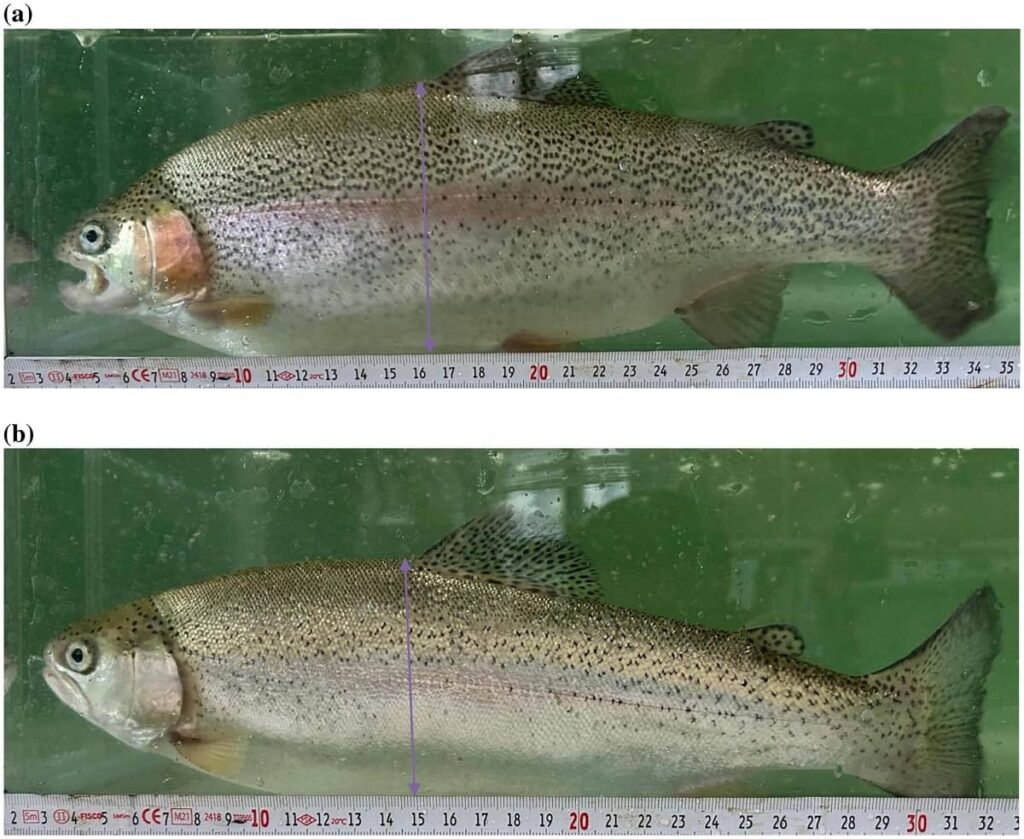
The visual impact is also striking. The edited trout developed a remarkably robust morphology, featuring a 24% increase in body height and 27% greater lateral surface area: the phenotypic manifestation of “double-muscling” applied to fish farming.
Technical Considerations and Study Limitations
It would be irresponsible—and the authors themselves are rigorous in this regard—to present this breakthrough as an immediately deployable commercial solution, as concrete technical reasons dictate caution.
First, survival rate is a major factor: of all CRISPR-injected embryos, only 23.5% reached the fry stage, compared to 87.6% in the control group. This high mortality stems from multiple concurring factors, including mechanical stress from microinjecting a fragile oocyte, potential cytotoxicity of the introduced ribonucleoprotein complex, and the impact of knocking out this gene during early embryonic stages, when myostatin plays a role in tissue development—representing the exact type of real methodological challenge biotechnology must resolve before raising premature expectations.
Second, these fish are first-generation (F0) mosaic organisms where not all cells carry the genetic modification; consolidating a stable, uniform, and transmissible breeding line—an indispensable prerequisite for industrial aquaculture—requires crossing these founder specimens to fix the mutation in subsequent generations (F1 and F2), a process currently underway.
Finally, an open question remains regarding neural expression: since mstnb1 is also expressed in nervous tissue, detailed histological studies are needed to evaluate whether its knockout alters long-term behavior or neurological development, as fine brain analysis remains a legitimate methodological query to complete despite no behavioral anomalies observed during the 10-month trial.
What This Breakthrough Represents for the Future of Aquaculture Production
Let us return to that fish farmer contemplating his pond, evaluating his production cost structure. Compound feed will continue to account for 50% to 60% of his operating expenses; that reality remains unchanged. However, possessing a fish that reaches market size two months sooner while maintaining the same conversion rate per kilogram produced represents the strategic lever capable of restructuring the profitability margin of an entire production cycle.
Although this advancement is not yet commercially available—and the regulatory framework for gene-edited organisms moves at varying paces across different countries—the research from Atatürk University demonstrates a principle that hitherto remained theoretical for salmonids: trout growth regulators can be targeted for inactivation to produce higher-mass specimens without compromising feed efficiency. For a highly competitive aquaculture industry, this scientific evidence offers valuable certainty.
The mountain farmer will likely not have these trout in his pond next season; nonetheless, the prospect of planning production cycles two months shorter is no longer mere theoretical speculation.
Contact
Abdulkadir Bayır
Department of Aquaculture,
Faculty of Fisheries, Atatürk University,
25240 Erzurum, Türkiye.
Email: abayir@atauni.edu.tr
Reference (open access)
Bayır, A., Bayır, M., Tao, W., Wang, C., Turhan, S., Uzun, B. N., Arslan, G., Arslan, H., & Wang, D. (2026). CRISPR/Cas9-mediated mstnb1 disruption enhances growth in rainbow trout. Journal of the World Aquaculture Society, 57(4), e70139. https://doi.org/10.1111/jwas.70139

Editor at the digital magazine AquaHoy. He holds a degree in Aquaculture Biology from the National University of Santa (UNS) and a Master’s degree in Science and Innovation Management from the Polytechnic University of Valencia, with postgraduate diplomas in Business Innovation and Innovation Management. He possesses extensive experience in the aquaculture and fisheries sector, having led the Fisheries Innovation Unit of the National Program for Innovation in Fisheries and Aquaculture (PNIPA). He has served as a senior consultant in technology watch, an innovation project formulator and advisor, and a lecturer at UNS. He is a member of the Peruvian College of Biologists and was recognized by the World Aquaculture Society (WAS) in 2016 for his contribution to aquaculture.