- 1 Key Study Findings
- 2 The Energetic Trap: What Transpires in Salmon Under Oxygen Depletion?
- 3 The Appetite Mystery: Why Salmon Reject Formulated Feeds
- 4 Disease Susceptibility and Fillet Quality: The Silent Aftermath of Hypoxia
- 5 The Triploid Dilemma: When Genetics Clashes with Environmental Constraints
- 6 From Reaction to Predictive Management: The Technological Arsenal Against Hypoxia
- 7 Conclusion
- 8 Entradas relacionadas:
Key Study Findings
- Novel mathematical models corroborate that feed intake decreases continuously alongside dissolved oxygen (DO) depletion, plummeting critically when saturation drops below 50% to 40%.
- Nutrient assimilation incurs substantial metabolic oxygen expenditure (specific dynamic action); under constrained gas availability, salmon voluntarily cease feeding to stave off physiological collapse.
- As fish hyperventilate to harness the scarce ambient oxygen, they experience body water loss and an excessive influx of saline ions, imposing severe osmoregulatory strain atop respiratory distress.
- Owing to their larger cell size and reduced gill surface area-to-volume ratio, they exhibit significantly lower tolerance to the synergistic effects of elevated water temperatures and low oxygen concentrations.
- Contemporary management extends beyond deploying emergency diffusers; it presently demands real-time sensor networks, functional feeds, and “digital twins” capable of forecasting critical hypoxic events.
It was just past 2:00 PM at a fjord-based aquaculture facility. Monitoring cameras revealed an unsettling behavior to the operations manager: the fish remained schooling densely at a depth of ten meters, allowing commercial pellets to sink uneaten to the seafloor. Within minutes, hundreds of dollars’ worth of high-energy feeds were accumulating beneath the cages, while telemetry sensors triggered alerts that dissolved oxygen saturation had breached the critical 55% threshold.
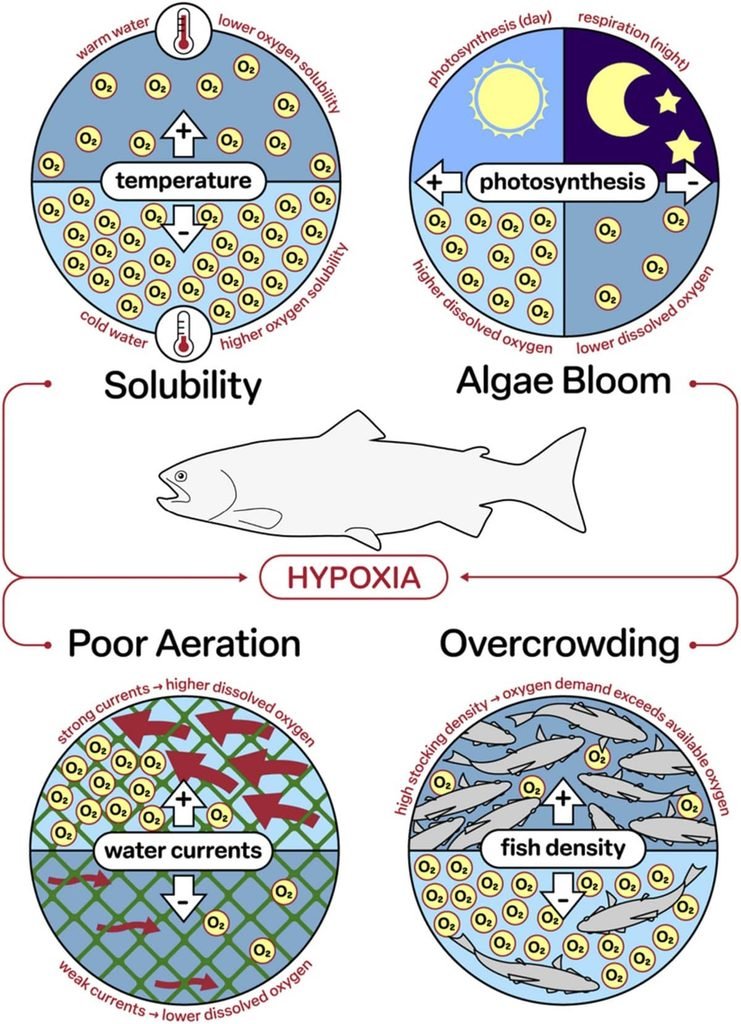
This scenario is by no means an isolated anomaly, but rather a persistent operational dilemma for marine cage operators across Norway, Chile, and Canada. In the face of warming summer seasons, unpredictable harmful algal blooms, and high stocking densities, hypoxic episodes—severe deficits in dissolved oxygen—have emerged as one of the foremost hazards to both profitability and Atlantic salmon (Salmo salar) welfare.
To dissect this challenge and establish a practical technical roadmap, a multidisciplinary research cohort from SPAROS Lda., the University of Bergen, BioMar AS, and the Institute of Marine Research synthesized state-of-the-art physiological, environmental, and technological insights in a review published in Aquaculture Reports. Their findings confirm that hypoxia triggers more than acute mortality: it impairs feed conversion efficiency, diminishes fillet yield, and undermines immunological competence against ubiquitous pathogens.
The Energetic Trap: What Transpires in Salmon Under Oxygen Depletion?
The Atlantic salmon is a metabolically high-performance organism, evolutionarily adapted to cold, dynamic, and oxygen-saturated currents. To understand its vulnerability, it is useful to conceptualize its energy balance as a physiological budget, termed “aerobic scope” in the scientific literature. The baseline of this balance represents the minimum expenditure required to survive at rest (standard metabolic rate), whereas the upper limit reflects the maximum biological effort prior to exhaustion. The difference between these two values defines the functional margin available for swimming, immune response, predator avoidance, and, critically, food digestion.
When dissolved oxygen concentration declines in the water column, the metabolic ceiling plummets. Nonetheless, basal maintenance costs remain unchanged—or even increase if ambient water temperatures rise—shrinking the operational scope at a critical pace.
In response to this progressive gas deficit, the fish deploys immediate physiological countermeasures. First, it amplifies both the frequency and amplitude of branchial ventilation, rising from a baseline rate of approximately 85 breaths per minute to over 95 when saturation approaches 50%. Furthermore, when currents permit, it engages in ram ventilation, swimming with its buccal cavity ajar to propel water across the gill apparatus.
Within the circulatory system, a key adjustment takes place: the myocardium enters hypoxic bradycardia, moderating the heart rate between 23 and 30 beats per minute to preserve adenosine triphosphate (ATP) reserves. To sustain perfusion across vital organs, the heart compensates for this decline by increasing stroke volume per beat. Concurrently, falling internal pH triggers the Bohr and Root effects in hemoglobin, driving the efficient offloading of residual oxygen to tissues with elevated metabolic demand.
However, these compensatory mechanisms impose a severe bioenergetic toll. In marine environments, the gills face an ongoing physiological trade-off: optimizing gas diffusion while preserving bodily fluids and excreting excess salts. By forcing substantial water volumes across dilated lamellae to harvest scarce oxygen, the salmon undergoes osmotic water loss alongside an ion overload. Consequently, energy that would otherwise drive muscle growth is diverted toward ion-pumping mechanisms to maintain osmoregulatory homeostasis.
The Appetite Mystery: Why Salmon Reject Formulated Feeds
For decades, operational management in aquaculture facilities operated under the assumption of a “hard threshold”—commonly placed around 6 mg/L or 70% dissolved oxygen saturation—below which salmon were presumed to abruptly suspend feeding. However, the collective evidence in this review demonstrates that teleost physiology does not operate on binary on/off switches.
Mantente siempre informado
Stay Informed
Únete a nuestras comunidades para recibir al instante las noticias, informes y análisis más importantes del sector acuícola.
Join our communities to get instant access to the most important news, reports, and analysis from the aquaculture industry.
Modeling extensive experimental datasets revealed that daily feed intake decline follows continuous sigmoidal curves (Hill-type kinetics). Appetite diminishes progressively alongside falling oxygen availability, sharply contracting within a critical band of 40% to 30% saturation, where feeding nearly halts.
What physiological mechanism drives this voluntary suppression? The crux lies in the metabolic overhead of nutrient assimilation, formally known as specific dynamic action (SDA). Hydrolyzing proteins, assimilating lipids, and synthesizing muscle tissue impose a substantial oxygen budget. Were fish to consume standard rations under hypoxic constraints, the digestive burden would breach their maximum aerobic capacity, triggering postprandial physiological collapse. Thus, fasting is not behavioral failure; it is a critical homeostatic strategy to avert metabolic exhaustion.
Historically, this cessation was attributed to central neuroendocrine circuits, such as hypothalamic melanocortin pathways or gastric ghrelin signaling. Nonetheless, recent findings indicate that the central expression of orexigenic and anorexigenic neuropeptides remains largely unaltered during sustained hypoxia. The primary inhibitory signals stem from peripheral metabolic and endocrine cues—notably persistent plasma cortisol and tissue lactate—which subordinate feeding behavior to immediate cellular survival.
Disease Susceptibility and Fillet Quality: The Silent Aftermath of Hypoxia
When dissolved oxygen deficits turn chronic or recurrent, the economic toll far exceeds the losses attributed to acute mortality alone.
The salmon’s immune system undergoes a critical breakdown: while select non-specific innate defenses may briefly mobilize at the onset of an event, the host’s competence to counteract targeted pathogens is substantially depressed. Indeed, in fish exposed to 40% saturation over six weeks, both leukocyte recruitment and the upregulation of key proinflammatory genes are severely compromised during bacterial challenges.
High-impact pathologies such as Amoebic Gill Disease (AGD), caused by Paramoeba perurans, create a critical feedback loop: the protozoan damages the respiratory epithelium, thereby restricting gas exchange, while ambient hypoxia exacerbates clinical severity and renders the fish vulnerable to therapeutic bath treatments or routine handling. Concurrently, heavy sea lice burdens inflate the salmon’s standard metabolic rate by up to 25%, compounding physiological demands and nullifying resilience against ambient oxygen fluctuations.
The organoleptic and commercial attributes of the final product face a parallel deterioration. Pre-slaughter hypoxia rapidly depletes glycogen reserves in white muscle, driving the accumulation of lactic acid and hydrogen ions; this tissue acidification diminishes water-holding capacity, softens fillet texture, and accelerates the onset of rigor mortis during primary processing.
Furthermore, empirical evidence offers critical insights into focal melanic spots—pigmented lesions that lead to commercial downgrades at the processing plant. These intramuscular anomalies represent sites of chronic inflammation and apoptosis characterized by melanomacrophage aggregation; localized hypoxia within myotomal tissue, induced by sustained swimming in oxygen-depleted waters, unleashes persistent oxidative stress that accelerates the formation of these detrimental pigments.
The Triploid Dilemma: When Genetics Clashes with Environmental Constraints
To mitigate the environmental impact of accidental escapes and prevent gene flow into wild populations, salmon aquaculture has broadly assessed the adoption of sterile triploids. However, field experience and the evidence synthesized in this study confirm that these fish exhibit heightened vulnerability to environmental fluctuations.
Bearing three complete chromosome sets, triploid salmon have larger cell volumes, which directly correlate with a reduced gill lamellar density that restricts the functional surface area for blood-gas exchange. While they maintain competitive zootechnical performance in cold, saturated waters, their feed intake drops far more severely than that of conventional diploids when facing elevated temperatures and moderate dissolved oxygen depletion. This physiological constraint prompted Norwegian regulators to enforce a moratorium on their open-cage commercial farming in 2023, underscoring that any applied biotechnology must remain within the species’ homeostatic limits.
From Reaction to Predictive Management: The Technological Arsenal Against Hypoxia
In this scenario, waiting for cage mortality alarms to trigger is a direct recipe for economic ruin. This scientific review outlines modern tools to pivot from reactive damage control to a strictly predictive strategy:
Oxygen Injection and Decompression Risks
Aeration and liquid oxygen diffusion systems remain the primary line of contingency. However, their efficacy in open fjord concessions remains subject to technical debate due to steep energy costs and hydrodynamic dispersion patterns. Furthermore, an underestimated operational hazard persists: supersaturation and elevated total gas pressure (TGP). When forced oxygenation is applied in deep-sea cages or semi-closed containment systems, and fish are rapidly pumped to the surface—such as during transfers to wellboats or delousing units—sudden decompression can induce gas bubble disease (GBD), causing fatal tissue aeroembolisms.
Functional Nutrition and Strategic Fasting
Feed modulation represents the most immediate, cost-effective operational intervention. Temporarily withholding feed during moderate hypoxic events eliminates the metabolic burden of digestion, safeguarding stock viability at the expense of a transient growth lag. Regarding functional feeds, formulations incorporate targeted amino acid profiles such as histidine—which, via dipeptides like anserine, buffers intracellular pH against lactic acid in white muscle—and immunostimulants derived from hydrolyzed yeast (Debaryomyces hansenii) to mitigate post-stress cortisol surges.
Sensor Networks, Artificial Intelligence, and Digital Twins
The true operational paradigm shift stems from high-density oceanographic sensor arrays. Dissolved oxygen within a sea cage is far from uniform: it fluctuates dramatically between the core and the perimeter, as well as vertically from surface to depth, shifting by up to 90% across a single tidal cycle. Integrating these dynamics into machine learning algorithms and digital twin platforms enables operators to forecast oxygen drops hours in advance based on tides, wind patterns, water temperature, and estimated biomass. Cage managers no longer rely on guesswork; automated systems proactively throttle feeding regimes well before the school experiences hypoxic distress.
Conclusion
Back at the sea cage, the tidal flow begins to pick up, replenishing water exchange within the nets. In the control room, warning lights normalize as telemetry confirms dissolved oxygen has returned to safe saturation ranges, while the operator watches with relief as the fish resume their typical schooling behavior. Nevertheless, this scientific synthesis delivers an unequivocal takeaway: dissolved oxygen can no longer be taken for granted. In an aquaculture sector facing warmer, increasingly dynamic seas, understanding fish respiratory thresholds and staying ahead of oceanographic cycles will draw the line between a profitable harvest and operating deep in the red.
Contact
Marina Linhares Azevedo
SPAROS Lda.
Área Empresarial de Marim, Lote C, Olhão 8700-221, Portugal
Department of Biological Sciences, University of Bergen
PO 7803, Bergen N-5020, Norway
Email: MarinaAzevedo@sparos.pt
Ivar Rønnestad
Department of Biological Sciences, University of Bergen
PO 7803, Bergen N-5020, Norway
Email: ivar.ronnestad@uib.no
Reference (open access)
Azevedo, M. L., Rønnestad, I., Sigholt, T., & Hvas, M. (2026). Hypoxia in Atlantic salmon aquaculture: Current understanding and the way forward toward mitigation and predictive management. Aquaculture Reports, 49, 103739. https://doi.org/10.1016/j.aqrep.2026.103739

Editor at the digital magazine AquaHoy. He holds a degree in Aquaculture Biology from the National University of Santa (UNS) and a Master’s degree in Science and Innovation Management from the Polytechnic University of Valencia, with postgraduate diplomas in Business Innovation and Innovation Management. He possesses extensive experience in the aquaculture and fisheries sector, having led the Fisheries Innovation Unit of the National Program for Innovation in Fisheries and Aquaculture (PNIPA). He has served as a senior consultant in technology watch, an innovation project formulator and advisor, and a lecturer at UNS. He is a member of the Peruvian College of Biologists and was recognized by the World Aquaculture Society (WAS) in 2016 for his contribution to aquaculture.