- 1 Key Study Findings
- 2 Why Distance Between Farms Decides Almost Everything
- 3 Models in Place Since 2005: A Lack of Field Validation
- 4 Outbreak Control Strategies
- 5 Knowledge Gaps in Current Research
- 6 Practical Implications for Aquaculture Management
- 7 Mapping Uncertainty at Sea
- 8 Entradas relacionadas:
Key Study Findings
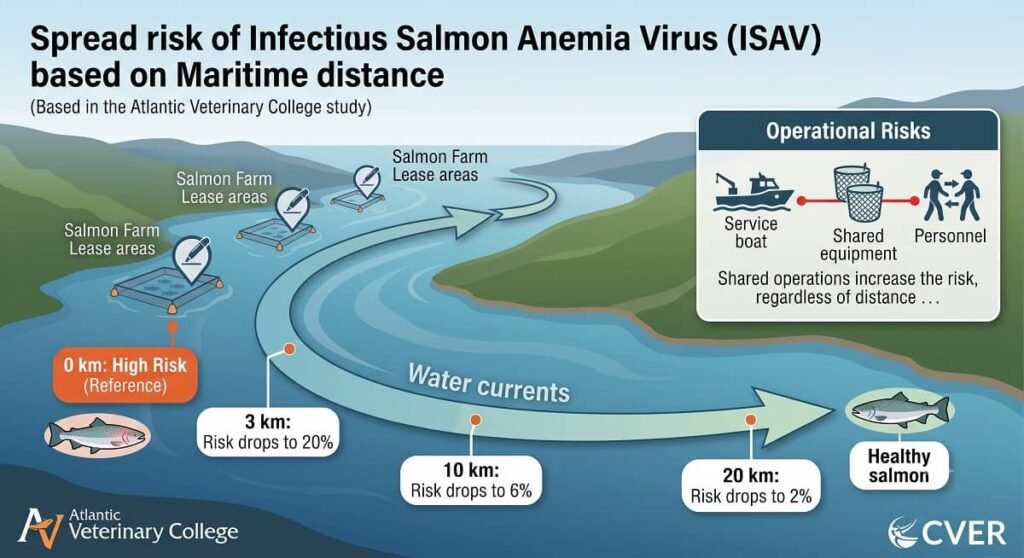
- Distance is decisive: Compared to adjacent sites (0 km), the risk of infection drops to 20% at 3 km, 6% at 10 km, and 2% at 20 km of hydrodynamic distance.
- Rapid culling is essential: Early depopulation remains the most effective tool; in Norway, combining screening and depopulation reduced outbreaks from 18.4% to 0.36% of production cycles.
- Vaccination assists, but is not definitive: Vaccinated fish still transmit the virus, albeit with reduced infectivity of around 40%.
- Detection remains delayed: Outbreak identification takes between 3.6 and 5.6 months from initial infection, allowing nearly half a year of silent spread.
- Unvalidated models: Of the 24 models evaluated, only four were validated, and a mere two underwent complete calibration and validation processes.
The first sign is rarely dramatic. It is usually a mortality sheet with a slight uptick in Cage 6, or a couple of fish swimming near the surface with gills paler than usual. The farm manager logs it, discusses it with the veterinarian, and moves on with the day. However, two weeks later, the infectivity curve leaves no room for doubt.
At that point, the question no one wants to ask aloud emerges: which farm will be next? Just four kilometers away, on the other side of the channel, lies a site holding two million fish, with another located nine kilometers out. The water current flows, service boats pass back and forth, and personnel move between sites. For decades, the response to this threat has been built on a mix of experience, regulations, and a healthy dose of faith.
To evaluate the strength of that response, a team from the Atlantic Veterinary College (University of Prince Edward Island), in collaboration with the Centre for Veterinary Epidemiological Research (CVER) and the Department of Fisheries, Forestry and Agriculture of Newfoundland and Labrador, reviewed 898 studies published between 1980 and June 2024. The researchers selected 24 papers representing the entirety of mathematical models developed to predict how Infectious Salmon Anemia Virus (ISAV) spreads among fish, cages, and farm sites.
What they uncovered is eye-opening—both for what it confirms (that hydrodynamic distance between farms is the single most influential factor) and for what it exposes: the vast majority of these models have never been validated against real-world field data.
Why Distance Between Farms Decides Almost Everything
For those working in aquaculture, it is clear that water serves as the primary dispersal route for pathogens. What was less evident, however, was the exact way this risk decays: rather than following a linear trajectory, it experiences a steep decline.

Norwegian studies analyzing thousands of production cycles—one of which monitored 1,475 sites and 6,829 cohorts between 2004 and 2019—provided quantitative evidence for this intuition. Taking the risk of operating adjacent to an infected farm as a baseline, the danger drops to one-fifth at three kilometers and to one-twentieth at twenty kilometers. The curve flattens rapidly: the first few kilometers offer a considerably larger margin of protection than the last.
However, there is a critical factor: distance must be measured along the flow of water, not as a straight line on a map. This is defined as hydrodynamic distance—the actual path a viral particle travels around coastlines, islands, and peninsulas. Two sites that appear geographically close may be epidemiologically distant if separated by a landmass; conversely, two distant sites may be connected by a direct current.
On the other hand, water is not the only vector. Research revealed that belonging to the same operational contact network as an infected site—through shared vessels, equipment, or personnel—increases infection risk to nearly the same level as being located less than five kilometers away. Spacing out facilities proves insufficient if operational vectors move freely between them. In fact, in various outbreaks, over 30% of cases could not be traced to any documented source.
Models in Place Since 2005: A Lack of Field Validation
The first ISAV propagation models emerged in Canada in 2005 through hydrodynamic simulations that released virtual particles from a site and tracked their dispersal with the tides. Although the approach was rigorous, the review authors point out a major limitation: most of these simulations released particles during a single season and over a single tidal cycle.
Mantente siempre informado
Stay Informed
Únete a nuestras comunidades para recibir al instante las noticias, informes y análisis más importantes del sector acuícola.
Join our communities to get instant access to the most important news, reports, and analysis from the aquaculture industry.
This approach omits critical variables. Currents and wind reach their peak intensity in spring and early summer, the period when most clinical outbreaks are recorded. Therefore, a model calibrated during a calm autumn day can systematically underestimate the reach of the virus during higher-risk seasons.
The review also revealed counterintuitive findings regarding fixed buffer zones. The traditional 5 km radius around a site tended to overestimate actual water connectivity. Furthermore, connections are not always reciprocal: between 20% and 58% of the time, the flow leaving Site A reached Site B, but water from Site B never returned to Site A. Marine transmission has a defined direction.
Of the 24 studies analyzed:
- 16 were mechanistic (reproducing the biological process step by step).
- 5 were hybrid.
- 3 were purely statistical.
Thirteen of them operated with a deterministic approach, yielding the same results for the same input data. However, disease transmission is a stochastic process subject to chance—the susceptibility of the first fish, wind conditions, or the exact timing of the outbreak relative to harvest. This variability has a greater impact when populations are small, or prevalence is low. Starting in 2020, research began shifting toward models that incorporate this uncertainty.
The most critical aspect exposed by the review is that only four of the 24 studies validated their results, and in most cases, this was done through expert opinion rather than against real-world outbreaks. The authors attribute this to the fact that obtaining field data is costly, ethically complex, and sometimes unfeasible due to a lack of systematic records.
Outbreak Control Strategies
From an operational standpoint, the review yields highly applicable data.
In Norway, rapid depopulation of infected sites proved to be a highly effective measure. The combination of systematic screening and depopulation reduced the proportion of production cycles with outbreaks from 18.4% to 0.36%. Incorporating mandatory vaccination into this framework further decreased the figure to 0.24%. These reductions explain why early culling remains the most effective control method.
Regarding vaccination, important nuances emerge. A trial conducted at the individual level (420 fish) determined that vaccinated individuals continued to transmit the virus, albeit with infectivity reduced by approximately 40%. Meanwhile, genetic selection lowered daily mortality from 0.013 to 0.003 per fish, but did not decrease susceptibility to infection. In practical terms: fish contract the disease at the same rate, but exhibit lower mortality.
Not all interventions yield identical results across different geographies. A model applied in Canada and the United States indicated that the surveillance and culling package did not significantly reduce the number of infected sites, although it did contain the impact within each site. Researchers explained that full detection took between 32 and 93 days, and the model was based on the 2002–2004 outbreak in New Brunswick and Maine, where 25 of 32 active sites became infected despite the implementation of control measures.
Scotland represents a benchmark for model-based public policy. Since 2000, it has implemented management areas requiring sites to maintain a separation equal to twice the tidal excursion distance: 7.2 km on the mainland and 3.6 km in the Shetland Islands. Between 2008 and 2009, the region reported only a single isolated incident.
Knowledge Gaps in Current Research
The study also highlights several scientific gaps requiring priority attention:
- Basic Reproductive Number (R0): The number of secondary sites infected by a single index farm was estimated in only two studies, based on the 2007–2009 Chilean epidemic (with site-level values ranging from 1.3 to 2.5). This metric has yet to be calculated according to seasonality or viral genotype.
- Fundamental Biological Parameters: Variables such as incubation period, infectious period, viral shedding rate, and recovery rate were not estimated in any of the 24 evaluated studies.
- The Role of HPR0: This non-pathogenic ISAV variant is often excluded from surveillance programs focused on the HPR-deleted variant. However, evidence shows that HPR0 can mutate into virulent forms. In Chile, HPR0 prevalence was documented to increase after pathogenic outbreaks were controlled, representing a silent reservoir omitted by most models.
Practical Implications for Aquaculture Management
Based on the review’s findings, four key recommendations emerge for decision-making at farm sites:
- Dynamic Distances: The reliance on fixed radii should be re-evaluated in favor of site- and season-specific distance calculations. Water connectivity varies drastically between winter and spring.
- Territorial Reconfiguration: A structure consisting of fewer, larger-scale farms with greater spacing between them exhibited less disease spread than a model featuring multiple small, closely situated sites.
- Targeted Surveillance: One study demonstrated that monitoring 65% of sites—strategically selected for their high water connectivity—allows for the identification of 100% of affected farms, optimizing resource allocation.
- Economic Evaluation: None of the control measure studies incorporated a cost-benefit analysis, a critical input given the substantial costs linked to culling, vaccination, or lease relocation.
Mapping Uncertainty at Sea
The farm manager who spotted the first anomalies in Cage 6 evaluates, in practice, the same factors that epidemiological models study: the probability of waterborne transmission.
Today, the industry possesses stronger evidence to support decision-making. It is recognized that a hydrodynamic distance of ten kilometers substantially reduces risk compared to three kilometers, although operational vectors can mitigate that advantage. Likewise, upon diagnostic suspicion, early depopulation remains the measure with the strongest technical backing, considering that the window of silent transmission may have begun months prior.
The Atlantic Veterinary College review emphasizes that the science applied to ISAV epidemiology continues to consolidate. Identifying these knowledge gaps does not invalidate current recommendations; rather, it positions them as the best available tools while the field data needed to refine future models is gathered.
Contact
Ahsan Raquib
Department of Health Management, Atlantic Veterinary College, University of Prince Edward Island
Charlottetown, Prince Edward Island, Canada
Email: araquib@upei.ca
Reference (open access)
Raquib, A., Thapa, P. C., Hammell, K. L., Sanchez, J., & Thakur, K. K. (2026). A Systematic Review of Studies Investigating the Transmission Dynamics of Infectious Salmon Anemia Virus. Reviews in Aquaculture, 18(4), e70190. https://doi.org/10.1111/raq.70190

Editor at the digital magazine AquaHoy. He holds a degree in Aquaculture Biology from the National University of Santa (UNS) and a Master’s degree in Science and Innovation Management from the Polytechnic University of Valencia, with postgraduate diplomas in Business Innovation and Innovation Management. He possesses extensive experience in the aquaculture and fisheries sector, having led the Fisheries Innovation Unit of the National Program for Innovation in Fisheries and Aquaculture (PNIPA). He has served as a senior consultant in technology watch, an innovation project formulator and advisor, and a lecturer at UNS. He is a member of the Peruvian College of Biologists and was recognized by the World Aquaculture Society (WAS) in 2016 for his contribution to aquaculture.