- 1 Key Points
- 2 Why Aquaponics Requires High-Precision Technical Control
- 3 The Smart Aquaponics Bottleneck: Disconnected Solutions and No Unified Framework
- 4 What Is a Reference Architecture in Aquaponics?
- 5 Five Analytical Dimensions for Smart Aquaponic System Engineering
- 6 Technical Validation: Benchmarking Two Paradigms Under a Single Architectural Framework
- 7 Architectural Scope and Methodological Limitations
- 8 Practical Field Guide: Implementing the Reference Architecture in Production Facilities
- 9 Entradas relacionadas:
Key Points
- Digitalization in aquaponics is frequently based on isolated prototypes and disparate tools, which hampers technical integration and scalability.
- Researchers from Bursa Technical University, Qatar University, and Wageningen University & Research have devised a “reference architecture” designed to structure aquaponic projects modularly.
- The framework differentiates between indispensable core elements (tanks, biofilters, pumps, and baseline control) and optional advanced modules (multispectral cameras, computer vision, and predictive models), scaling seamlessly from pilot setups to commercial facilities.
- The proposal underwent theoretical benchmarking against two documented configurations—one focused on sensor instrumentation with edge computing, and another dedicated to advanced visual monitoring—demonstrating its versatility across both operational contexts.
- While the framework lacks empirical performance evaluations on an operational aquaponic farm, it delivers an essential methodological roadmap to mitigate structural design risks prior to capital expenditure.
At six in the morning, a grower checks his smartphone before entering the greenhouse. One application reports dissolved oxygen levels; another, from a different vendor, governs the photoperiod; the recirculation controller runs on a standalone panel; and feed logs languish in an outdated spreadsheet. Meanwhile, the camera deployed to observe the fish school continuously accumulates unanalyzed footage.
Individually, each piece of equipment fulfills its operational function. The true bottleneck arises when attempting to achieve interoperability: configuring an oxygen drop to automatically trigger aerators, correlating diminished fish appetite with foliar anomalies in the hydroponic crop, or consolidating all telemetry into a unified control dashboard. This is the precise moment the operator realizes they have procured disconnected hardware rather than an integrated solution.
This recurring operational challenge prompted the research published in the journal Aquacultural Engineering. The scientific team posits that smart aquaponics faces a foundational bottleneck due to the absence of a structural standard—a roadmap delineating how sensors, data flows, automation controllers, and predictive analytics models must interface. Their reference architecture provides that technical standard, enabling producers and system integrators to eliminate guesswork, dismantle data silos, and engineer scalable operations on resilient foundations.
Why Aquaponics Requires High-Precision Technical Control
Aquaponics integrates two well-established production paradigms: recirculating aquaculture systems (RAS) and hydroponics, or soilless plant cultivation. Through this biological coupling, metabolic waste generated by fish ceases to be an environmental liability and is converted into a bioavailable nutrient source for crop production.
The foundational biological engine resides within the microbiome. Aquatic biomass excretes ammonia, which accumulates to toxic, lethal levels if unmanaged. Within biofilters and growing media, nitrifying bacterial consortia (Nitrosomonas and Nitrobacter) oxidize ammonia into nitrite and subsequently into nitrate, an inorganic form readily assimilated by root systems. This bioprocess purifies the effluent stream before recirculating it back to the aquatic rearing units.
The operational challenge lies in orchestrating three distinct biological organisms with conflicting requirements regarding pH, temperature, and dissolved oxygen: finfish, crops, and nitrifying bacterial biofilms. While empirical management may suffice at bench or pilot scales, system stability rapidly deteriorates as stocking and planting densities scale. Consequently, modern facilities demand technological modernization leveraging Internet of Things (IoT) sensors, process automation, and artificial intelligence.
The Smart Aquaponics Bottleneck: Disconnected Solutions and No Unified Framework
Applied research across precision aquaculture and aquaponics has experienced exponential growth. Contemporary literature showcases considerable breakthroughs in fish counting via computer vision, benthic uneaten feed pellet detection, automated disease and parasite diagnosis through imaging, foliar nutrient deficiency classification, and photometric water turbidity estimation.
Nevertheless, as emphasized by Ahmet Kasif, Cagatay Catal, and Bedir Tekinerdogan, the vast majority of these technological endeavors address isolated operational tasks or optimize solitary parameters. The comprehensive architectural framework required to systematically harmonize these disparate modules remains largely neglected. Consequently, the industry faces severe technical fragmentation, which impedes vendor interoperability, constrains operational scaling, and prevents the replication of proven architectures across production sites.
Addressing the vacuum of documented structural frameworks in smart aquaponics, the authors formulated this reference architecture to bridge this critical strategic gap.
Mantente siempre informado
Stay Informed
Únete a nuestras comunidades para recibir al instante las noticias, informes y análisis más importantes del sector acuícola.
Join our communities to get instant access to the most important news, reports, and analysis from the aquaculture industry.
What Is a Reference Architecture in Aquaponics?
Consider the structural design of a hatchery or a commercial RAS facility. Long before purchasing the first pump, engineers draft tank layouts, hydraulic dynamics, mechanical and biological filtration stages, and provisions for future expansion. While this blueprint does not replace the physical facility, it preempts severe structural failures and hydraulic incompatibilities.
A reference architecture serves an identical function for digital infrastructure: it provides a standardized model defining which operational modules constitute the automated system, the specific responsibilities of each component, and their interoperability protocols. Downstream, individual producers or systems integrators can tailor this baseline framework to their target operational scale and capital budget.
The international scientific consortium—led by the corresponding author from Wageningen University & Research—developed this model under a collaborative initiative focused on AI-driven aquaponics and global food security, partnering with institutions across the Netherlands, Qatar, and Turkey, including Akdeniz University. The research was supported by funding from the Qatar Research, Development, and Innovation (QRDI) Council. The consortium leveraged extensive multidisciplinary expertise across precision agriculture architectures, automated logistics, and predictive digital twins.
Five Analytical Dimensions for Smart Aquaponic System Engineering
Rather than relying on a static, one-dimensional schematic, the reference architecture organizes the technological ecosystem across five complementary perspectives, analogous to analyzing a facility through its hydraulic piping, electrical schematics, and central control room.
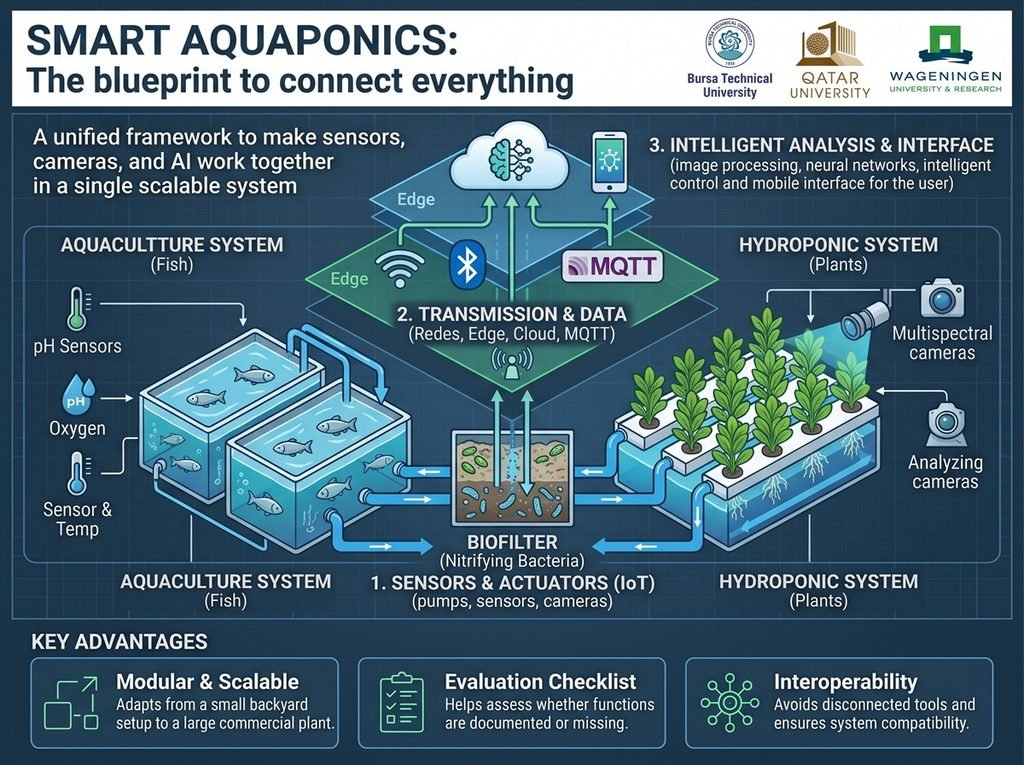
- The Capabilities Feature Model: The primary dimension is a structural feature catalog delineating mandatory baseline requirements from modular add-ons. Core hydraulic infrastructure (rearing tanks, biofilters, and pumps) represents the non-negotiable foundation, whereas rotary drum filters, supplementary lighting, computer vision rigs, and machine learning pipelines function as scalable enhancements. Furthermore, it details physical network connectivity (Wi-Fi, Bluetooth, cellular arrays, WSN, or lightweight IoT standards such as MQTT) and computing topologies—spanning edge processing, cloud infrastructure, or hybrid pipelines. This modular hierarchy ensures that low-cost artisanal systems and intensive industrial facilities derive from an identical technical taxonomy.
- System Stakeholders and Actor Profiles: The second dimension maps human and external entities interfacing with the platform. Operators configure schedules and monitor critical operational streams; facility administrators oversee preventive maintenance cycles and identity access management. The system modularly incorporates domain specialists, including agronomists and aquatic veterinarians, providing tailored analytics panels for biomass health and biosecurity tracking. Crucially, the model encompasses supply chain actors—such as hardware vendors for technical service and feed suppliers for replenishment logistics—demonstrating that digitization extends beyond water chemistry into end-to-end operational governance.
- Functional Modular Decomposition: The third axis bifurcates system operations into three foundational domains: telemetry and closed-loop process control (fully decoupling the aquaculture recirculation loop from the hydroponic plant circuit), data governance (ingestion, sanitation, analytical processing, persistence, user interface delivery, and cybersecurity), and telecommunications infrastructure. This functional partitioning mirrors biological realities: the physicochemical parameters and response dynamics of aquatic fauna differ substantially from those governing botanical nutrient absorption.
- Layered IoT Architecture: The fourth dimension arranges operational data flows into a seven-tier hierarchy grounded in established IoT structural standards. Physical field sensors and actuators occupy the foundational layer, followed successively by network routing, data analytics, and automated decision-support layers. Directly above these resides specialized agronomical and zootechnical logic (feed conversion rates, welfare indicators, plant pathology detection, and nutrient balancing), while executive analytics dashboards and mobile client interfaces occupy the uppermost layer. Horizontally intersecting every tier, a robust cybersecurity layer safeguards data integrity and access privileges across the entire environment.
- Physical Deployment Topology: The final dimension maps computational tasks across edge nodes, centralized cloud servers, and client terminals. Low-latency, mission-critical processes—such as automated emergency fail-safes and dissolved oxygen aeration routines—execute locally on edge microcontrollers, whereas heavy historical data mining and complex neural network training reside on centralized servers.
Technical Validation: Benchmarking Two Paradigms Under a Single Architectural Framework
To evaluate the operational validity of the proposed framework across disparate implementations, the research team mapped two existing, peer-reviewed technological designs governed by divergent engineering paradigms.
The first benchmarked implementation, published by Wan et al. (2022), details a low-cost, compact modular monitoring system. This hardware configuration employs a cost-effective microcontroller integrated with physical probes measuring pH, dissolved oxygen, ambient carbon dioxide, and water temperature, paired with a Raspberry Pi single-board computer and a 5-megapixel optical sensor to track canopy development. System telemetry routes over Wi-Fi via MQTT broker protocols to a cloud platform, enabling operators to control pumping cycles, supplemental lighting, and threshold alerts directly through a WeChat interface. Every hardware and software subsystem is mapped cleanly into the five analytical dimensions of the reference architecture.
The second benchmarked configuration, AquaVision by Malik et al. (2025), is an edge-centric platform dedicated to high-throughput visual analytics. This implementation employs multispectral camera arrays interfaced with a Raspberry Pi 4, processing visual streams at 15 frames per second. Its computational core incorporates dual deep learning architectures: one network conducts temporal tracking of fish schooling behaviors and physiological stress biomarkers, while the companion model automates foliar nutritional diagnostics.
This structural benchmarking revealed a critical operational takeaway: the primary AquaVision documentation omitted concrete details regarding network transmission protocols, cybersecurity safeguards, storage topology, and frontend user interfaces. Rather than extrapolating missing parameters, the researchers formally categorized these subsystems as “unspecified in source documentation.”
For aquaponics producers and systems integrators, the utility of this framework functions as a rigorous procurement and engineering checklist. If a commercial turn-key vendor obscures data ownership protocols, boundary firewall configurations, or failover modes during network latency spikes, technical teams possess a structured audit rubric to mandate technical transparency before executing capital contracts.
Architectural Scope and Methodological Limitations
The study’s authors transparently articulate the methodological constraints inherent to this phase of research. Theoretical validation relied exclusively on two published case studies and was constrained by the depth of data disclosed in those publications. The reference architecture was not subjected to live, longitudinal empirical runtime deployment in an active production facility; consequently, quantified operational benchmarks regarding network latency, system throughput, dynamic horizontal scalability, cross-vendor hardware interoperability, and long-term cybersecurity resilience remain unmeasured. Furthermore, mapping third-party components into structural tiers introduced minor subjective interpretation, which the authors mitigated through rigorous triangulation and multi-investigator peer review across three independent software engineers.
The team also notes that emerging hardware paradigms will inevitably introduce novel operational requirements beyond the current framework. Accordingly, the reference model was engineered as an extensible, modular baseline. Near-term research priorities emphasize embedding high-fidelity digital twins for predictive farm simulation, ensuring native interoperability with enterprise precision agriculture platforms, and formalizing distributed data governance protocols for decentralized production hubs.
In essence, the architecture does not provide an off-the-shelf, commercial “plug-and-play” deployment; rather, it establishes a standardized, peer-reviewed blueprint capable of harmonizing heterogeneous aquaponic hardware into an integrated system.
Practical Field Guide: Implementing the Reference Architecture in Production Facilities
While initially developed for systems engineers and software architects, the reference architecture yields concrete operational strategies for commercial growers seeking facility automation:
- Prioritize Architectural Modularity Prior to Procurement: Formulate explicit technical distinctions between core environmental control essentials and peripheral expansion modules, circumventing the risks of purchasing disparate, vendor-locked equipment driven by aggressive vendor marketing.
- Decouple Critical Control Loops from Cloud Analytics: Critical life-support automation (such as emergency oxygenation injection and recirculating pump actuation) must run on localized edge computing hardware with redundant offline failover; longitudinal performance analytics and trend modeling can remain safely routed to the cloud.
- Maintain Distinct, Synchronized Control for Aquaculture and Hydroponics: While sharing water chemistry through recirculation, finfish and crops represent divergent biological systems requiring dedicated instrumentation and distinct parameter thresholds.
- Mandate Complete Interface and Architecture Specifications from Vendors: Data transmission protocols, persistence architectures, telemetry ownership, and edge cybersecurity protocols must never remain “unspecified” in commercial engineering agreements.
- Incorporate the Human Element into Interface Design: Farm operators, production managers, crop consultants, and aquatic health veterinarians represent distinct operational tiers requiring purpose-built telemetry views and authorization profiles.
Returning to the morning greenhouse scenario: the grower retains the identical suite of sensors, lighting units, pumps, and cameras. The fundamental breakthrough lies in system orchestration: every sensor operates within a defined layer, telemetry streams merge into a singular data bus, and actionable warnings route seamlessly to relevant personnel. The reference architecture does not introduce yet another isolated point solution; it provides the structural blueprint necessary to protect capital investments and transition fragmented hardware into an enterprise-grade production platform.
Reference (open access)
Kasif, A., Catal, C., & Tekinerdogan, B. (2027). A model-based Reference Architecture for smart aquaponics systems. Aquacultural Engineering, 116, 102830. https://doi.org/10.1016/j.aquaeng.2026.102830

Editor at the digital magazine AquaHoy. He holds a degree in Aquaculture Biology from the National University of Santa (UNS) and a Master’s degree in Science and Innovation Management from the Polytechnic University of Valencia, with postgraduate diplomas in Business Innovation and Innovation Management. He possesses extensive experience in the aquaculture and fisheries sector, having led the Fisheries Innovation Unit of the National Program for Innovation in Fisheries and Aquaculture (PNIPA). He has served as a senior consultant in technology watch, an innovation project formulator and advisor, and a lecturer at UNS. He is a member of the Peruvian College of Biologists and was recognized by the World Aquaculture Society (WAS) in 2016 for his contribution to aquaculture.