Aquaculture is firmly establishing itself as one of the fastest-growing sectors in the global food industry. However, the remarkable diversity of its environments—ranging from land-based operations to coastal and offshore zones—exposes producers, professionals, and workers to a unique and complex occupational risk landscape. In response to this scenario, and with the ultimate goal of drastically reducing workplace accidents and occupational diseases, the International Labour Organization (ILO) has developed the Code of Practice on Safety and Health in Aquaculture.
This technical document, scheduled for examination by the ILO Governing Body in November 2026, establishes a non-binding international reference framework, whose priority objective is to guide governments, employers, and workers toward fostering decent, safe, and sustainable working environments for the sector.
- 1 Key Points
- 2 Structure and Governance: Obligations and Social Dialogue
- 3 The OSH Management System (OSH-MS) and Emergency Preparedness
- 4 Technical Guidelines in Aquaculture Infrastructure
- 5 Critical Risks and Specialized Operations
- 6 Ergonomics, Chemical Management, and the Working Environment
- 7 Conclusion of the Study
- 8 Entradas relacionadas:
Key Points
- Preventive and Systematic Approach: Mandatory implementation of Occupational Safety and Health Management Systems (OSH-MS) tailored to the scale and life cycle of each aquaculture facility.
- Priority in the Hierarchy of Controls: An obligation to address hazards by eliminating them at the source or applying engineering controls before resorting to Personal Protective Equipment (PPE).
- Gender and Inclusion Perspective: Integration of risk assessments that differentiate by sex and age variables, guaranteeing maternity protection and adapted ergonomics.
- Safety in Critical Operations: Strict protocols for high-risk activities such as commercial diving, mass mortality response, and transport on floating platforms.
The success of any Occupational Safety and Health (OSH) policy lies in a solid governance infrastructure, comprehensively backed by tripartite social dialogue. In this regard, the ILO guidelines define the responsibilities of each sector actor with absolute transparency.
It is the responsibility of governments to formulate, implement, and periodically review national OSH policies in aquaculture. To this end, they must establish specialised labour inspection services, providing inspectors with the necessary powers to enter facilities without prior notice, investigate incidents, and order the immediate suspension of operations in the face of serious or imminent dangers.
Employers
Employers assume general responsibility for ensuring physical and mental integrity within the workplaces under their control. This involves fully funding prevention measures, formally registering personnel in social security schemes, and providing continuous training in formats and languages fully accessible to workers.
Workers and Contractors
Workers have both the right and the duty to actively participate in joint safety and health committees. Their role requires cooperating with preventive protocols, taking care of the supplied PPE, and exercising the right to stop working when facing an imminent risk to their lives, without fear of retaliation. Likewise, contractors and subcontractors are strictly subject to the same compliance and oversight standards as the principal company.
The OSH Management System (OSH-MS) and Emergency Preparedness
The optimisation of safety conditions in aquaculture facilities must not respond to a reactive approach; on the contrary, it demands a systematic strategy grounded in the principle of continuous improvement.
The Management System Cycle
In accordance with the international ILO-OSH 2001 guidelines, every facility in the sector must structure its Occupational Safety and Health Management System (OSH-MS) through five fundamental phases:
- Policy: A written statement signed by top management that formalises institutional commitment and the allocation of resources for risk prevention.
- Organisation: A clear definition of the line of accountability, designating properly competent safety coordinators.
- Planning and Implementation: The development of a comprehensive initial review to identify hazards and continuously assess risks.
- Evaluation: Active monitoring (through periodic inspections) and reactive monitoring (via accident statistics) of the system’s performance.
- Action for Improvement: The modification and updating of preventive controls based on audits, reported incidents, or the incorporation of technological innovations.
Contingency Management and Evacuation Plans
Aquaculture companies are obliged to design emergency response plans tailored to each foreseeable risk scenario. These plans must cover specific operational accidents as well as natural disasters or extreme weather events, such as floods, storms, or thermal stress from extreme heat.
Mantente siempre informado
Stay Informed
Únete a nuestras comunidades para recibir al instante las noticias, informes y análisis más importantes del sector acuícola.
Join our communities to get instant access to the most important news, reports, and analysis from the aquaculture industry.
Furthermore, the protocol requires defining properly signposted escape routes, optical and acoustic alarm systems, strategically located first-aid stations, and the mandatory presence of at least one worker trained in resuscitation techniques per work shift.
Technical Guidelines in Aquaculture Infrastructure
The technical section of the ILO code specifically regulates the engineering controls and safe working procedures that must be implemented in various production facilities.
Ponds, Cages, and Floating Platforms
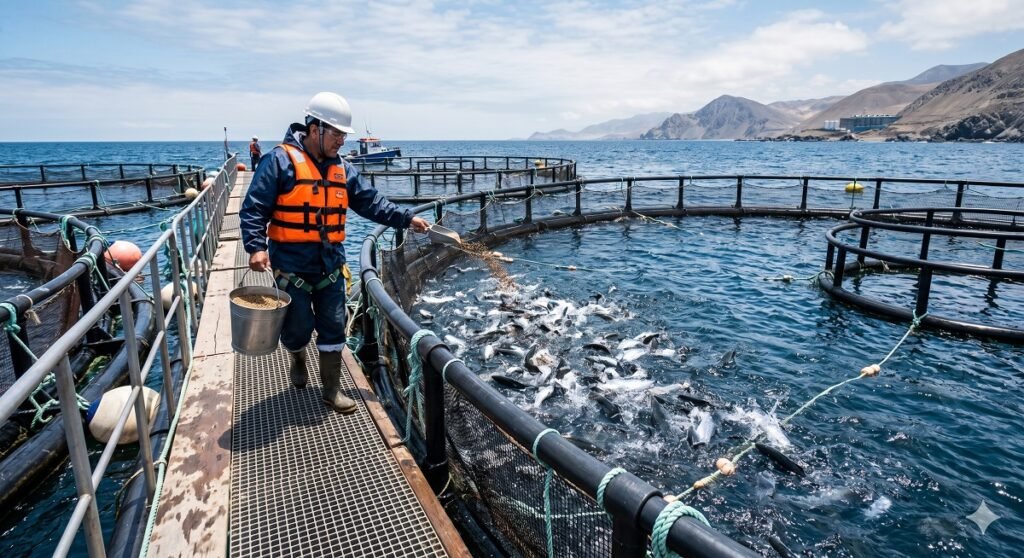
Cage culture units—whether marine or inland—require a structural design that guarantees their anchoring, buoyancy, and stability against the combined action of currents, tides, and winds. In this regard, perimeter walkways must comply with regulated minimum widths to facilitate safe operational maneuvers:
| Walkway Type | Recommended Minimum Width | Additional Safety Requirements |
| Outer Walkway | Equal to or greater than 600 mm | Mandatory in new structures; must feature a non-slip surface. |
| Inner Walkway | Equal to or greater than 900 mm | Incorporation of toe-boards on internal edges to prevent slipping. |
| Landing Platforms | Equal to or greater than 2000 mm | Mandatory installation on cages lacking fixed access walkways. |
To prevent falls into the water or entrapment between mobile structures, it is imperative to install rigid metal or wooden guardrails (the use of ropes being strictly prohibited) at intersections, corners, and critical transit zones. Likewise, lifebuoys with lines of adequate length must be available within a maximum radius of 50 meters from any work area over the water surface.
Electrical Safety in Wet Environments
The constant interaction among water, salinity, condensation, and corrosion exponentially elevates the risk of electrocution and fires in the aquaculture environment. Therefore, all distribution boards and connections must feature a certified IP protection rating against dust and moisture. It is mandatory to equip circuits with residual current devices (RCDs), lockable emergency stop disconnect switches, and effective grounding systems that neutralize static electricity discharges in feed hoses. Regarding corded portable tools, they must limit their operating voltage or, failing that, be replaced by wireless battery-powered alternatives.
Confined Spaces and Respiratory Hazards
Vessel holds, tunnels, cold rooms, sludge tanks, and feed silos constitute high-risk confined spaces. Entering these areas is strictly prohibited without a written work permit, prior gas measurements (such as ammonia or hydrogen sulfide), along with verification of oxygen levels, continuous forced ventilation, and the deployment of a standby buddy system (two external observers ready for the safe extraction of the worker using a harness and lifeline).
Critical Risks and Specialized Operations
Safety in Diving Operations
Diving has established itself as an indispensable activity in modern aquaculture; however, it exposes professionals to decompression sickness, asphyxiation, and severe musculoskeletal disorders. In light of these risks, the ILO guidelines recommend prioritizing the use of surface-supplied breathing systems over autonomous equipment (SCUBA), especially in confined environments, currents exceeding one knot, or during tasks requiring power tools.
Consequently, every diver must hold a current professional certification and medical examinations issued by specialists in underwater medicine. Furthermore, surface backup from assistants and rescue divers properly equipped with emergency oxygen systems is mandatory.
Mass Fish Mortality Management
Mass mortality events, caused by pathogens or large-scale environmental crises, demand rapid mobilization under a strict contingency plan. The primary occupational safety and health (OSH) hazard during this phase is exposure to hydrogen sulfide gas generated by organic decomposition. For this reason, concentrations of this gas must be continuously monitored using calibrated sensors.
Under this scenario, if allowable limits are exceeded, evacuation and waste disposal must be executed using closed-hold vessels with automated suction systems. This avoids direct manual handling, ensuring that operators are equipped with self-contained breathing apparatuses (SCBA) and on-site emergency shower stations.
Ergonomics, Chemical Management, and the Working Environment
Ergonomics and Manual Materials Handling
Post-harvest and primary processing tasks—such as filleting, fin-clipping, and manual sorting—subject workers to highly repetitive movements and awkward postures. In light of this scenario, it is imperative to restrict the manual lifting of loads exceeding 23 kilograms by incorporating mechanical aids or automated transfer devices. Furthermore, employers must implement job rotation programs and scheduled active breaks, a key strategy to mitigate cumulative fatigue and prevent chronic musculoskeletal disorders.
Chemical Risk Management
The handling of disinfectants, anesthetics, pesticides, and antimicrobials requires the immediate availability of Safety Data Sheets (SDS), properly translated into local languages. The protocol demands that these agents be stored in exclusive, ventilated, fireproof facilities bounded by containment dikes that prevent seepage into the soil or surface water sources. Finally, empty containers must undergo pressure triple-rinsing and be mechanically punctured to categorically neutralize their reuse for storing water or food.
Conclusion of the Study
The Code of Practice on Safety and Health in Aquaculture ratifies that the economic viability and sustainability of this industry are intrinsically linked to the well-being of its workforce. The prevention of occupational accidents and diseases, far from being a mere operational cost, establishes itself as a strategic investment that optimizes global productivity and dignifies employment in coastal and rural communities. This international standardization effort and rigorous technical development have been comprehensively coordinated by the Labour Governance and Sectoral Policies Department of the International Labour Office.
Reference (open access)
International Labour Organization. (2026). Code of practice on occupational safety and health in aquaculture (Technical document MEOSHA/2026/6). Labour Governance and Sectoral Policies Department.

Editor at the digital magazine AquaHoy. He holds a degree in Aquaculture Biology from the National University of Santa (UNS) and a Master’s degree in Science and Innovation Management from the Polytechnic University of Valencia, with postgraduate diplomas in Business Innovation and Innovation Management. He possesses extensive experience in the aquaculture and fisheries sector, having led the Fisheries Innovation Unit of the National Program for Innovation in Fisheries and Aquaculture (PNIPA). He has served as a senior consultant in technology watch, an innovation project formulator and advisor, and a lecturer at UNS. He is a member of the Peruvian College of Biologists and was recognized by the World Aquaculture Society (WAS) in 2016 for his contribution to aquaculture.