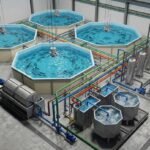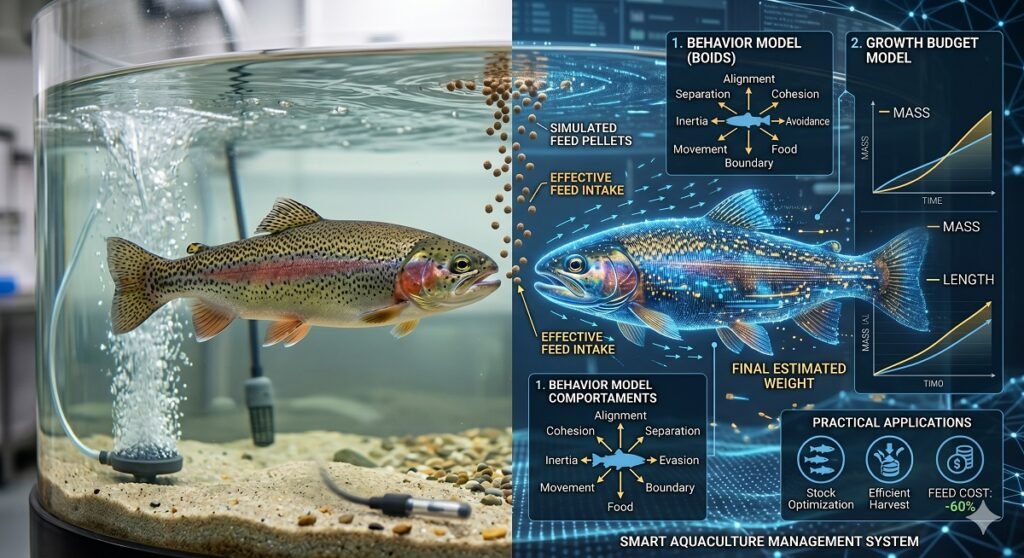
In a context where the saturation of marine spaces and concerns over eutrophication limit traditional aquaculture, land-based production in Recirculating Aquaculture Systems (RAS) emerges as the leading alternative. However, this model faces a severe financial challenge: commercial feed accounts for nearly 60% of total operating expenses.
To address this challenge and maximize profitability without resorting to costly, prolonged experiments on live fish, a team of Japanese scientists has developed an innovative digital tool. This individualized aquaculture simulator accurately predicts the growth trajectory and evaluates the feeding efficiency of rainbow trout (Oncorhynchus mykiss). This strategic breakthrough was published in the prestigious journal Scientific Reports. The study was led by a multidisciplinary team from Hokkaido University, comprising the Faculty of Fisheries Sciences, the Graduate School of Fisheries Sciences, and the Field Science Center for Northern Biosphere (Nanae Fresh-Water Station).
Takeways
- Accurate Prediction: The new model successfully simulates short-term growth trajectories for individual trout.
- Digital Feeding Twin: It integrates the Boids behavioral model with Dynamic Energy Budget (DEB) equations.
- Feed Sensitivity: Testing demonstrates that feed efficiency and conversion rates change markedly based on the fish’s growth stage.
- Identified Areas for Improvement: In the long term, the simulator tends to overestimate growth by omitting critical variables such as stocking density effects and dissolved oxygen levels.
How does the smart aquaculture simulator work?
The developed system divides the process into two main interconnected components that operate cyclically on a day-to-day basis:
The Fish Behavioral Model
To accurately recreate how trout swim and interact, researchers adapted the classic Boids model to the dynamics of an aquaculture tank. The individual movement of each fish is governed by seven fundamental force rules:
- Separation: Avoid collisions with the closest tankmates.
- Cohesion: Maintain proximity to the school or shoal.
- Alignment: Swim in the same direction as the school’s average.
- Boundary avoidance: Safely dodge the tank walls.
- Inertia: Maintain the fish’s own swimming tendency.
- Random movement: Spontaneous and natural variations in the trajectory.
- Food approach: Modify speed and direction when pellets are distributed in the water.
Feeding Mechanics: A fish activates its “feeding mode” when food is available and its stomach has not reached the maximum daily limit (set at 4% of its body mass). At that moment, its maximum speed multiplies to compete for food. When the virtual fish model comes into contact with a pellet, the system registers it as an effective intake.
The Energetic Growth Model
All data regarding individually captured food is transferred to the growth model. This block employs Dynamic Energy Budget (DEB) equations, a mathematical framework that simulates essential physiological processes such as metabolism, assimilation, and excretion. By solving these equations, the simulator computes with mathematical precision the exact daily increase in each trout’s body mass and fork length.
Experimental Validation: From the Computer to the Actual Tank
To verify the simulator’s fidelity, the researchers conducted a real breeding experiment over 203 days at the university’s biological station. The study began by monitoring 331 juvenile trout in a 500-liter circular tank under a controlled temperature of 10°C. The specimens were fed in excess, and their actual daily consumption was meticulously recorded.
Growth Results and Detected Discrepancies
Data generated by this “digital twin” showed an excellent match with the live experiment during the early stages of culture. For instance, in the first 79 days, the actual Feed Conversion Ratio (FCR) was 1.19, while the software calculated an almost identical FCR of 1.18. However, from day 80 onward, the virtual results began to diverge from reality:
| Metric (At 203 days) | Real Experiment | Digital Simulator | Deviation / Error |
| Mean final weight | Base data | Overestimated | +19.0 grams (22.7%) |
| Cumulative FCR | 1.34 | 1.06 | Underestimated |
What Accounts for the Long-Term Differences?
The scientists identified three key factors that explain this divergence and outline the roadmap for future software optimization:
- Omission of the Density Effect: Throughout the experiment, biomass density in the tank rose from 0.19% to 3.5%. In real-world conditions, higher density slows growth due to the subtle degradation of the physical environment—a factor the system did not account for.
- Dissolved Oxygen Dynamics: The current model considers temperature but ignores dissolved oxygen (DO) levels, a critical variable that restricts salmonid appetite and metabolism in advanced phases.
- Unrealistic Feed Monopolization: In the program, larger fish swim faster. This caused dominant specimens in the virtual environment to excessively hoard pellets, generating much greater internal size variability than was observed in the actual tank.
Practical Applications for Smart Aquaculture Management
Despite requiring metric adjustments to refine its long-term predictions, this study demonstrates the tremendous potential of individual behavior-based models. Indeed, its greatest virtue lies in the unprecedented ability to project the growth trajectory of each fish independently. In commercial farm management, this technology offers key strategic advantages:
Mantente siempre informado
Stay Informed
Únete a nuestras comunidades para recibir al instante las noticias, informes y análisis más importantes del sector acuícola.
Join our communities to get instant access to the most important news, reports, and analysis from the aquaculture industry.
- Batch Optimization: Identifying size dispersion in real time allows for the timely removal of unusually large or small specimens. This prevents compounding negative impacts on biomass uniformity—a critical factor that directly affects market pricing and complicates industrial processing.
- Efficient Harvesting and Feeding: The simulation helps determine the exact, most profitable timing for harvesting. Furthermore, it enables the design of dynamic, tailored feeding strategies based on the batch’s biological phase, achieving a substantial reduction in production costs.
Conclusions and Industrial Impact
The development of this simulator by Hokkaido University establishes a robust methodological foundation for the technological transformation of land-based salmonid production. By enabling virtual experimentation with diverse feeding rations and frequencies without risking live biomass, this tool emerges as a strategic asset for commercial planning and the reduction of the ecological footprint in fish farming activities.
The future integration of critical variables into the model—such as dissolved oxygen levels, pellet dissolution rates, and probabilistic feed-capture models—will refine the system into high-precision, real-time decision-making software capable of being scaled to other high-value commercial species.
Study Funding: This research was partially supported by public funds through the JSPS Program for Forming Japan’s Peak Research Universities, J-PEAKS (Grant Number: JPJS00420230001), and the JST Adaptable and Seamless Technology Transfer Program through Target-Driven R&D (Grant Number: JPMJTM20AC).
Reference (open access)
Takahashi, Y., Yoshida, T., Yamazaki, Y., Takahashi, E., Yamaha, E., & Komeyama, K. (2026). An aquaculture simulator for rainbow trout (Oncorhynchus mykiss) based on a fish schooling behavioral model and a dynamic energy budget. Scientific Reports, 16(1), 7706. https://doi.org/10.1038/s41598-026-39028-y

Editor at the digital magazine AquaHoy. He holds a degree in Aquaculture Biology from the National University of Santa (UNS) and a Master’s degree in Science and Innovation Management from the Polytechnic University of Valencia, with postgraduate diplomas in Business Innovation and Innovation Management. He possesses extensive experience in the aquaculture and fisheries sector, having led the Fisheries Innovation Unit of the National Program for Innovation in Fisheries and Aquaculture (PNIPA). He has served as a senior consultant in technology watch, an innovation project formulator and advisor, and a lecturer at UNS. He is a member of the Peruvian College of Biologists and was recognized by the World Aquaculture Society (WAS) in 2016 for his contribution to aquaculture.