- 1 Key Takeaways
- 2 The Impact of Stress on Intensive Aquaculture
- 3 The Role of Butyrate in Aquaculture Nutrition: Physiological Mechanisms and the Need for Supplementation
- 4 Meta-Analysis Methodology: 1,174 Comparisons Under the Microscope
- 5 Immunological Impact of Butyrate: Decisive Reinforcement of the First Line of Defense
- 6 Inflammation Modulation: Butyrate as a Homeostatic Regulator in Aquaculture
- 7 Reinforcement of the Antioxidant System: Enzymatic Mechanisms and Interspecies Divergence
- 8 The Critical Question in Formulation: What Is the Optimal Butyrate Inclusion Rate?
- 9 Scope and Limitations of the Meta-Analysis: Methodological Rigor Versus Production Reality
- 10 Conclusions Applied to the Farming Environment
- 11 Entradas relacionadas:
Key Takeaways
- A meta-analysis consolidated 65 studies across 23 aquaculture species (fish and crustaceans) to assess the actual impact of dietary butyrate on the immune system.
- A significant increase was confirmed in lysozyme activity, the complement system, and cellular phagocytic capacity against pathogens.
- The additive increased key enzymes such as glutathione peroxidase, superoxide dismutase, and catalase, while concurrently reducing malondialdehyde (MDA), a critical indicator of oxidative stress.
- Proinflammatory mediators (IL-1β, IL-6, TNF-α) showed inconsistent responses, whereas adaptive immunity reflected moderate variations.
- The inclusion concentration accounted for only a marginal percentage of the observed variability; the effective regimen is conditioned by species, developmental stage, and the compound’s formulation.
It is six in the morning, and the technical manager of an aquaculture farm inspects the rearing units, notebook in hand. The previous water exchange proved more drastic than scheduled; biomass density is high, and dissolved oxygen readings hover near the critical threshold. Although the organisms are consuming feed, the intake pattern is irregular, and atypical mortalities are observed across several ponds. This does not yet constitute a production collapse, but rather serves as that recurring warning that the operational equilibrium is on the verge of breaking.
Under such circumstances, the concern extends beyond academia; it evolves into an operational and financial dilemma: is it viable to incorporate a functional additive to enhance stress tolerance and mitigate infectious outbreaks? And if this alternative is feasible, what is the optimal inclusion rate relative to the return on investment?
To address these questions, researchers from Ningbo University (China), in collaboration with specialists from the University of Ebolowa and the University of Douala (Cameroon), adopted an integrative approach. Rather than conducting an isolated trial, they synthesized data from 65 peer-reviewed papers focused on butyrate supplementation in fish and crustaceans. The meta-analysis, published in the journal Aquaculture Nutrition, represents the first quantitative review to simultaneously evaluate immunological performance and antioxidant balance in aquatic organisms. Its verdict provides promising conclusions, accompanied by a caveat essential for feed formulators and producers: butyrate exerts a genuine protective effect—perhaps more moderate than isolated reports suggest—yet it lacks a universal dosing protocol.
The Impact of Stress on Intensive Aquaculture
In intensive aquaculture, the link between management and health is direct: heightened stocking densities, continuous handling, physicochemical water fluctuations, and persistent pathogen exposure trigger severe physiological stress. These factors induce an overproduction of reactive oxygen species (free radicals)—unstable molecules that degrade cellular structures from within. Analogous to corrosion weakening a pipeline, a moderate load remains physiologically manageable; however, once the organism’s antioxidant capacity collapses, the damage progresses toward chronic inflammation, immunosuppression, and marked reductions in growth rates.
The economic repercussions are critical. According to the authors, global losses stemming from disease outbreaks in the aquaculture sector range between USD 6 billion and USD 10 billion annually. Concurrently, conventional antibiotic use faces mounting restrictions driven by antimicrobial resistance, environmental impacts, and stringent food safety regulations. Against this backdrop, functional additives—compounds formulated specifically to modulate health rather than merely meet basal nutritional requirements—have emerged as cornerstones of precision nutrition, with butyrate positioning itself as one of the most promising alternatives.
The Role of Butyrate in Aquaculture Nutrition: Physiological Mechanisms and the Need for Supplementation
Butyrate is a short-chain fatty acid (SCFA)—a low-molecular-weight molecule generated primarily by the gut microbiota through dietary fiber fermentation. This compound plays a pivotal, dual physiological role: it serves as the primary energy substrate for enterocytes (the epithelial cells lining the intestine) while concurrently operating as a cellular signaling molecule capable of regulating the expression of genes associated with immunity and metabolic homeostasis.
Unlike herbivorous mammals, whose enteric microbiota synthesizes substantial volumes of butyrate, the digestive tract of fish and shrimp exhibits limited fermentative capacity, leading to insufficient endogenous production. For this reason, exogenous supplementation in aquafeeds gains operational relevance, being predominantly formulated as sodium butyrate, the most prevalent salt reported in the analyzed scientific literature.
Over the past decade, numerous studies have documented improvements in intestinal barrier integrity, immunological performance, antioxidant enzyme activity, and resistance against bacterial challenges. Nonetheless, the experimental landscape has remained fragmented: certain trials reported positive responses at minimal concentrations, others required elevated doses to elicit measurable effects, and some recorded no significant variations. The evaluated levels ranged from 0.05 to 5 g/kg of feed—a hundredfold variation—which complicates the extrapolation of findings to commercial farming conditions given the disparities across species, trial scales, and analytical methodologies.
Meta-Analysis Methodology: 1,174 Comparisons Under the Microscope
The research team screened three leading scientific databases, selecting 65 trials that evaluated the performance of butyrate-supplemented animals against an unsupplemented control group after de-duplication and screening against methodological inclusion criteria; from this consolidated corpus, 1,174 direct comparisons between evaluated treatments and respective controls were extracted. To standardize and synthesize such heterogeneous datasets, the authors employed Hedges’ g as the effect size metric—a statistical estimator that quantifies the magnitude of divergence between the supplemented and control cohorts, normalized against the individuals’ intrinsic biological variability, where scores near zero denote negligible variation and values exceeding 0.8 reflect marked physiological and statistical significance.
Mantente siempre informado
Stay Informed
Únete a nuestras comunidades para recibir al instante las noticias, informes y análisis más importantes del sector acuícola.
Join our communities to get instant access to the most important news, reports, and analysis from the aquaculture industry.
The geographical and biological distribution of the sample reveals pronounced trends: 72% of the studies originated in Asia—with 62% conducted exclusively in China—while largemouth bass (Micropterus salmoides) and Pacific white shrimp (Litopenaeus vannamei) predominated with 11 studies each, followed by Nile tilapia with 7 publications, alongside the finding that virtually all assessments were performed during juvenile stages, with only a single trial documenting adult specimens.
Immunological Impact of Butyrate: Decisive Reinforcement of the First Line of Defense
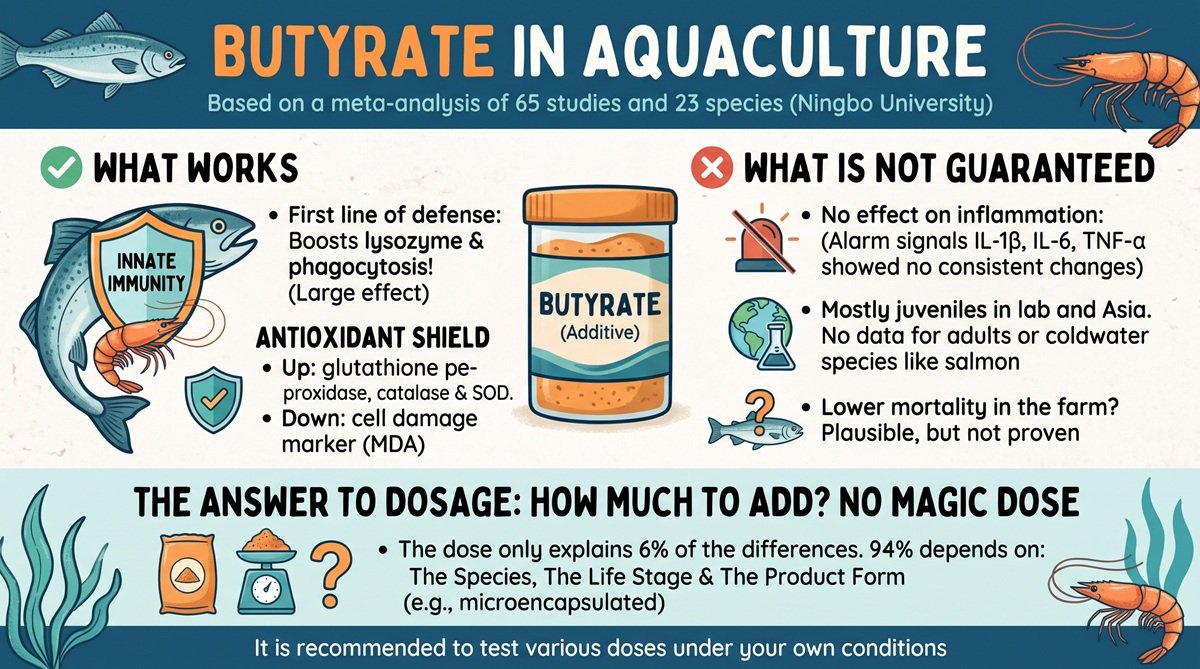
The most conclusive finding of the meta-analysis was observed in innate immunity—the immediate response mechanism that neutralizes pathogens without requiring prior antigenic sensitization—analogous to security personnel at a processing plant’s entrance, blocking intrusion outright without questioning the intruder’s nature. Within this branch, butyrate supplementation demonstrated a remarkable effect size (g = 2.14), backed by substantial elevations in lysozyme activity, complement system cascades, respiratory burst capacity, and overall phagocytic potential, maintaining a consistently favorable biological trajectory despite inter-study heterogeneity.
Conversely, the adaptive immune response was more moderate (g = 0.98) and variable, characterized primarily by uniform increases in immunoglobulin M (IgM) across teleosts, whereas other biomarkers displayed divergent outcomes—such as antimicrobial peptides increasing in Chinese mitten crab (Eriocheir sinensis) yet declining in crayfish.
Inflammation Modulation: Butyrate as a Homeostatic Regulator in Aquaculture
One of the most revealing findings of the meta-analysis concerns cytokines, the intercellular chemical mediators coordinating the immune response into early-warning proinflammatory signals and physiological regulators that quell reactive cascades and drive tissue repair. Classical proinflammatory mediators—such as interleukin-1 beta (IL-1β), interleukin-6 (IL-6), and tumor necrosis factor-alpha (TNF-α)—along with upstream signaling cascades like NF-κB, MyD88, and Toll-like receptors (TLRs), exhibited no statistically significant changes across the compiled body of research, whereas interleukin-10 (IL-10), a critical biomarker for resolving inflammation, demonstrated a steady, consistent increase (g = 0.64).
The authors interpret this pattern as a precise modulatory mechanism rather than indiscriminate immunostimulation: butyrate orchestrates the transition from an acute defensive state toward homeostatic resolution, averting chronic inflammation under intensive aquaculture conditions to preserve metabolic energy for sustained growth.
Reinforcement of the Antioxidant System: Enzymatic Mechanisms and Interspecies Divergence
The other compelling piece of evidence from the meta-analysis was recorded in cellular antioxidant capacity, the enzymatic system responsible for neutralizing reactive oxygen species. Overall, antioxidant enzymatic activity experienced a substantial increase (g = 1.59). Glutathione peroxidase exhibited the highest response magnitude, closely followed by superoxide dismutase and catalase; these enzymes function sequentially in a coordinated detoxification cascade, wherein the primary radicals are converted first, and subsequent enzymes complete the degradation of residual cytotoxic intermediates.
In parallel, total antioxidant capacity increased uniformly across diverse taxonomic groups. Concurrently, malondialdehyde (MDA)—a critical biomarker quantifying lipid peroxidation within cellular membranes—showed a statistically significant decrease.
Nevertheless, the data provide a practical caveat: the physiological response is far from homogeneous across taxa. While enzymatic elevations were consistent in Nile tilapia, grass carp, crucian carp, jade perch, and gilthead seabream, none of the three evaluated enzymes exhibited significant variations in largemouth bass. Likewise, in Pacific white shrimp and crayfish, both catalase and superoxide dismutase remained unaltered. For shrimp producers, this discrepancy serves as a cautionary note: metabolic benefits validated in freshwater teleosts cannot be automatically extrapolated to crustacean rearing conditions.
The Critical Question in Formulation: What Is the Optimal Butyrate Inclusion Rate?
At this juncture, the meta-analysis offers its most revealing finding and greatest practical value for the aquaculture sector, determining that additive concentration accounted for at most approximately 6% of the observed variability across trials, meaning that over 90% of discrepancies stem from dose-independent biological and experimental factors.
Preliminary trends suggested that higher inclusion levels moderately amplified innate immune responses while attenuating the reduction of oxidative stress biomarkers; consequently, no single concentration proved universally superior, and none of these correlations retained statistical significance following adjustments for multiple comparisons.
The authors’ conclusion is categorical: the current body of evidence precludes establishing a universal inclusion standard, as optimal requirements depend on the target species, developmental stage, and physical-chemical formulation (such as microencapsulated forms designed to withstand gastric transit and reach the distal intestine), thus requiring direct dose-response trials under system-specific rearing conditions.
Scope and Limitations of the Meta-Analysis: Methodological Rigor Versus Production Reality
Part of the value of this research lies in the explicit acknowledgment of its own methodological limitations. The authors implemented diagnostic tests to evaluate publication bias—a frequent phenomenon stemming from the propensity to publish trials with favorable outcomes more readily. The analyses confirmed the presence of this bias in innate immunity parameters and antioxidant enzymatic activity; following statistical adjustments, the effect size for innate immunity decreased from 2.14 to 1.33, while for antioxidant enzymes it dropped from 1.59 to 0.84. Although these values retain statistical significance and biological relevance, they reflect a more moderate impact, whereas previously observed effects on non-enzymatic antioxidants and oxidative damage biomarkers lost significance post-correction.
Compounding this landscape are other critical considerations: most trials evaluated merely three replicates per treatment, a factor that can overestimate observed differences. Furthermore, virtually all data originate from juvenile organisms held under controlled laboratory conditions over short durations, without spanning full commercial production cycles. Several studies evaluated additive blends with other functional compounds, precluding the isolation of the effect solely attributable to butyrate; additionally, strategic cold-water species such as Atlantic salmon are virtually absent from the sample. Finally, it was not possible to substantiate whether improvements in these biomarkers ensure a proportional reduction in on-farm mortality: a benefit the authors characterize as biologically plausible, yet not formally demonstrated.
Conclusions Applied to the Farming Environment
Let us revisit the scenario of the technician inspecting the ponds at dawn, with dissolved oxygen at critical thresholds and a well-founded suspicion of imminent sanitary deterioration: what practical guidelines does this meta-analysis offer?
The work demonstrates that butyrate is no placebo: there is quantitative scientific backing, synthesized from dozens of trials, proving that it strengthens primary defense mechanisms in fish and crustaceans while protecting cells against the sequelae of metabolic stress; however, it confirms that it is far from being an infallible or standardized solution. Prior to establishing an inclusion rate, it is essential to demand technical validation from suppliers for the target species and its specific life stage, verify the encapsulation technology or delivery form of the compound, and, whenever feasible, conduct on-site dose-response trials before farm-wide implementation.
In an industry where compound feed represents the highest operating cost, the difference between “a laboratory-proven additive” and “a profitable additive in my pond” ultimately defines the line between an unnecessary expense and a strategic investment.
Reference (open access)
Gouife, Moussa, Noufeu, Tchouli, Chen, Yubin, Jia, Xiwen, Xu, Jiajie, Dietary Butyrate as a Functional Feed Additive in Aquaculture: A Systematic Review and Meta-Analysis of Immunological and Antioxidant Responses With Dose–Response Insights, Aquaculture Nutrition, 2026, 1873426, 20 pages, 2026. https://doi.org/10.1155/anu/1873426

Editor at the digital magazine AquaHoy. He holds a degree in Aquaculture Biology from the National University of Santa (UNS) and a Master’s degree in Science and Innovation Management from the Polytechnic University of Valencia, with postgraduate diplomas in Business Innovation and Innovation Management. He possesses extensive experience in the aquaculture and fisheries sector, having led the Fisheries Innovation Unit of the National Program for Innovation in Fisheries and Aquaculture (PNIPA). He has served as a senior consultant in technology watch, an innovation project formulator and advisor, and a lecturer at UNS. He is a member of the Peruvian College of Biologists and was recognized by the World Aquaculture Society (WAS) in 2016 for his contribution to aquaculture.