- 1 Key Takeaways on Global Demand
- 2 Market Certainties and the Gaps of Traditional Analysis
- 3 Income Level: The Key Driver of Global Demand
- 4 Growth Mapping: Where Future Demand Is Headed
- 5 International Trade: The Link Between Producers and Global Markets
- 6 Back to the Farmer by the Ponds
- 7 Entradas relacionadas:
Key Takeaways on Global Demand
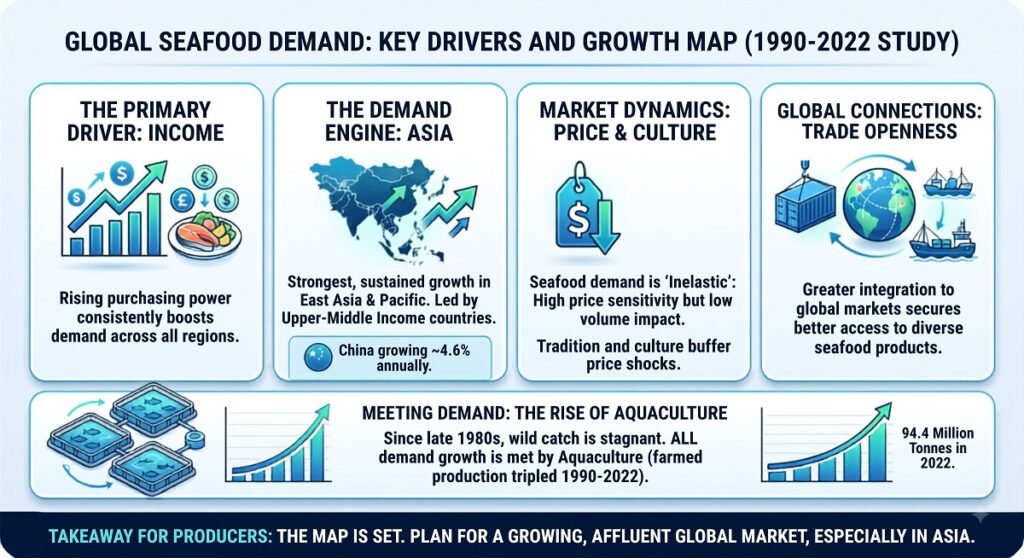
- Income drives consumption: Purchasing power is the sole factor consistently driving seafood demand across all regions and socioeconomic levels; as a nation’s income rises, so does its fish consumption.
- Asia as a global engine: The most robust and sustained growth is concentrated in East Asia and the broader Asian continent, propelled by upper-middle-income countries.
- China grows at 4.6% annually: As the world’s largest seafood consumer, China maintained this average annual expansion rate throughout the analyzed period.
- Low price sensitivity: Demand is highly inelastic, meaning price fluctuations barely alter consumption because culture and dietary habits carry greater weight than cost.
- International trade opens markets: Commercial openness yields a positive impact, as nations integrated into global markets gain greater and superior access to seafood products.
Every aquaculture producer finishing a harvest inevitably faces the same question: if I double production tomorrow, who will buy it and at what price? This is no minor concern, as expanding ponds, investing in floating cages, or establishing a processing plant presupposes a buyer waiting on the other side of the market—one that may well be an ocean away in a country that barely consumed seafood two decades ago.
For years, such expansion relied on intuition and local dynamics, but an evaluation of seafood consumption across 124 countries from 1990 to 2022 by Dejene Gizaw Kidane’s team at UiT The Arctic University of Norway, published in Aquaculture Economics & Management, now provides a solid analytical framework detailing key global demand drivers and high-growth regions.
Market Certainties and the Gaps of Traditional Analysis
That seafood consumption varies drastically across countries is no surprise to any exporter. In 2022, per capita intake ranged from less than one kilogram per year in certain nations to over 80 kilograms in others—an abysmal gap. The prevailing explanation seemed self-evident: higher income levels lead to higher consumption, cultural traditions exert a strong influence, and coastal populations naturally demand more fishery products than landlocked ones.
However, these premises stemmed from isolated studies focused on specific countries or regions, using heterogeneous methodologies and datasets that were difficult to compare; while targeted evaluations were available, a comprehensive overview of the global market was lacking. No previous study had pitted key variables—income, price, trade openness, demographics, aging, and urbanization—against each other within a unified model to determine which ones retain their relevance when analyzed together.
Herein lies the value of this research: rather than adding another local analysis, the team structured a single economic framework spanning 124 countries—52 more than the previous benchmark study—over a 33-year time series. By assessing all variables under identical conditions, a clear and conclusive analytical hierarchy emerged.
Income Level: The Key Driver of Global Demand
The study’s central finding is strikingly clear: population income is the sole variable that remains consistent across all metrics. Regardless of a country’s region, continent, or socioeconomic level, as consumer purchasing power rises, seafood demand increases in tandem, confirming that seafood acts economically as a ‘normal good’ whose consumption grows alongside disposable income. This dynamic stems from a well-established sector phenomenon known as the ‘nutritional transition,’ wherein households rising above poverty thresholds gradually substitute basic carbohydrates with higher-value, more varied protein sources—positioning the fisheries and aquaculture sectors among the primary beneficiaries of this dietary shift.
Examining other factors under the same methodology proves equally revealing. Local price fluctuations, substitute prices (such as poultry or beef), urbanization, age demographics, and country size show relevance in specific contexts, but none display global consistency; they shift trends, lose statistical significance, or dilute depending on the region. They represent real yet conditional variables—useful for analyzing a specific market, but unreliable for underpinning long-term investment decisions.
The price variable warrants particular attention as it dispels a recurring industry concern. Although it exerts a negative effect—higher prices yield lower consumption—the market’s response is muted. Seafood demand is marked by high inelasticity, meaning consumption undergoes minimal shifts in response to price hikes, while dietary habits and cultural preferences cushion price volatility to offer producers stability. To establish this relationship, the research team resolved the simultaneity between price and quantity using the FAO global price index as an external instrumental variable—a methodological adjustment validated through statistical robustness tests to isolate price’s true impact on demand.
Growth Mapping: Where Future Demand Is Headed
Understanding which variables drive demand is essential, but identifying which markets will grow is decisive for financial decision-making. In this regard, the research provides the most actionable metrics for the sector.
Mantente siempre informado
Stay Informed
Únete a nuestras comunidades para recibir al instante las noticias, informes y análisis más importantes del sector acuícola.
Join our communities to get instant access to the most important news, reports, and analysis from the aquaculture industry.
The average annual demand growth rate shows significant variation depending on the country, ranging from contractions near −3% in shrinking markets to increases exceeding 8% in emerging economies. However, the regional pattern is overwhelming: demand trends upward across all global regions, with pronounced momentum in East Asia and the Pacific. At a continental scale, Asia leads in growth volume, while by socioeconomic level, the main drive comes from upper-middle-income countries, followed by high-income ones.
This converging segment combines a sustained rise in per capita income, demographic expansion, and a remarkable boom in aquaculture. Since capture fisheries have remained stagnant since the late 1980s, additional supply comes from farming. Between 1990 and 2022, global aquatic animal production from aquaculture expanded 3.5-fold to reach 94.4 million tonnes—a rate of expansion comparable to poultry farming. This local aquaculture supply, largely oriented toward domestic consumption, explains Asia’s leadership: there is greater purchasing power alongside a growing availability of accessible protein.
International Trade: The Link Between Producers and Global Markets
Commercial openness emerges as a third critical driver in the analysis. Fishery and aquaculture products rank among the world’s most traded foods—accounting for roughly 60 million tonnes exported in 2020 (about 11% of total global agricultural trade value)—with 78% of worldwide seafood consumption tied to international market dynamics. Consequently, the price a farmer receives at harvest largely hinges on events unfolding in distant markets.
While trade-integrated nations secure a more stable seafood supply across all price tiers, the study reinforces a familiar warning: export openness can drain top-tier products from local markets when international pricing proves lucrative—a pattern typical of developing economies that export premium species while importing lower-value alternatives for domestic use.
Back to the Farmer by the Ponds
Returning to the producer weighing operational expansion at harvest end, this research offers a strategic roadmap rather than a definitive verdict. It confirms a sustained upward trajectory in global seafood demand driven by consumers with growing purchasing power, primarily in Asia and emerging economies. Furthermore, it reassures that price volatility should not trigger alarm—given the resilience of dietary habits—while underscoring that long-term business viability relies on a dynamic market transcending local borders. Ultimately, while no analytical roadmap replaces investment decisions, projecting expansion with one will always surpass blind intuition.
Contact
Dejene Gizaw Kidane
School of Business and Economics, UiT The Arctic University of Norway
Tromsø, Norway
Email: dejene.g.kidane@uit.no
Reference (open access)
Kidane, D. G., Myrland, Ø., & Zhang, D. (2026). Global seafood demand in transition. Aquaculture Economics & Management, 1–28. https://doi.org/10.1080/13657305.2026.2709351

Editor at the digital magazine AquaHoy. He holds a degree in Aquaculture Biology from the National University of Santa (UNS) and a Master’s degree in Science and Innovation Management from the Polytechnic University of Valencia, with postgraduate diplomas in Business Innovation and Innovation Management. He possesses extensive experience in the aquaculture and fisheries sector, having led the Fisheries Innovation Unit of the National Program for Innovation in Fisheries and Aquaculture (PNIPA). He has served as a senior consultant in technology watch, an innovation project formulator and advisor, and a lecturer at UNS. He is a member of the Peruvian College of Biologists and was recognized by the World Aquaculture Society (WAS) in 2016 for his contribution to aquaculture.