- 1 Key Points
- 2 What is FAO proposing, and why is it pivotal for the aquaculture sector?
- 3 The 30×30 Target and OECMs: Key Concepts in Understanding This Conservation Framework
- 4 The Role of Modern Aquaculture: Looking Beyond Environmental Footprints
- 5 Aquaculture Systems with Potential for Recognition as Conservation Areas
- 6 Barriers to Formal Recognition: Why Aquaculture Rarely Qualifies as Conservation
- 7 Five Indispensable Criteria for Aquaculture Facilities to Qualify as OECMs
- 8 Economic Viability: The Overlooked Pillar of Aquaculture Conservation
- 9 The Ca Mau Case: Commercial Viability as the Catalyst for Conservation
- 10 Entradas relacionadas:
Key Points
- Certain aquaculture facilities could be officially designated as conservation areas under the international “30×30” target, which aims to protect 30% of land, waters, and oceans by 2030.
- These are recognized as “Other Effective Area-Based Conservation Measures” (OECMs): zones that, without being traditional protected areas, actively preserve long-term biodiversity.
- A recent FAO report examines seven schemes supported by positive evidence: bottom-culture oyster and clam farming, suspended mussel and oyster culture, temperate and tropical seaweed cultivation, mangrove-integrated shrimp farming, and rice-fish agro-aquaculture systems.
- Merely mitigating environmental impacts is not enough; the activity must deliver net, measurable, and sustained benefits underpinned by transparent governance, continuous monitoring, and social equity.
- Economic viability is a vital cornerstone: without commercial profitability, sustainable practices deteriorate, thereby compromising both conservation status and long-term continuity.
In Ca Mau Province, at the southernmost tip of Vietnam, aquaculture farmers coexist directly with the mangrove ecosystem. For decades, the regional standard dictated clearing land to maximize water surface area. Today, the approach has shifted: local experience has demonstrated that maintaining approximately 30% mangrove cover establishes the optimal balance between ecological performance and operational profitability.
Thousands of kilometers away in the Firth of Thames, New Zealand, snapper dwelling beneath green-lipped mussel long-lines feed better than those inhabiting conventional sandy bottoms, exhibiting twice the lipid concentration in their diet (16% versus 8%).
Although these producers did not design their operations for conservation purposes, FAO’s new guidance opens the door for them to be formally recognized for their ecological value.
What is FAO proposing, and why is it pivotal for the aquaculture sector?
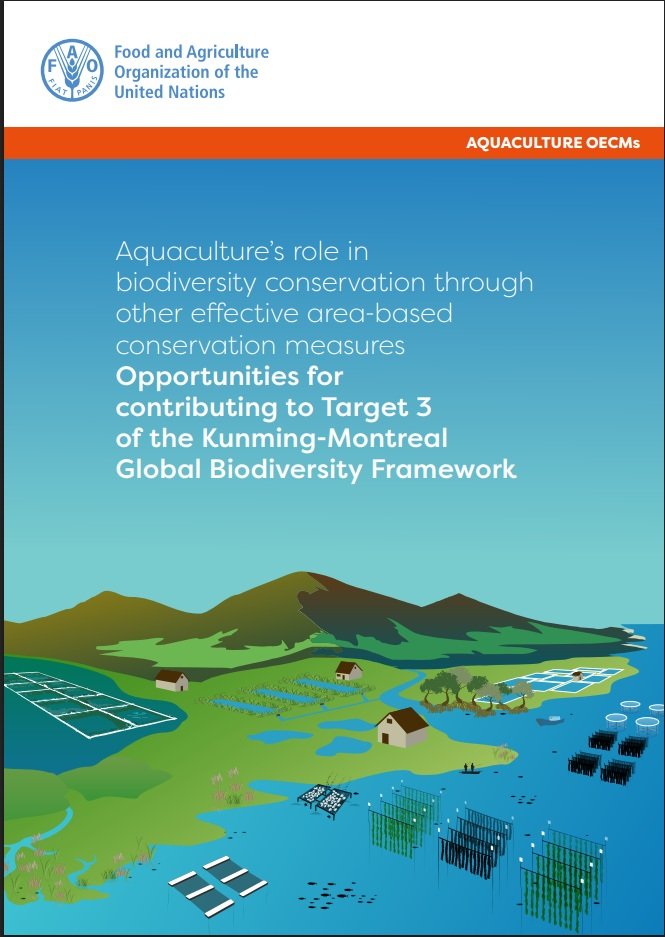
The report Aquaculture’s role in biodiversity conservation through other effective area-based conservation measures, led by Heidi Alleway (The Nature Conservancy, Australia), Angela Lentisco (FAO Regional Office for Asia and the Pacific, Bangkok), and Amber Himes-Cornell (FAO), assesses the feasibility of integrating certain aquaculture facilities into the global target of protecting 30% of the planet by 2030. The verdict is a ‘conditional yes’: it is achievable provided that operations demonstrate net, sustainable, and quantifiable biodiversity benefits under robust, equitable governance. For the industry, this represents an unprecedented strategic opportunity to transition from the stigma of environmental risk to formal recognition as conservation agents, thereby reinforcing reputation, social license to operate, and access to incentives.
The 30×30 Target and OECMs: Key Concepts in Understanding This Conservation Framework
In 2022, Parties to the Convention on Biological Diversity adopted the Kunming-Montreal Global Biodiversity Framework. Target 3, widely known as ’30×30′, establishes the conservation of at least 30% of terrestrial, inland water, and coastal and marine areas by 2030.
The conventional pathway to meet this target relies on protected areas such as national parks and marine reserves. However, the agreement incorporates a complementary mechanism: Other Effective Area-Based Conservation Measures (OECMs). These are geographically defined spaces with a primary productive function—such as food production—whose sound management demonstrably and durably sustains biodiversity.
To qualify for this designation, a site must fulfill four criteria:
- Legal distinction: It must not already be designated as a protected area.
- Defined governance: It must possess precise geographic boundaries and a legitimate management authority.
- Proven ecological impact: It must demonstrate an effective, sustained contribution to in situ biodiversity conservation, corroborated by technical monitoring.
- Holistic approach: It must safeguard ecosystem services while acknowledging the sociocultural and economic values of the local community.
Adoption capacity remains vast. As of September 2026, the World Database on Protected and Conserved Areas (WDPCA) recorded 312,943 protected areas compared to only 7,663 OECMs. Protected schemes currently encompass 18.45% of terrestrial and inland water environments and merely 10.03% of marine areas, revealing a substantial gap relative to the 30% threshold.
The Role of Modern Aquaculture: Looking Beyond Environmental Footprints
The aquaculture industry is acutely aware of the historical criticisms directed at its operations: mangrove clearance for pond construction, nutrient discharges inducing eutrophication—excess organic matter triggering algal blooms and deoxygenation—escapes of invasive alien species, pathogen transmission, and extractive pressures on pelagic forage fisheries for fishmeal and fish oil production.
Mantente siempre informado
Stay Informed
Únete a nuestras comunidades para recibir al instante las noticias, informes y análisis más importantes del sector acuícola.
Join our communities to get instant access to the most important news, reports, and analysis from the aquaculture industry.
Conversely, the sector has established itself as the world’s primary provider of aquatic foods. Having attained a record volume of 141.6 million tonnes—accounting for 60% of global aquatic animal and algae output—and sustained an annual growth rate of 5.1% since 2000, FAO projects aquatic animal production to reach 214 million tonnes by 2034. Given this scale, operational guidelines across the sector exert a decisive ecological influence.
In parallel, scientific evidence underscores the sector’s regenerative potential. A systematic review of 65 studies revealed that bivalve culture sites exhibit increased biological abundance and species richness compared to unmanipulated control areas. Furthermore, a complementary meta-analysis found fish densities up to 72 times higher and double the fish diversity around bivalve farms and sea cages compared to unstructured habitats.
Aquaculture Systems with Potential for Recognition as Conservation Areas
Bottom-Culture Oysters and Clams
Oyster aggregations function as biogenic reefs, providing shelter, foraging substrate, and nursery grounds for fishes and invertebrates. In the Pearl River Delta (southern China), disused oyster structures exhibited taxonomic diversity comparable to adjacent mudflats while yielding a tenfold increase in associated faunal biomass. In Australia, various fish species utilize oyster trestles and baskets for foraging and refuge akin to natural reefs. Similarly, indigenous clam gardens along Canada’s Pacific coast enhance microhabitat complexity and species richness.
Suspended Mussel Long-Lines
In Lyme Bay (United Kingdom), the continuous shedding of mussels and shells beneath suspended systems builds biogenic benthic mounds that provide structural habitat for crustaceans, forming de facto reefs. This is complemented by a strategic operational advantage: the farm infrastructure physically deters bottom-trawling, one of the most disruptive activities impacting marine ecosystems.
Floating Oyster Cages and Pearl Farming
In the Northwest Atlantic, suspended culture modules attract higher fish densities and greater taxonomic diversity, providing vertical refuge for juvenile stages. In the Federated States of Micronesia, pearl farms positioned within or adjacent to marine protected areas sustain alternative local livelihoods during seasonal fishery closures.
Tropical and Temperate Seaweed Cultivation
A synthesis of seven tropical field studies documented a moderate positive effect on biological diversity. In Belize, experimental seaweed plots fostered increased invertebrate and fish abundance, including reef herbivores and commercially targeted species. In Japan, the customary satoumi paradigm harmonizes nori cultivation, shellfish harvesting, artisanal fisheries, and ecotourism under community stewardship.
Mangrove-Integrated Shrimp Farming
In Berau (Indonesia), ecological mangrove rehabilitation within integrated shrimp-mangrove systems enhanced the density of critical taxonomic assemblages. Likewise, in Subang (West Java), surveys cataloged 23 avian species, including two under threatened conservation categories.
Integrated Rice-Fish Systems
Representing one of humanity’s oldest agro-aquacultural practices, rice-fish systems in China date back over 2,000 years. Fish suppress insect pests and provide organic fertilization, substantially curbing agrochemical inputs. In Cambodian rice fields, at least 150 wild aquatic species (amphibians, reptiles, fishes, and waterbirds) have been documented, whereas in Senegal, this polyculture significantly reduced the transmission of parasitic zoonoses.
Barriers to Formal Recognition: Why Aquaculture Rarely Qualifies as Conservation
Despite available evidence, a fundamental question emerges: why have so few aquaculture operations attained recognition? The answer lies in the reality that elevated fish aggregations around artificial infrastructure do not automatically equate to effective biodiversity conservation. The authors explicitly stress that much of this increased biomass reflects artificial habitat attraction rather than net biodiversity generation, often deviating from pristine ecological baseline functions. Beneficial functions such as biofiltration and nitrogen assimilation, while ecologically valuable, do not independently serve as direct metrics of biodiversity.
Furthermore, local environmental contexts dictate outcomes. In the Philippines, an empirical evaluation found seaweed farms had negligible effects on ichthyofaunal diversity and noted that improper siting compromised the effectiveness of adjacent marine reserves. Similarly, in the northeastern United States, kelp farms mirroring British designs showed no significant ecological shifts, demonstrating that identical production models and target species can yield diametrically opposing outcomes across distinct embayments.
Added to this is the requirement of long-term permanence. The OECM framework mandates sustained ecological benefits over extended horizons, whereas aquaculture enterprises face inherent closure risks stemming from price volatility, climatic shocks, and social conflicts—constituting their primary structural vulnerability. Finally, global reporting mechanisms exhibit severe deficits: of the 6,482 OECMs formally reported worldwide, fewer than 5% included empirical technical data validating compliance with core criteria.
Five Indispensable Criteria for Aquaculture Facilities to Qualify as OECMs
The report outlines five rigorous technical thresholds prior to conferring OECM status upon any aquaculture site:
- Guaranteed sustainability: Merely mitigating impacts is insufficient; critical risks, such as the introduction of invasive alien species, must be definitively eliminated.
- Rigorous management of ecological risks: Proactive prevention of organic enrichment, pathogen vectors, dependency on wild-caught fishmeal, and avoidance of ‘ecological traps’ (attracting wild fish into zones characterized by elevated parasitic pressure or predation).
- Quantitative biodiversity monitoring: Establishing rigorous baselines, standardized indicators, and repeatable monitoring regimes that ensure longitudinal data comparability.
- Effective and equitable governance: Delineating clear geographic boundaries, establishing statutory administrative authorities, and actively integrating local communities and Indigenous peoples via adaptive co-management frameworks.
- Landscape-scale ecological connectivity: Isolated concessions smaller than 10 hectares provide negligible ecological benefits; cohesive production clusters functionally integrated with adjacent natural habitats maximize conservation value.
The assessment identifies marked comparative advantages for non-fed extractive operations (bivalves and macroalgae), integrated polycultures (such as rice-fish systems), the exclusive use of native species, and models that protect traditional sociocultural values and local livelihoods.
Economic Viability: The Overlooked Pillar of Aquaculture Conservation
The report emphasizes a commercial reality that every producer understands: operators who reduce stocking densities, rehabilitate mangroves, or finance monitoring protocols shoulder the full operational expenditure, whereas positive externalities—such as water filtration, fishery replenishment, and coastal shoreline buffering—accrue to society at large. If market mechanisms fail to remunerate this ecological stewardship, sustainable practices become financially unviable over time; without permanence, the OECM status dissolves.
Consequently, the authors stress that financial viability is not an incidental co-benefit, but a fundamental structural prerequisite for sustained conservation. Recommended instruments include operational license fee waivers, subsidized ecological monitoring, green financing access, and payments for ecosystem services (PES) tailored to aquaculture.
The authors also acknowledge several limitations: the empirical review focused exclusively on English-language scientific literature, potentially omitting pertinent case studies published in other languages or grounded in Indigenous knowledge systems. Furthermore, the report presents a phased implementation pathway—relying on candidate-site screening followed by detailed technical assessment—rather than a prescriptive evaluation methodology, allowing sovereign authorities to align the framework with domestic statutory regimes.
The Ca Mau Case: Commercial Viability as the Catalyst for Conservation
The Vietnamese shrimp farmer who maintains 30% mangrove cover does not do so under a UN mandate; the decision persists because the model is technically sound and economically profitable. This forms the central thesis of the report: aquaculture operations holding the greatest potential for formal conservation designation are those that organically integrate commercial viability, ecological integrity, and verifiable empirical data.
Should statutory bodies move to institutionalize this pathway, bridging the gap between well-intentioned operations and formally credentialed 30×30 sites will hinge upon three imperatives: rigorous spatial demarcation, systematic biological monitoring, and governance frameworks underpinned by binding community engagement. The mangrove is already performing its ecological duty; the pending challenge lies in formally auditing and accrediting its contribution.
Reference (open access)
Alleway, H., Lentisco, A. & Himes-Cornell, A. 2026. Aquaculture’s role in biodiversity conservation through other effective area‑based conservation measures – Opportunities for contributing to Target 3 of the Kunming-Montreal Global Biodiversity Framework. Rome, FAO. https://doi.org/10.4060/ce1886en

Editor at the digital magazine AquaHoy. He holds a degree in Aquaculture Biology from the National University of Santa (UNS) and a Master’s degree in Science and Innovation Management from the Polytechnic University of Valencia, with postgraduate diplomas in Business Innovation and Innovation Management. He possesses extensive experience in the aquaculture and fisheries sector, having led the Fisheries Innovation Unit of the National Program for Innovation in Fisheries and Aquaculture (PNIPA). He has served as a senior consultant in technology watch, an innovation project formulator and advisor, and a lecturer at UNS. He is a member of the Peruvian College of Biologists and was recognized by the World Aquaculture Society (WAS) in 2016 for his contribution to aquaculture.