- 1 Key Study Highlights
- 2 Water Quality and Aquaculture Health: The Decisive Factor Against Pathogens
- 3 Real-Time Water Quality Monitoring: Automation in the Face of Climate Change
- 4 The Limits of a Reactive Approach: Antimicrobial Resistance and Biosecurity in Aquaculture
- 5 eDNA and eRNA Diagnostics: Molecular Detection of Waterborne Pathogens
- 6 Biosensors and Microfluidics: Continuous Molecular Surveillance in Aquaculture Systems
- 7 Biotechnology Against Antimicrobial Resistance: Probiotics and Phage Therapy in Aquaculture
- 8 From Test Strips to Autonomous Aquaculture: The Technological Roadmap
- 9 A Holistic and Integrated Approach: Strategic Synergy Against Pathogens
- 10 Entradas relacionadas:
Key Study Highlights
- Water quality as a health determinant: Critical parameters such as temperature, dissolved oxygen, pH, and ammonia not only dictate growth performance but directly modulate pathogen virulence and proliferation.
- Reactive diagnostics fall short: While conventional physicochemical monitoring captures environmental stress, it fails to detect the specific dissemination of infectious agents.
- Environmental genomic diagnostics: Analyzing environmental DNA and RNA (eDNA/eRNA) enables early identification of viruses, bacteria, and parasites well before clinical signs emerge.
- Precision biocontrol: The strategic deployment of probiotics, phage therapy, and biosensors minimizes reliance on antibiotics and mitigates antimicrobial resistance.
- Automated monitoring and AI: Water quality management is shifting from manual testing kits to continuous sensor networks paired with predictive algorithms capable of issuing real-time alerts and autonomous interventions.
It is 6:00 AM, and the operator conducts a routine inspection across the culture units. An abnormal behavior is apparent: several fish linger lethargically near the surface, entirely unresponsive to feed. By midday, initial mortalities occur. Days later, laboratory diagnostics confirm the culprit: an opportunistic bacterium had proliferated throughout the system. The underlying challenge is that by the time overt clinical symptoms surfaced, the pathogen had already spent days multiplying within the water column.
This scenario—all too familiar to managers of earthen ponds, net pens, and recirculating aquaculture systems (RAS)—marks the very turning point modern aquaculture research seeks to resolve. The governing principle is clear and actionable: aquatic environments dispatch early warning signals long before stock display illness, and state-of-the-art technologies now allow us to interpret these cues in real time.
Water Quality and Aquaculture Health: The Decisive Factor Against Pathogens
Every aquaculture producer understands that water quality dictates production success. Nocturnal drops in dissolved oxygen, ammonia spikes driven by overfeeding, or pH swings triggered by algal blooms exert immediate impacts on standing biomass. Nevertheless, an international scientific review—coordinated by Tallinn University of Technology alongside researchers from Ca’ Foscari University of Venice, the University of Porto, and Bursa Uludag University, among other European institutions—underscores a critical, frequently underestimated reality: these parameters not only stress the host organism, but directly govern pathogen virulence and proliferation.
The aquatic medium functions as a shared, dynamic environment. As water temperatures rise, several bacterial strains accelerate their replication rates, while hypoxia-stressed fish suffer suppressed immune responses. Concurrently, sublethal ammonia concentrations inflict gill tissue lesions that facilitate secondary infections. Suspended solids—comprising uneaten feed and fecal matter—not only elevate turbidity but also shield viruses and parasites, undermining UV disinfection efficiency through optical shadowing.
An additional, pivotal dimension lies in the continuous microbial interaction between the water column and mucosal barriers (skin, gills, and gut). This mucosal microbiome forms a primary biological defense that outcompetes pathogens for nutrients and ecological niches, synthesizes antimicrobial compounds, and modulates host immunity. Perturbations in these environmental variables trigger dysbiosis, dismantling natural protection and enabling opportunistic pathogens to thrive.
Real-Time Water Quality Monitoring: Automation in the Face of Climate Change
Prior to deploying genomic tools or artificial intelligence, the scientific review underscores a fundamental cornerstone: the continuous monitoring of conventional physicochemical variables. Measuring dissolved oxygen, temperature, pH, ammonia, and nitrite is hardly novel; the genuine paradigm shift resides in the methodology and frequency of data acquisition.
Historically, management relied on discrete sampling: spot measurements using handheld probes once or twice daily, or colorimetric test kits triggered only when visual anomalies arose. However, aquatic dynamics operate continuously without adhering to fixed schedules. A critical dissolved oxygen crash during the pre-dawn hours, a post-feeding ammonia surge, or pH swings driven by phytoplankton activity can trigger severe mortalities and dissipate well before the subsequent scheduled reading. Relying solely on discrete grab sampling is akin to monitoring cardiovascular health just once a day: any acute intermediate event remains undetected.
The study details the industry’s transition toward continuous, Internet of Things (IoT)-integrated multiparameter sensors capable of streaming real-time telemetry to mobile platforms or centralized dashboards equipped with automated early-warning alerts. These technological architectures have evolved from passive logging to proactive, predictive mitigation. By leveraging algorithmic models trained on system circadian cycles—such as daytime photosynthetic oxygen production versus nighttime respiratory consumption—operators can accurately forecast hypoxia events and trigger emergency aeration or supplemental oxygenation systems without manual intervention.
This level of automation has shifted from an operational luxury to an absolute necessity. Escalating climate variability continues to amplify the frequency of extreme events: heightened hypoxia incidence, acidification requiring continuous surveillance for alkaline dosing, thermal peaks that exacerbate un-ionized ammonia toxicity, and abrupt salinity shifts. In an increasingly dynamic environment, discontinuous sampling proves fundamentally inadequate compared to uninterrupted, automated supervision.
Mantente siempre informado
Stay Informed
Únete a nuestras comunidades para recibir al instante las noticias, informes y análisis más importantes del sector acuícola.
Join our communities to get instant access to the most important news, reports, and analysis from the aquaculture industry.
A vital distinction must nevertheless be drawn: a real-time dashboard displaying optimal dissolved oxygen and pH levels merely confirms whether ambient conditions predispose stock to disease; it cannot verify whether a specific viral or bacterial pathogen is actively proliferating in the water column. This technical threshold marks the functional boundary of conventional parameters—even when fully automated—and paves the way for the next diagnostic frontier.
The Limits of a Reactive Approach: Antimicrobial Resistance and Biosecurity in Aquaculture
For decades, aquatic health management operated under a predominantly reactive framework: clinical outbreak detection, confirmatory diagnostics, therapeutic intervention—frequently via antimicrobials—and the absorption of resulting mortalities. However, the ramifications of this model extend far beyond immediate economic losses.
The recurrent use of antibiotics within intensive production systems drives a critical challenge: antimicrobial resistance. The water column, benthic sediments, and particularly biofilms adhering to pipework, tanks, and biofilters serve as persistent reservoirs for resistance genes, facilitating horizontal gene transfer across bacterial communities. Within these complex matrices, such genetic exchange occurs significantly more efficiently than in the open water column, thereby sustaining active resistance even after treatments are discontinued; consequently, each delayed intervention heightens the long-term biological vulnerability of the production system.
The core premise within recent scientific literature advocates for a methodological paradigm shift: the ultimate objective is not to optimize treatments for symptomatic stock, but to detect pathogens before clinical signs emerge through advanced environmental diagnostics.
eDNA and eRNA Diagnostics: Molecular Detection of Waterborne Pathogens
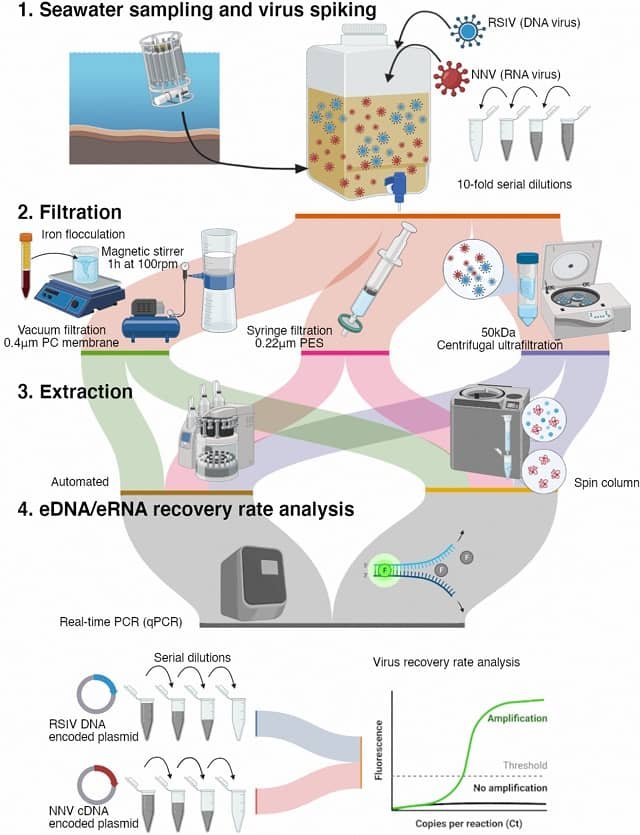
Within this landscape, the diagnostic tool with the greatest potential stands out: environmental DNA (eDNA) and environmental RNA (eRNA) analysis. The underlying biological principle is straightforward: every aquatic organism sheds residual genetic material, leaving fragments of fish, bacterial, viral, and parasitic nucleic acids suspended within the water column. By collecting and analyzing these liquid samples, operators can fully characterize the extant biological community without relying on invasive sampling or post-mortem necropsies.
A featured study demonstrated that seawater analysis identifies specific viruses far earlier than conventional tissue necropsies. Researchers optimized field workflows by validating rapid filtration protocols that maintain analytical sensitivity while employing a room-temperature preservative that eliminates cold-chain dependency, resolving major logistical bottlenecks for on-farm deployment. Concurrently, eRNA introduces a critical functional dimension by capturing real-time gene expression to reveal active physiological status and infectivity rather than mere basal presence, alongside microarray platforms capable of multiplexing up to 48 infectious agents—including Aeromonas salmonicida and the oomycete Saprolegnia—now advancing through pilot validation in commercial facilities.
Biosensors and Microfluidics: Continuous Molecular Surveillance in Aquaculture Systems
The industry’s primary operational objective centers on deploying autonomous devices capable of continuous water quality surveillance and automated early warnings, a demand effectively addressed by recent advances in biosensors and microfluidic platforms.
Biosensors couple specialized biorecognition elements—such as antibodies, DNA probes, or enzymes—with physical transducers that convert biological binding events into quantifiable analytical signals, yielding prototypes capable of detecting Aeromonas salmonicida in seawater at thresholds as low as a single cell per milliliter, alongside trace antibiotics and heavy metals.
Meanwhile, microfluidics enables lab-on-a-chip miniaturization where discrete microdroplets serve as independent analytical reactors—a principle underpinning droplet digital PCR (ddPCR), which achieves ultra-sensitive quantification down to one or two viral copies per sample to diagnose subclinical infections or early outbreak stages.
Nonetheless, prevailing scientific literature highlights field-transition hurdles: while highly effective in laboratory settings, complex aquatic matrices rich in organic matter, plankton, and suspended solids often induce severe biofouling and sensor drift, demanding enhanced operational robustness, streamlined user interfaces, and cost-effective manufacturing for broad commercial adoption.
Biotechnology Against Antimicrobial Resistance: Probiotics and Phage Therapy in Aquaculture
To mitigate antimicrobial dependency within culture systems, scientific research and commercial operations are converging on two principal biocontrol strategies:
The probiotics—beneficial microorganisms from genera such as Bacillus, Lactobacillus, or Carnobacterium that act via competitive exclusion, synthesize inhibitory compounds, and modulate host immunity in a strictly strain-dependent manner across target species and water parameters—and phage therapy. As lytic viruses targeting specific pathogens like Aeromonas hydrophila and Vibrio anguillarum without disrupting commensal microbiota, bacteriophages provide a precision alternative to broad-spectrum antibiotics.
However, aquatic deployment faces operational constraints, including phage inactivation by salinity shifts, the emergence of bacterial resistance, and degradation by standard UV and ozone disinfection protocols alongside pending regulatory frameworks.
From Test Strips to Autonomous Aquaculture: The Technological Roadmap
One of the scientific review’s most significant contributions lies in its forward-looking blueprint for environmental and aquatic health management. The authors outline a strategic, three-phase roadmap designed to steer capital allocation according to production scale and facility design:
- Short term (immediate deployment): Priority centers on highly accessible, cost-effective analytical tools, notably colorimetric test strips for quantifying ammonia, nitrates, or target pathogens via smartphone photometric analysis. This strategy democratizes on-farm diagnostics across budget-constrained pond operations by bypassing mandatory reliance on specialized laboratories for rapid, on-site early warnings.
- Medium term (3 to 7 years): Development focuses on advanced sensors featuring antifouling coatings to withstand harsh biofouling conditions in complex aquatic matrices. In parallel, the sector anticipates the maturation of microfluidic lab-on-a-chip molecular platforms—incorporating digital PCR and CRISPR-based diagnostic assays for ultra-sensitive pathogen detection—alongside controlled-release microcapsules for targeted vaccine and probiotic delivery.
- Long term (beyond 7 years): The technological horizon targets complete operational autonomy through self-powered sensor networks integrated with artificial intelligence algorithms. These systems will process real-time telemetry, diagnose subclinical anomalies, and execute automated corrective measures—such as therapeutic dosing, feeding rate adjustments, or environmental support activation—without manual intervention.
Machine learning models prove pivotal in this advanced tier by synthesizing high-volume environmental datasets to preemptively identify subclinical patterns, augmenting rather than replacing professional expertise through data-driven decisions. Ultimately, technological adoption must align with specific farm architectures: recirculating aquaculture systems (RAS) demand rigorous metabolite and microbial surveillance, marine net pens necessitate ruggedized biosensors resilient against pathogens and harmful algal blooms (HABs), and semi-intensive pond culture achieves peak cost-efficiency via rapid point-of-care field tests.
A Holistic and Integrated Approach: Strategic Synergy Against Pathogens
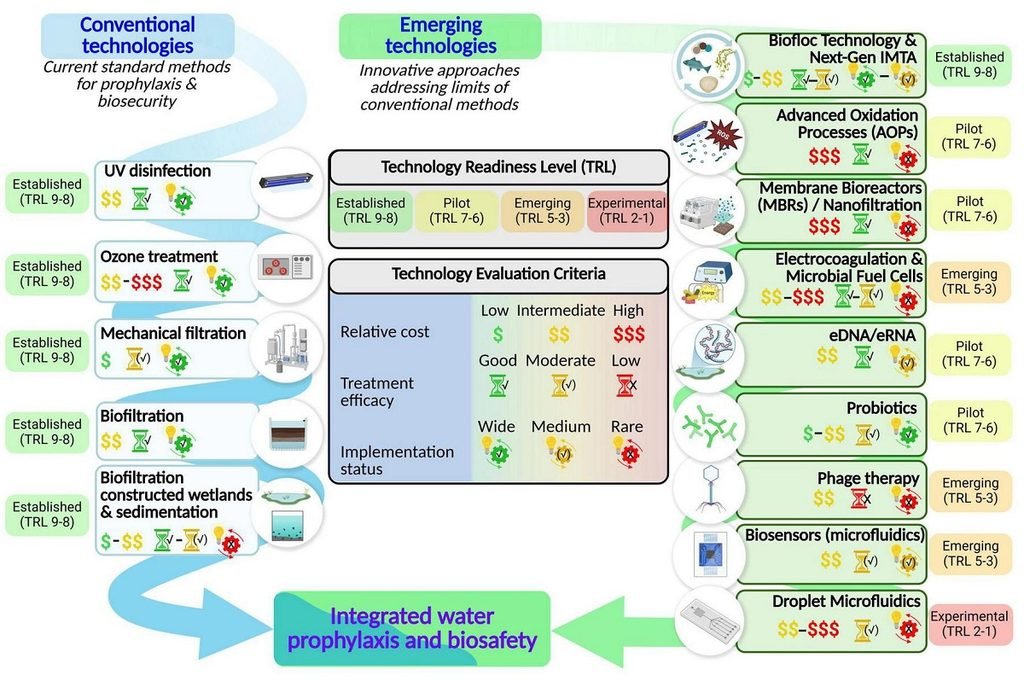
If an overarching takeaway emerges from this review, it is categorical: silver bullets do not exist, as no single filtration technology, advanced sensor, or biological treatment can resolve aquatic health challenges in isolation. The authors propose an integrated framework where conventional water treatment (mechanical filtration, biofiltration, UV irradiation, and ozonation) forms the foundational baseline, upon which molecular diagnostics, risk-modeling algorithms, and timely targeted interventions converge into facility-tailored strategies for earthen ponds, net pens, or RAS.
Returning to the opening dawn inspection, the operational paradigm fundamentally shifts from passive visual observation of lethargic stock to proactive biosecurity, driven by continuous sensors and early molecular warning signals that enable corrective measures well before clinical mortality occurs.
Contact
Simona Bartkova
Department of Chemistry and Biotechnology, Tallinn University of Technology
Tallinn, Estonia
Email: simona.bartkova@taltech.ee
Izzet Burcin Saticioglu
Department of Aquatic Animal Diseases, Faculty of Veterinary Medicine, Bursa Uludag University
Bursa, Türkiye
Email: iburcinsat@uludag.edu.tr
Reference (open access)
Bartkova S, Valentino F, Saraiva M, Duman M, Gerilovych A, Radosavljevic V, de Marco A, Saticioglu IB and Ay H (2026) Assessment of water prophylaxis and biosafety in finfish aquaculture – current and emerging technologies. Front. Microbiol. 17:1841960. doi: 10.3389/fmicb.2026.1841960

Editor at the digital magazine AquaHoy. He holds a degree in Aquaculture Biology from the National University of Santa (UNS) and a Master’s degree in Science and Innovation Management from the Polytechnic University of Valencia, with postgraduate diplomas in Business Innovation and Innovation Management. He possesses extensive experience in the aquaculture and fisheries sector, having led the Fisheries Innovation Unit of the National Program for Innovation in Fisheries and Aquaculture (PNIPA). He has served as a senior consultant in technology watch, an innovation project formulator and advisor, and a lecturer at UNS. He is a member of the Peruvian College of Biologists and was recognized by the World Aquaculture Society (WAS) in 2016 for his contribution to aquaculture.