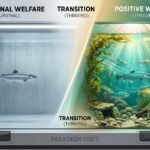
In global aquaculture, the rainbow trout (Oncorhynchus mykiss) stands as one of the most extensively produced and studied species. However, intensive farming systems frequently utilize “barren” tanks devoid of complex structures, an environmental monotony that induces chronic stress and restricts natural behavioral patterns. This prolonged stress transcends ethical dilemmas, representing a critical economic impact by compromising the immune system, increasing morbidity, and decelerating growth rates. In this context, environmental enrichment (EE) emerges as a non-invasive strategy capable of transforming sterile environments into habitats that trigger beneficial biological responses.
Groundbreaking research published in Scientific Reports supports this premise; experts from the Thünen Institute determined that integrating simple elements, such as elastomer ropes mimicking underwater vegetation, optimizes specimen welfare. According to the researchers, this method functions as a “remote immunostimulant,” bolstering the trout’s endogenous defenses without resorting to pharmacological interventions.
- 1 Key Highlights
- 2 Environmental Mimesis: Simulating Natural Habitats in Laboratory Settings
- 3 Structural Superiority: Why Vertical Ropes Are the Optimal Choice
- 4 Scalability and Impact: Practical Application in the Aquaculture Industry
- 5 Conclusions: Toward Resilient and Sustainable Aquaculture
- 6 Entradas relacionadas:
Key Highlights
- Immunostimulatory Effect: Vertical enrichment using rubber ropes significantly enhances cellular immune activity (respiratory burst) under high-density stress conditions.
- Cellular Optimization: Fish in enriched environments exhibit a reduction in circulating monocytes and lymphocytes, suggesting a more efficient cellular redistribution toward peripheral tissues.
- Mitigation of Aggression: Physical structures facilitate social stabilization and the formation of natural hierarchies, thereby reducing chasing behaviors.
- Practical Scalability: The vertical design is more hygienic and easier to implement in commercial systems compared to traditional gravel substrates.
Environmental Mimesis: Simulating Natural Habitats in Laboratory Settings
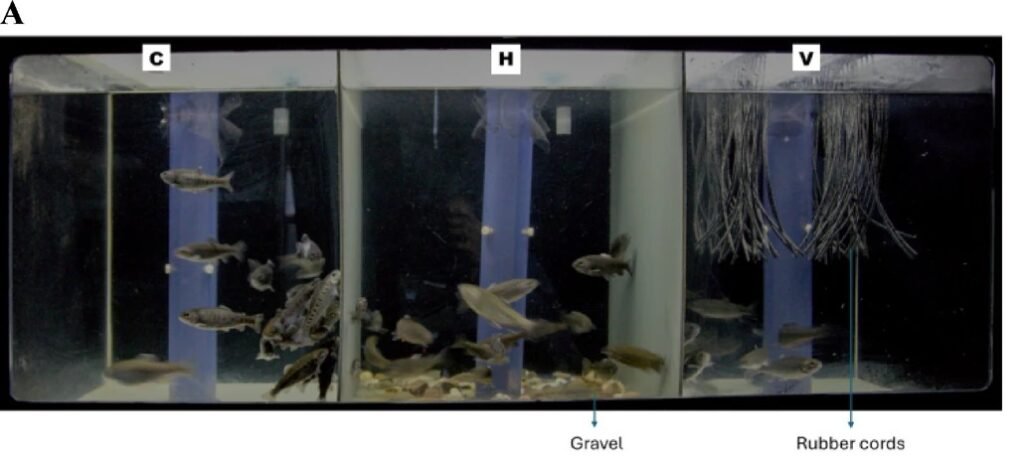
To determine the impact of environmental complexity, researchers conducted two experimental designs on juvenile rainbow trout. The study evaluated the biological response to two specific structural configurations:
- Horizontal Enrichment (H): Implementation of a gravel substrate at the bottom of the tank to emulate a riverbed.
- Vertical Enrichment (V): Suspension of elastomer ropes arranged to simulate the presence of macrophyte vegetation.
Both environments were contrasted with control tanks devoid of structure (C). The scientific assessment focused on neuroendocrine parameters through cortisol measurement, behavioral pattern analysis, and, as a priority, the functionality of head kidney leukocytes (HKL)—the primary lymphoid organ and a key component of the teleost immune system.
Structural Superiority: Why Vertical Ropes Are the Optimal Choice
Research results underscore that environmental architecture is a determining factor. While the gravel substrate (H) fostered social interaction and activated inflammatory markers, it presented operational challenges by compromising tank hygiene due to detritus accumulation. In contrast, the vertical configuration (V) proved to be the most functional and efficient solution. The key findings are broken down below:
Immunostimulation under High-Density Conditions
One of the most groundbreaking discoveries was that even when doubling population density—a critical stressor in industrial aquaculture—trout in environments with vertical ropes maintained elevated levels of spontaneous respiratory burst activity (SRBA) and higher serum lysozyme activity. This translates into superior immunological robustness against potential infectious outbreaks.
Cellular Optimization vs. Leukocyte Mass
Paradoxically, specimens in enriched environments showed lower total monocyte and lymphocyte counts in the head kidney. Researchers postulate that this does not indicate vulnerability, but rather a strategic redistribution. It is likely that the enriched environment optimizes the efficiency of each cell or promotes its migration toward peripheral tissues (mucosa, skin, or gills), ensuring a more focused and effective defense.
Structural complexity allowed dominant individuals to delimit territories, facilitating the establishment of stable hierarchies. In enriched tanks, the incidence of aggressive chasing was drastically reduced, thereby minimizing the risk of mechanical injuries and secondary metabolic stress.
Scalability and Impact: Practical Application in the Aquaculture Industry
For the production sector, the implementation of vertical ropes represents a low-cost, highly scalable tool. Unlike immunostimulation protocols based on dietary supplements or vaccines, structural enrichment constitutes a passive and permanent solution. Furthermore, the study confirms that these optimizations in animal welfare do not compromise growth rates or the condition factor of the specimens. The adoption of vertical enrichment offers competitive advantages that transcend the experimental setting:
Mantente siempre informado
Stay Informed
Únete a nuestras comunidades para recibir al instante las noticias, informes y análisis más importantes del sector acuícola.
Join our communities to get instant access to the most important news, reports, and analysis from the aquaculture industry.
- Sanitary Profile Optimization: By functioning as a natural immune modulator, EE has the potential to mitigate antibiotic dependency and reduce the frequency of invasive interventions that generate additional metabolic stress.
- Strengthening Corporate Image: Given the growing consumer demand for demonstrable animal welfare standards, the use of enriched structures provides tangible evidence of ethical and biological responsibility.
- Operational and Economic Efficiency: Unlike horizontal substrates that retain detritus, vertical ropes are cost-effective, facilitate disinfection protocols, and maintain the integrity of water flow and feed distribution.
Conclusions: Toward Resilient and Sustainable Aquaculture
While the findings are highly promising, the authors emphasize that the efficacy of environmental enrichment is intrinsically linked to the operational context. Subtle variables in structural design or population density can modulate biological outcomes. Consequently, the scientific roadmap suggests that the next phase should involve pathogen challenge trials. The goal is to validate whether this immune optimization translates into superior survival against critical pathologies, such as Cold Water Disease (Flavobacterium psychrophilum).
In summary, structural enrichment via vertical ropes acts as an effective modulator of the neuroendocrine-immune axis in rainbow trout. By fostering natural behavioral patterns and enhancing immunological competence without invasive interventions, this technique establishes itself as a cutting-edge strategy to strengthen the operational sustainability and reputation of the intensive aquaculture sector.
Reference (open access)
Subramani, P.A., Gennaraki, M.A., Emami, N. et al. Environmental enrichment as an immunostimulant for rainbow trout aquaculture. Sci Rep 16, 12367 (2026). https://doi.org/10.1038/s41598-026-44702-2

Editor at the digital magazine AquaHoy. He holds a degree in Aquaculture Biology from the National University of Santa (UNS) and a Master’s degree in Science and Innovation Management from the Polytechnic University of Valencia, with postgraduate diplomas in Business Innovation and Innovation Management. He possesses extensive experience in the aquaculture and fisheries sector, having led the Fisheries Innovation Unit of the National Program for Innovation in Fisheries and Aquaculture (PNIPA). He has served as a senior consultant in technology watch, an innovation project formulator and advisor, and a lecturer at UNS. He is a member of the Peruvian College of Biologists and was recognized by the World Aquaculture Society (WAS) in 2016 for his contribution to aquaculture.