- 1 Key Factors Underpinning Diatom Potential
- 2 Global Aquaculture: The Nutritional Bottleneck the Industry Can No Longer Ignore
- 3 Diatoms in Aquafeed Nutrition: Biochemical Profile, Digestibility, and Antibacterial Protection
- 4 Aquaculture Bioremediation: Upcycling Effluents and Wastewater into High-Value Nutritional Inputs with Diatoms
- 5 The Diatom Bottleneck in Aquaculture: Production Costs, Digestibility Constraints, and Scaling Challenges
- 6 Genetic Engineering in Diatoms: The Biotechnological Route to Aquaculture Profitability
- 7 The Future of Aquafeed: From Fishmeal Dependence to Diatom Adoption
- 8 Entradas relacionadas:
Key Factors Underpinning Diatom Potential
- Superior Nutritional Profile: They provide protein, vitamins, minerals, and essential omega-3 polyunsaturated fatty acids (EPA and DHA) at concentrations that are competitive with fishmeal and markedly superior to soybean meal.
- Validated Zootechnical Efficacy: Species such as Phaeodactylum tricornutum and Thalassiosira pseudonana are already deployed as live feed in mollusk, shrimp, and marine fish hatcheries, demonstrating proven gains in growth rates, survival, and immunocompetence.
- Bioremediation and Circular Economy: They can be cultivated using on-farm aquaculture effluents, simultaneously cutting fertilization costs and treating wastewater for reuse or compliant discharge.
- The Economic Scaling Bottleneck: The primary constraint lies in production economics: generating one kilogram of dry biomass currently ranges between 5 and 20 USD, compared to 0.40–0.70 USD for soybean meal and 1.50–2.50 USD for fishmeal.
- Biotechnological Optimization: Metabolic engineering in model strains such as P. tricornutum has successfully doubled lipid accumulation and quadrupled high-value pigment yields, paving the way for tailor-made strains optimized for the industry.
It is five in the morning, and the manager of a shrimp farm reviews, once again, the invoice for the latest feed delivery, which has risen yet again due to the escalating cost of its primary ingredient: fishmeal. While this comes as no surprise—following a pattern established for years—each price hike underscores a critical reality: feed accounts for over 60% of farm operating costs, with a substantial share tied to wild fish stocks that are increasingly constrained and expensive.
This challenge is global, prompting shrimp, tilapia, salmon, and shellfish facilities worldwide to confront the same dilemma: how to sustain aquaculture production when pelagic fisheries can no longer meet the demand for fishmeal and fish oil? In response to this impasse, an international research consortium comprising the Diatom Research Laboratory at Amity University (India), Indiana State University, the University of Allahabad, and the University of Hamburg proposes a microscopic solution: diatoms, microalgae that have underpinned marine food webs for millions of years.
Global Aquaculture: The Nutritional Bottleneck the Industry Can No Longer Ignore
Aquaculture is no longer a marginal or niche endeavor; expanding at three times the rate of conventional terrestrial agriculture, it currently supplies approximately 57% of all aquatic products consumed worldwide. Sector projections anticipate sustained production growth that will demand at least 25 million additional metric tons of aquafeed. However, this upward trajectory collides directly with a biological and ecological barrier: fishmeal and fish oil—indispensable sources of protein and long-chain omega-3 polyunsaturated fatty acids—originate from capture fisheries operating at their maximum sustainable yield. Cognizant of this limitation, the aquaculture industry has spent years exploring plant-based alternatives, including meals derived from soybean, canola, rubber seed, and Jatropha.
While these terrestrial feedstocks are viable within specific inclusion thresholds, they introduce critical zootechnical limitations. Soybean meal, the prevailing substitute due to its availability and competitive cost, contains antinutritional factors that impair gut health and nutrient digestibility in farmed species. More fundamentally, no terrestrial plant source synthesizes eicosapentaenoic acid (EPA) or docosahexaenoic acid (DHA), which are critical nutrients for the growth, survival, and immunocompetence of species such as shrimp and salmon, as well as for delivering the nutritional profile demanded by consumer markets. This represents a nutritional deficit that oilseeds, grains, and terrestrial by-products have consistently failed to resolve comprehensively.
Diatoms in Aquafeed Nutrition: Biochemical Profile, Digestibility, and Antibacterial Protection
For decades, diatoms were investigated almost exclusively through the lens of fundamental marine biology: they drive approximately 40% of oceanic primary production, account for 20% of global carbon fixation, and synthesize a biogenic silica cell wall—the frustule—resembling a microscopic glass capsule. Today, however, the complex biochemical matrix sustaining oceanic productivity has captured the strategic focus of aquafeed formulation. Evidence compiled across dozens of species is compelling: Phaeodactylum tricornutum, a leading model microalga, exhibits 30% to 52% crude protein in dry biomass alongside a 20% to 30% lipid range, yielding eicosapentaenoic acid (EPA) levels that reach 30% to 36% of the total fatty acid profile—substantially outperforming the 5–12% found in fishmeal and completely absent in soy products. Concurrently, Thalassiosira pseudonana demonstrates consistent, analogous nutritional values, while genera such as Nitzschia sp. and Chaetoceros gracilis maintain competitive protein-to-carbohydrate balances against traditional raw materials.
This potential extends well beyond proximal composition into validated zootechnical trials. Dietary inclusion of P. tricornutum enhanced apparent protein and lipid digestibility in Atlantic salmon post-smolts while concurrently improving muscle pigmentation; in parallel, T. pseudonana boosted growth rates and survival in Pacific white shrimp (Litopenaeus vannamei), and Skeletonema costatum optimized feed conversion efficiency in Nile tilapia. Furthermore, strains such as Haslea nusantara and select benthic diatoms have demonstrated potent antimicrobial activity against Vibrio pathogens, suppressing bacterial loads to undetectable levels in bioassays. For producers grappling with recurring vibriosis outbreaks, this targeted bioactivity represents an actionable, first-order zootechnical countermeasure rather than an academic curiosity.
Aquaculture Bioremediation: Upcycling Effluents and Wastewater into High-Value Nutritional Inputs with Diatoms
At this juncture, current research introduces a pivotal perspective for both operational profitability and environmental sustainability. Diatoms require nitrogen, phosphorus, and silica for cellular proliferation—precisely the dissolved nutrients that saturate and compromise the quality of aquaculture effluents. Researchers report remarkable nutrient-removal efficiencies: up to 60% of total nitrogen, 89% of phosphorus, and 88% of chemical oxygen demand (COD) when cultivating species such as Chaetoceros gracilis and Thalassiosira weissflogii in blended matrices of seawater and mariculture effluents.
In practical terms, discharge streams that currently entail costly pretreatment or pose environmental liability risks can be repurposed into growth media to yield nutritional biomass for subsequent production cycles. This establishes a closed-loop framework where farm waste sustains microalgal cultures, and the harvested biomass returns to the system as a functional feed ingredient, aligning seamlessly with circular bioeconomy principles to cut wastewater treatment costs and reduce reliance on commercial fertilizers.
The Diatom Bottleneck in Aquaculture: Production Costs, Digestibility Constraints, and Scaling Challenges
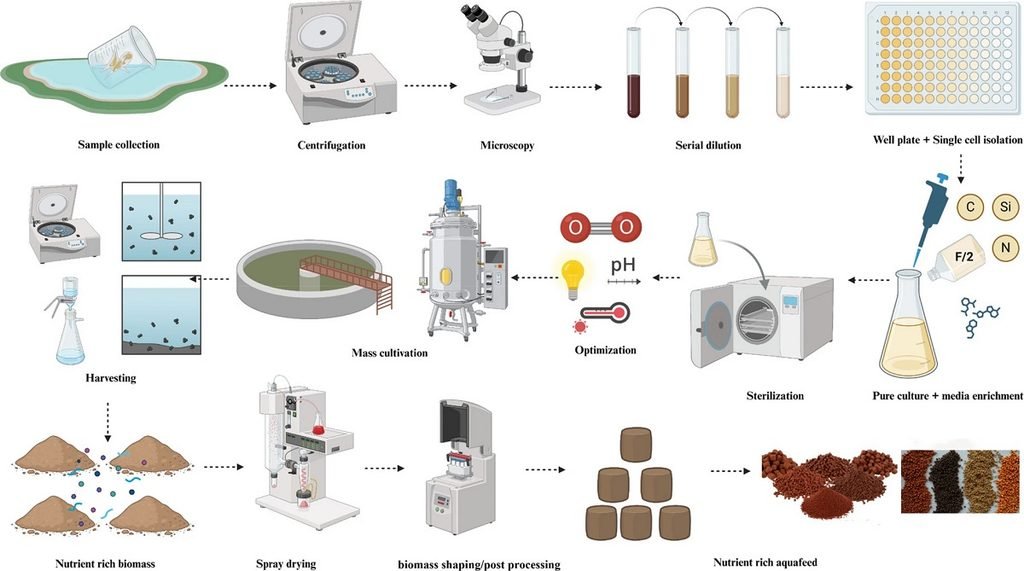
If diatoms offer such high nutritional value, why are they not standard ingredients in commercial aquafeeds? Researchers point definitively to economic viability: producing one kilogram of microalgal biomass—including diatoms—costs between 5 and 20 USD, depending on the selected strain, photobioreactor or cultivation platform, and downstream processing stages. Compared to 0.40–0.70 USD per kilogram for soybean meal and 1.50–2.50 USD for fishmeal, this cost disparity explains the lack of widespread industrial adoption.
Mantente siempre informado
Stay Informed
Únete a nuestras comunidades para recibir al instante las noticias, informes y análisis más importantes del sector acuícola.
Join our communities to get instant access to the most important news, reports, and analysis from the aquaculture industry.
Much of this cost premium stems from a structural biological constraint: the silica frustule shielding the microalga and conferring environmental resilience doubles as a mechanical barrier against digestive enzymes in fish and crustaceans.
The authors term this the “digestibility paradox”—the rigid casing that ensures microorganism robustness concurrently impedes intracellular lipid and protein assimilation unless pre-treatments like mechanical cell disruption, bead milling, or enzymatic hydrolysis are applied to rupture the siliceous envelope; consequently, thin-walled species such as Phaeodactylum tricornutum exhibit inherently superior bioavailability and account for most current zootechnical applications. Compounding this challenge are downstream operational bottlenecks, including disparate ecophysiological requirements across strains, energy-intensive dewatering methods (e.g., centrifugation, microfiltration, flocculation), and the absence of dedicated regulatory frameworks for commercial aquafeed registration.
Genetic Engineering in Diatoms: The Biotechnological Route to Aquaculture Profitability
The most promising component of the study—and the one likely to determine whether diatoms transcend their status as a marginal alternative—lies in genetic engineering. For years, optimizing the performance of these microorganisms relied almost exclusively on manipulating abiotic culture variables: modifying light irradiance, inducing phosphorus stress, or testing alternative nitrogen sources. While these strategies operate with relative success, they exhibit a limited biological ceiling.
This landscape is transformed substantially by advances in gene editing applied directly to Phaeodactylum tricornutum. Through the overexpression of genes linked to lipid synthesis (such as PtD5b and MCAT), researchers achieved a 2.61-fold increase in total intracellular lipid accumulation. Furthermore, the co-expression of the DGAT2B and OtElo5 genes elevated docosahexaenoic acid (DHA) levels—the omega-3 polyunsaturated fatty acid with the highest commercial value, which is absent in terrestrial oilseeds—from a mere 1.8% to a range between 3.8% and 8.4% of dry biomass. Simultaneously, modulating carotenoid biosynthetic pathways quadrupled the synthesis of fucoxanthin, a pigment endowed with elevated nutritional and nutraceutical value. In this context, precision molecular tools such as CRISPR/Cas9 are already deployed to optimize the stability of these strains.
Although these innovations do not reduce the cost structure immediately, they signal an unequivocal strategic direction: the design of bioengineered diatoms to maximize the synthesis of high-value target molecules—DHA, antioxidant pigments, and functional proteins—from a lower volume of biomass, which translates directly into a lower cost per unit of assimilable nutrient.
The Future of Aquafeed: From Fishmeal Dependence to Diatom Adoption
The aquaculture farm manager who anxiously examined the feed bill at dawn will not find diatoms in the next aquafeed order—at least not immediately, nor within a competitive short-term cost structure. Nevertheless, the roadmap outlined by current research confirms that the raw material poised to alleviate this financial strain is already an operational reality: it is successfully cultivated, enhances growth rates and immunocompetence in documented shrimp and fish trials, and purifies aquaculture effluents through bioremediation processes during its life cycle.
The immediate challenge does not lie in discovering the resource, but rather in scaling production at viable costs, overcoming the mechanical constraints of its digestibility, and establishing the essential regulatory frameworks required for safe commercialization. If biotechnological engineering maintains the pace of its recent breakthroughs, the very microalga currently confined to the laboratory could soon emerge as the staple ingredient stored in farm warehouses during future operating cost assessments.
Contact
Archana Tiwari
Diatom Research Laboratory, Amity Institute of Biotechnology, Amity University
Noida, India
Email: panarchana@gmail.com
Reference (open access)
Wali, Z., Parikh, H., Tyagi, R. et al. Diatoms for sustainable aquaculture: nutritional potential, cultivation strategies, and circular bioeconomy applications. Phycol. J. 2, 9 (2026). https://doi.org/10.1186/s44377-026-00014-0

Editor at the digital magazine AquaHoy. He holds a degree in Aquaculture Biology from the National University of Santa (UNS) and a Master’s degree in Science and Innovation Management from the Polytechnic University of Valencia, with postgraduate diplomas in Business Innovation and Innovation Management. He possesses extensive experience in the aquaculture and fisheries sector, having led the Fisheries Innovation Unit of the National Program for Innovation in Fisheries and Aquaculture (PNIPA). He has served as a senior consultant in technology watch, an innovation project formulator and advisor, and a lecturer at UNS. He is a member of the Peruvian College of Biologists and was recognized by the World Aquaculture Society (WAS) in 2016 for his contribution to aquaculture.