- 1 Key Points
- 2 Why Trout Feed Changed (and What Was Lost Along the Way)
- 3 The Poultry Premix in Trout Farming
- 4 Warning Signs You Can Spot in the Pond
- 5 What a Rainbow Trout Actually Needs
- 6 Selenium and Vitamin E: A Duo That Protects the Batch
- 7 Chelated Minerals and Nanoparticles: The New Generation of Supplements
- 8 What the Producer Gains with Precision Micronutrition
- 9 From the Feed Bag to the Harvest
- 10 Entradas relacionadas:
Key Points
- Fishmeal and fish oil naturally supply vitamins and minerals; soy, cereals, and legumes provide fewer of them and contain compounds (such as phytates) that block their absorption.
- Many feeds still use vitamin and mineral premixes formulated for poultry and livestock, not for rainbow trout. They are inexpensive and easy to source, but they do not meet the demands of a cold-water fish.
- Micronutrient deficiency alters the fish’s liver and metabolism long before deformities, anemia, cataracts, or mortality appear.
- Synergy between selenium and vitamin E: Supplementing them together improved growth, blood parameters, immune response, and survival in trout exposed to Aeromonas salmonicida.
- Chelated minerals and nanoparticles promise greater absorption with less waste, but their dosages and safety still need to be validated at a commercial scale.
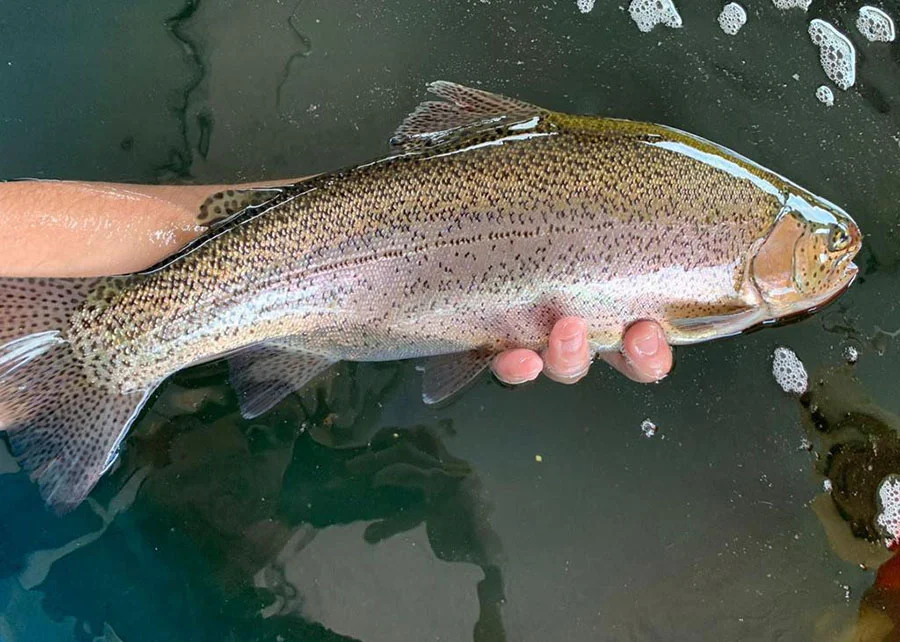
It is six in the morning, and the pond water is still steaming in the cold. The farmer walks along the ponds with a bucket of feed and notices the usual: a batch that just won’t take off. The trout are eating, but they are not gaining weight at the expected rate. Some have frayed fins; others swim erratically. In the previous harvest, fish with crooked spines turned up, and the buyer rejected them.
He checks the water parameters: oxygen is fine, and so is the temperature. He verifies the stocking density: within the normal range. The feed is the same as always, from the same brand and with the same protein percentage on the label. So, what is going wrong?
The answer could be hiding in the smallest and least monitored fraction of the ration: those few grams of vitamins and minerals that almost no one examines twice.
That is the central thesis of a scientific review published in November 2026 in Frontiers in Aquaculture by Umar Rasool Parry, Mir Ishfaq Nazir, and Oyas A. Asimi, from the Division of Fish Nutrition and Biochemistry at the Sher-e-Kashmir University of Agricultural Sciences and Technology of Kashmir, in India. The authors compiled the available evidence on the vitamin and mineral requirements of rainbow trout (Oncorhynchus mykiss) and reached an uncomfortable conclusion for the industry: as feed incorporates more plant-based ingredients, generic premixes are no longer enough, and trout demand tailored “precision micronutrition.” For the producer, this means that a large portion of the growth, deformity, and disease problems usually blamed on farm management could actually originate directly in the feed bag.
Why Trout Feed Changed (and What Was Lost Along the Way)
For decades, fishmeal and fish oil were the foundation of salmonid feeds. In addition to protein and energy, they included a silent advantage: they came loaded with vitamins and minerals in forms that fish absorb easily. Properly balancing protein and fat was enough, as micronutrients came along almost by themselves.
However, fishmeal is a finite resource. Its price is rising, its availability is shrinking, and environmental pressure is growing. The industry responded by replacing it with plant proteins and oils—a logical transition in both economic and ecological terms.
The drawback is that a plant-based diet is not simply a fish-based diet with a different label. Legumes and cereals contain what nutritionists call antinutritional factors: natural plant compounds—such as phytates, tannins, and saponins—that bind to minerals and prevent them from entering the body. It works like a water filter that, in addition to trapping impurities, also traps useful nutrients. The mineral is listed in the formula, yes, but it is excreted in the feces without fulfilling its function.
The authors highlight a pattern already documented in human nutrition that is replicated in aquaculture: plant-based diets usually provide sufficient copper and manganese, but they are deficient in bioavailable iron, zinc, and selenium. Precisely three minerals that are essential for blood health, immune defenses, and cellular protection.
The Poultry Premix in Trout Farming
Numerous aquafeed mills use vitamin and mineral premixes originally formulated for poultry and livestock. The decision makes commercial sense: they are cheap, abundant, and easy to acquire.
Mantente siempre informado
Stay Informed
Únete a nuestras comunidades para recibir al instante las noticias, informes y análisis más importantes del sector acuícola.
Join our communities to get instant access to the most important news, reports, and analysis from the aquaculture industry.
Nevertheless, a trout is not a chicken. It lives in cold water, breathes through gills, absorbs minerals not only through the intestine but also through the gills and skin, and its metabolism follows different rules. One striking example: salmonids do not synthesize their own vitamin C, meaning they depend entirely on dietary intake. Using a premix designed for terrestrial animals is like calibrating a pond aerator using a tractor manual.
The researchers also warn that excess is equally harmful. Overloading the ration with vitamin A, for example, can trigger adverse effects. Likewise, excess minerals compete with one another: too much zinc or copper interferes with the absorption of the other in the intestine. Adding “a little extra just in case” is not a viable strategy—it drives up feed costs and ends up as wasted nutrients in the water.
Warning Signs You Can Spot in the Pond
The review systematizes the symptoms that science has linked to each deficiency. Among the most recognizable for anyone working daily with trout are:
- Crooked spine and bone deformities: deficiency of phosphorus, vitamin C, vitamin D, manganese, or zinc.
- Cataracts (cloudy eyes): deficiency of zinc, riboflavin (B2), or thiamine (B1).
- Eroded fins: deficiency of zinc, copper, niacin (B3), or pantothenic acid (B5).
- Anemia and pale gills: deficiency of iron, selenium, folic acid, vitamin B12, or vitamin E.
- Bulging eyes (exophthalmia): deficiency of vitamin C or vitamin A.
- Erratic swimming and convulsions: deficiency of B-complex vitamins.
- Fatty liver: deficiency of choline or biotin.
But there is one finding that transforms how the problem is approached. Studies on trout liver cited in the review show that, when faced with a lack of micronutrients, the fish alters the expression of genes linked to lipid metabolism, oxygen transport, and growth long before clinical signs appear. In other words, the organism is already compensating and diverting energy just to get by with what it has. By the time a crooked spine becomes visible, the batch has been losing performance for weeks.
What a Rainbow Trout Actually Needs
The authors contrast two classic references: the recommendations of the U.S. National Research Council (NRC, 2011) and those of De Silva and Anderson (1995). According to the NRC, a rainbow trout ration should provide, among other values:
| Nutrient | Dietary Requirement (NRC, 2011) |
| Vitamin A | 0.75 mg/kg |
| Vitamin D | 40 µg/kg |
| Vitamin E | 50 mg/kg |
| Vitamin C | 20 mg/kg |
| Phosphorus | 0.70% |
| Zinc | 15 mg/kg |
| Manganese | 12 mg/kg |
| Copper | 3 mg/kg |
| Selenium | 0.15 mg/kg |
What is most revealing is the researchers’ warning about this table: it should not be interpreted as a fixed recipe, but rather as a starting point. Actual demands vary depending on the fish’s life stage, diet composition, farming stress, water temperature, and disease pressure. For certain nutrients, such as vitamin K and vitamin B12, there is still no exact established figure for trout, and iron is listed in the NRC as “not tested.” Science still has gaps to fill, and the authors clearly acknowledge this.
Selenium and Vitamin E: A Duo That Protects the Batch
For years, each micronutrient was evaluated in isolation: how much zinc, how much selenium, or how much vitamin E the fish required. Recent research shows that the interaction between nutrients matters just as much as the dosage.
The strongest example is selenium and vitamin E. Both protect cells against oxidative damage—a kind of internal wear and tear that accelerates under the stress of intensive farming. In a study cited in the review (Shah et al., 2025), trout that received both nutrients together grew better, showed improved blood indicators, a more active immune response, and higher survival against Aeromonas salmonicida—the bacterium responsible for furunculosis—compared to unsupplemented fish.
Another study (Aramli et al., 2023) evaluated a combination of 0.5 mg/kg of organic or nanoparticle selenium, 150 mg/kg of vitamin E, and 20 mg/kg of coenzyme Q10. Although the blend did not necessarily accelerate growth, it did strengthen antioxidant defenses, digestive enzyme activity, and stress resistance. The vitamin E dose stands out: three times higher than the minimum suggested by the NRC. The authors interpret this to mean that, under demanding farming conditions, the optimal level may lie well above the minimum required to prevent a deficiency.
Chelated Minerals and Nanoparticles: The New Generation of Supplements
If the obstacle is that the mineral does not reach its destination, the logical solution is to improve the delivery vehicle. In this area, two technologies analyzed in the review stand out.
The first is chelated minerals: minerals bound to amino acids or small peptides that “escort” them through the intestine, protecting them from the plant compounds that would otherwise block them. Organic selenium, such as selenomethionine or selenium-enriched yeast, is assimilated better than conventional inorganic sources. In large-scale trials with Atlantic salmon, organic sources broadly improved mineral retention and various production indicators.
The second is nanoparticles: minerals reduced to such a tiny scale that the body absorbs them more efficiently. In rainbow trout, nano-selenium at 3 mg/kg notably boosted growth at high stocking densities, reinforced antioxidant defenses, reduced stress markers, and stimulated genes linked to muscle development. Zinc oxide nanoparticles, meanwhile, activated genes associated with immunity.
However, the authors themselves temper the enthusiasm. Some nanoparticles, such as silver or magnesium oxide, caused damage to the gills, kidneys, or brain in studies with other species. Dosage, particle type, and safety profile must be rigorously evaluated before transferring them to commercial production. It is a promising technology, but not yet ready for mass adoption.
What the Producer Gains with Precision Micronutrition
The review’s final argument is economic. A feed with vitamins and minerals specifically tailored to trout can translate into better feed conversion, lower mortality, fewer disease losses, and a higher-quality fillet—with more uniform coloration and greater stability against oxidation thanks to the protective effect of selenium and vitamin E.
The authors cite a study involving 1,595 trout in which the most efficient individuals achieved a feed conversion ratio (FCR) of 0.99: practically one kilogram of fish for every kilogram of feed. That individual variability reveals how much room still exists to better integrate genetics with nutrition. At the same time, fine-tuning dosages avoids paying for supplements that the fish cannot utilize and that end up loading the culture water.
The review leaves several open questions: how much trout need at each stage of their life cycle, how to diagnose their nutritional status before symptoms appear, and whether the benefits observed in the lab hold up at a commercial scale. These are the next challenges that science will need to answer.
From the Feed Bag to the Harvest
Let us return to the farmer at six in the morning, watching a batch that won’t take off. With this evidence on the table, his list of suspects expands. In addition to checking the water and stocking density, it is now worth asking the supplier what type of premix their feed contains, whether it was formulated for salmonids or terrestrial animals, what chemical form the selenium and zinc are in, and how much vitamin C and E the ration retains after processing and storage.
Perhaps the explanation behind the frayed fins and crooked spines is not in the pond, but in those few grams that almost no one checks. Science is still fine-tuning the exact figures, but the lesson is already clear: in rainbow trout, the smallest part of the ration can define the outcome of the entire harvest.
Reference (open access)
Parry, U. R., Nazir, M. I., & Asimi, O. A. (2026). Precision micronutrition in rainbow trout (Oncorhynchus mykiss): Vitamin and mineral requirements, bioavailability and innovations in aquafeed formulation. Frontiers in Aquaculture, 5, 1919172. https://doi.org/10.3389/faquc.2026.1919172

Editor at the digital magazine AquaHoy. He holds a degree in Aquaculture Biology from the National University of Santa (UNS) and a Master’s degree in Science and Innovation Management from the Polytechnic University of Valencia, with postgraduate diplomas in Business Innovation and Innovation Management. He possesses extensive experience in the aquaculture and fisheries sector, having led the Fisheries Innovation Unit of the National Program for Innovation in Fisheries and Aquaculture (PNIPA). He has served as a senior consultant in technology watch, an innovation project formulator and advisor, and a lecturer at UNS. He is a member of the Peruvian College of Biologists and was recognized by the World Aquaculture Society (WAS) in 2016 for his contribution to aquaculture.