- 1 Key Takeaways
- 2 The Direct Impact on the Aquaculture Production Sector
- 3 Regulatory Gaps: The Lack of Global Oversight in Aquaculture Inputs
- 4 Environmental Dynamics and Bioaccumulation: The Fate of Chemicals in Aquatic Environments
- 5 Trophic Transfer: Carnivorous Species Face the Highest Risk of Bioaccumulation
- 6 Scientific Rigor and Predictive Modeling: The True Scope of the Database
- 7 Informed Decision-Making: Towards Responsible Chemical Management in Aquaculture Production
- 8 Entradas relacionadas:
Key Takeaways
- Global regulatory void: An international study evaluated 690 chemicals used in aquaculture (antibiotics, parasiticides, and disinfectants), finding that the vast majority lack clear regulatory frameworks.
- Trophic chain impact: Multiple compounds persist in aquatic environments and bioaccumulate across organisms, posing a latent risk of reaching end consumers.
- Persistent residues: Banned substances, such as malachite green, continue to be detected in aquatic ecosystems years after official prohibitions.
- Critical compounds: Six frequently used chemicals—including azithromycin, erythromycin, and atrazine—were classified as “very persistent and very mobile,” facilitating their widespread dispersion.
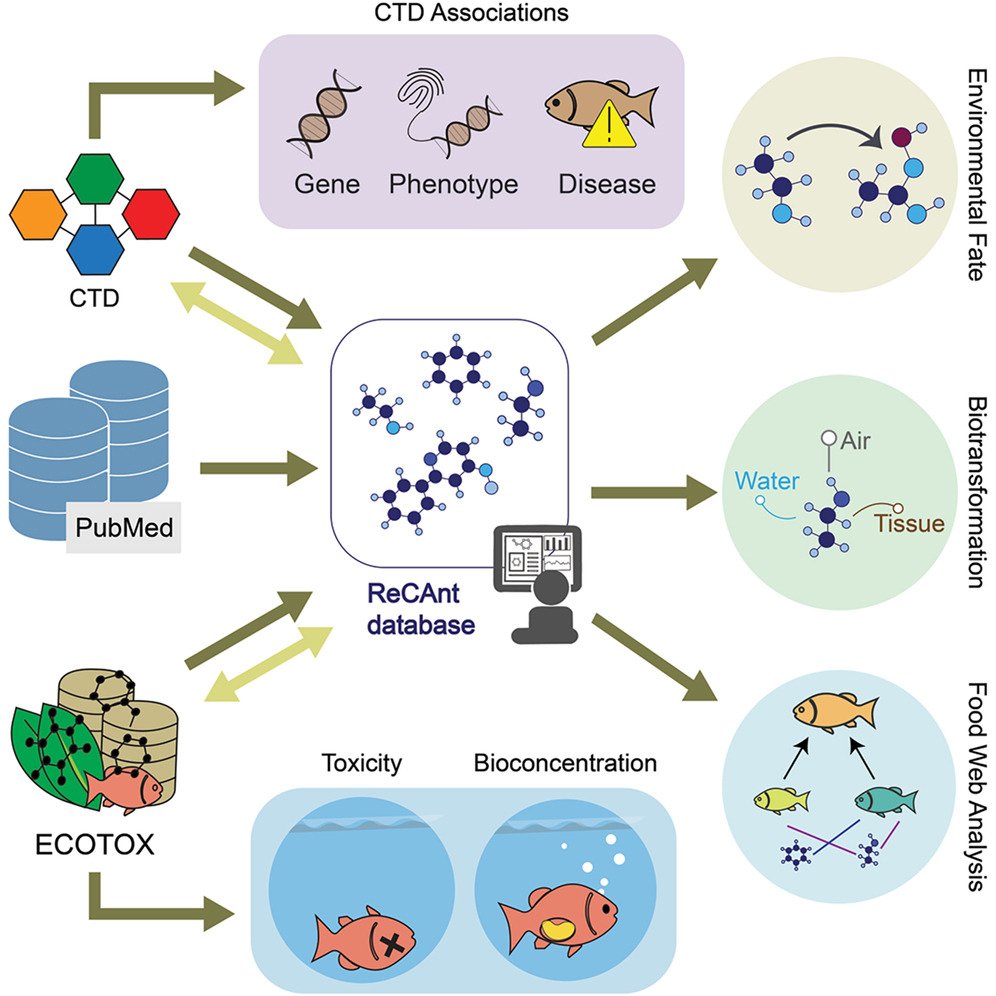
- Open-access via ReCAnt: The free public platform ReCAnt centralizes this dataset, enabling producers, technicians, and regulators to assess compound safety before application.
In a shrimp culture pond, a sanitary alert demands immediate action: the animals stop feeding, display lethargy, and the operational window is minimal. The technician administers a proven treatment, adjusts the dosage, and succeeds in salvaging the harvest within days.
However, a critical dilemma persists: what is the environmental fate of these active ingredients? Do they degrade in the water column, settle into the sediment, or contaminate adjacent areas? Furthermore, does the compound comply with the phytosanitary and veterinary regulations of key export target markets?
For decades, addressing these questions was nearly impossible due to scattered data across heterogeneous scientific publications and toxicological inventories. The ReCAnt platform consolidates this knowledge for the first time into a single, unified, and accessible resource.
The Direct Impact on the Aquaculture Production Sector
Aquaculture represents the primary global source of aquatic protein today and is projected to supply the vast majority of seafood by 2050. This rapid expansion has intensified reliance on chemical compounds to safeguard organism health and maximize yields. The challenge lies not in their use—often indispensable—but in their application without precise knowledge of their environmental fate or formal regulatory status.
Addressing this information gap, a research team from The Institute of Mathematical Sciences (IMSc, Chennai) and the National Centre for Coastal Research (Ministry of Earth Sciences, India) compiled and cross-referenced hundreds of scientific studies with major global toxicological databases. The resulting public platform, ReCAnt, consolidates the technical profiles of 690 substances used in aquaculture—covering toxicity levels, environmental dynamics, regulatory frameworks, and trophic transfer potential—into a unified repository. For producers and technical specialists, this tool transforms a scattered search into a streamlined dashboard to verify input safety and traceability within seconds.
Regulatory Gaps: The Lack of Global Oversight in Aquaculture Inputs
The study’s most critical finding lies in the regulatory gap: of the 690 chemical substances analyzed, a mere 57 possess formal regulatory data, leaving the remainder in a legal and operational limbo.
When cross-referencing this catalog against diverse international legal frameworks, researchers identified that only 7 compounds belong to the 29 antibiotics prohibited for shrimp farming in India, while barely 5 are listed as US FDA-approved drugs for aquaculture application; likewise, across the official registries of eight Southeast Asian nations, only 27 substances were registered, with just 8 explicitly banned.
The authors introduce a vital methodological caveat: approximately half of the 690 compounds correspond to botanical extracts and essential oils that circumvent conventional pharmacological oversight, meaning that while a lack of regulation does not automatically denote toxicity or illegality, the core conclusion stands—the vast majority of inputs lack clear technical guidelines for responsible use.
Environmental Dynamics and Bioaccumulation: The Fate of Chemicals in Aquatic Environments
A core contribution of the study lies in moving beyond a mere usage inventory to assess the post-application behavior of these compounds.
Mantente siempre informado
Stay Informed
Únete a nuestras comunidades para recibir al instante las noticias, informes y análisis más importantes del sector acuícola.
Join our communities to get instant access to the most important news, reports, and analysis from the aquaculture industry.
Through predictive modeling, researchers evaluated environmental partitioning across atmospheric, aqueous, and lipid phases, revealing that while some chemicals volatilize, multiple active ingredients exhibit low water solubility and marked lipophilicity—driving accumulation in adipose tissues and facilitating biomagnification throughout the food web.
The report classifies six critical compounds as ‘very persistent and very mobile’ (azithromycin, erythromycin, sulfadiazine, triclosan, diuron, and atrazine), all characterized by high chemical stability and widespread environmental dispersion.
Conversely, the study highlights microbial biodegradation pathways capable of breaking down complex structures like atrazine into simpler metabolites (such as acetaldehyde and methanol), though this natural attenuation falters when contaminant loads exceed ecosystem resilience.
Trophic Transfer: Carnivorous Species Face the Highest Risk of Bioaccumulation
One of the most consequential findings for the aquaculture sector lies in the food web analysis, where the research team modeled predator-prey dynamics across cultured species by integrating compound-specific toxicity and bioaccumulation metrics to identify commercial organisms most susceptible to pollutant loading from lower trophic levels.
The results singled out high-value commercial teleosts—notably channel catfish (Ictalurus punctatus) and other apex carnivorous feeders—due to their substantial network connectivity with multiple contaminants, underscoring that higher trophic positions exponentially increase biomagnification rates of substances previously assimilated by prey.
These findings carry direct operational implications for farm management, precisely delineating critical control points and health surveillance protocols for carnivorous species reared on inputs or organisms sourced from vulnerable aquatic environments.
Scientific Rigor and Predictive Modeling: The True Scope of the Database
A foundational caveat emphasized by the authors is the indicative nature of their work: it serves as a methodological roadmap rather than a definitive ruling, as a substantial portion of the environmental dynamics and trophic transfer data derives from predictive computational models rather than in situ empirical sampling across every global production unit.
The research team rigorously articulated their methodological limitations—the species catalog is not exhaustive, predictive models inherently carry margins of uncertainty, and the lack of regulatory data does not formally certify safety nor substantiate illegality.
This technical transparency underpins the study’s validity, positioning the ReCAnt platform not as an immutable verdict, but as a standardized baseline to address core strategic questions: What is the compound’s toxicological profile? Is it authorized in key export markets? Does it pose bioaccumulation risks in target culture species? And are there more sustainable therapeutic or management alternatives?
Informed Decision-Making: Towards Responsible Chemical Management in Aquaculture Production
Returning to the opening scenario of the technician who controlled a disease outbreak with a conventional parasiticide, farm management today no longer requires operating in the dark. Through platforms like ReCAnt, operators can centrally verify the toxicological profile of each active ingredient, its persistence and bioaccumulation rates, its environmental dispersion potential, and any prospective regulatory restrictions across international target markets.
The industry’s goal is not to eliminate chemical inputs—which remain critical to securing biosecurity and yields in aquaculture production—but to deploy them under rigorous technical criteria, as the transition toward a competitive, sustainable sector relies on accessing validated scientific data at the point of decision. For the first time, critical insights on 690 compounds transition from fragmented literature into a publicly accessible, directly actionable field tool.
Reference (open access)
Madgaonkar S, Vashishth S, Chivukula N. … 2026. A resource on chemicals used in aquaculture and their ecotoxicity. Cell Reports Sustainability, 2026; 0

Editor at the digital magazine AquaHoy. He holds a degree in Aquaculture Biology from the National University of Santa (UNS) and a Master’s degree in Science and Innovation Management from the Polytechnic University of Valencia, with postgraduate diplomas in Business Innovation and Innovation Management. He possesses extensive experience in the aquaculture and fisheries sector, having led the Fisheries Innovation Unit of the National Program for Innovation in Fisheries and Aquaculture (PNIPA). He has served as a senior consultant in technology watch, an innovation project formulator and advisor, and a lecturer at UNS. He is a member of the Peruvian College of Biologists and was recognized by the World Aquaculture Society (WAS) in 2016 for his contribution to aquaculture.