- 1 Key Points
- 2 What Syndromic Convergence Is and Why Your Farm Should Care
- 3 How It Is Measured: The 1.5 Rule and the Five Criteria
- 4 The White Feces Syndrome Case: When Two Separately Harmless Agents Become Lethal
- 5 Temperature is the Trigger
- 6 What You Can Do Tomorrow: The Early Warning Index
- 7 What We Still Don’t Know
- 8 Back to the Pond
- 9 Entradas relacionadas:
Key Points
- Single pathogens rarely explain modern outbreaks. Most current mortality events stem from the intersection of environmental stress, compromised host immunity, and multiple co-acting microorganisms.
- Syndromic Convergence (SyCo): Proposed in Reviews in Aquaculture, this framework defines convergence when observed mortality is at least 1.5 times higher than the sum of individual pathogen impacts.
- Temperature acts as a trigger: Beyond critical thresholds, bacteria activate virulence genes precisely when host immune defenses decline—delivering a simultaneous double blow.
- The EHP + Vibrio paradigm: Neither agent alone fully replicates White Feces Syndrome (WFS) in shrimp; together, they reproduce the pathology.
- Actionable diagnostics: The framework introduces a 5-criterion diagnostic matrix and a farm-level early warning index combining water quality, microbiome shifts, behavior, and stress history.
The lab technician was clear over the phone: Vibrio parahaemolyticus. There it was, confirmed by PCR, complete with its full name and virulence plasmid. The producer hung up, reviewed the protocol, applied the treatment, and waited for mortality to subside within 48 hours.
It didn’t.
Ten days later, the pond continued to trail those white feces threads floating on the surface, the hepatopancreas of sampled shrimp was atrophied, and the emergency harvest yielded animals at half their projected weight. The diagnosis had been correct. So was the treatment. Yet, the pond’s crop was lost anyway.
That scene—the accurate diagnosis that fails to save the harvest—unfolds repeatedly across shrimp farms in Asia and Latin America, salmon cages in Norway, and tilapia ponds in India. It led a Turkish researcher to conclude that the problem lay neither with the labs nor the producers. It lay in the very question we had all been asking.
What Syndromic Convergence Is and Why Your Farm Should Care
Ilhan Altinok, from Karadeniz Technical University, published a scientific review in Reviews in Aquaculture proposing that aquaculture abandon the “one pathogen, one disease” model inherited from 19th-century human medicine. His framework—termed syndromic convergence—describes what any experienced producer instinctively recognizes: certain outbreaks are greater than the sum of their parts. They become an entirely different entity—one that goes undetected in lab reports because labs only test for what they are asked to find.

Koch’s postulates (isolating a microorganism, replicating the disease, and closing the case) worked remarkably well for straightforward threats like furunculosis in closed systems, where they remain effective. The issue is that most global aquaculture takes place in open ponds and net-pens exposed to environmental shifts—where water temperatures rise by two degrees, dissolved oxygen drops overnight, and an entire community of opportunistic microorganisms lies in wait.
For years, the industry’s response to this complexity was faster, more precise diagnostics: expanded molecular panels, higher sensitivity, and quicker turnaround times, all without questioning the core premise of hunting for a single culprit. Yet, the numbers stopped adding up.
In 2024, Norway’s salmon sector lost 57.8 million fish during the sea phase—a 15.4% mortality rate—attributed not to a single agent, but to a compound impact: amoebic gill disease, tenacibaculum infections, winter ulcer disease, and the thermal and handling stress of sea lice treatments. In Indian tilapia farms, mortality rates between 59.6% and 95% were linked to co-infections of tilapia parvovirus, Tilapia Lake Virus (TiLV), and opportunistic Aeromonas. Meanwhile, annual global shrimp losses attributed to opportunistic Vibrio species alone exceed 40% of total production capacity.
This is where the study’s concrete contribution lies: simply labeling outbreaks as “multifactorial” is insufficient for operational decision-making on a Monday morning. What was missing was a definitive rule to distinguish between a co-infection of two pathogens and a scenario where those pathogens, compounded by environmental stress, produce a synergy far more damaging than their individual parts.
How It Is Measured: The 1.5 Rule and the Five Criteria
Altinok proposes a scoring matrix with five criteria, each rated from 0 to 2 points. Classifying an outbreak as syndromic convergence requires a total score of 8 or higher, with at least one point in every criterion:
Mantente siempre informado
Stay Informed
Únete a nuestras comunidades para recibir al instante las noticias, informes y análisis más importantes del sector acuícola.
Join our communities to get instant access to the most important news, reports, and analysis from the aquaculture industry.
- Multiple Pathogens: Are two or more distinct pathogens confirmed by molecular methods in at least 70% of sampled, affected animals?
- Measurable Environmental Stress: Was a quantifiable stressor present at onset—such as temperatures above 28°C for 48+ hours, dissolved oxygen below 4 mg/L, or a salinity shift greater than 5 ppt—backed by hard data rather than memory?
- Synergistic Mortality: Did mortality exceed 1.5 times the expected sum of individual pathogen impacts? This core criterion separates standard co-infections from true convergence.
- Distinct Clinical Picture: Are there clinical signs or lesions present that neither agent produces independently?
- Single-Factor Reversibility: Does removing one pathogen or mitigating the stressor reduce mortality by 30% or more?
Notably, the author acknowledges that the 1.5 multiplier is a pragmatic benchmark adapted from pharmacological synergy models rather than an absolute biological law. While subject to future recalibration, this pragmatic transparency makes the framework a highly credible diagnostic tool.
The White Feces Syndrome Case: When Two Separately Harmless Agents Become Lethal
If there is one example that underpins the entire argument, it is that of the white leg shrimp. Enterocytozoon hepatopenaei (EHP) is a microscopic parasite that lodges itself within the cells of the hepatopancreas. On its own, it rarely kills—it steals energy. Literally. It hijacks ATP from the cells it infects—the fuel that powers cellular function—causing energy levels in heavily infected tissues to plummet to 40–60% of normal.
Think of it as a filtration system with its filter cartridges gradually getting clogged one by one. Water keeps flowing, the plant remains operational, and no alarms sound. Yet, the capacity to respond to any additional stress is completely lost.
That is the scenario EHP prepares. Lipid metabolism is disrupted, gut microbial diversity collapses—beneficial bacteria like Lactobacillus drop by 30% to 50%—and the intestinal environment can no longer resist invaders. At that point, Vibrio colonizes the basement membrane of the hepatopancreatic tubules, cells are shed en masse, and those characteristic white feces threads appear floating on the pond surface.
Controlled challenge studies are conclusive: neither agent alone reproduces White Feces Syndrome (WFS). Together, they do. Applying the five-criterion matrix to this case yields a score of 10 out of 10. By comparison, a classic furunculosis outbreak in a closed RAS system would score 3 points or fewer, as it simply fails to meet the criteria for multiplicity or synergy.
Temperature is the Trigger
Here is the insight that most radically shifts how we approach management. Multi-agent complexes are well documented in terrestrial systems like swine and livestock, but aquatic environments present a critical difference: temperature simultaneously regulates two forces in opposite directions—forces that are far more decoupled on land. It increases pathogen virulence while dampening host immune competence.
To conceptualize this tipping point, Altinok proposes the term “bacterial outbreak temperature,” defined as the thermal threshold at which at least three distinct pathogen virulence mechanisms—toxins, adhesion, and iron acquisition—are activated simultaneously, while host defenses drop by at least 25%. His provisional thresholds include: Aeromonas hydrophila in cyprinids at around 28°C; Aeromonas salmonicida in salmonids between 15 and 18°C; Vibrio parahaemolyticus in Penaeus vannamei between 27 and 30°C; and betanodavirus in Mediterranean marine fish between 20 and 25°C.
The author rigorously separates proven facts from speculation, categorizing each mechanism into three levels of confidence based on whether it was replicated in live animals, demonstrated solely in cell cultures, or merely inferred from genomic data. What is solid: heat activates virulence genes in the short term. What remains hypothetical is whether climate change is giving rise to evolutionarily more aggressive pathogens, as long-term field studies distinguishing temporary adaptation from permanent evolutionary change have yet to be conducted.
What You Can Do Tomorrow: The Early Warning Index
The most actionable section of the review is a farm-level risk scoring system totaling 0 to 10 points across four domains:
- Water Quality (0–3): Temperature anomaly greater than 2°C above seasonal baseline, dissolved oxygen below 4 mg/L for over 12 hours, or pH deviation exceeding 0.5 units.
- Microbiome Dysbiosis (0–3): Shifts in bacterial proportions, over 20% loss in diversity, or Vibrio counts exceeding 5% of the total microbiome.
- Behavioral Cues (0–2): Two consecutive skipped feedings or abnormal swimming patterns detected by computer vision.
- Stress History (0–2): Treatment, transport, or grading within the past 14 days, or prior presence of a predisposing pathogen like EHP.
A score of 0–3 warrants routine monitoring; 4–6 triggers heightened surveillance and expanded sampling; and 7–10 requires an active alert and ready-to-deploy intervention protocols. The index is fully modular: farms without microbiome sequencing can calculate scores using available domains while explicitly noting missing data.
Importantly, the author highlights a critical operational gap—environmental mitigation (e.g., shading, deep-water aeration, density adjustments, or pre-heatwave harvests) is easiest to implement in high-tech intensive systems, whereas semi-intensive ponds in Asia and Africa face the highest convergence risk alongside the lowest monitoring capacity.
What We Still Don’t Know
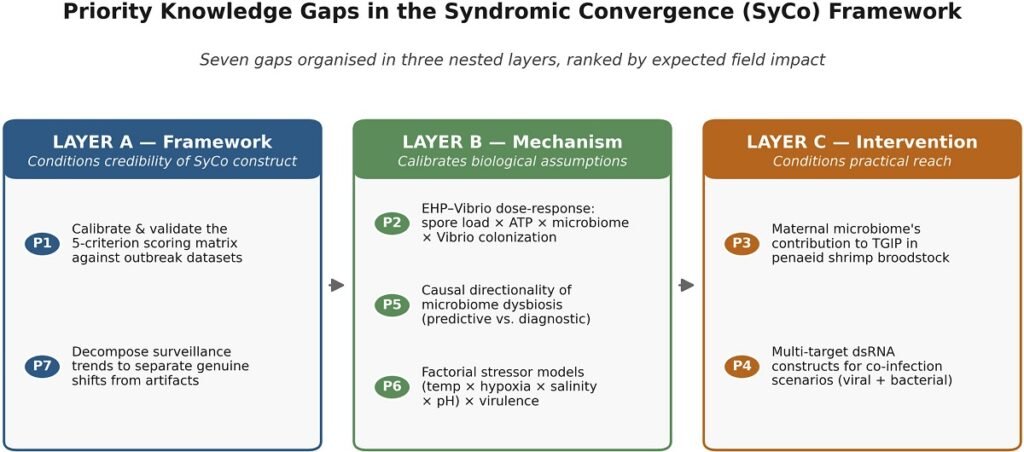
The scientific review identifies key knowledge gaps, prioritized by expected impact. Most urgent is validating the scoring matrix against real-world outbreak data from both controlled experiments and natural events. Until then, it remains a tool for organizing data collection rather than certifying diagnoses.
Additional gaps include quantifying the dose-response relationship between EHP spore load and the gut dysbiosis that enables Vibrio; determining whether maternal broodstock microbiomes influence offspring resilience; and developing RNA construct therapies capable of simultaneously targeting viruses and bacteria during co-infections—an approach currently absent from the literature despite the urgent logic of this framework.
Beyond scientific hurdles, regulatory obstacles loom: in the European Union, RNA tools are classified as GMOs or pesticides, while bacteriophage cocktails occupy a regulatory gray area between feed additives and veterinary pharmaceuticals. In practice, the most promising interventions remain restricted where they are needed most.
Back to the Pond
The producer who received a single pathogen identification from the lab was not given an incorrect answer—they were given an incomplete one. The laboratory reported what was in the water, but missed that temperatures had exceeded 29°C for three consecutive days, dissolved oxygen was crashing at dawn, and a silent parasite had spent weeks depleting cellular energy in the hepatopancreas. Together, those compounding factors were the disease.
Under Altinok’s proposed framework, that diagnostic call would unfold differently: inquiring about environmental trends, temperature logs, recent handling stress, and baseline microbiome shifts. The goal shifts from faster diagnosis to earlier diagnosis—while the crop can still be saved.
Adapting this mindset requires no immediate capital equipment. It simply requires shifting from asking “Which pathogen do I have?” to “Which conditions aligned to make this pathogen matter?” That second question is harder to answer, but it is the only one that prevents an outbreak instead of merely explaining a lost harvest.
Contact
Faculty of Marine Sciences, Department of Fisheries Technology Engineering, Karadeniz Technical University
Trabzon, Türkiye
Email: ialtinok@ktu.edu.tr
Reference (open access)
Altinok, I. (2026). Syndromic Convergence in Aquaculture Disease Management: A Critical Review of Climate-Pathobiome Interactions, Diagnostic Frameworks, and Knowledge Gaps. Reviews in Aquaculture, 18(4), e70189. https://doi.org/10.1111/raq.70189

Editor at the digital magazine AquaHoy. He holds a degree in Aquaculture Biology from the National University of Santa (UNS) and a Master’s degree in Science and Innovation Management from the Polytechnic University of Valencia, with postgraduate diplomas in Business Innovation and Innovation Management. He possesses extensive experience in the aquaculture and fisheries sector, having led the Fisheries Innovation Unit of the National Program for Innovation in Fisheries and Aquaculture (PNIPA). He has served as a senior consultant in technology watch, an innovation project formulator and advisor, and a lecturer at UNS. He is a member of the Peruvian College of Biologists and was recognized by the World Aquaculture Society (WAS) in 2016 for his contribution to aquaculture.