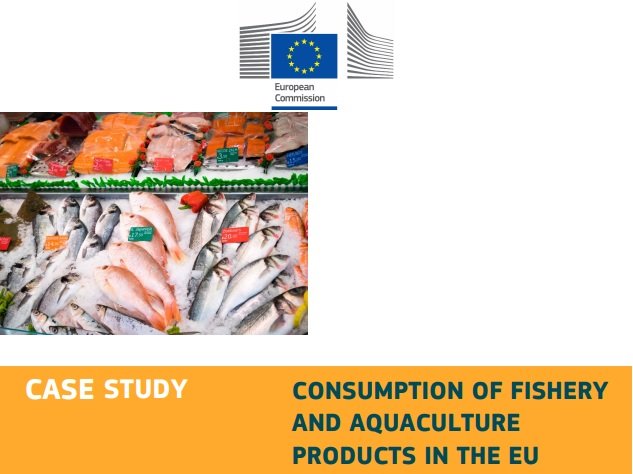
At a supermarket fish counter in Madrid, the ice display tells a story without needing words. Where whole hake, sardines, and bonito stood ten years ago, sealed trays now dominate: portioned salmon loins, clean sea bream fillets, and peeled shrimp ready for the pan. The approaching customer does not ask to have the fish gutted or inquire about the fish market; they grab a tray, check the price per unit—not per kilo—and move on.
This scene, replayed thousands of times a day across Europe, is the visual summary of a profound shift that a new report has just quantified. For those raising fish on an aquaculture farm, these numbers carry a reading that should not be missed.
The July 2026 study, published by the European Commission’s European Market Observatory for Fisheries and Aquaculture Products (EUMOFA), analyzed a full decade of fish and seafood consumption. It is worth clarifying the study’s methodology: the general figures—volumes, per capita consumption, species trends, prices—cover all 27 EU nations and rely on the EUMOFA supply balance and the Eurobarometer survey, which consulted over 26,000 people across the Union.
Conversely, the more granular work—interviews with producers, wholesalers, retailers, and research institutes, alongside the analysis of shifting habits—focused on six representative markets: Spain, France, Italy, Poland, the Netherlands, and Austria, chosen to encompass diverse consumption patterns. With that caveat in mind, the fundamental conclusion is jarring at first glance: Europeans are consuming less fish. Yet, when opening the black box of this decline, a second, far more compelling story emerges for the aquaculture sector. While the total pie shrinks, the share belonging to aquaculture-sourced species expands. Aquaculture is not experiencing the same crisis as fisheries; in several markets, it is occupying the space that wild fisheries leave behind.
- 1 Key Study Takeaways
- 2 Why Fish Consumption Is Declining in Europe
- 3 Aquaculture Fills the Space Left by Fisheries
- 4 Convenience Governs (and Standardizes the Plate)
- 5 Price Matters, But It Does Not Explain Everything
- 6 Sustainability: Still Secondary but Rising
- 7 Back to the Counter
- 8 Entradas relacionadas:
Key Study Takeaways
- Total fish and seafood consumption in the European Union dropped by 21% between 2014 and 2023, with per capita consumption hitting a decade low of 22.9 kg.
- Conversely, aquaculture species—such as salmon, sea bass, sea bream, trout, and shrimp—either stabilized or grew, while many traditional wild-caught species plummeted.
- This trend is driven by more than just consumer preference: supermarkets favor species with predictable supply chains and stable pricing, a factor that heavily benefits farmed and imported products.
- Convenience (ready-to-cook and ready-to-eat products) currently acts as a primary catalyst for consumption, particularly among younger demographics who rarely know how to clean whole fish.
- While price is an influential factor, it does not fully account for the shift; salmon remains the most consumed species in Europe despite its high cost, proving that availability, consumer habits, and brand image dictate choices just as much as the price tag.
Why Fish Consumption Is Declining in Europe
For years, fish was a weekly staple in many European households, especially in coastal southern nations. Portugal and Spain continue to lead per capita consumption; even today, a Spaniard living within five kilometers of the coast eats fish with a frequency that an inland Austrian can hardly imagine.
However, habits are shifting. Apparent consumption in the EU dropped from nearly 13 million tonnes in 2014 to just over 10 million tonnes in 2023. This decline accelerated after 2019, driven by a succession of economic shocks—the health crisis, rising energy costs, and inflation—that disrupted consumer budgets and routines. The most consistent pattern identified by the report is not that people eat smaller portions when they consume fish, but rather that they eat it less frequently. Weekly at-home consumption has plummeted, being replaced by occasional and out-of-home dining at restaurants.
Beneath this trend lies a generational shift that anyone with children will recognize. Younger generations are less accustomed to eating fish, cook less overall, and, crucially, have lost the skill to prepare it. A whole fish—complete with bones and odor—presents an obstacle to many of them, rather than a meal. The report states this bluntly: among the reasons for avoiding fish, the difficulty of preparing and cleaning it ranks increasingly high.
This is where the narrative diverges. Because that very same consumer who avoids whole fish does not shy away from a ready-to-bake salmon fillet, a tuna poke bowl, or sushi. And those products almost always involve species originating from an aquaculture farm or an industrialized supply chain.
Aquaculture Fills the Space Left by Fisheries
Now let us look at the species-by-species breakdown, where the contrast is stark. Cod, historically one of the staples on European plates, plummeted by 43% in a decade, dragged down by quota cuts that left the market undersupplied and drove prices sky-high. Hake declined, mussels declined, and sardines declined.
Mantente siempre informado
Stay Informed
Únete a nuestras comunidades para recibir al instante las noticias, informes y análisis más importantes del sector acuícola.
Join our communities to get instant access to the most important news, reports, and analysis from the aquaculture industry.
On the other side of the counter, salmon remained the most consumed species across the EU, exceeding one million tonnes per year. Warm-water shrimp rose, and tuna, in its various product forms, saw spectacular increases. Furthermore, in countries like Italy and Spain, the report explicitly notes a sharp rise in the consumption of species originating from stable aquaculture supply chains, such as sea bass and sea bream. In Spain, while overall consumption collapsed by 27% in volume between 2015 and 2024, sea bass grew by 29%, sea bream by 5%, and smoked salmon by 18%.
This is no coincidence, and it highlights a key point that the report emphasizes repeatedly: consumption is no longer defined solely by consumer preference, but rather by what the retail system makes accessible. Major supermarkets, which account for nearly 79% of seafood purchases in Europe, structure their offerings around species that solve a business problem. They require year-round volume, predictable pricing, and consistent quality to plan promotions and avoid empty displays. Wild fisheries, subject to quotas, seasonality, and weather conditions, cannot always provide this. Aquaculture can.
This same logic explains why Europe imports around 70% of the fish it consumes. The EU’s domestic production fell by 37% over the decade, almost entirely on the fisheries side. When examining the self-sufficiency levels of the most consumed species, the picture is telling: salmon stands at just 1%, Alaska pollock at 0%, and shrimp at 11%. Among the top six species that account for half of European consumption, only mussels exceed a 50% self-sufficiency rate. Trout (84%) and sea bream (74%), on the other hand, demonstrate the extent to which aquaculture can sustain the domestic supply when wild fisheries fall short.
Convenience Governs (and Standardizes the Plate)
If there is one word that resonates throughout the entire report, it is convenience. In the six countries studied—Spain, France, Italy, Poland, the Netherlands, and Austria—operators, moving past the debate over origin (wild-caught versus farmed), delivered the same diagnostic: consumers demand a product that is easy to prepare, portioned, packaged, ready to cook, or directly ready to eat.
This presents a massive opportunity for farmed species, as they are precisely the ones best suited for these formats. A study cited in the report found that consumers are willing to pay an extra half-euro per kilogram for a ready-to-cook product compared to a whole fish. Fillets, boneless portions, smoked options, and modified atmosphere packaging all add value, and they align far better with salmon, trout, sea bass, or sea bream than with highly variable wild-caught fish from the daily market auction.
However, the report also raises a yellow flag. This same drive toward convenience is standardizing consumption around a mere handful of species. When the seafood counter shrinks to salmon, tuna, shrimp, and two or three others, consumers lose sight of the vast diversity of fish available and, crucially, lose a sense of seasonality. For aquaculture, this is a double-edged sword: it opens doors if you produce one of those dominant species, but narrows the market for those wagering on diversification.
Price Matters, But It Does Not Explain Everything
Every producer understands that recent inflation hit consumer pockets hard, and seafood was no exception. Fish and seafood prices escalated by around 45% since 2015—a pace comparable to meat—reinforcing the perception of seafood as a luxury item and driving some consumers toward cheaper proteins like chicken or eggs, or more affordable fish species.
However, as repeatedly stressed in the report’s interviews, price alone cannot account for consumer behavior. The prime example is salmon: expensive, yet still Europe’s number one species. If price were the sole driver, this would not be the case; what sustains salmon is a combination of year-round availability, established habits, a healthy product image, and ease of preparation. In other words, salmon won because coordinated campaigns, convenient formats, and constant shelf presence created a product that European families incorporate into their routines without a second thought.
This is likely the study’s most valuable lesson for the sector: it is not just about producing more cheaply, but about delivering something that the consumer perceives as reliable, available, and easy to prepare.
Sustainability: Still Secondary but Rising
A fourth factor is growing slowly but steadily: environmental, social, and ethical considerations. While it still trails behind price, appearance, and convenience during purchasing decisions—and carries more weight among younger consumers and in northern countries—it is reshaping markets. In the Netherlands, for instance, supermarkets now exclusively stock species classified as sustainable according to tools like the VISwijzer seafood guide, completely removing those flagged in red.
For aquaculture, this represents a favorable playing field. Certification and traceability, often perceived as operational costs, are turning into entry keys for European retail, especially in the north. The report notes that these considerations carry more weight in business-to-business (B2B) relationships than at the final checkout, which is precisely the link where the producer negotiates.
Back to the Counter
That Madrid fish counter, with its sealed trays of sea bream and salmon where whole hake once stood, is no longer an anomaly. It is the map of the European market as redrawn after a decade of crises, shifting habits, and price pressures.
The big picture indicates that Europe is consuming less fish. However, the fine print—the part that matters to anyone standing on the edge of a pond or next to a cage—reveals something else: the fish that Europe does continue to eat is, increasingly, farmed fish. Salmon, trout, sea bream, sea bass, and shrimp—the species that offer what the supermarket requires and what the rushed consumer seeks—are not merely gathering the scraps. They are taking the space that wild fisheries leave open.
The challenge for the aquaculture producer is not, therefore, to row against an ebbing tide. It is to understand that the tide is shifting, and to position oneself exactly where the water is rising.
Reference (open access)
European Market Observatory for Fisheries and Aquaculture Products. (2026). Consumption of fishery and aquaculture products in the EU (KL-01-26-030-EN-N). Publications Office of the European Union. https://doi.org/10.2771/1497235

Editor at the digital magazine AquaHoy. He holds a degree in Aquaculture Biology from the National University of Santa (UNS) and a Master’s degree in Science and Innovation Management from the Polytechnic University of Valencia, with postgraduate diplomas in Business Innovation and Innovation Management. He possesses extensive experience in the aquaculture and fisheries sector, having led the Fisheries Innovation Unit of the National Program for Innovation in Fisheries and Aquaculture (PNIPA). He has served as a senior consultant in technology watch, an innovation project formulator and advisor, and a lecturer at UNS. He is a member of the Peruvian College of Biologists and was recognized by the World Aquaculture Society (WAS) in 2016 for his contribution to aquaculture.