The global aquaculture sector is undergoing an unprecedented transformation, driven by the dual imperatives of climate adaptation and technological innovation. As environmental dynamics shift, the industry must transition from traditional sustainability frameworks toward robust, site-specific resilience strategies capable of safeguarding global food security. Navigating this evolution requires a multifaceted approach that addresses not only production systems and value chains but also public perception, policy frameworks, and knowledge democratization.
To address these critical challenges, the upcoming Aquaculture Europe 2026 (AE2026) conference will gather some of the world’s leading experts to share actionable pathways for the sector’s future. This year’s plenary program features high-impact sessions led by pioneering researchers, digital storytellers, and policy consultants. Below, we introduce the distinguished plenary speakers who will drive the conversation on climate resilience, global communication strategies, and the transition toward net-zero emissions.
Aquaculture: From Sustainability to Resilience
Speaker: Jurica Jug-Dujaković (MJD Consulting, Croatia)
Despite being one of the fastest-growing food sectors, aquaculture faces serious threats from global change that will inevitably affect its productivity and sustainability. Climate change will obviously have direct and indirect effects—not only on cultured species, but also on supply and product prices, including feed ingredients as well as goods and services required by aquaculture producers. Numerous reports illustrate that climate change effects on aquaculture will vary depending on geographical areas, economy, climatic zones, production systems, and cultured species.
As we move from “Sustainable Aquaculture” to “Resilient Aquaculture”, this presentation will assess cultured species and the resilience of production systems. It will also review new technologies, production methods, and management strategies as a first step towards enhancing aquaculture production in response to climate change. Understanding these variables is essential for assessing the vulnerability of aquaculture systems and developing site-specific adaptation strategies that will also contribute to food security expectations.
There are already small-scale examples combining aquaculture production with other agricultural strategies, either as integrated or separate systems, resulting in a symbiotic circularity. These technological and ecological innovations offer actionable pathways for climate adaptation and mitigation in both marine and freshwater environments; several of these case studies will be presented during the session.
About Jurica Jug-Dujaković
Prof. Jurica Jug-Dujaković is the Head of the Biotechnology Department at MJD Advisory and Development. With a career spanning scientific research, academia at the University of Dubrovnik, and international consultancy, he is a recognized World Bank expert on aquaculture and seafood markets. During his tenure in the United States, he designed the first commercial closed recirculation nursery and co-designed an advanced commercial aquaponics facility. An accomplished author with more than 200 papers, he holds two national patents and an internationally protected industrial design.
Breaking the Bubble: Making Aquaculture’s Stories Go Global
Speakers: Larissa Lewis (SALT, UK) & James Sibley (Aquaculture Creator, USA)
Despite rapid advances across farming systems, nutrition, health, and technology, much of the sector’s progress remains largely invisible outside industry and research circles. As a result, aquaculture continues to face challenges around public understanding, workforce recruitment, investment confidence, social acceptance, and the visibility of research and innovation. This combined presentation explores how aquaculture stories can move beyond this industry bubble—and what happens when they do.
Mantente siempre informado
Stay Informed
Únete a nuestras comunidades para recibir al instante las noticias, informes y análisis más importantes del sector acuícola.
Join our communities to get instant access to the most important news, reports, and analysis from the aquaculture industry.
Part 1 — Larisa Lewis: How Aquaculture Stories Travel
Aquaculture research generates a vast amount of knowledge, yet much of this data remains difficult for wider audiences to discover. The challenge is not simply communication, but how knowledge is structured, translated, and discovered. Research outputs are typically designed for documentation: papers, reports, and conference presentations. These formats are essential, but they are not tailored for many of the audiences who shape the sector’s future—including entrepreneurs, investors, policymakers, future workers, and the wider public.
This presentation explores how aquaculture knowledge can be translated into formats designed for different audiences, from optimizing the user experience of knowledge platforms to producing film-led storytelling about the sector.
For research and innovation, this has growing importance. Producing knowledge is only one part of impact. Increasingly, researchers are expected to ensure their work is visible, discoverable, and meaningful beyond journals, reports, and conferences. Designing how aquaculture knowledge is structured and presented therefore becomes an essential part of how research and innovation reach wider audiences.
About Larisa Lewis
Larisa Lewis is a marine biologist specializing in the intersection of aquaculture, marketing, and commercial storytelling. Her background includes developing cultivation protocols for low-trophic species across the UK, Sweden, and Norway, as well as managing operational realities at Seaweed Solutions. After directing editorial and social strategies at The Fish Site, she currently serves as Head of Operations at SALT, where she helps build purpose-led brands for sustainable food innovators.
Part 2 — James Sibley: What Happens When Aquaculture Stories Reach Millions
If storytelling pathways allow aquaculture knowledge to travel beyond the sector, digital media determines how far those stories can ultimately reach—and who encounters them first. For many people, platforms such as YouTube, Instagram, and TikTok are now the first place they encounter aquaculture.
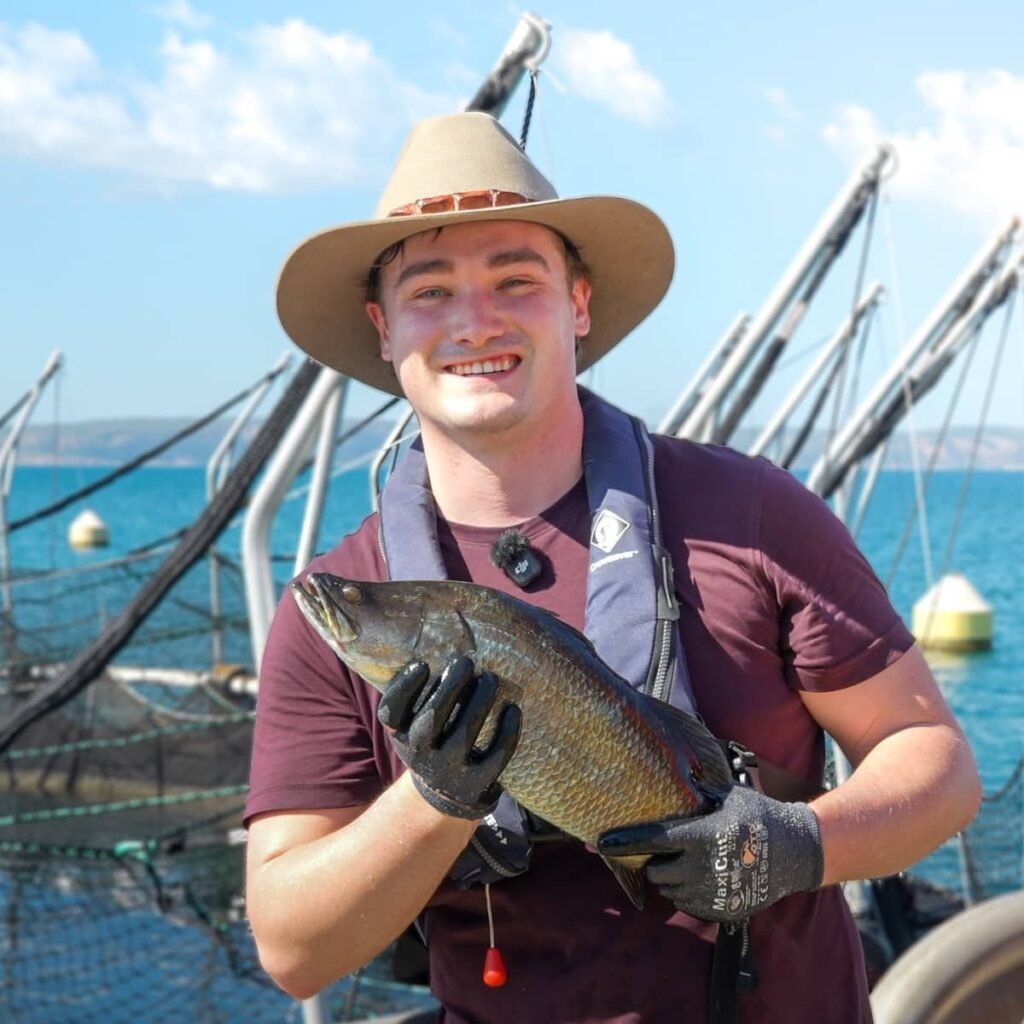
Through his online channels, aquaculture creator James Sibley brings global audiences directly inside farms, hatcheries, and research facilities. His films translate complex farming systems, technologies, and research into visual stories that reach millions of viewers and reveal how aquaculture production actually operates.
Drawing on filming experiences across countries including Scotland, New Zealand, Australia, and The Falklands, this presentation shares practical lessons from bringing aquaculture to large public audiences. It explores where common misconceptions about the sector tend to arise and how complex research and technologies can be explained clearly to wider audiences while maintaining scientific credibility.
These experiences illustrate how communication is becoming an increasingly important part of aquaculture’s development. When research and innovation are translated through formats that people actively engage with, they reach far beyond traditional industry channels—helping the sector become more visible, better understood, and better equipped to build long-term public trust.
About James Sibley
James Sibley is an aquaculture digital creator and biologist (B.S., Northeastern University) with a social media audience of over half a million followers. He produces high-impact, documentary-style video content that brings transparency and scientific credibility to global seafood production. His professional experience includes field operations and novel communications for Mowi Scotland, and he is currently dedicated to expanding his visual storytelling globally to capture evolving practices in aquatic cultivation.
Towards Net Zero by 2050 and Energy-Efficient EU Aquaculture Production
Speaker: Callum Howard (Senior Consultant, MRAG, UK)
The climate crisis poses fundamental challenges for aquaculture, reshaping not only what, how, and where we farm, but placing the sector under pressure to meet legally mandated greenhouse gas (GHG) emission reduction targets. Meeting these targets demands cross-cutting action across the entire value chain, requiring coordinated efforts from researchers, industry, and policymakers alike.
While viable solutions exist to reduce GHG emissions from aquaculture, achieving widespread adoption remains complex. High investment costs and operational demands present particular difficulties for an industry dominated, at the EU level, by SMEs. Other promising solutions remain confined to pilots or research projects due to regulatory and political barriers, alongside inadequate knowledge transfer mechanisms. Low-trophic aquaculture is frequently presented as a panacea; while it can deliver genuine environmental benefits, realizing its potential at scale requires overcoming significant barriers related to market development, spatial planning, and regulatory frameworks.
This presentation examines the pathways to achieving net zero in EU aquaculture, drawing on recent European Commission studies on emission reduction costs and pathways, as well as the challenges and opportunities for implementing lower trophic production in Europe. It covers recommendations for carbon neutrality pathways and addresses the policy, regulatory, and economic barriers that must be overcome to enable systemic change.
About Callum Howard
Dr. Callum Howard is a Senior Consultant at MRAG, specializing in bridging the gaps between academic research, evidence-based policy, and commercial practice. He holds a PhD and an MSc in Aquaculture from the University of Stirling’s Institute of Aquaculture. Throughout his career, he has advised the World Bank, UNIDO, the European Commission, and private investors across Europe, Africa, Asia, North America, and the Middle East on digital transformation, training, and GHG reduction pathways.

Editor at the digital magazine AquaHoy. He holds a degree in Aquaculture Biology from the National University of Santa (UNS) and a Master’s degree in Science and Innovation Management from the Polytechnic University of Valencia, with postgraduate diplomas in Business Innovation and Innovation Management. He possesses extensive experience in the aquaculture and fisheries sector, having led the Fisheries Innovation Unit of the National Program for Innovation in Fisheries and Aquaculture (PNIPA). He has served as a senior consultant in technology watch, an innovation project formulator and advisor, and a lecturer at UNS. He is a member of the Peruvian College of Biologists and was recognized by the World Aquaculture Society (WAS) in 2016 for his contribution to aquaculture.