The aquaculture industry relies heavily on submerged plastic infrastructure; however, global concern regarding cultivation netting as a source of microplastics (MPs) has escalated significantly. In regions such as Norway, it is estimated that fisheries and aquaculture could release between 1,000 and 10,000 tons of these particles annually. In response to this scenario, cutting-edge research analyzes how material selection, coatings, and cleaning technologies determine the magnitude of these emissions.
In a standard farming site, nets constitute approximately 75% of the submerged surface area. Historically, the scientific community lacked precise data on mesh fragmentation during operational cycles or following biofouling removal processes. Nevertheless, a multidisciplinary team led by SINTEF Ocean has published a comparative analysis in the journal Aquaculture that promises to transform the sector’s sustainability through scientific rigor.
Key Industry Insights
- Nylon Under Scrutiny: Uncoated nylon nets release up to five times more microplastics than polyethylene alternatives (HDPE and UHMWPE).
- The Coating Dilemma: Applying “premium” protective layers to nylon nets can, paradoxically, double particle release due to poor adhesion and flaking.
- Robotic Cleaning to the Rescue: The use of preventative brushing via Autonomous Underwater Vehicles (AUVs) causes significantly less structural damage to coatings than traditional high-pressure or cavitation washing.
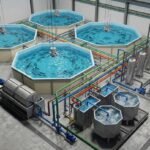
- Land-Based Filtration: Onshore service stations manage to capture nearly all microplastics through multi-stage filtration systems before returning water to the sea.
From the Laboratory to the Norwegian Fjord: A Three-Tiered Methodology
To decipher the impact of these infrastructures, researchers integrated a three-phase analytical framework that bridges laboratory precision with open-sea operational reality:
Technical Abrasion Simulation
At the SINTEF Industry facilities, the MILA 200 WET system was employed to subject netting panels—both new and used—to friction processes under controlled moisture conditions. The study compared three critical polymers:
- Nylon (PA): The conventional standard composed of fine multifilaments.
- High-Density Polyethylene (HDPE): Characterized by larger-gauge monofilaments.
- Ultra-High-Molecular-Weight Polyethylene (UHMWPE): A cutting-edge fiber with superior resistance properties.
Accelerated Cleaning Experiment
An experimental cage was installed in Frøya, Norway, segmented into panels with varying coating qualities (standard and premium). These were subjected to an intensive maintenance cycle equivalent to 10 months of operation, evaluating three disruptive technologies:
- Pressure Washing: Direct application at 130 bar.
- Cavitation Cleaning: Based on the collapse of micro-bubbles to remove biofouling.
- Preventative AUV Brushing: Utilization of Autonomous Underwater Vehicles equipped with horsehair bristles.
Validation in Commercial Environments
Finally, the team validated the findings at an active salmon farm, measuring real-time emissions during conventional cleaning operations. During this phase, the effect of external variables—such as the perimeter “skirts” used for sea lice protection—was also evaluated.
Materials and Resistance: The Structural Vulnerability of Nylon
The research conducted controlled abrasion tests comparing new and operational nets made of three fundamental polymers: Nylon, High-Density Polyethylene (HDPE), and UHMWPE. The results yielded decisive conclusions: Nylon, being composed of highly fine multifilaments, exhibits an intrinsic susceptibility to mechanical wear that is superior to the robust monofilaments of HDPE or the structural integrity of UHMWPE.
A critical finding lies in the interaction between the materials and the antifouling and UV-protection coatings. On nylon nets, the protective film tends to have superficial adhesion, leading to laminar shedding or “flaking” during its operational life, thereby increasing the total volume of microplastics released into the environment. In contrast, UHMWPE nets facilitate deep penetration of the coating into the fibers, establishing a more resilient and durable barrier against erosion.
Impact of In-Situ Cleaning Technologies on Net Integrity
To ensure optimal oxygenation and the welfare of biological assets, nets undergo periodic cleanings that can occur as frequently as once a week. The study evaluated three methodologies under real operational conditions:
Mantente siempre informado
Stay Informed
Únete a nuestras comunidades para recibir al instante las noticias, informes y análisis más importantes del sector acuícola.
Join our communities to get instant access to the most important news, reports, and analysis from the aquaculture industry.
- Pressure Washing: Application of high-velocity water jets (approx. 130 bar).
- Cavitation Cleaning: Based on the implosion of micro-bubbles to remove fouling organisms.
- Preventative Brushing (AUV): Robotic systems that perform daily cleanings with soft horsehair bristles, preventing biofouling consolidation.
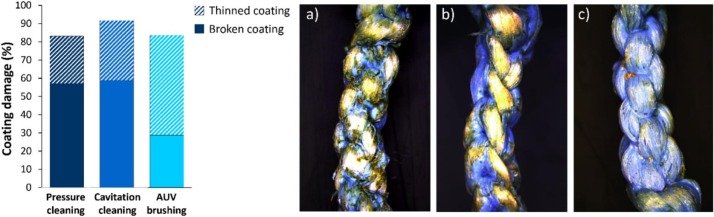
Through microscopic analysis, it was confirmed that both pressure washing and cavitation caused severe structural damage—identified as “sharp-edged breaks”—in 57% and 59% of the coating, respectively. Conversely, robotic brushing resulted in uniform, low-aggression wear, preserving the mesh’s integrity and extending its service life.
Operational Challenges and Land-Based Mitigation Solutions
Monitoring at commercial farming sites revealed that microplastic release is a sporadic phenomenon, highly conditioned by operational variables. For instance, it was observed that sea lice skirts act as temporary barriers that retain particles, delaying their dispersion into the surrounding water column.
Concurrently, the research identifies a critical optimization opportunity at onshore service centers. Processing plants that integrate multi-stage filtration systems, chemical flocculation, and ozonation manage to mitigate microplastic presence to residual levels (0.05 particles per liter) before discharging or recirculating the effluent.
Despite these advances, the study warns of a persistent technical complexity: background contamination. During open-sea trials, control samples showed microplastic concentrations equivalent to those obtained during cleaning operations. This saturation of the marine ecosystem by external sources (shipping traffic, coatings, and port activity) complicates the chemical traceability of the particles. Nevertheless, through FTIR spectroscopy, a specific increase in polyamide was identified at sites without protective skirts, confirming that aquaculture infrastructure contributes episodically to the local pollutant load.
Conclusion: Toward Low-Emission Aquaculture
The mitigation of microplastics in the aquaculture industry does not rely on a single solution but on the synergistic optimization of materials, coatings, and maintenance protocols. The transition toward polymers such as HDPE or UHMWPE, alongside the implementation of low-abrasion cleaning technologies—such as robotic brushing or controlled filtration systems—represents immediate actions to bolster the sector’s sustainability.
Contact
Andy M. Booth
SINTEF Ocean AS, Trondheim, Norway
Email: andy.booth@sintef.no
Nina Bloecher
SINTEF Ocean AS, Trondheim, Norway
Email: nina.bloecher@sintef.no
Reference (open access)
Booth, A. M., Gomiero, A., Piarulli, S., Føre, H. M., Kubowicz, S., Stránský, P., Bondø, M. S., Hatlebrekke, H. H., Igartua, A., & Bloecher, N. (2026). Comparative analysis of microplastic release from aquaculture nets under different material, coating, and cleaning technology scenarios. Aquaculture, 620, 743910. https://doi.org/10.1016/j.aquaculture.2026.743910

Editor at the digital magazine AquaHoy. He holds a degree in Aquaculture Biology from the National University of Santa (UNS) and a Master’s degree in Science and Innovation Management from the Polytechnic University of Valencia, with postgraduate diplomas in Business Innovation and Innovation Management. He possesses extensive experience in the aquaculture and fisheries sector, having led the Fisheries Innovation Unit of the National Program for Innovation in Fisheries and Aquaculture (PNIPA). He has served as a senior consultant in technology watch, an innovation project formulator and advisor, and a lecturer at UNS. He is a member of the Peruvian College of Biologists and was recognized by the World Aquaculture Society (WAS) in 2016 for his contribution to aquaculture.