Smoltification, or the parr-smolt transformation, is a critical and complex process in which juvenile salmonids undergo physiological preparation in freshwater to survive in marine environments. In intensive aquaculture, this process represents a fundamental bottleneck: incomplete or poorly synchronized smoltification leads to stunted growth, increased susceptibility to infectious diseases, and mortality following sea-cage transfer.
A recent comprehensive review published in the North American Journal of Aquaculture by Jesse T. Trushenski et al. analyzes how science has evolved from merely observing this phenomenon since 1830 to controlling it through sophisticated lighting techniques and functional nutrition.
- 1 Key Conclusions for the Industry
- 2 The Osmoregulation Challenge: The Freshwater-to-Ocean Transition
- 3 Induction Methods in Aquaculture
- 4 Is There a “True Smolt”? The Scientific Debate
- 5 Research Gaps and Limitations
- 6 Success Indicators: When is the Fish Ready?
- 7 General Conclusion of the Study
- 8 Entradas relacionadas:
Key Conclusions for the Industry
- Essential Synchronization: Controlled smoltification is vital for aligning production schedules and ensuring animal welfare.
- Consolidated Photoperiod: The use of a “winter signal” (short days) followed by continuous light remains the standard method for Atlantic salmon.
- Dietary Innovation: Diets that stimulate calcium-sensing receptors (CaSR) allow for smoltification under continuous light, thereby maximizing pre-transfer growth.
- Species-Specific Differences: While Atlantic salmon respond well to light, rainbow trout (O. mykiss) are less responsive to photoperiod and benefit more from dietary stimulation.
- Smoltification Window: The use of specialized functional feed can double the duration the fish remains “sea-ready” compared to traditional photoperiod methods.
The Osmoregulation Challenge: The Freshwater-to-Ocean Transition
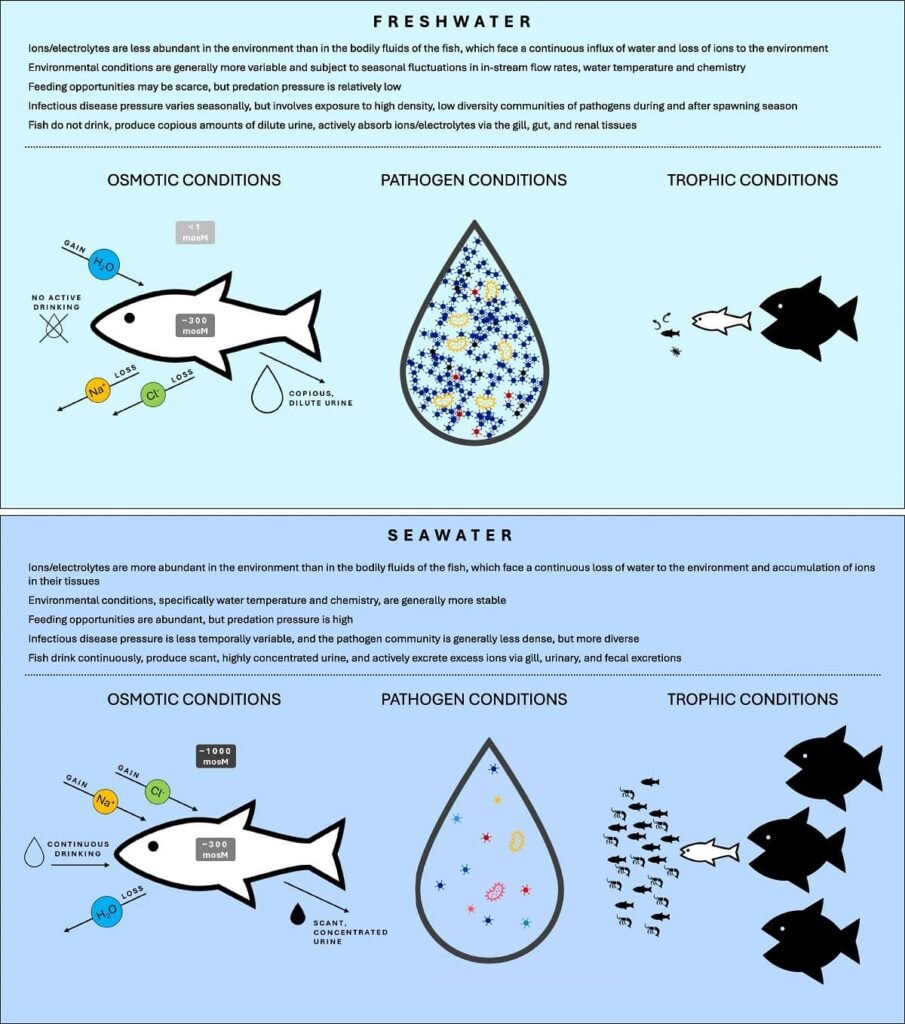
A fish’s survival during migration depends on a radical physiological transformation. The specimen must adapt its organism from a hyposmotic medium (freshwater), where it tends to gain water and lose salts, to a hyperosmotic one (marine), which necessitates continuous water ingestion and the active excretion of excess electrolytes.
During the smoltification process, the gills undergo profound cellular remodeling. In this phase, freshwater-adapted chloride cells—characterized by the isoform—are replaced or supplemented by specialized cells for the marine environment ( isoform). This phenomenon occurs while the fish still remains in freshwater, giving rise to the critical period known as the “smoltification window.”
To understand the relevance of these strategies, it is vital to analyze the underlying physical challenge. In freshwater, fish are hyperosmotic relative to their environment: water constantly penetrates their tissues while electrolytes attempt to escape. In the ocean, this dynamic is completely reversed, forcing the system to reconfigure itself to prevent dehydration.
Physiological Comparison: Environmental Adaptation
| Feature | Freshwater (Parr) | Saltwater (Smolt) |
| Behavior | Avoid active water ingestion. | Continuous ingestion to maintain hydration. |
| Renal Excretion | Large volumes of highly dilute urine. | Scanty and highly concentrated urination. |
| Branchial Function | Active uptake of and . | Active export of and . |

Finally, smoltification “remodels” the branchial architecture, substituting the alpha-1a isoform of the sodium-potassium ATPase enzyme (predominant in freshwater) with the alpha-1b isoform, a key component for homeostasis in the marine environment.
Induction Methods in Aquaculture
Photoperiod Manipulation
Since the 1990s, the salmon industry has employed light control to synchronize the biological clocks of fish. This method consists of applying a “winter signal” (short-day photoperiod, typically 12 hours of light and 12 of darkness) for a period of 6 to 8 weeks. Subsequently, exposure to continuous light or long days acts as a “spring signal,” ultimately triggering the smoltification process.
Analysis of the Lighting Strategy
While this procedure is a consolidated method that does not require specialized diets, its implementation entails critical challenges that affect production efficiency:
- Metabolic Restriction: During the “artificial winter” phase, feeding opportunities are lost, resulting in a reduction of the fish’s condition factor prior to sea transfer.
- Infrastructure Limitations: It requires costly facilities equipped with high-precision controlled lighting systems.
- The Smoltification Window: Once the specimen enters this phase under light stimulus, time becomes a determining factor. The fish has a limited margin (approximately 500 degree-days) before desmoltification (reversal of the process) occurs if it is not transferred to the marine environment in a timely manner.
In summary, although photoperiod control is an effective tool for population synchronization, the loss of biomass and the rigidity of transfer timelines force producers into extremely precise logistical management.
Mantente siempre informado
Stay Informed
Únete a nuestras comunidades para recibir al instante las noticias, informes y análisis más importantes del sector acuícola.
Join our communities to get instant access to the most important news, reports, and analysis from the aquaculture industry.
Dietary Stimulation of Calcium-Sensing Receptors (CaSR): The New Aquacultural Frontier
The current frontier in aquaculture is diet-induced smoltification, a strategy based on the ability of salmonids to detect changes in water chemistry through calcium-sensing receptors (CaSR). These receptors act as biological salinity sensors, allowing the fish to initiate its physiological transformation in response to specific nutritional stimuli.
Unlike traditional methods based on “salt feeds” ($NaCl$), which often resulted in partial acclimation and poor growth, latest-generation functional diets employ a synergistic combination of:
- Divalent Cations (Calcium and Magnesium): These function as direct ligands for the CaSR receptors.
- Free Tryptophan: An essential amino acid that increases the sensitivity of these receptors to the presence of calcium.
Cost-Benefit Analysis of the Nutritional Strategy
This approach allows specimens to complete smoltification under continuous light regimes, maximizing growth potential in the freshwater phase and ensuring that the fish reach the marine environment with greater robustness.
| Aspect | Technical Consideration |
| Primary Advantage | Maximizes growth and is highly effective for the re-smoltification of fish that have reverted to the parr state. |
| Critical Limitation | Success strictly depends on active intake; extremely low temperatures that reduce appetite may compromise the method’s effectiveness. |
Is There a “True Smolt”? The Scientific Debate
One of the historical criticisms of dietary methods was whether they produced a “true smolt” or merely a fish with temporary salt tolerance. Trushenski’s review is clear: the molecular indicators ( expression) and physiological markers (seawater challenge survival) are equivalent between light-treated and diet-treated fish. The only notable difference is the condition factor. Diet-induced smolts do not lose the robust appearance characteristic of the parr stage, which is an advantage for farmers as the fish enters the marine stage with superior energy reserves.
The Case of Rainbow Trout and Other Facultative Species
Unlike Atlantic salmon, which is an obligate anadromous species, others such as rainbow trout (O. mykiss) exhibit facultative anadromy. In these species, the photoperiod response is weak or non-existent. Historically, it was believed that sea transfer for trout depended solely on size, but high morbidity rates suggest this is an error. Recent studies show that the use of smoltification feeds induces positive changes in branchial enzyme activity in trout, improving subsequent performance at sea.
Research Gaps and Limitations
Despite advancements, science still faces “known unknowns”:
- Rainbow Trout: Remains the “difficult child” of smoltification, showing notable resistance to photoperiod signals.
- Giant Smolts: There is an industry trend toward producing smolts up to 2 kg on land. It is unclear if traditional readiness metrics remain valid for such large individuals.
- Early Maturation: Intensive light use and high temperatures to accelerate growth may inadvertently trigger precocious sexual maturation, reducing product quality.
Success Indicators: When is the Fish Ready?
To prevent post-transfer failure, several benchmarks are utilized:
- Smolt Index: Visual assessment of silvering, fin darkening, and the disappearance of parr marks.
- Activity: Direct measurement of the enzyme or molecular analysis of its isoforms. The fish is considered ready when the ratio of exceeds 2.
- Seawater Challenges: 24 to 96-hour survival tests in hypersaline water, monitoring plasma osmolality.
General Conclusion of the Study
Predictive control of smoltification has consolidated as a fundamental pillar, not only to guarantee post-transfer survival but also to optimize growth and immunocompetence in salmonids. Current scientific evidence confirms that both photoperiod and dietary intervention are highly effective tools; however, their implementation must be strictly customized according to the species and biometric objectives of each farming site.
This review highlights a paradigm shift: smoltification is no longer viewed as a process linked exclusively to the specimen’s weight. Today, it is understood as a multidimensional interaction between genetics, environmental variables, and specialized nutrition. In this scenario, recognizing that this phenomenon impacts processes beyond basic osmoregulation is decisive for elevating animal welfare standards in the global industry.
The knowledge frontier now lies in the adoption of nutritional strategies based on receptors. This approach grants producers unprecedented operational flexibility, allowing physiological preparation to be decoupled from seasonal light cycles. By integrating these technologies, the industry not only improves biological efficiency but also ensures a more robust and resilient transition of the fish to the marine environment.
Contact
Jesse T. Trushenski
Nordly Holding, Lofoten Bio Centre, Leknes, Norway
Email: jesse.trushenski@nordly.no
Reference (open access)
Jesse T Trushenski, Eduardo Aguilera, Mathias Andersen, Mette Sørensen, Richard Torrissen, Smoltification strategies in intensively cultured salmonids, North American Journal of Aquaculture, 2026;, vrag001, https://doi.org/10.1093/naaqua/vrag001

Editor at the digital magazine AquaHoy. He holds a degree in Aquaculture Biology from the National University of Santa (UNS) and a Master’s degree in Science and Innovation Management from the Polytechnic University of Valencia, with postgraduate diplomas in Business Innovation and Innovation Management. He possesses extensive experience in the aquaculture and fisheries sector, having led the Fisheries Innovation Unit of the National Program for Innovation in Fisheries and Aquaculture (PNIPA). He has served as a senior consultant in technology watch, an innovation project formulator and advisor, and a lecturer at UNS. He is a member of the Peruvian College of Biologists and was recognized by the World Aquaculture Society (WAS) in 2016 for his contribution to aquaculture.