How Digitalization and Robotics Are Turning Microalgae Farming Into a Reliable Feed Source for Fish and Shrimp.
It is five in the morning, and before even having coffee, an aquaculture farm manager in Latin America is already checking international fishmeal prices. This is no new habit. For years, every regional conflict, extreme weather event, or global logistics crisis has converted almost immediately into an email from his supplier announcing yet another feed price hike. He cannot control the weather or international markets; the only variable within his grasp is what he puts into his fish feeders.
This sense of being at the mercy of external factors is arguably the most shared sentiment across today’s aquaculture industry. It is also precisely the challenge a group of researchers from Malaysia, Estonia, and Romania—led by Chin Fhong Soon from the Institute for Integrated Engineering at Universiti Tun Hussein Onn Malaysia, and published in Aquaculture International—has just addressed in a review proposing a new framework for large-scale microalgae production: “Algae Industry 5.0.”
- 1 Key Study Takeaways
- 2 Microalgae Are No Longer Just an Ingredient; They Are an Industry Requiring Radical Reinvention
- 3 The Industry’s Progress With Sensors and Automation
- 4 Current Systems Alert but Do Not Act—The Ultimate Bottleneck
- 5 Therefore, the Five-Layer Framework of Algae Industry 5.0 Is Born
- 6 The Human Face Behind the Numbers: Trial, Error, and Teamwork
- 7 Traceability and Trust: Blockchain Enters the Supply Chain
- 8 The Metrics Every Producer Wants to See
- 9 The Obstacles Still Hindering Mass Adoption
- 10 Returning to the Aquaculture Producer
- 11 Entradas relacionadas:
Key Study Takeaways
- Microalgae already work as feed; the hurdle is cost-effective, large-scale production. Rich in protein, omega-3s, pigments, and antioxidants, microalgae can replace up to 15% of fishmeal and fish oil without hindering fish growth. The bottleneck is economic rather than biological: cultivation and processing costs remain high, ranging between 1 and 10 USD per kilogram of dry biomass.
- Current technology alerts but does not act. While IoT sensor monitoring systems detect issues like nutrient deficiencies or contamination, they cannot make decisions or execute adjustments autonomously. Industry 5.0 aims to bridge this gap—between detection and resolution—through collaborative robots (cobots) and automated harvesting and drying.
- The proposed model features five distinct layers rather than just a surge in sensors. It integrates physical, digital, intelligence (AI and digital twins), human (man-machine collaboration), and sustainability layers. The core of the 5.0 approach is that technology augments human judgment rather than replacing it, which is vital since the biological behavior of microalgae remains difficult to predict with absolute precision.
- AI optimization is already yielding concrete results. In a neural network experiment, automatically adjusting cultivation variables (carbon-to-nitrogen ratios, light, and aeration) tripled biomass production and increased lipid yields sevenfold in Chlorella sorokiniana—proving that digital precision translates directly into tangible productivity.
- Circular economy principles and blockchain are cornerstone components. Utilizing agricultural waste or wastewater as nutrients can slash cultivation costs by 40% to 60%. Meanwhile, blockchain enables the certification of feed origin and quality throughout the supply chain, fostering trust among buyers and regulators alike.
Microalgae Are No Longer Just an Ingredient; They Are an Industry Requiring Radical Reinvention
For years, microalgae have been hailed as the most promising alternative to fishmeal and fish oil. They are rich in protein, omega-3 fatty acids, pigments, and antioxidants, and can be cultivated on arable-deficient land, even utilizing wastewater as a nutrient source. The dilemma has never been whether microalgae function effectively as feed—that has already been well established—but rather whether they can be produced at a cost and scale that make commercial sense. It is precisely here, according to this comprehensive review of over 200 scientific studies, that the industry has hit a standstill.
The Industry’s Progress With Sensors and Automation
Over the last decade, the sector has made considerable strides thanks to what researchers term “Algal Industry 4.0”: Internet of Things (IoT)-connected sensors, artificial intelligence, and automation that enable real-time monitoring of variables such as pH, temperature, dissolved oxygen, and nutrient levels within cultivation tanks. In certain instances, these systems have already yielded concrete results; for example, a decision-making model tested years ago achieved a 9% increase in simulated cultivation productivity simply by providing timely alerts for parameter adjustments.
Current Systems Alert but Do Not Act—The Ultimate Bottleneck
This is the exact problem the authors pinpoint with absolute clarity, and one that any commercial producer will immediately recognize: current technology detects issues but does not resolve them. A sensor can flag low nutrient levels, but it cannot determine how much fertilizer to apply or when to distribute it; that decision still relies, minute by minute, on human intervention. Furthermore, the most labor-intensive tasks—such as harvesting, drying, and filtering biomass—remain manual, slow, and grueling processes.
Compounding this is a more subtle obstacle: open raceway ponds are cost-effective to construct but highly vulnerable to contamination and evaporation, resulting in low biomass concentrations. Conversely, closed photobioreactors offer higher yields and purity but consume excessive energy for artificial lighting and climate control. It is, quite literally, a trade-off between two distinct challenges, and neither option alone solves the cost-benefit equation required by commercial farms.
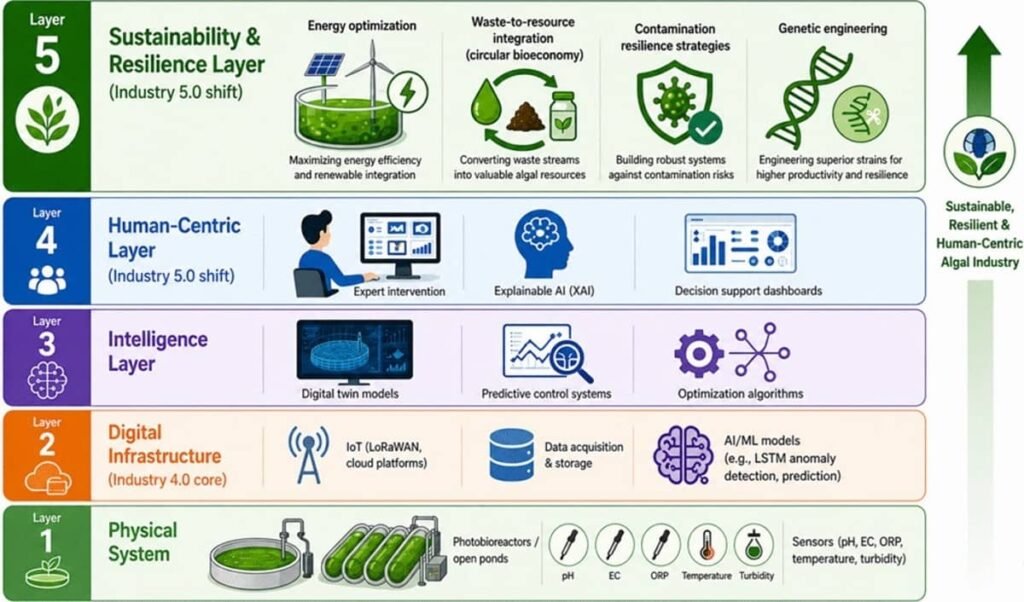
Therefore, the Five-Layer Framework of Algae Industry 5.0 Is Born
The core proposal of this study is a five-layer model that goes far beyond merely adding more sensors. It is helpful to think of it like a well-designed pond filtration system: having a powerful pump (technology) is not enough; water must also circulate intelligently (the digital layer), the system must learn from variations (the intelligence layer), someone must supervise when to intervene based on sound judgment (the human layer), and the entire setup must operate without exhausting environmental resources (the sustainability layer). In practical terms, this entails:
- Physical Layer: The tanks, photobioreactors, and sensors are already in use.
- Digital Layer: The IoT connectivity that aggregates data in the cloud.
- Intelligence Layer: AI models and “digital twins” (virtual cultivation replicas) that predict issues before they arise.
- Human Layer: Collaborative robots (“cobots”) that take over repetitive physical tasks—such as harvesting and drying—allowing staff to focus on decisions requiring biological expertise.
- Sustainability Layer: The integration of renewable energy, carbon capture, and the recycling of agricultural waste or wastewater as nutrients, effectively closing the loop.
A highly concrete finding from the study illustrates the potential of this integration: in a neural network experiment applied to Chlorella sorokiniana cultivation, automatically adjusting variables like the carbon-to-nitrogen ratio, light intensity, and airflow tripled biomass production and increased lipid yields sevenfold. Far from science fiction, this is precision optimization—akin to what a skilled agronomist achieves through intuition and experience, but driven by data and executed in real time.
Mantente siempre informado
Stay Informed
Únete a nuestras comunidades para recibir al instante las noticias, informes y análisis más importantes del sector acuícola.
Join our communities to get instant access to the most important news, reports, and analysis from the aquaculture industry.
The Human Face Behind the Numbers: Trial, Error, and Teamwork
While it is easy to read such a study and think only of cold robots and algorithms, behind every metric lie years of trial and error by real research teams. The authors acknowledge that building a reliable digital twin for microalgae cultivation is far more complex than doing so for a factory or a building because biology does not behave linearly; temperature, light, nutrients, and even the activity of other microorganisms interact in unpredictable ways. A model can fail, deliver faulty predictions, and confuse the operator. Therefore, the researchers stress that AI should augment experienced personnel rather than replace them, as diagnosing a culture anomaly—be it contamination, nutritional stress, or temperature shifts—still requires a technician’s trained eye. This balance between automation and human judgment is not a minor detail; it is the philosophical core of the proposal: moving from an industry that replaces humans with machines to one where both collaborate.
Traceability and Trust: Blockchain Enters the Supply Chain
Another notable contribution of the study addresses a growing concern for buyers and regulators: knowing exactly where feed originates. The researchers outline how blockchain technology—the same unalterable digital ledger used in cryptocurrencies—can be deployed to verify every step of the supply chain, from raw material origin to storage and transport conditions, and even the quality certificates of a specific microalgae biomass batch. Similar pilot systems are already functioning in seafood supply chains, operating on a simple logic: the more automated and verifiable links a chain possesses, the less room there is for fraud or deceptive labeling.
The Metrics Every Producer Wants to See
Beyond technological promises, the study addresses the hard economic data. Producing one kilogram of dry microalgae biomass can cost between 1 and 10 USD depending on the system, with downstream processing—harvesting, drying, and extraction—accounting for over 50% of that total cost. This is precisely where automation and waste valorization (such as using sugarcane bagasse, rice husks, or municipal wastewater) can make a definitive difference, slashing cultivation nutrient costs by up to 40% to 60%.
The Obstacles Still Hindering Mass Adoption
It would be naive to present this as a plug-and-play solution ready for tomorrow. The authors openly admit that this technology is in its infancy and currently makes the most economic sense for large-scale industrial operations, where data volume is sufficient to train AI models. Small and medium-sized farms face tangible barriers: lack of capital for sensors and computing systems, limited access to stable electricity, and a shortage of personnel trained in both biology and digital technology. Additionally, ethical questions are beginning to surface regarding data ownership: who owns the data generated by an automated farm—the producer or the technology provider?
Returning to the Aquaculture Producer
Consider again that the manager is checking fishmeal prices before dawn. This study does not suggest he will have a robotic photobioreactor in his backyard tomorrow, but it does map out a reasonable trajectory: microalgae cultures that self-adjust to light and temperature variations, sensors that detect contamination before it ruins a batch, robots handling harvests so he can focus on critical decisions, and traceability that proves to buyers exactly where every gram of protein comes from. While reliance on unpredictable international markets will not disappear overnight, there is now a data-driven technical roadmap to mitigate it directly from the farm. Science, as this research demonstrates, advances through successive adjustments rather than magical leaps—a bit more light here, a bit less nitrogen there, a sensor that fails and is recalibrated. Ultimately, it requires the same patience that any aquaculture producer applies daily to their own pond.
Contact
Chin Fhong Soon
Institute for Integrated Engineering, Universiti Tun Hussein Onn Malaysia
Parit Raja, 86400, Batu Pahat, Johor, Malaysia
Email: soon@uthm.edu.my
Reference (open access)
Soon, C.F., Sunar, N.M., Adris, N.A. et al. Algal Industry 5.0 for sustainable aquafeeds: integrating digital technologies and bioprocessing. Aquacult Int 34, 208 (2026). https://doi.org/10.1007/s10499-026-02604-0

Editor at the digital magazine AquaHoy. He holds a degree in Aquaculture Biology from the National University of Santa (UNS) and a Master’s degree in Science and Innovation Management from the Polytechnic University of Valencia, with postgraduate diplomas in Business Innovation and Innovation Management. He possesses extensive experience in the aquaculture and fisheries sector, having led the Fisheries Innovation Unit of the National Program for Innovation in Fisheries and Aquaculture (PNIPA). He has served as a senior consultant in technology watch, an innovation project formulator and advisor, and a lecturer at UNS. He is a member of the Peruvian College of Biologists and was recognized by the World Aquaculture Society (WAS) in 2016 for his contribution to aquaculture.