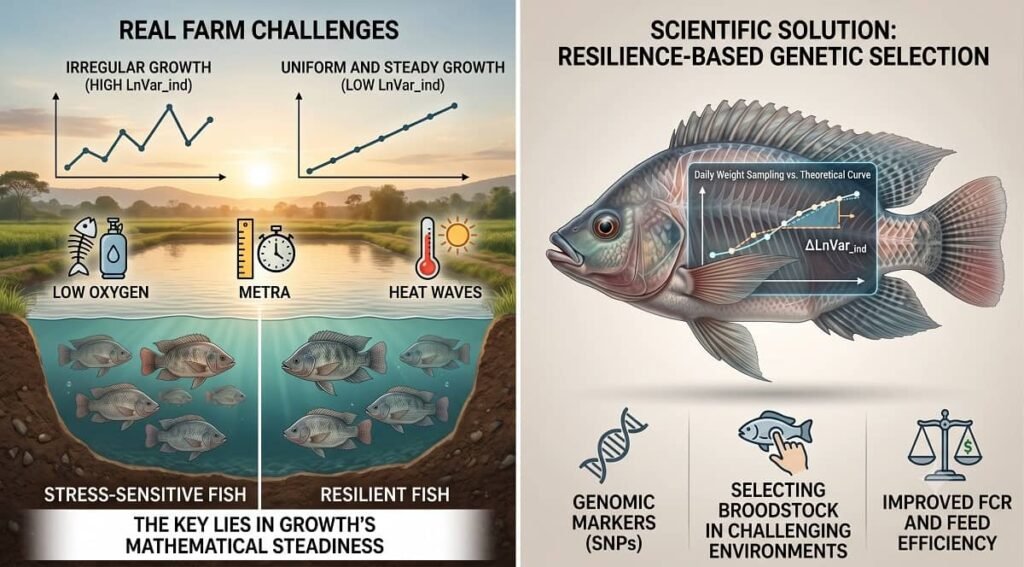
Science has found a way to identify the fish that best survive environmental stress. Here is what this means for tilapia farmers worldwide.
It is six o’clock in the morning at a non-aerated tilapia pond in northern Malaysia. The sun is just starting to rise, and dissolved oxygen levels in the water are already critically low—a nightly occurrence in thousands of smallholder tilapia farms across Southeast Asia, Africa, and Latin America. For hours, some fish have been eating less than usual and moving less, shifting their energy toward the simple task of surviving the stress. As the sun warms the water and oxygen levels rise, some of these fish resume their growth almost as if nothing had happened. Others never fully recover.
What sets these fish apart? Until recently, the honest answer was: we did not know with enough precision to leverage it in a genetic breeding program. Now, a new study published in Scientific Reports by researchers from Wageningen University, WorldFish, and Indonesia’s BRIN proposes a promising tool to change that: measuring the resilience of each fish based on the consistency of its individual growth curve over time.
Key Findings of the Study
- Tilapia resilience is measurable and genetically based: The indicator LnVar (log-transformed variance of deviations from expected body weight) captures the consistency of individual growth over time and can serve as a proxy for resilience to environmental disturbances.
- A crucial methodological innovation: The key breakthrough lies in calculating using each fish’s individual growth curve () as a baseline, rather than the cohort average (). This adjustment enables the model to detect stress events that impact the entire group simultaneously—a phenomenon the previous method failed to capture.
- High heritability under challenging conditions (non-aerated): In a non-aerated pond environment, resilience proved to be clearly inheritable. The heritability () of was 0.28, more than double that of the previous cohort-based method (0.12) under the same conditions. A value of 0.28 is high enough to drive significant progress in genetic breeding programs.
- Environmental stability masks genetic differences: In controlled, aerated environments, heritability drops to 0.06, rendering it practically undetectable. This confirms a fundamental biological principle: when the environment is perfectly stable, genetic variations in resilience have no opportunity to express themselves. It takes a challenging environment to reveal which fish are truly resilient.
- 1 Resilient Fish Grow More Consistently
- 2 The Experiment: Two Ponds, One Tilapia Family, Strikingly Different Results
- 3 Selecting for Fast Growth Also Improves Resilience
- 4 The Complication: A Gene That Works in One Environment May Not Perform the Same in Another
- 5 Why Measuring via Individual Curves Matters More Than It Seems
- 6 What Lies Ahead: The Role of Automated Phenotyping
- 7 Back to the Malaysian Pond
- 8 Entradas relacionadas:
Resilient Fish Grow More Consistently
Before examining the findings, it is worth understanding the underlying problem this study addresses. In aquaculture, resilience is defined as an animal’s capacity to cope with environmental disturbances—such as fluctuations in oxygen, temperature, handling stress, or pathogens—and return to its baseline condition as swiftly as possible.
A resilient fish does not necessarily grow faster under ideal conditions; rather, what distinguishes it is that its growth fluctuates less when conditions deteriorate. Consider two workers: one who maintains a steady output every week, rain or shine, and another who excels during good weeks but produces almost nothing during bad ones. In the long run, the consistency of the former may prove more valuable than the intermittent peaks of the latter.
The indicator proposed by the study is termed (log-transformed variance of deviations from expected body weight). Essentially, it measures how much a fish’s actual weight deviates from its expected growth trajectory over time. The lower the , the more consistent the growth, and thus, the more resilient the fish is considered. The key contribution of this new research is calculating this expected trajectory on an individual basis—fitting a customized growth curve for each fish—rather than comparing it to the cohort average as previous studies did. While seemingly technical, this distinction holds profound practical implications.
The Experiment: Two Ponds, One Tilapia Family, Strikingly Different Results
The experiment was conducted at the Department of Fisheries’ Aquaculture Extension Center in Malaysia, utilizing the GIFT strain (Genetically Improved Farmed Tilapia), the global benchmark for growth-focused genetic breeding. Researchers distributed 1,570 fish across two ponds with identical conditions except for one key variable: one featured active aeration (paddlewheels and blowers to maintain constant normoxic oxygen levels), while the other lacked aeration, exposing the fish to the natural diurnal fluctuations of dissolved oxygen typical of smallholder systems.
The fish were individually weighed five times over 217 days—at stocking and on days 55, 104, 167, and harvest—to fit individual growth curves and calculate each animal’s . The results revealed crucial insights for selective breeding programs:
Mantente siempre informado
Stay Informed
Únete a nuestras comunidades para recibir al instante las noticias, informes y análisis más importantes del sector acuícola.
Join our communities to get instant access to the most important news, reports, and analysis from the aquaculture industry.
- In the non-aerated pond: The heritability of the individual resilience indicator reached 0.28, meaning 28% of the observed variation in growth consistency is genetically based and inheritable, a value high enough to drive significant progress under artificial selection.
- In the aerated pond: This heritability dropped to just 0.06, rendering it statistically negligible.
The interpretation is intuitive: under stable, controlled conditions, almost all fish grow consistently, masking genetic differences in resilience. Conversely, challenging environments with recurrent hypoxia—typical of smallholder non-aerated ponds—expose and make these genetic variations visible and measurable.
Selecting for Fast Growth Also Improves Resilience
One of the most important questions the researchers wanted to answer was whether resilience and growth are traits that “fight” each other genetically or if they go hand in hand. The logic of conflict makes intuitive sense: if a fish allocates energy to tolerate stress, isn’t there less left for growth?
The study data suggest that, at least in the GIFT strain after nearly 20 generations of selection for growth, the genetic correlations between the resilience indicator and growth are negative and moderate (-0.44 to -0.68, depending on the environment and the growth variable measured). In this context, a negative correlation between LnVar and growth is favorable: it means that selecting fish that grow faster also tends to produce fish with more consistent growth (lower LnVar, higher resilience).
In other words: in the GIFT strain, decades of selection for growth have apparently been accompanied by an indirect improvement in resilience. It is not that resilience and growth are the same thing, but they seem to share genes that drive them in the same direction.
This is good news for producers working with improved lines: the breeding work already being done is likely also building a genetic foundation for greater tolerance to environmental stress.
The Complication: A Gene That Works in One Environment May Not Perform the Same in Another
Here, the study delivers a more complex and vital message for genetic breeding program designers. The researchers estimated the genetic correlation between the same trait (LnVar) measured in the two different environments (aerated vs. non-aerated pond), yielding a value of 0.50. What does this number imply? In practical terms, a genetic correlation of 1.0 between two environments would mean that the same genes making a fish resilient under controlled conditions also make it resilient under challenging ones, whereas a correlation of 0 would mean they are genetically completely distinct traits. A value of 0.50 indicates a substantial genotype-by-environment interaction (): the top-performing fish in one environment are not necessarily the best in the other.
For selective breeding programs, this has a direct implication: selecting tilapias for resilience within an aerated breeding nucleus will not guarantee that this improvement fully transfers to the non-aerated ponds of smallholder farmers. The genetic winners under laboratory conditions are not always the champions under real field conditions.
The solution proposed by the study is to incorporate records from relatives produced in non-aerated environments (the most common setting for smallholders in developing nations) into the selection programs.
By combining data from the controlled nucleus with information from cousins or half-siblings in challenging conditions, selection accuracy can be improved, ensuring that genetic advances translate into real on-farm benefits. It is the difference between designing a car in a perfect wind tunnel without testing how it performs on real roads with potholes, rain, and dust.
Why Measuring via Individual Curves Matters More Than It Seems
The study introduces a technical distinction that deserves closer attention because it carries concrete practical consequences. The previous method for calculating LnVar compared each fish’s weight to the group average (cohort LnVar). The new method calculates LnVar by comparing each fish’s weight to its own individually fitted expected growth curve.
Why does this difference matter? Imagine a pond where, for two weeks, a parasite infestation or a temperature drop affects all fish equally. With the cohort method, if all fish slow down their growth simultaneously, none “appear” to deviate from the group average. The stress event remains invisible within the indicator because the entire group shifted together.
With the individual method, however, that event is detected: each fish’s actual weight drops below what its own growth trajectory predicted, and that deviation is recorded in the individual LnVar. In technical terms, the heritability of the individual indicator (0.28 in the non-aerated pond) was more than double that of the cohort indicator (0.12 in the same pond). This means the individual method captures more genuine genetic variation and is therefore more useful for selective breeding programs.
What Lies Ahead: The Role of Automated Phenotyping
There is a significant practical limitation that the study itself acknowledges: calculating individual LnVar requires weighing each fish individually at multiple points during the production cycle. In current commercial practice, this involves manually capturing, sedating, and weighing hundreds or thousands of fish several times throughout the cycle—a process that is costly, stressful for the animals, and logistically complex.
However, the study’s authors point out that this is changing. Automated phenotyping—the use of cameras, artificial intelligence, and computer vision systems to estimate fish weight without handling them—is advancing rapidly in aquaculture. This technology is already functioning in salmon, tilapia, catfish, sea bream, and other species. An automated system that weighs or estimates fish weight non-invasively multiple times during the production cycle could make LnVar calculations routine and economically viable at a commercial scale.
The future described by the study is one where genetic breeding programs include resilience—measured via individual LnVar—as a standard selection trait, rather than just growth or survival. In this future, smallholder tilapia farmers operating without aeration in Nigeria, Bangladesh, Peru, or Indonesia will benefit from genetic lines that not only grow well under controlled conditions but also maintain their growth when oxygen levels drop at three in the morning, and environmental stress arrives unannounced.
Back to the Malaysian Pond
We return to that non-aerated pond at dawn. The fish that science can now identify—those growing more consistently despite oxygen fluctuations, without sacrificing entire weeks of growth whenever the environment complicates—are exactly what smallholder tilapia farmers in the developing world need.
What this study offers is not an off-the-shelf solution for tomorrow, but rather something perhaps more valuable: a robust proof of concept that tilapia resilience has a real, measurable genetic basis that is inheritable enough to respond to selection. The same genes driving fast growth in the GIFT strain also tend to make it more consistent; furthermore, the path to bringing that improvement to non-aerated ponds requires incorporating data from those challenging environments into breeding programs, rather than ignoring them because they are difficult to control.
For fish farmers, this translates into a concrete question worth asking their fingerling suppliers: Were your genetic lines selected solely under controlled conditions, or also under conditions that resemble my farm?
Contact
Muhammad Hunaina Fariduddin Aththar
Animal Breeding and Genomics, Wageningen University & Research
Wageningen, the Netherlands
Research Center for Applied Zoology, National Research and Innovation Agency (BRIN)
Cibinong, Indonesia
Email: farid.aththar@wur.nl
Reference (open access)
Aththar, M.H.F., Mengistu, S.B., Benzie, J.A. et al. Log-transformed variance from individual growth curves as a potential indicator of resilience in Nile tilapia Oreochromis niloticus. Sci Rep 16, 9558 (2026). https://doi.org/10.1038/s41598-025-91353-w

Editor at the digital magazine AquaHoy. He holds a degree in Aquaculture Biology from the National University of Santa (UNS) and a Master’s degree in Science and Innovation Management from the Polytechnic University of Valencia, with postgraduate diplomas in Business Innovation and Innovation Management. He possesses extensive experience in the aquaculture and fisheries sector, having led the Fisheries Innovation Unit of the National Program for Innovation in Fisheries and Aquaculture (PNIPA). He has served as a senior consultant in technology watch, an innovation project formulator and advisor, and a lecturer at UNS. He is a member of the Peruvian College of Biologists and was recognized by the World Aquaculture Society (WAS) in 2016 for his contribution to aquaculture.