In the semi-arid interior of northeastern Brazil, far from any coastline, a farmer checks the potassium levels in his pond water before deciding whether to drain the next harvest. He doesn’t view the ocean from his office; instead, he looks out at a groundwater well feeding his rearing tanks for the Pacific white shrimp, Penaeus vannamei, the species that dominates global aquaculture. Twenty years ago, this scene would have sounded like science fiction. Today, it is a growing reality from Thailand to Kuwait, stretching through Alabama and into the Brazilian sertão.
This “inland” shrimp migration is neither an accident nor a fad. It is an industry-wide response to concrete pressures: devastating coastal diseases, a scarcity of shoreline land, and an urgent need for enhanced biosecurity control. Now, a new bibliometric study published in Critical Insights in Aquaculture—led by Renato Pinheiro Gouveia and a team of Brazilian researchers from the Federal University of Recôncavo da Bahia (UFRB) and the State University of Bahia (UNEB)—has synthesized over two decades of science on this phenomenon, analyzing 604 scientific studies to map exactly where this field is heading.
- 1 Freshwater isn’t the problem; minerals are
- 2 Why did so many farms move inland?
- 3 What science discovered about farming shrimp away from the sea
- 4 The Three Technical Pillars of Success
- 5 Innovations Redefining Inland Shrimp Farming
- 6 Who is leading this research?
- 7 What we still don’t know
- 8 Back to the pond in the sertão
- 9 Entradas relacionadas:
Freshwater isn’t the problem; minerals are
Here is the paradigm-shifting idea: farming shrimp in low-salinity water is not inherently detrimental to the animal. In fact, seminal studies demonstrate that shrimp can grow even better in moderate salinities (5–15 parts per thousand) than in pure seawater. The real challenge is not the lack of salt itself, but rather the mineral imbalance that typically characterizes the groundwater or recycled water used inland.
Think of it as the difference between feeding someone less food and feeding them the wrong food. Seawater naturally delivers a balanced matrix of sodium, potassium, magnesium, and calcium in ratios that the shrimp has evolutionarily adapted to. Well water, conversely, often presents potassium deficiencies, skewed calcium-to-magnesium ratios, and sodium-to-chloride ratios that bear no resemblance to their ancestral habitat. It is akin to asking someone accustomed to a Mediterranean diet to survive solely on white rice: they are technically eating, but lacking essential nutrients.
Why did so many farms move inland?
For years, shrimp aquaculture was synonymous with coastal ponds near the sea, where saltwater was literally just around the corner. While that model worked for decades and remains dominant in many regions, the coast introduced a vulnerability that ultimately proved devastating.
In 1999, the White Spot Syndrome Virus (WSSV) decimated farms across Asia and Latin America, causing mortality rates of up to 90%. A decade later, in 2009, another blow struck: Acute Hepatopancreatic Necrosis Disease (AHPND)—caused by a strain of the bacterium Vibrio parahaemolyticus—once again brought coastal producers to their knees, compounded by mangrove protection regulations that restricted traditional shoreline expansion.
The industry’s response was definitive: if the coast is vulnerable, find another place—and that “other place” proved to be inland, utilizing groundwater, recycled water, or artificially salinized mixtures far from marine pathogens and with far greater control over biosecurity.
What science discovered about farming shrimp away from the sea
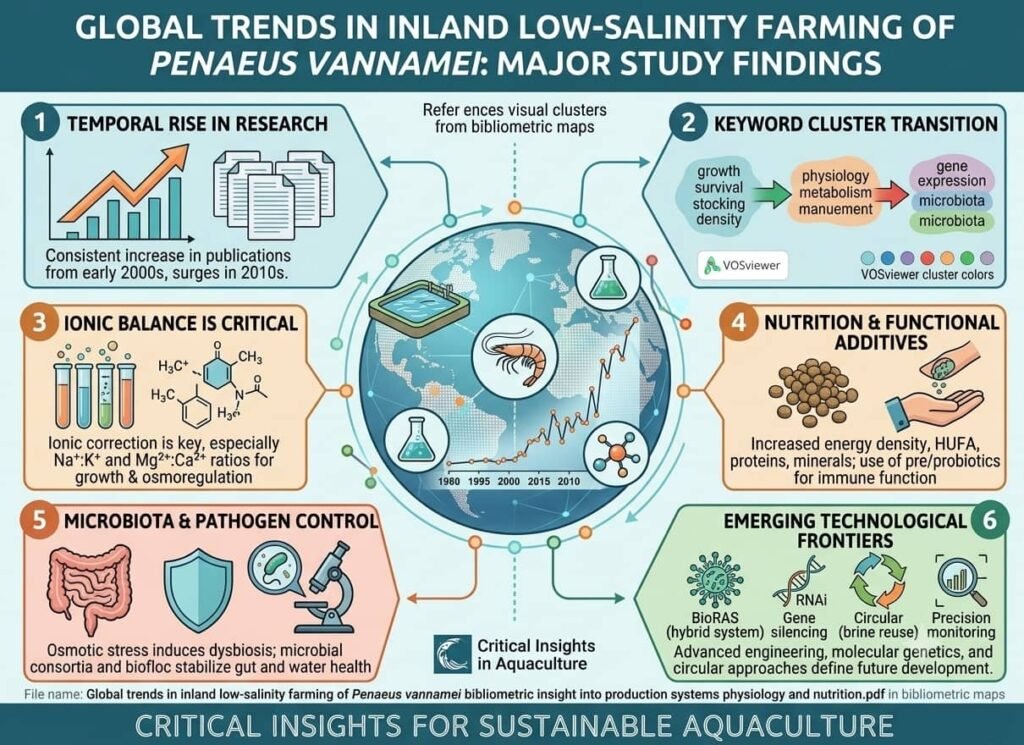
The study by Gouveia and his team identifies a fascinating pattern in how scientific research on this topic evolved, dividing it into three major stages that reflect the exact pressures mentioned above.
First Stage: Does this even work?
Between 1999 and 2004, the primary focus of scientists was to prove that low-salinity aquaculture was viable in terms of production. Pioneering studies, such as the one by William Bray and his colleagues, showed something surprising: shrimp could grow just as well or even better in moderate salinities than in pure seawater, provided the ionic composition was adequate. Other researchers, such as Issam Saoud, uncovered something even more revealing: well water deficient in potassium and magnesium could be more lethal to shrimp than the low salinity itself.
Stay Always Informed
Join our communities to instantly receive the most important news, reports, and analysis from the aquaculture industry.
This game-changing finding shifted the core question from “Can shrimp live without as much salt?” to “Which specific minerals must be replenished if we remove that salt?”
Second Stage: Understanding the energy cost of survival
Beginning in 2009, with the AHPND crisis pushing even more farms inland, the science became increasingly sophisticated. Researchers began to study the energetic cost of osmoregulation—the physiological process through which shrimp maintain a balance of salt and water within their bodies.
Think of osmoregulation as a building’s HVAC system: under normal conditions (balanced seawater), the system operates with minimal effort because the external environment is already close to the desired temperature. However, in unbalanced, low-salinity water, that system must work at full capacity constantly to maintain internal equilibrium, consuming energy that would otherwise be directed toward growth.
This explains a key finding of the study: at extremely low salinities (3 ppt), shrimp allocate so much energy to osmoregulation and excretion that they literally have less energy available to grow. It is not that the shrimp cannot survive there; rather, surviving there carries a higher metabolic price, paid in lost harvest weight.
Third Stage: The era of microbiota, genetics, and precision
From 2015 to the present, with Recirculating Aquaculture Systems (RAS) and biofloc technologies now mature, research has shifted toward much more sophisticated areas: how the shrimp’s gut microbiota behaves under salinity stress, which genes are upregulated or downregulated, and how to apply precision tools to optimize every aspect of cultivation.
Here, one of the study’s most interesting insights emerges: low salinity can trigger dysbiosis—an imbalance in the bacterial communities living in the shrimp’s gut—which favors the growth of opportunistic pathogens such as various Vibrio species. This follows the same principle where an imbalance in the human gut flora opens the door to infections that otherwise would not stand a chance.
The Three Technical Pillars of Success
If you had to summarize two decades of science into three practical operational rules based on the most influential studies in the field, they would be:
- Choose your salinity range wisely: Avoid extremes (0–3 ppt) without adequate ionic and nutritional support. Research by Erchao Li and co-workers showed that 17 ppt is near the physiological optimum, whereas at 3 ppt, shrimp suffer a sharp decline in antioxidant capacity, becoming highly vulnerable to oxidative stress.
- Correct minerals, not just salt: The sodium-to-potassium () and magnesium-to-calcium () ratios are just as important—if not more so—than the salinity level itself. Work by Les Roy and David Davis demonstrated that supplementing with salts such as and not only improves survival but also mitigates chronic physiological stress.
- Tailor the diet to new energy demands: Under low-salinity conditions, shrimp require diets with higher energy density, highly unsaturated fatty acids (HUFAs), and specific mineral ratios like phosphorus (ideally a calcium-to-phosphorus ratio close to 1:1) to support proper exoskeleton formation during molting.
Innovations Redefining Inland Shrimp Farming
Beyond traditional foundations, the study highlights ten recent investigations (2025–2026) driving the sector’s future, with several showing immense promise for forward-thinking producers:
- Microalgae-bacterial consortia: Chinese researchers led by Shuanglin Dong demonstrated that introducing specific microalgae, such as Chlorella and Scenedesmus, into low-salinity biofloc systems enhances nitrogen transformation pathways, reducing ammonia and nitrite while providing additional natural food. This essentially converts your biological filtration system into an extra feed source.
- Desalination brine reuse: A study in Kuwait revealed massive potential for arid regions: blending groundwater with brine from desalination plants—typically a costly industrial waste—can correct the water’s ionic profile while reducing costs and environmental impact. This is a circular economy applied directly to shrimp aquaculture.
- Rice straw biochar: Applied to oligohaline pond sediments, this material stabilizes pH and adsorbs ammonia, achieving survival rates above 90% even during toxic nitrogen compound spikes.
- Aquaporin gene silencing: On the molecular front, researchers identified a protein called superaquaporin (LvAQP11) as critical for low-salinity tolerance. Experimentally silencing this gene caused molting failure, suggesting a powerful new marker for genetic selection programs.
Who is leading this research?
The international collaboration analysis revealed an interesting pattern in global knowledge distribution: China leads a dense Asian cluster (including India, Thailand, Malaysia, and Taiwan) focused on high-density intensive systems. The United States acts as a central hub, bridging Asia with American nations like Brazil and Mexico, while driving advancements in systems engineering and physiology. Meanwhile, Latin America specializes in semi-arid adaptations through international cooperation.
This distribution is no accident; it reflects the distinct hydrological and economic realities of each region, where Asia bets on large-scale water recycling and intensive systems, while other regions focus on amending locally available water to fit specific constraints.
What we still don’t know
Despite these advancements, the study is transparent about the field’s current limitations. Research remains fragmented, with relatively few studies simultaneously integrating production performance, physiology, microbiota, and genetics under real commercial conditions.
One of the most intriguing gaps identified by the authors involves chronobiology—the study of the shrimp’s circadian rhythms. Pinpointing when digestive enzymes are most active or when the immune system is most alert could have massive practical implications for optimizing feeding schedules and management in low-salinity systems.
Back to the pond in the sertão
Returning to our Brazilian farmer checking potassium levels in his groundwater well, this extensive scientific synthesis offers something more valuable than a magic bullet: a clear roadmap of which questions to ask and in what order of priority.
First, is the salinity range within the window that balances osmoregulatory cost and growth? Second, is he specifically correcting potassium, magnesium, and calcium-to-phosphorus ratios, or merely adding generic salt? Third, does his feed formulation account for the higher energy demands of living under these conditions?
Inland shrimp farming has evolved from a marginal alternative into a core component of global shrimp production. As this analysis of over two decades of science demonstrates, the path to making it truly sustainable and profitable lies not in mimicking the sea, but in deeply understanding what the shrimp actually needs when the ocean is far away.
Contact
Rafael Queiroz dos Anjos
Shrimp Nutrition and Behavior Laboratory, Center for Development and Dissemination of Aquatic Technologies, State University of Bahia (UNEB)
Paulo Afonso, Bahia, Brazil
Email: engpesca.queiroz@gmail.com
Reference (open access)
Gouveia, R. P., Pereira, J. da S., Queiroz dos Anjos, R., & Evangelista-Barreto, N. S. (2026). Global trends in inland low-salinity farming of Penaeus vannamei: bibliometric insight into production systems, physiology, and nutrition. Critical Insights in Aquaculture, 2(1). https://doi.org/10.1080/29932181.2026.2662226

Editor at the digital magazine AquaHoy. He holds a degree in Aquaculture Biology from the National University of Santa (UNS) and a Master’s degree in Science and Innovation Management from the Polytechnic University of Valencia, with postgraduate diplomas in Business Innovation and Innovation Management. He possesses extensive experience in the aquaculture and fisheries sector, having led the Fisheries Innovation Unit of the National Program for Innovation in Fisheries and Aquaculture (PNIPA). He has served as a senior consultant in technology watch, an innovation project formulator and advisor, and a lecturer at UNS. He is a member of the Peruvian College of Biologists and was recognized by the World Aquaculture Society (WAS) in 2016 for his contribution to aquaculture.