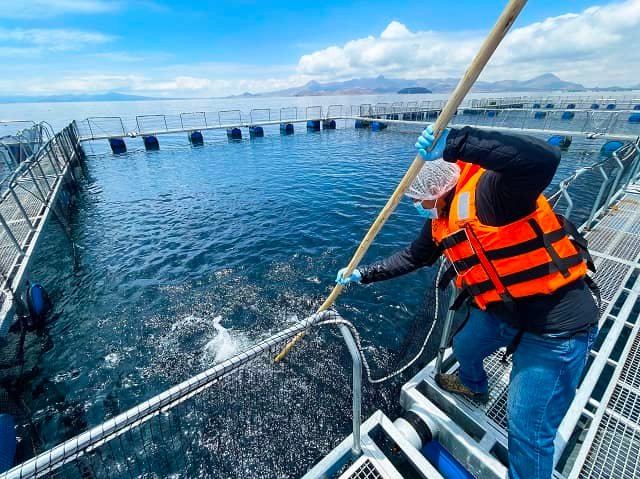
A trout farmer inspects his raceways at dawn, just like any other morning. The water runs clear, and the fish rise to feed. Everything seems normal. Yet, a few days later, he notices a few fish swimming on their sides, while others no longer respond to feed. It is not a massive die-off—just a fraction of the stock—but it is enough to sound the alarm. What the farmer does not yet know is that, if his facility is small-scale, this seemingly minor loss could mean the difference between balancing the monthly books and financial insolvency.
This is the most striking conclusion of a new economic study on the U.S. salmonid industry: a farm’s scale determines, more than almost any other factor, how devastating a disease outbreak will be. Consequently, small-scale operations have the most to lose.
- 1 Key Study Takeaways
- 2 A Large, Quiet, and Surprisingly Exposed Business
- 3 Measuring the Previously Intuit
- 4 The Finding That Changes How We Think About Risk
- 5 Salmon in Net-Pens vs. Tanks: The System Matters as Much as Scale
- 6 The Sanitary Paradox of Closed Tanks
- 7 When Fish Survive But Remain Unsellable
- 8 Spillover Costs Across the Value Chain
- 9 Back to the Producer
- 10 Entradas relacionadas:
Key Study Takeaways
- Small farms are highly vulnerable: A small-scale food-size trout operation faces cash flow deficits with a mere 7% loss of its marketable harvest. Conversely, a large recreational trout farm can withstand up to a 63% loss before reaching that same tipping point.
- The long-term break-even point is even lower: When accounting for total economic costs rather than just cash flow, some farms cease to be profitable, with losses ranging between 3% and 59%, depending on production type and scale.
- Complete depopulation can be catastrophic: A mandatory sanitary cull represents a 100% harvest loss; for the smallest trout farms, this triggered revenue losses equivalent to 1,520% of an average year’s income. In contrast, the largest operations experienced a “mere” 158% loss.
- The culture system is decisive: Marine net-pen salmon operations sustained up to a 40% loss without falling into the red. Meanwhile, recirculating aquaculture systems (RAS) remained unprofitable across all baselines—for both salmon and trout—even prior to factoring in disease.
- Economy-wide impacts: Every 1% decline in domestic salmonid sales due to an outbreak translates to $3.9 million in lost economic output and 22 lost jobs. A 25% drop would cost the economy $98.7 million and 541 jobs.
A Large, Quiet, and Surprisingly Exposed Business
Salmonid aquaculture is the second most crucial finfish sector in the United States, contributing $886 million and over 2,000 jobs in 2022. While most domestic salmon consumption relies on imports, recreational trout—sold live to stock private ponds, fishing clubs, and government programs—is almost entirely reared within national borders.
This global trade of fish and eggs carries an unwanted passenger: pathogens. Historical outbreaks, such as the Infectious Salmon Anemia Virus (ISAV), devastated the Chilean industry between 2006 and 2010 by slashing total production by 75%, while also striking Maine and Canada. The issue is that, until now, no one had put precise figures on the table: at what point does an outbreak transition from a setback into a farm’s bankruptcy? That is precisely the gap Carole Engle and her team filled in a study published in the Journal of the World Aquaculture Society, alongside researchers from Engle-Stone Aquatic LLC, Texas A&M University, Virginia Tech University, Mississippi State University, the University of Kansas, and Aquaculture Results LLC.
Measuring the Previously Intuit
For years, the industry knew that diseases were costly, but who suffered the most remained unclear. Comparing the impact of a specific pathogen is nearly impossible, as mortality rates vary from mild to devastating depending on water temperature, life stage, stocking density, or location; IHNV can kill between 20% and 94% of a batch, while severe ISAV exceeds 90%.
Instead of getting lost in this labyrinth of variables, the researchers took a clever shortcut: they used marketable harvest—the total weight of fish a farm successfully sells annually—as a single metric summarizing all disease impacts. Ultimately, whether a fish dies, experiences stunted growth, or becomes unsellable due to deformities, it all translates to fewer billable kilograms.
The team constructed nine representative “model farms” based on real surveys covering 94.5% of domestic salmonid production, ranging from a 2,500-ton annual marine net-pen salmon operation to a small 17.7-ton recreational trout farm. They then incrementally reduced the harvest of each model—by 5%, 10%, 20%, up to 100%—to identify the exact tipping point where the business begins to sink.
The Finding That Changes How We Think About Risk
This is where the data that should send shockwaves through the industry appears: not all fish farms withstand pressure equally. A small food-size trout operation producing 27.2 tons annually begins struggling to pay its bills with a mere 7% harvest loss. Meanwhile, its larger counterpart, a 453.6-ton recreational farm, can survive up to a 63% loss before reaching the same financial choking point.
Why such a brutal difference? Large-scale farms spread their fixed costs over many more kilograms of fish and typically operate with margins that provide a cushion to absorb shocks. Small farms, however, operate on a knife-edge: any misstep pushes them over the brink.
This contrast becomes dramatic in the worst-case scenario: a complete sanitary depopulation. When a regulatory authority orders a farm cull to contain a pathogen, the producer loses their entire inventory at once, with nothing to sell and years of stock rebuilding ahead. In monetary terms, this meant losses of $19.3 million per farm for marine net-pen salmon, $7.9 million for the large food-size trout farm, and $4.85 million for the largest recreational farm. Yet, measured as a blow to the business’s financial health, the smallest trout farm suffered a revenue decline equivalent to 1,520% of its normal annual income. Translated, that number means only one thing: ruin.
Mantente siempre informado
Stay Informed
Únete a nuestras comunidades para recibir al instante las noticias, informes y análisis más importantes del sector acuícola.
Join our communities to get instant access to the most important news, reports, and analysis from the aquaculture industry.
This depopulation hazard is not theoretical. Pathogen introductions, which prompted this study, occur primarily through imported eggs, as live fish are rarely imported. Consequently, biosecurity practices and egg disinfection before farm entry represent the primary line of defense.
Salmon in Net-Pens vs. Tanks: The System Matters as Much as Scale
For salmon, the study revealed an equally telling contrast, but for a different reason. The researchers modeled two rearing methods: traditional marine floating net-pens and modern recirculating aquaculture systems (RAS).
The net-pen salmon farm proved remarkably resilient, maintaining both positive cash flow and profitability even with a 40% harvest loss. Its long-term unprofitable threshold was reached only at a 50% drop, and cash flow deficits to cover bills began at 58%. In other words, an outbreak would have to be exceptionally severe to jeopardize this type of operation.
Salmon in RAS showed the opposite reality. Even in the baseline scenario—without any disease—it failed to achieve profitability once all costs were accounted for, and faced cash flow deficits with a mere 11% harvest loss. Based on the study’s figures, it is a system born in the red; any outbreak simply worsens an already losing equation.
It is important to be objective about what the study could and could not measure. Because very few salmon farms operate in the United States, the researchers modeled a single scale to protect business confidentiality. Thus, unlike with trout, they could not compare how the impact varies by salmon farm size. What did become clear, however, was the magnitude of the risk in absolute terms: a complete sanitary depopulation of the net-pen salmon farm—the largest operation in the study—resulted in a $19.3 million loss, the highest of all analyzed scenarios.
The Sanitary Paradox of Closed Tanks
The economic fragility of recirculating aquaculture systems (RAS) coexists with a genuine sanitary advantage. Being closed and isolated from the environment makes pathogen entry into an RAS difficult; however, if one penetrates, high stocking densities and constant water recycling can disperse the disease across the entire facility in record time—yielding high entry protection but extreme internal vulnerability. This economic struggle is not unique to salmon, as RAS-reared trout also proved unprofitable across all modeled scenarios, meaning any outbreak simply worsens an already deficit-ridden equation.
When Fish Survive But Remain Unsellable
Recreational trout producers know well a detail this study highlights: sometimes the issue is not fish mortality, but rather unsightly survival. Fish recovering from acute IHNV outbreaks can develop scoliosis—a spinal curvature that deforms their bodies—with researchers documenting that 2% to 4% of survivors were left with deformities that rendered them unsellable. For a farm selling live fish to fishing clubs, a crooked fish is unwanted, regardless of how healthy it might otherwise be; this morbidity loss (stunted growth, poor feed conversion, and sub-optimal fish) compounded with direct mortality, explains why the true economic impact always exceeds mere death counts.
Spillover Costs Across the Value Chain
The damage extends far beyond the farm’s perimeter, as decreased farm revenue reduces purchases from feed manufacturers, equipment suppliers, and transporters, while triggering layoffs. Researchers calculated that every 1% drop in domestic salmonid sales slashes $3.9 million in economic output and costs 22 jobs; a 25% decline would escalate to a loss of $98.7 million and 541 jobs, heavily impacting rural areas where these farms act as key economic engines.
Consequently, the study emphasizes a critical public policy point: when authorities order a sanitary cull, the speed of financial compensation determines whether a small farm recovers or permanently disappears.
Back to the Producer
Returning to our trout producer, the next time he spots abnormal fish, his mental calculations will no longer be blind guesses. Armed with data, he now knows his small-scale farm crosses the danger threshold far sooner than larger operations, that a severe regulatory response could mean the end of his business rather than just a poor season, and that every dollar spent on biosecurity, certified eggs, and early detection acts as insurance against a fifteen-fold loss scenario.
While the study cannot eliminate disease risk, it provides producers and policymakers with a clear map of the line dividing a temporary setback from bankruptcy—and knowing where that line lies is the first step to avoiding crossing it.
Contact
Carole Engle
Engle-Stone Aquatic LLC
Strasburg, Virginia 22657, USA
Email: caroleengle2015@gmail.com
Reference (open access)
Engle, C., Hegde, S., Kumar, G., Ellis, C., & Fornshell, G. (2026). Economic effects of disease outbreaks on U.S. Salmonid farms. Journal of the World Aquaculture Society, 57(4), e70125. https://doi.org/10.1111/jwas.70125

Editor at the digital magazine AquaHoy. He holds a degree in Aquaculture Biology from the National University of Santa (UNS) and a Master’s degree in Science and Innovation Management from the Polytechnic University of Valencia, with postgraduate diplomas in Business Innovation and Innovation Management. He possesses extensive experience in the aquaculture and fisheries sector, having led the Fisheries Innovation Unit of the National Program for Innovation in Fisheries and Aquaculture (PNIPA). He has served as a senior consultant in technology watch, an innovation project formulator and advisor, and a lecturer at UNS. He is a member of the Peruvian College of Biologists and was recognized by the World Aquaculture Society (WAS) in 2016 for his contribution to aquaculture.