- 1 Key Takeaways
- 2 Why Gene Editing Has Not Yet Scaled in Commercial Aquaculture
- 3 The Bottleneck of Genetic Mosaicism in Precision Aquaculture
- 4 Germline Stem Cells: The Biotechnological Key to Precision Gamete Production
- 5 In Vitro Editing and Cell Transplantation: The Strategy to Scale Salmonid Biotechnology
- 6 Pending Biotechnological Challenges: The Three Bottlenecks of Salmonid Cell Culture
- 7 Lessons from Avian Biotechnology: The Precedent of Germline Transplantation
- 8 From the Microneedle to the Culture Dish: A Paradigm Shift for Salmon Farming
- 9 Entradas relacionadas:
Key Takeaways
- Although CRISPR technology operates successfully in salmon, trout, tilapia, carp, and catfish, the current protocol demands individual microinjections into each fertilized egg, rendering the process cost-prohibitive and hindering commercial scalability.
- Manual microinjection frequently yields mosaic organisms—exhibiting cellular chimerism characterized by a mosaic of wild-type and edited cells—compelling researchers to wait two generations (six to eight years in Atlantic salmon) to establish stable, homozygous germlines.
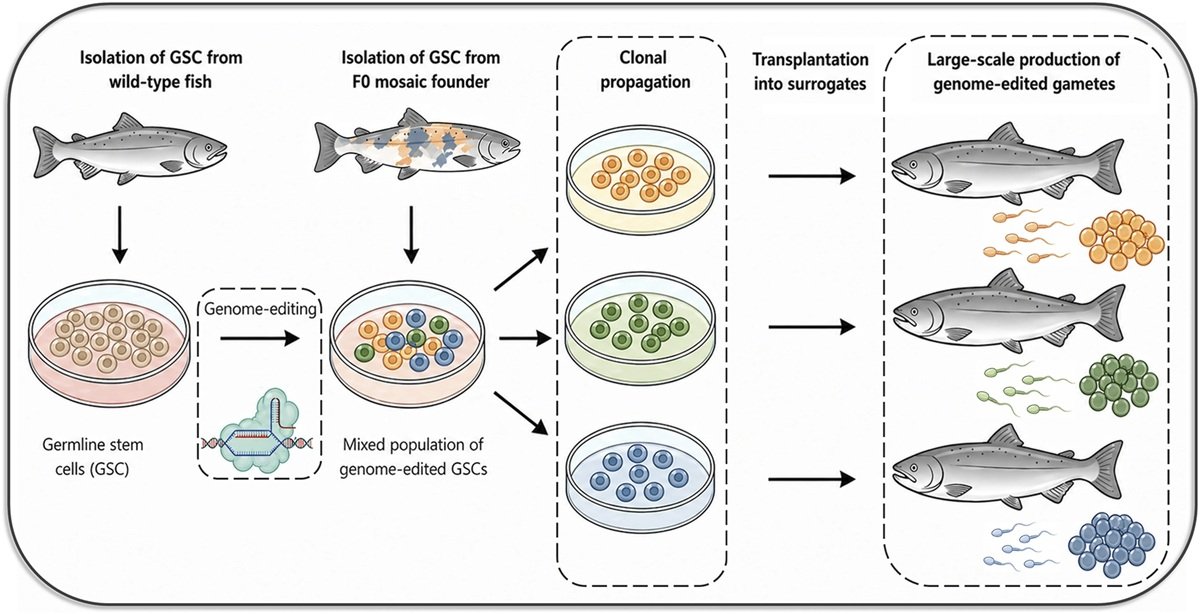
- Investigators from The Roslin Institute (University of Edinburgh), Norway’s Institute of Marine Research, and Benchmark Genetics Norway AS propose a novel paradigm: gene editing of germline stem cells in vitro, validating intended genomic sequences, and subsequently transplanting them into sterile recipients serving as surrogate broodstock.
- This approach would enable the production of fully uniform gametes within a single generation, effectively capitalizing on the extraordinary reproductive fecundity of teleost fish.
- The technique nonetheless remains developmental, as critical milestones still require optimization: establishing stable salmonid cell culture lines, refining in vitro editing protocols, achieving clonal expansion, and maximizing the overall efficiency of cellular transplantation.
Inside a reproductive biotechnology suite, a specialist adjusts the micrometer. Resting on the stage is a Petri dish containing freshly fertilized salmon ova, spherical and deeply amber-hued. Utilizing a glass microneedle finer than a strand of hair, she punctures the envelope, delivers a microdose of gene-editing reagents, and repeats the procedure on the subsequent specimen—over and over again.
The intervention exacts a severe biological toll: numerous ova fail to withstand the mechanical puncture, while others succumb to osmotic shock. Among the fry that manage to hatch, a substantial proportion displays genetic mosaicism, expressing the intended mutation only across scattered tissues. Verifying phenotypic efficacy requires rearing these fish to sexual maturity, crossing the progeny, and waiting for an F2 generation—a reproductive cycle requiring three to four years per generation in Atlantic salmon (Salmo salar).
This biological and commercial bottleneck forms the crux of the scientific review published in Frontiers in Genetics by Mari Raudstein and colleagues from The Roslin Institute (University of Edinburgh), the Institute of Marine Research in Bergen, and Benchmark Genetics Norway AS. Their proposed paradigm replaces single-egg microinjection with the in vitro reprogramming of gamete precursor cells. If consolidated at an industrial scale, global salmon farming and the aquaculture of other finfish species will gain an expedited pathway to establish vital traits—such as endemic pathogen resistance or the induction of reproductive sterility—with phenotypic uniformity and at an unprecedented operational scale.
Why Gene Editing Has Not Yet Scaled in Commercial Aquaculture
Aquaculture represents a nascent productive sector compared to terrestrial livestock farming—a condition that confers a strategic advantage: substantial untapped potential for the genetic improvement of farmed finfish. While conventional selective breeding programs deliver steady progress generation after generation, the rate of genetic gain decelerates when biological generation intervals are prolonged, and the objective involves simultaneously optimizing multiple traits with antagonistic genetic correlations.
In this landscape, gene editing stands out—particularly the CRISPR/Cas system: a biotechnological platform operating with the precision of a molecular scalpel capable of cleaving DNA at target sequences to knock out or modulate specific genes. The authors emphasize that this technology has already demonstrated efficacy in Atlantic salmon, rainbow trout, Nile tilapia, common carp, and channel catfish. In salmon specifically, researchers have successfully silenced loci governing reproductive development, skin pigmentation, essential lipid biosynthesis, and immune responsiveness.
Several findings outline clear potential for industry transfer. Most notably, the generation of germ-cell-free sterile salmon via the ablation of the dnd1 gene yielded, after exhaustive evaluation across a full production cycle, zootechnical performance comparable to that of conventional counterparts. Moreover, gene-edited aquatic species are already commercially available in select markets such as Japan.
Nevertheless, outside these exceptions, the technology remains predominantly confined to experimental settings. While the authors recognize heterogeneous international regulatory frameworks as a limiting factor, they orient their analysis toward a less visible methodological barrier: the inherent constraints of current microinjection and genetic modification protocols in fish.
The Bottleneck of Genetic Mosaicism in Precision Aquaculture
Currently, most gene editing in teleost fish relies on manual microinjection into freshly fertilized eggs, ideally prior to the first mitotic cleavage of the zygote (one-cell stage). This laborious, low-throughput procedure demands rigorous technical skill and imposes strict constraints on operational scalability. Furthermore, mechanical puncture compromises embryonic viability, and certain molecular reagents elicit cytotoxicity.
However, the primary methodological bottleneck lies in cellular chimerism. If the embryo initiates blastomeric cleavage prior to microinjection, or if nuclease kinetics prove inefficient or protracted, the resulting specimen develops mosaicism: an organism composed of a heterogeneous assembly of edited and wild-type cells. Compounding this complexity, the modified cell lineages may harbor disparate mutational outcomes, such as null alleles, partial disruptions, or nonsense mutations.
Mantente siempre informado
Stay Informed
Únete a nuestras comunidades para recibir al instante las noticias, informes y análisis más importantes del sector acuícola.
Join our communities to get instant access to the most important news, reports, and analysis from the aquaculture industry.
In terms of commercial production, a theoretically uniform batch of fry becomes a heterogeneous conglomerate of independent genotypes, precluding reliable phenotypic characterization within the founder cohort (F0 generation).
The current mitigation strategy demands biological patience. Founder males—whose gonadal maturation typically precedes that of females—are backcrossed with wild-type individuals to establish a stable F1 progeny, after which a secondary generation (F2) must be reared to fix homozygosity for the trait of interest. While crossing founders inter se shortens this chronological timeline, it introduces asymmetrical mutant alleles between parental lines; consequently, in late-maturing taxa requiring three to four years to reach reproductive maturity, each generational interval entails a cost-prohibitive delay.
Compounding this scenario is a structural biotechnological barrier: the vast majority of reported edits remain confined to gene knockouts. Targeted integration of exogenous sequences (knock-in) poses a significantly greater technical challenge because homology-directed repair (HDR), which mediates precise genomic insertion, displays substantially lower efficiency compared to non-homologous end joining (NHEJ). Although full gene cassettes have been introduced in channel catfish to enhance disease resistance and lipid synthesis, progress in salmonids remains restricted to single-nucleotide substitutions or short indels, with consistent, complex gene knock-ins yet to be consolidated.
Germline Stem Cells: The Biotechnological Key to Precision Gamete Production
The disruptive strategy proposed by the researchers hinges on a cell lineage endowed with unique properties: germline stem cells. These elements constitute the functional matrix of the reproductive system—differentiating into oocytes in females and spermatozoa in males while retaining a remarkable intrinsic capacity for self-renewal—with their immediate embryonic precursors designated as primordial germ cells (PGCs).
This methodological proposal capitalizes on an established biotechnological platform: surrogate broodstock technology. The protocol involves isolating germ cells from a genetically superior donor and transplanting them into a sterile recipient hatchling around the time of hatching; once inoculated, these cells migrate to the host’s gonadal primordia, colonize the reproductive niche, and, upon reaching sexual maturity, yield viable gametes that exclusively transmit the donor’s genetic profile—a biological principle akin to seeding a high-purity cultivar into a biological substrate devoid of endogenous genetic load.
A biological phenomenon of exceptional technical relevance occurs in species such as Atlantic salmon, rainbow trout, masu salmon, and Japanese flounder: the differentiation of these cells into oocytes or spermatozoa is governed not by the donor’s chromosomal sex, but by the gonadal and endocrine microenvironment of the recipient. Consequently, a female surrogate will produce mature ova and a male surrogate will synthesize functional sperm regardless of the donor tissue’s genetic sex; moreover, these cells can be efficiently cryopreserved in both sexes without compromising reproductive competence, overcoming a major bottleneck in modern aquaculture—namely, the inability to freeze teleost eggs due to osmotic fragility compared to the relative ease of sperm cryopreservation.
A bioassay in medaka (Oryzias latipes) clearly exemplifies the industrial potential of this mechanism: in this model, fshr-knockout males remain fertile while females develop gonadal sterility, yet transplanting germ cells from edited males into sterile females possessing a receptive gonadal stroma induced the production of gene-edited oocytes, yielding a 100% sterile progeny upon cross-fertilization. In Atlantic salmon, the review notes that fshr-deficient males also exhibit sterility (a phenotype not yet characterized in females), a trait shared by both sexes in rainbow trout. These findings delineate a viable biotechnological route for the mass production of sterile salmonids—an attribute of paramount zootechnical and ecological value to preclude genetic introgression with wild stocks following farm escapes and to mitigate the welfare and growth impairments associated with precocious sexual maturation.
In Vitro Editing and Cell Transplantation: The Strategy to Scale Salmonid Biotechnology
The research team’s methodological framework comprises three complementary phases: first, isolating germline stem cells from a donor salmon and maintaining their proliferation under laboratory conditions; second, performing direct gene editing within the cell culture plates; and finally, selectively transplanting verified cell lines into sterile surrogate broodstock.
The central innovation of this protocol lies in the intermediate phase, where, despite in vitro editing yielding a heterogeneous mixture of modified and wild-type cells similar to zygote microinjection, cell culture uniquely allows isolating single cells, inducing their clonal expansion into genetically homogeneous colonies, and rigorously sequencing their DNA prior to transplantation—a biological quality-control step that confirms on-target precision, excludes unintended structural variations, and verifies the absence of off-target mutations across the genome.
Once genotypically validated, these cell clones would be microinjected into cohorts of completely sterile male and female surrogates devoid of endogenous germ cells, enabling each broodstock individual to function as a living biomanufacturing platform propagating uniform, mutation-identical gametes; moreover, leveraging the extraordinary fecundity of teleosts—whose individual spawns yield thousands of viable ova—this strategy unlocks substantial commercial scalability for the aquaculture industry.
The authors also delineate an alternative route: rather than editing wild-type lineages in vitro, germ cells could be harvested from an F0 mosaic founder generated via conventional microinjection and then purified in the laboratory to enrich for the desired allelic variant, bypassing in vitro transfection while still relying on an initial embryonic puncture.
Furthermore, the researchers identify cell culture as a strategic gateway to resolving the bottleneck of complex gene knock-ins, since unlike a single, fragile ovum that tolerates only one microinjection attempt, plated cell lines accommodate high-throughput replication to fine-tune donor template architecture, optimize delivery vectors, and selectively stimulate homology-directed repair pathways for maximum genome-editing fidelity.
Pending Biotechnological Challenges: The Three Bottlenecks of Salmonid Cell Culture
The scientific review maintains a transparent stance: most operational milestones for this model have yet to be established in Atlantic salmon (Salmo salar). Although the isolation of germ cells from wild-type fish and their transplantation into surrogate recipients have been experimentally validated, critical gaps persist—namely, establishing stable culture media, formulating in vitro editing protocols, achieving large-scale clonal expansion, and empirically confirming that modified cells preserve their functional totipotency across successive culture passages.
The first methodological bottleneck lies in the ex vivo viability of these cell lineages. Embryonic primordial germ cells (PGCs) are exceedingly scarce and difficult to isolate; beyond a four-month culture reported in zebrafish (Danio rerio), long-term primary lines in teleosts remain virtually nonexistent. While germline stem cells harvested from juvenile or adult stages are more accessible and medium-term maintenance has been reported in several studies, the authors emphasize that their behavior mirrors that of transient primary cultures rather than immortalized, continuous cell lines.
Furthermore, standardized formulations do not exist, as trophic factor and cytokine requirements vary drastically across species, necessitating case-by-case calibration of osmolarity, pH, thermal thresholds, and ionic concentrations—a challenge compounded by a shortage of molecular reagents and recombinant proteins tailored specifically for fish models. One viable strategy involves seeding cells onto gonadal stroma feeder layers to recreate the native physiological niche, with the authors recommending single-cell RNA sequencing (scRNA-seq) to unravel paracrine signaling pathways between stromal support and germ lineages.
The second barrier concerns transfection efficiency: while the CRISPR/Cas system has functioned effectively in teleost somatic cell lines via electroporation and recombinant viral vectors, and a 2026 study successfully edited primary germline stem cells in the Asian swamp eel (Monopterus albus), that trial neither evaluated clonal proliferative capacity nor performed gonadal transplantation, leaving unresolved whether gametogenic competence remained intact. Establishing clonal colonies from single cells—a feat achieved in Chinook salmon and rainbow trout somatic lines—poses an even greater technical hurdle in germ cells given their low basal proliferation rates.
The third obstacle involves transplantation engraftment efficiency: fertile progeny have been derived from fresh germ cell grafts in Atlantic salmon, but overall reproductive yields remain low, and empirical evidence is lacking regarding whether lineages subjected to culture stress, gene editing, and clonal selection retain full biological competence.
Lastly, the authors issue a zootechnical caveat: deriving entire broodstock cohorts from limited clonal pools will inevitably restrict genetic diversity, making it imperative to employ independent cell lineages across diverse genetic backgrounds to circumvent inbreeding depression.
Lessons from Avian Biotechnology: The Precedent of Germline Transplantation
Given the technical complexity of this challenge, the review examines parallels with industrial poultry breeding as a viable proof of concept. In chickens (Gallus gallus), single-cell embryonic microinjection is unfeasible, which drove the development of stable primordial germ cell cultures. Because these cells migrate through the embryonic bloodstream, they can be isolated, edited, expanded, and selected in vitro, and subsequently inoculated vascularly into sterile recipient embryos to colonize the gonads—a route that has successfully yielded transgenic birds entirely free of genetic mosaicism. Similarly, spermatogonial stem cells have been edited in swine, although their long-term maintenance remains in its infancy.
Despite the marked reproductive divergences among birds, mammals, and fish, this bioengineering framework provides a replicable roadmap; furthermore, teleosts possess an insurmountable strategic advantage: an exponentially higher fecundity rate.
From the Microneedle to the Culture Dish: A Paradigm Shift for Salmon Farming
Let us revisit the image of the technician bent over the microscope, meticulously inoculating ova one by one: should the European consortium’s model succeed, this artisanal bottleneck will transition to multiwell culture plates—transfecting in a single intervention, validating each cell colony’s genomic sequence, and transferring solely optimal clones into cohorts of sterile surrogate broodstock that, upon maturity, will release thousands of viable eggs and millions of spermatozoa with an entirely uniform genetic profile, devoid of chimerism or unforeseen generational delays.
Although the technique is not yet field-ready—with the researchers themselves acknowledging substantial technical hurdles before this protocol becomes an operational standard across commercial hatcheries—the roadmap is set, and every milestone in stem cell biology brings us closer to a horizon where hybrid vigor, immunocompetence, and salmon welfare no longer hinge on the mechanical precision of a needle.
Reference (open access)
Raudstein M, Datsomor AK, Stewart R, McGrew M, Fraslin C, Crespo D and Kleppe L (2026) The potential for large-scale genome editing in finfish aquaculture via germline stem cell culture and transplantation. Front. Genet. 17:1924271. doi: 10.3389/fgene.2026.1924271

Editor at the digital magazine AquaHoy. He holds a degree in Aquaculture Biology from the National University of Santa (UNS) and a Master’s degree in Science and Innovation Management from the Polytechnic University of Valencia, with postgraduate diplomas in Business Innovation and Innovation Management. He possesses extensive experience in the aquaculture and fisheries sector, having led the Fisheries Innovation Unit of the National Program for Innovation in Fisheries and Aquaculture (PNIPA). He has served as a senior consultant in technology watch, an innovation project formulator and advisor, and a lecturer at UNS. He is a member of the Peruvian College of Biologists and was recognized by the World Aquaculture Society (WAS) in 2016 for his contribution to aquaculture.