- 1 Study Highlights
- 2 Applied Methodology and Relevance to the Aquaculture Industry
- 3 Environmental Enrichment Enhances Foraging Behavior in Tilapia
- 4 Reduction of Stereotypic Behaviors in Tilapia Under High-Density Rearing Conditions
- 5 Agonistic Behavior in Tilapia: Density Modulates the Effect of Environmental Enrichment
- 6 Zootechnical and Physiological Invariance: Key Parameters in Favor of the Producer
- 7 From Scientific Experimentation to Commercial Scale: Implications for Fish Farming
- 8 Entradas relacionadas:
Study Highlights
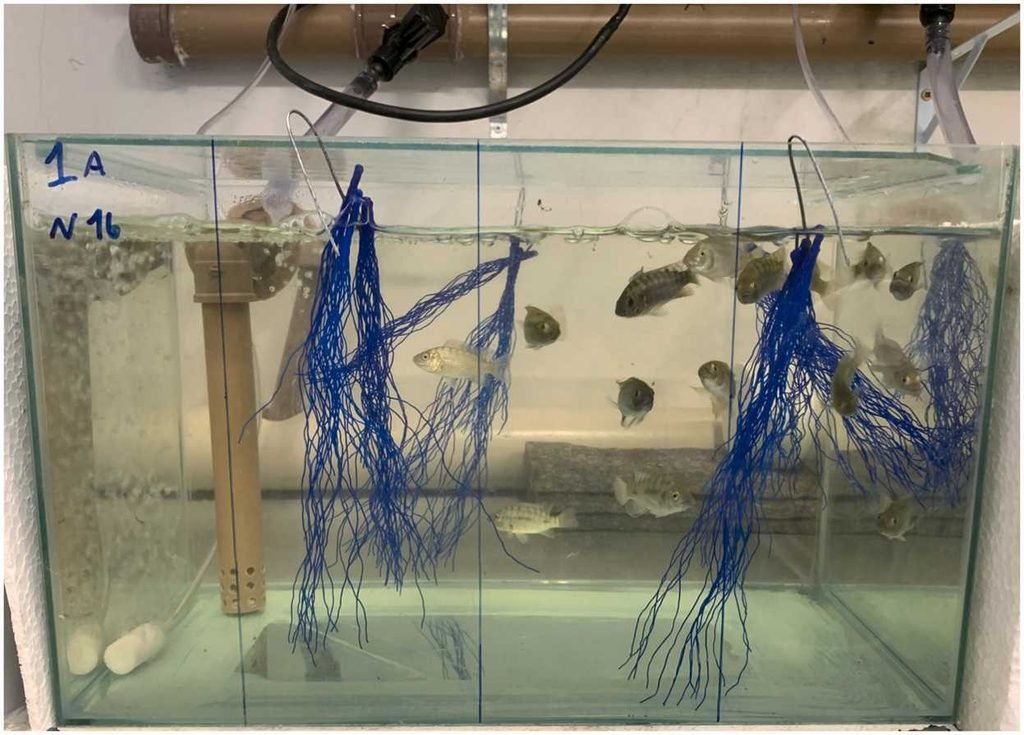
- Brazilian researchers deployed an artificial water hyacinth system—crafted from frayed blue nylon rope to mimic the root architecture of the macrophyte Eichhornia crassipes—in Nile tilapia (Oreochromis niloticus) tanks from fingerling to juvenile stages.
- Specimens in the enriched environments exhibited a significantly higher foraging rate across all stocking densities evaluated.
- At critical stocking densities (800 and 1,000 fish/m³), environmentally enriched tilapia displayed a substantial reduction in stereotypic behaviors—repetitive, functionless action patterns indicative of compromised animal welfare.
- Zootechnical performance indicators—including weight gain, feed conversion ratio (FCR), final biomass, and baseline cortisol levels—remained unaffected, confirming that environmental enhancement did not hinder productive metrics, and the trial achieved a 100% survival rate.
- The modulation of agonistic behavior proved volume-dependent: low-intensity encounters decreased at intermediate densities, whereas variations at lower and exceptionally high stocking densities remained inconclusive.
Those managing or conducting research in intensive fish farming are well-acquainted with the standard design: sterile, geometrically uniform, and strictly utilitarian tanks. These spaces are devoid of vegetation, substrate, or any structural complexity to break the aquatic monotony. Such configurations address well-established zootechnical imperatives—namely biosecurity compliance, expedited drainage, and operational ease. Yet, for decades, evaluating the sensory and behavioral experiences of the confined organism was largely overlooked.
Nonetheless, fish reared in barren environments frequently exhibit behavioral anomalies. They compulsively rub against the walls and bottom of the tank, or repeatedly open their mouths alongside accelerated opercular movements near the surface with no trophic purpose. In ethology and aquaculture welfare, these invariant motor sequences are defined as stereotypic behaviors. Virtually absent in natural habitats, they arise when animals lack adaptive avenues in response to chronic stress or sustained environmental deprivation, serving as a direct bioethical and physiological indicator.
Despite this, environmental enrichment has faced commercial reluctance due to concerns over high equipment overheads, complex cleaning routines, or potential compromises in feed conversion margins. This operational dilemma has historically stalled the transfer of such innovations from experimental bioassays to industrial application.
Addressing this bottleneck, a collaborative scientific team comprising UNESP’s Aquaculture Center (CAUNESP), the Botucatu Biosciences Institute (São Paulo State University), the FishEthoGroup Association, fair-fish, and Alianima developed a practical, cost-effective alternative. They replaced intricate structures with a segment of frayed blue nylon rope suspended to emulate the floating root architecture of water hyacinths, successfully reproducing the natural shelter and exploratory microhabitat of tilapia.
Applied Methodology and Relevance to the Aquaculture Industry
Nile tilapia (Oreochromis niloticus) ranks among the most widely cultured fish species globally, with Brazil—where this study took place—positioning itself as the fourth-largest global producer, exceeding 662,000 metric tons in 2024. Given this substantial biomass output, technical innovations capable of enhancing animal welfare without compromising zootechnical yields achieve strategic industrial relevance.

The research team monitored 384 all-male fingerlings, tracking them from an initial mean weight of 1.79 g to the juvenile stage (~34 g) over a six-week trial. Three experimental setups reflected commercial stocking densities: 12, 16, and 20 fish per tank (equivalent to 600, 800, and 1,000 fish/m³), where half of the tanks featured suspended frayed nylon root simulators while the remainder served as barren controls.
Ten-minute video recordings were captured weekly for each experimental unit prior to the initial morning feeding to assess three core ethological indicators: foraging frequency, stereotypic behaviors, and agonistic encounters. Full biometric assessments were performed at the initial and final stages to measure weight gain, complemented by blood sampling to quantify plasma cortisol as a benchmark physiological stress biomarker.
The selection of artificial water hyacinths builds on prior findings confirming the species’ preference for this structural complexity alongside documented improvements in fillet quality. Furthermore, the material presents direct operational advantages: nylon is an innocuous polymer widely used in aquaculture netting, showing exceptional durability, straightforward sanitization, and seamless replacement in commercial settings.
Environmental Enrichment Enhances Foraging Behavior in Tilapia
The initial experimental finding was unequivocal: tilapia reared in environments equipped with synthetic nylon roots exhibited a significantly higher foraging frequency compared to control tanks. This disparity reached statistical significance at low and intermediate stocking densities, while a consistent trend was observed at the highest density.
Mantente siempre informado
Stay Informed
Únete a nuestras comunidades para recibir al instante las noticias, informes y análisis más importantes del sector acuícola.
Join our communities to get instant access to the most important news, reports, and analysis from the aquaculture industry.
What is the underlying mechanism? Structural complexity diversifies available rearing space, providing interactive substrates, exploratory niches, and continuous sensory stimulation. This dynamic keeps specimens cognitively active; a consistent exploratory pattern serves as an unambiguous bioindicator of vigor and zootechnical health. Furthermore, this behavioral shift holds strategic commercial implications, as enhanced exploratory drive typically correlates with more uniform feed utilization, favorably impacting operational profitability.
It is essential to delineate conceptually between foraging and direct feed intake. Foraging encompasses the active exploration of the aquatic surroundings in search of nutrients—manifested through oral pecking against substrates, tank walls, or suspended structures. This represents an innate ethological repertoire observed in wild tilapia, which barren confinement systems drastically suppress.
Reduction of Stereotypic Behaviors in Tilapia Under High-Density Rearing Conditions
The second finding is critical for intensive tilapia production: at peak stocking densities (800 and 1,000 fish/m³), specimens provided with environmental enrichment exhibited a substantial decline in stereotypic behaviors compared to the control group, evidenced by reduced abnormal wall-rubbing and a marked decrease in non-trophic surface mouthing. The zootechnical implication is direct: under severe confinement, structural complexity mitigates crowding-induced welfare detriments, maximizing the efficacy of this cost-effective intervention where modern fish farming demands it most. Furthermore, assessing animal welfare through direct ethological observation rather than cost-intensive hematological panels offers farmers an accessible, reliable, and non-invasive on-farm bioindicator.
Agonistic Behavior in Tilapia: Density Modulates the Effect of Environmental Enrichment
The analysis of aggressive behavior yielded the most nuanced findings of the research, grounded in the territorial ethology of the Nile tilapia. As a species with a pronounced inclination toward spatial dominance, the frequency and intensity of confrontations are contingent upon the availability of usable volume.
At low density (12 specimens per tank), ample spatial leeway enabled the fish to demarcate territories with ease. Under this scenario, the suspended structure produced a dual effect: beyond serving as an exploratory substrate, it functioned as a monopolizable resource. Consequently, the enrichment did not diminish agonistic episodes, as individuals actively competed for ownership of the artificial substrate.
At intermediate density (16 fish), the response was markedly favorable. Spatial limitation prevented the establishment of rigid territories, allowing the synthetic roots to act as visual barriers and escape zones. The fish found timely refuge, avoiding direct visual contact and significantly reducing low-intensity aggressive encounters without escalating into physical confrontations.
Nonetheless, at the highest density (20 fish), extreme overcrowding neutralized this benefit. In the face of severe population saturation, social structure collapses, and conflictual encounters become constant; the spatial pressure surpasses any environmental mitigation. The zootechnical implication is unequivocal: environmental enrichment effectively attenuates intraspecific aggression, but it does not offset a critical excess of biological load within the system.
Zootechnical and Physiological Invariance: Key Parameters in Favor of the Producer
Two key variables remained homogeneous between specimens reared under enrichment and those in the control group; both conclusions prove highly favorable for the economic viability of the aquaculture producer.
In the first place, productive performance. Weight gain, feed conversion ratio, and final biomass exhibited no statistical discrepancies. Far from constituting an adverse result, this represents the optimal scenario: it demonstrates that incorporating synthetic nylon roots does not penalize the zootechnical yield of the culture. Fish welfare increases substantially without compromising growth. Contemporary welfare guidelines in aquaculture emphasize precisely this principle: any intervention that impairs productive performance is unlikely to achieve real-scale commercial adoption.
In the second place, plasma cortisol. Baseline concentrations of this stress biomarker remained stable across all treatments, falling within the reference ranges for tilapia (21 to 50 ng/mL). The authors methodologically highlight the associated limitations: quantification was conducted at a single time point after six weeks of trial, suggesting possible physiological adaptation or the loss of early transient responses. Furthermore, handling stress during venipuncture may have masked subtle variations, compounded by the absence of an earlier baseline. In summary, the stability of cortisol levels does not dismiss the verified behavioral benefits. The ethogram frequently reveals adaptive improvements that a single hematological assay fails to detect, confirming the need to assess welfare multidimensionally.
From Scientific Experimentation to Commercial Scale: Implications for Fish Farming
When contrasting this scenario with the initial barren tank—where fish exhibit continuous wall-rubbing—the evidence demonstrates that interrupting sensory deprivation requires neither onerous expenditures nor the reconfiguration of existing infrastructure. It essentially demands incorporating a length of frayed nylon rope suspended within the water column.
The outcome reveals that organisms display natural foraging patterns, mitigate confinement-induced stereotypic behaviors precisely at higher stocking densities, and, under intermediate densities, diminish their agonistic encounters. All of this occurs without impairment to weight gain performance, with zero mortality, and by utilizing a safe, accessible, and reusable polymer.
The researchers maintain justified methodological caution: these evaluations were conducted under controlled laboratory conditions rather than within the operational complexity of a commercial facility. Further research is required regarding durability, biofouling, replacement frequencies, and biosecurity protocols prior to formalizing widespread farm-level transfer. Nonetheless, the structural conclusion remains compelling. Faced with an industry undergoing rapid global expansion where animal welfare increasingly shapes consumer preferences, securing a technology that enhances fish quality of life without compromising operational profitability holds undeniable strategic value. Sometimes, the most consequential innovations in aquaculture do not demand high technology: they lie in the functional simplicity of a suspended fiber strand.
Contact
Caroline Marques Maia
CAUNESP – Aquaculture Center of UNESP, São Paulo State University
Jaboticabal, Brazil
FishEthoGroup Association, Faro, Portugal
fair-fish, Uster, Switzerland
Alianima, São Paulo, Brazil
Email: carol@fishethogroup.net, carol@fair-fish.net
Reference (open access)
Neto, J. F., Maia, C. M., Da Silva, G. V., De Oliveira, R. A., & Giaquinto, P. C. (2026). Low-cost structural enrichment promotes welfare in Nile tilapia by enhancing foraging and reducing stereotypies, without compromising growth or survival. Aquaculture Reports, 50, 103742. https://doi.org/10.1016/j.aqrep.2026.103742

Editor at the digital magazine AquaHoy. He holds a degree in Aquaculture Biology from the National University of Santa (UNS) and a Master’s degree in Science and Innovation Management from the Polytechnic University of Valencia, with postgraduate diplomas in Business Innovation and Innovation Management. He possesses extensive experience in the aquaculture and fisheries sector, having led the Fisheries Innovation Unit of the National Program for Innovation in Fisheries and Aquaculture (PNIPA). He has served as a senior consultant in technology watch, an innovation project formulator and advisor, and a lecturer at UNS. He is a member of the Peruvian College of Biologists and was recognized by the World Aquaculture Society (WAS) in 2016 for his contribution to aquaculture.