- 1 Key Study Takeaways
- 2 Functional Differences: What Nutritional Research Actually Assesses
- 3 Statistical Evidence: The Quantitative Data Behind the Recommendation
- 4 Water Dynamics: Why the Aquatic Environment Dictates Treatment Efficacy
- 5 Immune Response: What Fish Biomarkers Have Yet to Elucidate
- 6 Methodological Limitations: What the Meta-Analysis Itself Acknowledges
- 7 Back to Cage 9: Decision Criteria for Real-World Aquaculture
- 8 Entradas relacionadas:
Key Study Takeaways
- Probiotics, the most predictable alternative: Accounting for 75% of the 141 reviewed studies, they established themselves as the category yielding the most consistent improvements in weight gain and feed conversion ratio (FCR).
- Production systems dictate performance: Recirculating aquaculture systems (RAS) and biofloc technology demonstrated more stable growth rates; conversely, flow-through systems proved to be the most erratic.
- Synbiotics — high potential impact with lower reproducibility: Although they achieved the highest average increase in weight gain, their marked variability precludes guaranteed outcomes across diverse commercial settings.
- Prebiotics — moderate effect and limited empirical backing: Only 6.25% of the trials evaluated this category, thereby constraining the statistical robustness and representativeness of the reported averages.
- Immune response independent of the rearing system: Defense biomarkers improved broadly following additive supplementation, exhibiting no direct correlation with culture system typology.
The technical director of a cage-based tilapia farm evaluates the performance of a feed additive supplemented over the past six months. Despite promising projections of enhanced weight gain, superior feed conversion ratios (FCR), and heightened resilience, the biological response proved disparate: while the stock in cage 4 outperformed expectations, fish in cage 9 adhered to their baseline growth trajectory under identical feed batches, products, and dosing regimens.
This scenario recurs globally across aquaculture operations. For years, conventional reasoning attributed such discrepancies to product shortcomings, underdosing, or operational mixing inconsistencies. However, scientific evidence presents a far more compelling insight: the decisive factor lies not solely in the additive itself, but within the dynamics of the aquatic system in which it is applied.
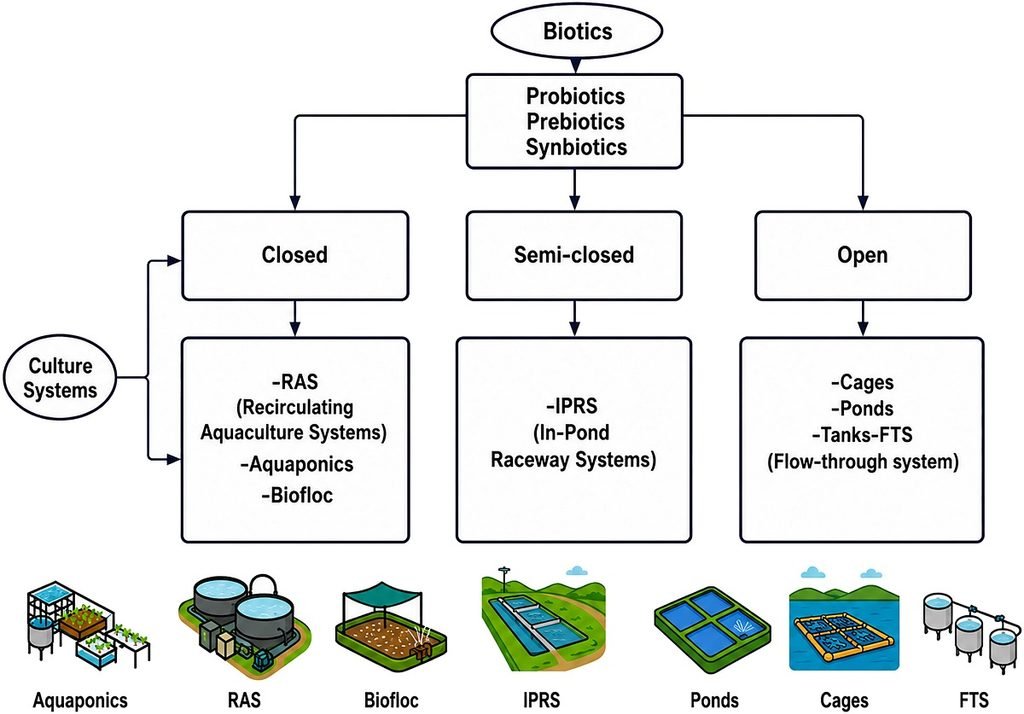
A study conducted by researchers at Universidad de La Sabana reviewed 141 scientific investigations on probiotics, prebiotics, and synbiotics in Nile tilapia (Oreochromis niloticus), statistically analyzing 96 of them. Their conclusion is unequivocal: while additives are functional, the rearing system fundamentally dictates the predictability of the outcome. In closed environments—such as recirculating aquaculture systems (RAS) and biofloc technology—production metrics proved remarkably homogeneous and consistent; conversely, in open systems—such as earthen ponds, cages, and flow-through operations—results ranged from extraordinary gains to virtually negligible impacts. For production managers and financial executives, this operational variability represents a decisive metric when forecasting return on investment (ROI) in aquafeed nutrition.
Functional Differences: What Nutritional Research Actually Assesses
Delineating these three concepts is essential prior to further examination, as the commercial market frequently conflates them despite their marked biological distinctions.
A probiotic is a live microorganism—typically bacterial—that, when administered in adequate quantities, confers zootechnical benefits upon the host. A prebiotic is inanimate: a non-digestible dietary ingredient that selectively nourishes autochthonous beneficial bacteria within the intestinal tract. A synbiotic integrates both elements into a single formulation: the viable strain paired with its specific energetic substrate.
This operational distinction accounts for their performance in production. Supplementing a probiotic parallels stocking fry: the functional organism is introduced directly. Administering a prebiotic is analogous to fertilizing a pond: it enhances pre-existing biomass without inoculating novel agents. If the digestive tract lacks a microbiome capable of metabolizing said substrate, the nutritional stimulus loses efficacy. The analysis corroborates this premise: prebiotics rely fundamentally on the fish’s native microbiome, explaining why their effects prove more moderate and heterogeneous.
Statistical Evidence: The Quantitative Data Behind the Recommendation
The research team evaluated a sample of over 12,500 fish across weight gain analyses, employing advanced statistical models to synthesize and contrast outcomes from multiple independent trials.
Probiotics elicited a robust, statistically significant improvement in weight gain while optimizing the feed conversion ratio (FCR), requiring less feed per kilogram of biomass produced. Meanwhile, synbiotics yielded the highest average impact among the three categories; however, they exhibited an extensive dispersion interval spanning from exceptional gains to negligible responses. Prebiotics occupied an intermediate position, supported by a more limited volume of scientific literature.
This observation holds strategic value for farm operations: a high average yield subject to substantial statistical dispersion does not constitute a reliable investment, much like selecting a batch of fry based solely on mean weight without analyzing standard deviation. The authors are unequivocal: synbiotics should not be regarded as the most predictable option, but rather as a high-potential intervention whose efficacy hinges on specific compatibility among the bacterial strain, the prebiotic substrate, and the physicochemical conditions of the culture system.
Mantente siempre informado
Stay Informed
Únete a nuestras comunidades para recibir al instante las noticias, informes y análisis más importantes del sector acuícola.
Join our communities to get instant access to the most important news, reports, and analysis from the aquaculture industry.
Microbiologically, the study mapped prevailing adoption patterns across the aquaculture sector. Within the probiotic segment, the genus Bacillus was overwhelmingly dominant (48% of records), followed by Lactobacillus (15%), Pediococcus (10%), Saccharomyces (7%), and Enterococcus (6%). Conversely, prebiotics displayed no singular dominance, with fructooligosaccharides (FOS), mannan-oligosaccharides (MOS), β-glucans, and enzyme complexes evenly distributed. Reported dosages across trials hovered around of feed for probiotics and between 0.5% and 2% dietary inclusion for prebiotics.
Water Dynamics: Why the Aquatic Environment Dictates Treatment Efficacy
The analysis’s most compelling insight extends beyond baseline fish growth rates to explain why an identical product elicits such disparate zootechnical responses depending on the production environment.
A recirculating aquaculture system (RAS) maintains critical water quality parameters—such as temperature, dissolved oxygen, ammonia, and organic loading—within narrow, strictly controlled ranges. This equilibrium enables administered microorganisms to persist in the culture medium and maximize contact time with the host organism. Conversely, in flow-through systems with daily water exchange rates between 20% and 75% of total volume, a substantial fraction of the inoculum is discharged with the effluent, rendering microbial exposure transient rather than sustained.
The authors synthesize this phenomenon into a core principle for technical farm management: biological performance does not rely on the nominal dosage declared on the product label, but rather on effective microbial exposure—specifically, the concentration of viable cells interacting continuously with the fish. Doubling the inclusion rate in a high-exchange system does not counteract water dilution; it merely inflates feed costs.
Biofloc technology represents the opposite operational framework: an ecosystem built upon dense microbial biomass and high organic load, where probiotics encounter optimal colonization conditions. Nonetheless, the researchers emphasize a critical methodological nuance: much of the empirical evidence on synbiotics in biofloc originates from Pacific white shrimp (Litopenaeus vannamei) culture, whose physiological requirements diverge significantly from tilapia farming—which demands tighter physicochemical control and lower tolerance to total suspended solids (TSS). Extrapolating these results across species represents an insufficiently rigorous approach.
Immune Response: What Fish Biomarkers Have Yet to Elucidate
In this section, the research presents a noteworthy finding that the authors themselves approach with rigorous caution.
When evaluating defense biomarkers—specifically lysozyme, superoxide dismutase, and catalase, all critical in mediating pathogen response and oxidative stress—significant improvements associated with additive supplementation were confirmed. Furthermore, a reduction in alanine aminotransferase (ALT) levels, an enzyme indicative of hepatic injury, was observed, suggesting a substantial hepatoprotective effect.
However, the differentiated pattern observed across culture systems did not replicate in this immunological domain. Unlike growth performance parameters, immune response exhibited no definitive correlation between open and closed systems, fluctuating primarily according to the specific biomarker assessed. Notably, only 33 of the 141 reviewed studies incorporated immunological variables, reporting measurements across disparate timeframes, target tissues, and analytical methodologies.
The authors’ interpretation is prudent and well-grounded: these findings do not prove that the rearing environment lacks an impact on immunity, but rather that the available literature remains too heterogeneous to establish a conclusive statistical correlation. A critical technical distinction exists between the genuine absence of an effect and the inability to detect one with existing evidence—a nuance frequently overlooked in commercial literature.
Methodological Limitations: What the Meta-Analysis Itself Acknowledges
No meta-analysis is infallible, and this study addresses its inherent constraints with transparency. Inter-study heterogeneity was remarkably high across all evaluated growth metrics. Furthermore, the majority of trials were conducted under laboratory or semi-controlled conditions, limiting direct extrapolation to commercial-scale operations. Nor can publication bias be discounted—namely, the historical tendency to withhold trials yielding null or negative findings. Strikingly, the research team did not identify a single study evaluating these additives in In-Pond Raceway Systems (IPRS), leaving a rapidly expanding technology devoid of empirical validation.
Compounding this is a clear lack of standardization that directly affects commercial purchasing decisions: dosages are reported in disparate units, featuring heterogeneous formulations and inconsistent administration periods. Consequently, comparing the relative efficacy of commercial products based on open literature remains a substantial technical challenge.
Back to Cage 9: Decision Criteria for Real-World Aquaculture
The technician evaluating the disparate performance between cages did not commit an operational error; rather, they applied a product validated under experimental conditions that their commercial production environment fails to replicate.
The core contribution of this meta-analysis lies neither in a novel additive nor in a universal dosage formula, but in establishing a technical decision framework. Prior to incorporating a probiotic, priority must be given to assessing the physicochemical stability of the aquatic medium and the effective residence time of the microorganism alongside the fish. In properly managed recirculating aquaculture systems (RAS) or biofloc environments, the probability of achieving projected zootechnical performance is exceptionally high. In floating cages or earthen ponds, the additive remains a valuable tool, yet its response must be managed across a range of variability and validated through dedicated on-farm control batches rather than assuming commercial catalog averages.
Ultimately, the contrast between Cage 4 and Cage 9 does not contradict scientific evidence—it corroborates it, proving that in aquaculture no additive operates in isolation, but strictly in concert with system dynamics.
Contact
Luisa Marcela Villamil Diaz
Doctorado en Biociencias, Facultad de Ingeniería, Universidad de La Sabana
Chína, Colombia
Email: luisa.villamil@unisabana.edu.co
Reference (open access)
Laverde, D. C., Ruiz Pardo, R. Y., & Villamil Diaz, L. M. (2026). Aquaculture Systems Affect the Impact of Probiotics, Prebiotics, and Synbiotics on Growth and Immunity of Oreochromis niloticus: A Systematic Review and Meta-Analysis. Reviews in Aquaculture, 18(4), e70199. https://doi.org/10.1111/raq.70199

Editor at the digital magazine AquaHoy. He holds a degree in Aquaculture Biology from the National University of Santa (UNS) and a Master’s degree in Science and Innovation Management from the Polytechnic University of Valencia, with postgraduate diplomas in Business Innovation and Innovation Management. He possesses extensive experience in the aquaculture and fisheries sector, having led the Fisheries Innovation Unit of the National Program for Innovation in Fisheries and Aquaculture (PNIPA). He has served as a senior consultant in technology watch, an innovation project formulator and advisor, and a lecturer at UNS. He is a member of the Peruvian College of Biologists and was recognized by the World Aquaculture Society (WAS) in 2016 for his contribution to aquaculture.