- 1 Key Study Findings
- 2 Why Gills Serve as the Premier Indicator of Fish Stress
- 3 Study Methodology: Experimental Design and Aquaculture Relevance
- 4 The Impact of Jellyfish on Salmon: A Secondary Driver Relative to Thermal Stress
- 5 The Impact of Thermal Stress on the Gill Microbiome: Shifts in Salmon Bacterial Communities
- 6 Immunological and Structural Reprogramming: The Molecular Response of Salmon to Thermal Stress
- 7 Environmental Stressor Interactions: Synergistic Responses in Salmon Facing Climate Change
- 8 Conclusions for the Salmon Industry: Gill Monitoring in the Face of Climate Change
- 9 Entradas relacionadas:
Key Study Findings
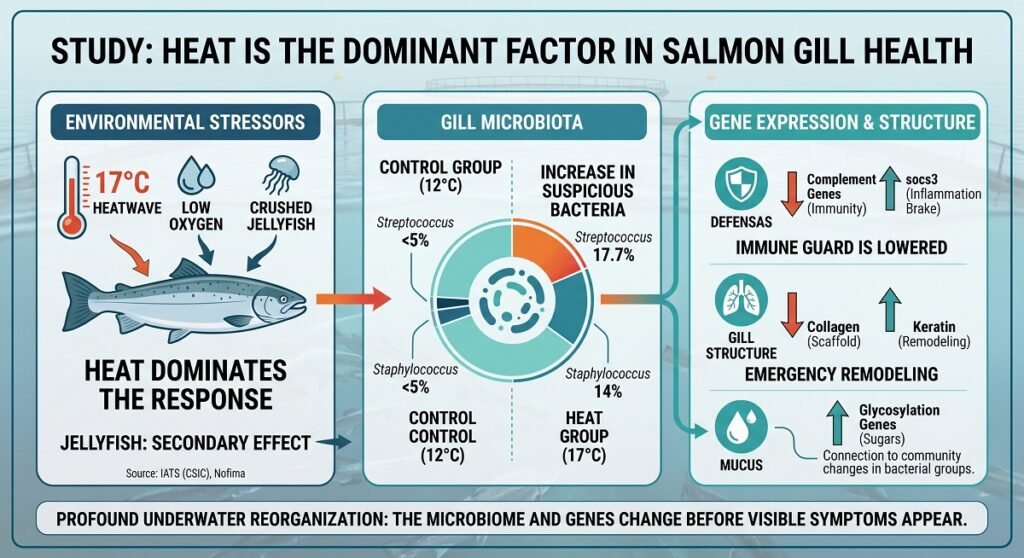
- Temperature as the overriding driver: Thermal elevation drove the most pronounced disruption in both gill microbiome architecture and host gene regulation, overshadowing all other environmental variables.
- Limited standalone impact of jellyfish: Exposure to jellyfish alone induced negligible shifts; its detrimental effects were amplified only through synergistic interaction with thermal stress and hypoxia.
- Proliferation of opportunistic taxa: Under elevated temperatures, potentially pathogenic genera such as Streptococcus and Staphylococcus expanded from under 5% to comprise 15–18% of the total microbial consortium.
- Immune and structural remodeling: Heat stress suppressed vital immune cascades (including the complement pathway) and upregulated anti-inflammatory modulators, concurrent with an upregulation of keratin and a depletion of branchial collagen.
- Mucosal biochemical alteration: Thermal challenge upregulated genes responsible for modifying mucin glycan profiles, a biochemical shift that directly correlated with heat-induced bacterial blooms.
Inside the sea cages, temperature readings reach an unprecedented threshold: 17 °C and climbing. At the surface, the translucent bells of a jellyfish bloom drift against the netting while dissolved oxygen levels decline, driving fish to crowd around aeration diffusers. Although conditions appear manageable on the surface—with active swimming and no immediate mortality—the true physiological toll unfolds out of sight within the gills, a vital organ governing respiration, osmoregulation, and immune defense.
This scenario epitomizes the critical crossroads facing salmon farming under climate change. Extreme events such as marine heatwaves, hypoxia, and jellyfish proliferations are already disrupting commercial operations, turning complex gill disorders into one of the industry’s greatest threats to fish welfare and economic viability; however, the synergistic cellular interactions among these stressors and the identity of the primary biological driver remained poorly understood.
To address this knowledge gap, a research team from the Institute of Aquaculture Torre de la Sal (IATS-CSIC) in Spain, in collaboration with Norway’s Nofima, exposed Atlantic salmon to elevated temperatures, hypoxia, and jellyfish contact. By concurrently profiling the branchial microbiota and host transcriptomic responses, the authors uncovered findings that fundamentally reshape prevailing assumptions across the aquaculture sector.
Why Gills Serve as the Premier Indicator of Fish Stress
If one had to single out an organ to evaluate fish health status, gills would undoubtedly take precedence. Operating in perpetual contact with the aquatic medium, they orchestrate vital physiological processes concurrently: mediating gas exchange, regulating osmotic balance, excreting metabolic wastes, and actively participating in mucosal immune defenses. Consequently, branchial tissues are the first to deteriorate under adverse environmental challenges, providing a definitive diagnostic advantage wherein structural and functional alterations directly mirror surrounding environmental pressures.
Furthermore, gill tissue harbors an essential yet historically overlooked component: the mucosal microbiota, a commensal bacterial community serving as a frontline defensive barrier. This biological dynamic functions as a balanced micro-ecosystem; as beneficial taxa occupy spatial niches and utilize available substrates, opportunistic pathogens are effectively outcompeted from colonizing the epithelium. Disruption of this homeostasis—whether through diversity loss or opportunistic proliferation—serves as an unequivocal hallmark of compromised host health.
Study Methodology: Experimental Design and Aquaculture Relevance
At the Tromsø aquaculture research station in Norway, scientists evaluated juvenile Atlantic salmon across three experimental regimens over 26 days. The control cohort was maintained at 12 °C, representing the optimal thermal range for the species. The second cohort simulated a marine heatwave—gradually elevating water temperature to a 17 °C peak, holding it for ten days, and subsequently ramping it down. The third group replicated this thermal event coupled with hypoxia by suppressing dissolved oxygen to 70% upon reaching 17 °C, thereby mirroring critical field scenarios where sea-cage aeration deficits occur, and life-support systems only partially offset the shortfall.
Subsequently, a biological challenge was introduced using the common moon jellyfish (Aurelia aurita), an abundant species in Norwegian waters capable of inducing epithelial lesions, respiratory distress, and secondary infections. To ensure a standardized, homogeneous exposure instead of introducing live specimens—whose contact rates inherently vary—a tissue homogenate was administered to half of each treatment group for three hours.
Finally, branchial tissue underwent dual genomic profiling: 16S rRNA gene sequencing via the portable MinION platform to characterize bacterial community composition, and total RNA sequencing via Illumina technology to quantify host transcriptomic responses—effectively generating a simultaneous roadmap of both the branchial microbiota and the fish’s molecular defense cascades under environmental stress.
The Impact of Jellyfish on Salmon: A Secondary Driver Relative to Thermal Stress
For years, jellyfish blooms have been regarded as a primary hazard: they foul sea cages, inflict skin and gill lesions via stinging nematocysts, and drastically deplete dissolved oxygen during decomposition, alongside hypotheses positioning them as biological vectors of pathogenic bacteria. Consequently, exposure to jellyfish was anticipated to profoundly disrupt the branchial microbiome.
Mantente siempre informado
Stay Informed
Únete a nuestras comunidades para recibir al instante las noticias, informes y análisis más importantes del sector acuícola.
Join our communities to get instant access to the most important news, reports, and analysis from the aquaculture industry.
However, empirical findings revealed the opposite: standalone jellyfish challenge failed to induce significant shifts in either bacterial community composition or broad-scale gene expression, downregulating merely seven branchial genes under stable baseline temperatures.
The authors acknowledge a potential methodological constraint—namely, that macerating and freezing specimens before administration may have prematurely triggered nematocyst discharge and exhausted venoms. While chronic exposure to intact, living jellyfish warrants further investigation, the operational takeaway remains unequivocal: during co-occurring heat and hypoxia events, the physicochemical environment decisively dictates salmon physiological responses, relegating jellyfish to a secondary role.
The Impact of Thermal Stress on the Gill Microbiome: Shifts in Salmon Bacterial Communities
This finding holds critical implications for health management strategies in salmon aquaculture. In thermally challenged cohorts, branchial bacterial alpha diversity increased alongside a fundamental restructuring of community dominance, marked by a pronounced surge in two genera: Streptococcus and Staphylococcus, which expanded to approximately 17.7% and 14% of the branchial microbiota, respectively, compared to baseline levels below 5% in the control group.
The clinical significance of these taxa stems from their veterinary relevance, as both genera harbor established salmonid pathogens—certain Streptococcus species cause streptococcosis, whereas elevated Staphylococcus loads have been linked to complex gill disorders such as Amoebic Gill Disease (AGD)—with elevated temperatures further potentiating virulence via the upregulation of pathogenicity traits.
Nevertheless, the authors urge caution: the resolution of 16S sequencing precluded species- and strain-level classification, preventing direct etiological attribution within an assay that yielded neither mortalities nor gross pathology; nonetheless, these microbial shifts provide a valuable early-warning biomarker, demonstrating that thermal stress tips the commensal equilibrium toward high-risk dysbiotic profiles typically preceding clinical outbreaks.
Immunological and Structural Reprogramming: The Molecular Response of Salmon to Thermal Stress
Parallel to the shifts in the microbiota, the branchial transcriptomic profile revealed profound cellular reorganization. Thermal elevation served as the primary biological driver, accounting for the highest proportion of differentially expressed genes across three key functional axes: protective mucosal secretion, immune competence, and tissue integrity.
At the immunological level, a critical signature emerged marked by the downregulation of complement pathway genes alongside the robust upregulation of socs3, an anti-inflammatory regulator. This modulation suggests the host dampens frontline immune defenses to sustain thermal tolerance, coinciding with the proliferation of opportunistic taxa.
In branchial architecture, collagen gene expression declined while cytokeratins were significantly upregulated, reflecting adaptive structural remodeling as metabolic resources are diverted from somatic growth to cellular maintenance. Concurrently, thermal challenge altered mucin biochemistry by inducing glycosyltransferase-encoding genes, a glycan remodeling that correlated directly with Streptococcus and Staphylococcus blooms and highlights an environmental selection pressure on mucosal colonization.
Environmental Stressor Interactions: Synergistic Responses in Salmon Facing Climate Change
A pivotal analytical finding emerged: while isolated jellyfish contact caused minimal impact, its concurrence with thermal challenge and hypoxia elicited unprecedented molecular responses absent under single-stressor conditions. Specifically, the combined heat-and-jellyfish cohort upregulated over 25 stress-response genes, whereas the simultaneous exposure to thermal stress, hypoxia, and jellyfish suppressed key cascades governing coagulation and cell motility—mechanisms essential for tissue repair and regeneration.
Physiologically, these stressors act synergistically rather than additively; a fish possessing adequate baseline thermal tolerance may still suffer severe physiological impairment when concurrently challenged by dissolved oxygen deficits and cnidarian exposure. For commercial aquaculture, this highlights a critical operational vulnerability: in open-water farming environments, climatic and biological disturbances seldom occur in isolation.
Conclusions for the Salmon Industry: Gill Monitoring in the Face of Climate Change
Returning to sea-cage operations, this study’s primary conclusion demonstrates that monitoring efforts centered solely on jellyfish blooms are fundamentally insufficient; during marine heatwaves, the decisive risk driver lies within the branchial microenvironment—characterized by dysbiotic microbial shifts and subclinical immune restructuring—where physiological disruption is already well advanced before gross lesions or mortalities manifest.
The core contribution of this work lies in establishing an early-warning diagnostic roadmap of gene biomarkers and bacterial profiles to monitor under thermal stress, providing the baseline to devise health management protocols that safeguard host defenses. As extreme climatic events and biological blooms intensify, enterprises that master these internal physiological mechanisms will lead in production resilience.
Contact
M. Carla Piazzon
Fish Pathology Group, Instituto de Acuicultura Torre de la Sal (IATS, CSIC)
Castellón, Spain
Email: carla.piazzon@csic.es
Reference (open access)
Toxqui-Rodríguez S, Ytteborg E, Johansen L-H, Sitjà-Bobadilla A, Pérez-Sánchez J, Lazado CC and Piazzon MC (2026) Climate change-related stressors in aquaculture: modulation of gill microbiota and transcriptome in Atlantic salmon. Front. Mar. Sci. 13:1913823. doi: 10.3389/fmars.2026.1913823

Editor at the digital magazine AquaHoy. He holds a degree in Aquaculture Biology from the National University of Santa (UNS) and a Master’s degree in Science and Innovation Management from the Polytechnic University of Valencia, with postgraduate diplomas in Business Innovation and Innovation Management. He possesses extensive experience in the aquaculture and fisheries sector, having led the Fisheries Innovation Unit of the National Program for Innovation in Fisheries and Aquaculture (PNIPA). He has served as a senior consultant in technology watch, an innovation project formulator and advisor, and a lecturer at UNS. He is a member of the Peruvian College of Biologists and was recognized by the World Aquaculture Society (WAS) in 2016 for his contribution to aquaculture.