- 1 Key Takeaways
- 2 Why the Aerator is the Primary Energy Consumer in a RAS
- 3 The Missing Piece: Teaching the System to Estimate Species-Specific Oxygen Demand
- 4 The Acid Test: A 72-Hour Typhoon Power Outage
- 5 The Investment Strategy: Optimizing Oxygen Thresholds Proves More Cost-Effective Than Expanding Battery Banks
- 6 From the Laboratory to the Commercial Tank: Scalability and the Future of Energy Management in Aquaculture
- 7 Entradas relacionadas:
Key Takeaways
- The Energy Challenge: Recirculating Aquaculture Systems (RAS) recycle up to 99% of their water; however, they consume 1.4 to 1.8 times more electricity than flow-through farms, primarily due to the continuous operation of aerators.
- Technological Innovation: Researchers in Japan have developed a smart control system that automates aerator activation based on real-time fish oxygen demand and the availability of renewable energy.
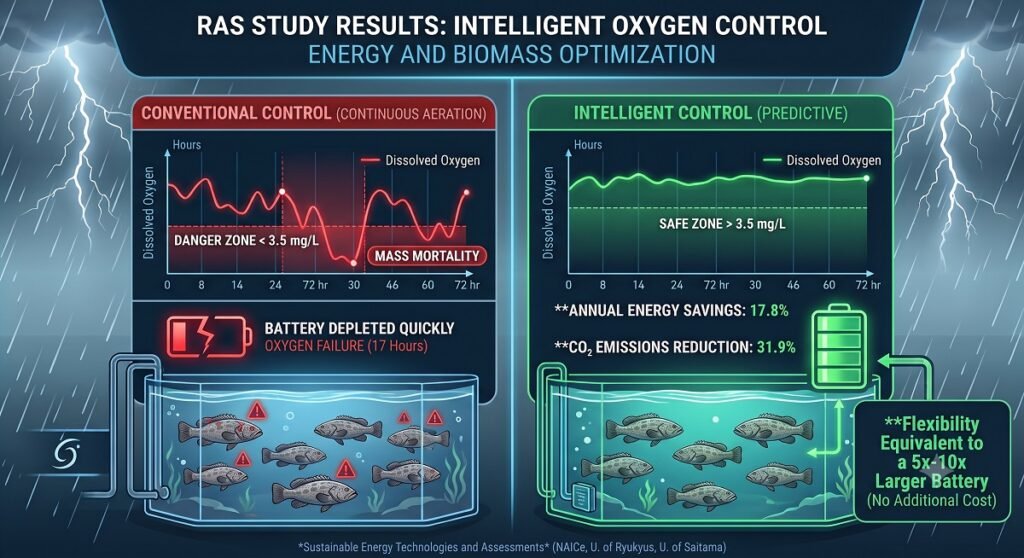
- Proven Results: Implementation achieved a 17.8% reduction in annual electricity consumption and a 31.9% decrease in CO₂ emissions, all while maintaining dissolved oxygen levels within strict safety thresholds.
- Emergency Resilience: During a 72-hour power outage simulation (mimicking a typhoon), the smart system sustained adequate oxygenation using a single battery. In contrast, conventional controls depleted the backup power, leaving the system without safe oxygen levels for 17 hours.
- Operational Insight: Precisely optimizing oxygen thresholds provides operational flexibility equivalent to scaling battery storage capacity by 5 to 10 times—at a fraction of the cost.
It is three in the morning, and the typhoon is sweeping in from the east. At a Malabar grouper farm in Okinawa, the operator can only stare at the oxygen meter: the power grid collapsed hours ago. The aerators, which normally run continuously, now rely on a battery that is depleting by the minute. He knows the math all too well: if dissolved oxygen in the tank falls below the critical threshold, he won’t just lose a few fish—he will lose the entire stock before dawn.
That scene—the blackout, the draining battery, and the clock ticking against fish suffocation—captures the core vulnerability of a technology poised to lead the future of sustainable aquaculture. Recirculating Aquaculture Systems (RAS) recycle nearly all of their water, contain nutrients, and guarantee production under controlled conditions. However, this level of control comes at a high energy cost that many producers struggle to bear.
A newly published study in the journal Sustainable Energy Technologies and Assessments proposes a concrete solution to this dual challenge: cutting daily electricity consumption and mitigating vulnerability to power outages, all without requiring additional equipment investments. The premise is straightforward: stop operating the aerator continuously and instead manage it as a flexible resource that triggers only when the biomass actually demands it.
Why the Aerator is the Primary Energy Consumer in a RAS
Any Recirculating Aquaculture System (RAS) operator can attest to this on their electricity bill: circulation pumps, biofilters, and, most critically, aerators operate continuously. The industry’s standard practice—running aeration 24/7—stems from a well-founded fear: dissolved oxygen is the quickest resource to deplete, and a parameter where no one wants to take risks, as a failure lasting just a few hours can wipe out an entire yield.
The drawback is that this continuous operation strategy overlooks the system’s biological dynamics. Fish do not consume oxygen at a constant rate; their demand fluctuates based on total biomass, feed rations provided, and the specific stage of the culture cycle. Consequently, equipment operates at overcapacity for much of the day, consuming electricity to maintain oxygen concentrations far exceeding what is actually needed at that moment.

For years, the conventional alternative was to apply intermittent aeration schemes, such as fixed cycles of eight hours on and eight hours off. While this method lowers operating costs, it does so blindly. The study demonstrates that although this strategy reduces energy bills, it pushes oxygen concentrations below safety limits for nearly 3,000 hours per year—an unacceptable risk level for commercial aquaculture production.
The Missing Piece: Teaching the System to Estimate Species-Specific Oxygen Demand
Herein lies the core contribution of the researchers from the University of the Ryukyus and Saitama University. Instead of programming aeration with fixed timers, they developed a predictive model that estimates tank oxygen consumption for the upcoming hours and manages the aerator accordingly.
To calibrate the model, the team conducted laboratory-scale measurements at the individual level. The study was carried out on Malabar grouper (Epinephelus malabaricus)—a high-value commercial species in Southeast Asia—at the Nakagusuku Aquaculture Innovation Center (NAICe) facilities in Okinawa. By monitoring the respirometry rate in closed tanks during fasting and post-feeding periods, they quantified a critical pattern: oxygen consumption spikes sharply following feed intake and scales proportionally with fish growth.
Using these parameters, the authors formulated an equation correlating individual weight, stocking density, and feeding rates with future dissolved oxygen requirements. Notably, with scientific rigor, the researchers point out that fish respiration follows a more complex allometric relationship relative to body mass. However, since the fish enter the RAS facilities near market size, a linear approximation yields equivalent predictive accuracy within that specific range—a pragmatic approach that converts a theoretical equation into a truly operational tool for the producer.
Mantente siempre informado
Stay Informed
Únete a nuestras comunidades para recibir al instante las noticias, informes y análisis más importantes del sector acuícola.
Join our communities to get instant access to the most important news, reports, and analysis from the aquaculture industry.
Oxygen Management as an Alternative Energy Storage System
Equipped with this predictive demand model, the researchers integrated the data into an optimization controller operating on a four-day forecast horizon. The algorithm cross-references three critical variables: the biological oxygen demand of the fish, solar and wind generation forecasts, and current electricity tariffs to determine the optimal aeration schedule.
The main innovation lies in managing surplus renewable energy. When solar radiation or wind peaks and the primary battery is fully charged, the system uses excess energy to intensify aeration, raising tank oxygen concentration close to saturation levels. This additional oxygen remains dissolved in the water column; subsequently, during periods without renewable generation, the controller pauses the aerator for hours, allowing the biomass to consume the accumulated reserve.
In this way, the tank itself acts as a zero-capital-cost complementary energy storage system—storing dissolved oxygen rather than electricity and mitigating renewable intermittency as effectively as a conventional battery bank.
The data supports this approach: compared to continuous aeration, the optimized system cut aerator runtime almost in half, reduced annual electricity costs by 32.1%, and increased the renewable energy share from 46.7% to 55.8%, all while ensuring dissolved oxygen remained strictly above the 3.5 mg/L safety threshold.
For the authors, this strategy marks a fundamental shift in the technical management of the sector. “Our results demonstrate that aerators in an aquaculture facility should not be treated simply as fixed electrical loads,” notes Assistant Professor Akito Nakadomari, researcher at Saitama University and corresponding author of the study. “From a power systems perspective, the key lies in understanding how biological and operational processes shape electrical demand. By embedding these dynamics into energy management, it becomes possible to unlock operational flexibility that previously remained hidden. In this research, dissolved oxygen served as the integrating link between aerator operation and crop safety, enabling coordinated aeration alongside renewable generation, battery storage, and the power grid.”
The Acid Test: A 72-Hour Typhoon Power Outage
Let us return to the typhoon contingency. The research team did not limit themselves to simulating a standard operating cycle; they recreated the most extreme scenario using Typhoon Tapah—which struck Okinawa on September 21, 2019—as a benchmark. The model simulated a total 72-hour grid failure and the preventive shutdown of the wind turbine to prevent structural damage, leaving the facility solely dependent on the battery bank and photovoltaic generation.
Under the conventional continuous aeration scheme, the outcome was predictable: oxygen concentrations dropped below the safety threshold on two separate occasions—first for 12 consecutive hours and later for 5 hours. This initial dip alone would have triggered massive biomass mortality; to prevent such a critical event using traditional methodology, a producer would need to double their battery storage capacity, a capital investment hard to justify.
In contrast, the smart controller managed the 72-hour emergency without dissolved oxygen ever falling below the safety limit, all while operating on the same battery capacity. By prioritizing power supply to aeration and shedding non-essential loads, it guaranteed stock survival without requiring additional hardware. In this scenario, operational resilience stemmed not from acquiring more infrastructure, but from optimizing decision-making with available resources.
The Investment Strategy: Optimizing Oxygen Thresholds Proves More Cost-Effective Than Expanding Battery Banks
Perhaps the most valuable finding for financial decision-making in the sector stemmed from the sensitivity analysis. The research team evaluated system behavior by adjusting two key variables: battery storage capacity and the minimum allowable dissolved oxygen threshold.
The finding was decisive: increasing battery capacity from 0.1 to 1.0 kWh had a marginal impact on CO₂ emission reductions and renewable energy penetration. In contrast, tuning the oxygen safety threshold to 3.5 mg/L delivered performance gains equivalent to scaling storage capacity five- to ten-fold. Operationally, precisely defining the species’ actual thermal and metabolic requirements is far more efficient than incurring capital expenditures on additional energy storage.
However, the authors establish a note of technical caution: in related species, mortality spikes drastically when oxygen levels fall below 1.4 mg/L. They therefore fixed the threshold at 3.5 mg/L—a conservative safety margin that absorbs potential instrumentation errors or predictive modeling deviations while maintaining an optimal daily average concentration of 5.0 mg/L. Relaxing this variable does not mean compromising crop biosecurity, but rather eliminating unnecessary over-oxygenation that inflates electricity bills.
From the Laboratory to the Commercial Tank: Scalability and the Future of Energy Management in Aquaculture
It is worth clarifying the scope of the study: the research was conducted on a small-scale pilot system equipped with 200 W solar panels, a 90 W turbine, and a 400-liter tank. Although absolute savings will vary when scaling to a commercial farm—a next phase noted by the authors—the underlying logic remains unchanged: quantifying the species’ actual physiology and using dissolved oxygen in the water column as a natural energy buffer does not depend on infrastructure scale.
This principle, according to Nakadomari, extends beyond grouper production. “System flexibility can be enhanced not only by adding batteries or other hardware, but also by understanding the processes shaping electrical demand,” the researcher explains. “While this study used dissolved oxygen to demonstrate the concept, RAS operations are governed by multiple interconnected process states and requirements. By integrating these interactions into energy management, we aim to uncover additional flexibility without compromising safe, reliable production. This same principle could extend to other critical facilities regulated by safety, quality, or service criteria.”
Let us return one last time to the farm under the typhoon. Under this approach, the operator would not need to anxiously monitor the oxygen meter in the dead of night, relying on remaining battery capacity. The smart controller would have anticipated the power outage days in advance, saturated the water with oxygen during peak sunlight hours, and rationed every watt to preserve the critical input for stock survival. The exact same infrastructure and battery bank—yet with an intact yield at dawn.
Contact
Akito Nakadomari
Saitama University
255 Shimookubo, Sakura-ku, Saitama-shi, Saitama, 338-8570, Japan
Email: nakadomari@mail.saitama-u.ac.jp
Reference (open access)
Nakadomari, A., Fukunaga, K., Ueda, S., & Senjyu, T. (2026). Optimization of renewable energy-integrated recirculating aquaculture systems under dissolved oxygen constraints. Sustainable Energy Technologies and Assessments, 91, 105029. https://doi.org/10.1016/j.seta.2026.105029

Editor at the digital magazine AquaHoy. He holds a degree in Aquaculture Biology from the National University of Santa (UNS) and a Master’s degree in Science and Innovation Management from the Polytechnic University of Valencia, with postgraduate diplomas in Business Innovation and Innovation Management. He possesses extensive experience in the aquaculture and fisheries sector, having led the Fisheries Innovation Unit of the National Program for Innovation in Fisheries and Aquaculture (PNIPA). He has served as a senior consultant in technology watch, an innovation project formulator and advisor, and a lecturer at UNS. He is a member of the Peruvian College of Biologists and was recognized by the World Aquaculture Society (WAS) in 2016 for his contribution to aquaculture.