In contemporary aquaculture, the rising demand for diversified offerings has propelled research toward optimizing key species such as the rainbow trout (Oncorhynchus mykiss). While global salmonid production is massive, commercial success currently hinges on producers’ ability to select strains with high productive potential and visual attributes capable of captivating specific market niches.
A recent study published in the journal Aquaculture Reports has revealed that skin pigmentation is far more than an aesthetic trait: it is intrinsically linked to the metabolic performance and growth rate of these specimens. The research was led by experts from prestigious Brazilian institutions, including the Graduate Program in Animal Science (FZEA/USP) and the Fisheries Institute of São Paulo.
Key study findings
- Yellow strain leadership: The yellow-albino variety significantly outperformed the others in final weight and growth rate.
- White-albino disadvantage: This strain exhibited the lowest performance across all evaluated parameters.
- Efficacy of the Gompertz model: This mathematical function proved highly reliable for predicting weight and developmental stages based on fish age.
- Genetic influence: Pigmentation acts as a physiological marker for metabolism and feed efficiency.
The Science Behind Accelerated Growth
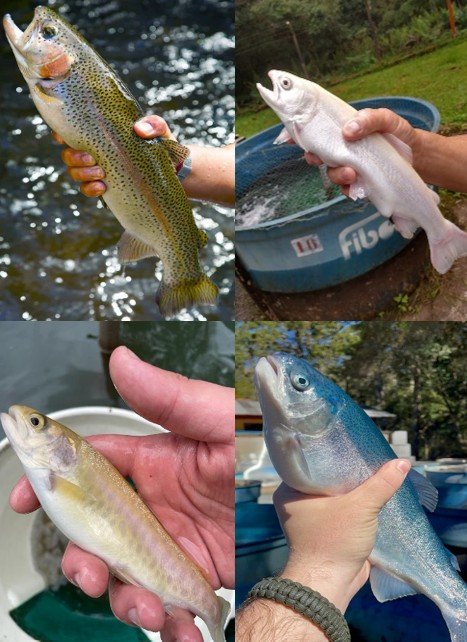
To unravel these metabolic differences, researchers compared four genetic variants of rainbow trout: wild-type, cobalt blue, yellow-albino, and white-albino. The 270-day experiment was conducted at the ‘Dr. Ascanio Carvalho de Faria’ Salmonid Research Center in Brazil.
The Competing Variants
The study analyzed 300 juveniles from each strain, starting with an average weight of 3.07 g:
- Wild-type: Featuring the dark pigmentation characteristic of the species.
- Cobalt Blue: Distinguished by a unique metallic hue.
- Yellow-Albino: Exhibiting an intense, bright golden coloration.
- White-Albino: Characterized by a near-total absence of pigment.
Experimental Protocol and Data Analysis
All groups received a standardized diet containing 45% crude protein, administered ad libitum three times daily. Monitoring included precise biometrics at 60, 120, 180, and 270 days of cultivation. To process the results, scientists utilized the Gompertz mathematical model, which allowed for the accurate estimation of asymptotic weight (maximum potential), specific growth rate, and the inflection point—the critical moment when biological development begins to decelerate.
What is the best option for fish farmers? The success of the yellow-albino trout
The yellow-albino variant stood out with a final weight of 301.70 g, the highest recorded in the study. According to Gompertz model projections, the estimated asymptotic weight reaches 1826.6 g, a figure that far exceeds the 895.6 g of the wild-type variety. This exceptional performance is linked to the activation of specific metabolic pathways (carotenoids and pteridines) that appear to enhance development.
‘The performance of the yellow phenotype was a surprise, as the wild variety is typically the most vigorous. Individuals with albinism generally show lower feed conversion efficiency, but here we observed a different pattern. The wild-type grew faster initially, but its development slowed down after 120 days,’ explains Vinicius Vasconcelos Silva, the study’s lead author.
The research was conducted during his doctoral studies with support from FAPESP at the Fisheries Institute (IP-APTA) and the Faculty of Animal Science and Food Engineering of the University of São Paulo (FZEA-USP).
Commercial and Recreational Potential
The project, coordinated by researcher Vander Bruno dos Santos, emphasizes that chromatic diversification offers strategic advantages. ‘This difference in coloration allows for the creation of differentiated products from the same species, especially for recreational fishing, where there is high demand for visually distinctive specimens,’ Santos states.
Performance Comparison: Wild-type, Blue, and White
- Intermediate Performance: The wild-type (237.79 g) and cobalt blue (221.92 g) varieties showed moderate performance, reaching their growth inflection point earlier than the albino variants.
- The White-Albino Challenge: Despite its aesthetic value, this strain recorded the slowest growth at just 145.80 g. Scientists suggest that its dominant genetic pattern might limit metabolic flexibility, affecting the hypothalamus-pituitary-thyroid axis, which is essential for optimal development.
Implications for the Aquaculture Industry
The implementation of non-linear models, such as the Gompertz model, empowers producers to design high-precision nutritional management and genetic selection strategies. The findings of this study underscore that phenotypic selection is not merely aesthetic but a critical management tool: choosing the right strain determines the viability of reaching market weight (250 g) within projected timelines, thereby avoiding costly operational delays. This research challenges the notion that chromatic variants are mere ornamental curiosities; on the contrary, skin pigmentation emerges as a highly valuable integrative physiological marker.
Stay Always Informed
Join our communities to instantly receive the most important news, reports, and analysis from the aquaculture industry.
Economic Advantage and Cultivation Cycles
In the Brazilian market, where ‘portion-size’ trout are commercialized upon reaching 250 g, the efficiency of the yellow-albino strain represents a direct competitive advantage. Genetic selection based on these results allows for shortened cultivation cycles and the optimization of high-cost feed conversion, maximizing farm profitability.
Limitations and Biological Considerations
The authors caution that the early maturation of males (present in 21% of the sample) may have introduced variability into the final data, particularly within the albino variants. Furthermore, they clarify that these specimens are not ‘pure albinos,’ as their eye pigmentation darkens during development. This characteristic alters their light sensitivity and, consequently, their feeding behavior—a key external factor for pond management.
Conclusion
The research concludes that skin pigmentation is not an isolated factor but is intrinsically linked to the biological performance of rainbow trout. While the yellow-albino strain stands out as the most promising option for the expansion of intensive aquaculture, the white-albino variant raises new questions regarding the metabolic barriers that limit its development. The Gompertz growth model illustrated below helps visualize these trajectories:
The adoption of advanced mathematical models enables the industry to transition from empirical observation toward scientific prediction. This approach ensures that the future of fish farming is as efficient as it is commercially attractive.
The study was supported by the São Paulo Research Foundation (FAPESP) under grant numbers 2021/15228-3 and 2022/08044-6.
Contact
Vinicius Vasconcelos Silva
Graduate Program in Animal Science, FZEA/USP, Brazil
Email: vvszoo@usp.br
Reference (open access)
Silva, V. V., Diório, M. V. B., Filho, A. C. K., De Morais Faria, C. P., Takahashi, N. S., Tabata, Y. A., & Dos Santos, V. B. (2026). Comparative modeling of growth in rainbow trout (Oncorhynchus mykiss) strains with distinct skin pigmentation using the Gompertz function. Aquaculture Reports, 47, 103437. https://doi.org/10.1016/j.aqrep.2026.103437

Editor at the digital magazine AquaHoy. He holds a degree in Aquaculture Biology from the National University of Santa (UNS) and a Master’s degree in Science and Innovation Management from the Polytechnic University of Valencia, with postgraduate diplomas in Business Innovation and Innovation Management. He possesses extensive experience in the aquaculture and fisheries sector, having led the Fisheries Innovation Unit of the National Program for Innovation in Fisheries and Aquaculture (PNIPA). He has served as a senior consultant in technology watch, an innovation project formulator and advisor, and a lecturer at UNS. He is a member of the Peruvian College of Biologists and was recognized by the World Aquaculture Society (WAS) in 2016 for his contribution to aquaculture.