Over 4,300 years ago, Ancient Egyptians documented the capture and husbandry of mullets in coastal ponds through hieroglyphs. This was no coincidence: the flathead grey mullet (Mugil cephalus) is an exceptionally suitable species for exploitation. Due to its omnivorous diet, resilience, and unique adaptability to diverse aquatic environments, this fish—which yields high-value gastronomic products—has been promised for millennia to transform global aquaculture.
However, this transformation has yet to be fully realized. Although the closing of its life cycle in captivity was experimentally achieved in 1977, large-scale commercial production of M. cephalus remains an outstanding challenge. The primary obstacle is decisive: the difficulty of achieving reliable reproduction without external hormonal induction protocols. This technical limitation continues to force aquaculturists to depend on the collection of wild-caught juveniles.
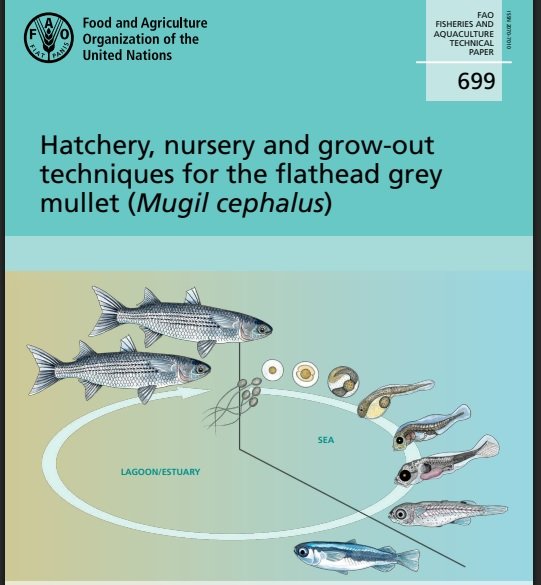
To address this gap, the FAO has published the most comprehensive technical manual to date. This document, integrated into the FAO Blue Transformation Roadmap strategy, synthesizes decades of research by international experts. For the first time, a practical and scalable guide for the commercial production of mullet is offered, spanning from the hatchery phase to the juvenile stage in aquaculture facilities.
- 1 Takeways
- 2 Biological and Adaptive Attributes of Mugil cephalus
- 3 Design and Management of the Flathead Grey Mullet (Mugil cephalus) Hatchery
- 4 Broodstock Management and Induced Spawning Protocols
- 5 Ciclo de producción: de la fase larval al estadio juvenil
- 6 Innovación nutricional: La estrategia del “agua verde”
- 7 Nutritional Innovation: The “Green Water” Strategy
- 8 Aquaculture Health and Prevention Protocols
- 9 Global Impact and Added Value
- 10 Limitations and Challenges: The Path Toward Sustainability
- 11 Entradas relacionadas:
Takeways
- Closing the Biological Cycle: Techniques for assisted reproduction using hormones (GnRHa) have been perfected to eliminate the dependence on wild-caught fry.
- Low Trophic Level Efficiency: As an omnivorous detritivore, the mullet drastically reduces the environmental footprint compared to carnivorous species.
- Bottarga Potential: The value of “Mediterranean gold” (mullet roe) exceeds 200 EUR/kg, offering exceptional economic profitability.
- Climate Resilience: Its euryhaline capacity (withstanding salinities from 0 to 75 ppt) makes it the ideal candidate for aquaculture in changing environments.
Biological and Adaptive Attributes of Mugil cephalus
Mugil cephalus stands out as the most widely distributed member of the Mugilidae family, which comprises over 70 species across 20 genera. Its geographical presence is vast, spanning between 42° N and 42° S, from the Western Atlantic and the Mediterranean to the Pacific and Indian Oceans. Few teleosts demonstrate comparable ecological plasticity, allowing it to colonize highly diverse habitats.
The key to its resilience lies in an exceptional combination of physiological adaptations. As an euryhaline species, it thrives in salinity ranges oscillating from 0 ppt (freshwater) to 75 ppt (hypersaline environments). Furthermore, it possesses a remarkable tolerance to hypoxia, surviving in dissolved oxygen levels where other commercial species would perish, while maintaining functionality across an extremely broad thermal spectrum.
Anatomically, the flathead grey mullet is distinguished by its subcylindrical body with grayish-green or bluish tones on the dorsum and silvery flanks with dark streaks. Its most distinctive feature is the translucent adipose eyelid—the most developed in its family—which covers much of the eyeball. Although it can reach 120 cm in length in the wild, specimens destined for commercial cultivation typically range between 50 and 60 cm.
Design and Management of the Flathead Grey Mullet (Mugil cephalus) Hatchery
Success in the production of mullet fingerlings depends on rigorous site selection and an infrastructure design that ensures total control over critical culture parameters.
Site Selection and Production Systems
Water supply is the determining factor. Optimal quality seawater is required, preferably within a thermal range of 20 to 25 °C, to enhance spawning and larval development. Systems can be open (lagoons), semi-closed (flow-through), or closed (Recirculating Aquaculture Systems – RAS). The latter are the preferred choice in modern hatcheries due to their ability to ensure strict biosecurity conditions and environmental stability, although they demand higher initial investment and highly qualified technical personnel.
The Live Feed Unit
An indispensable component of the hatchery is the uninterrupted production of microalgae, rotifers, and Artemia. Microalgae, specifically strains such as Nannochloropsis oculata and Isochrysis galbana, serve a dual function: they provide nourishment for rotifers and facilitate the ‘green water’ technique in larval rearing tanks. This environment significantly improves prey capture efficiency by the larvae and optimizes their early development.
Mantente siempre informado
Stay Informed
Únete a nuestras comunidades para recibir al instante las noticias, informes y análisis más importantes del sector acuícola.
Join our communities to get instant access to the most important news, reports, and analysis from the aquaculture industry.
Broodstock Management and Induced Spawning Protocols
Since mullets frequently exhibit reproductive dysfunctions in captivity—primarily the arrest of gonadal development due to stress—the implementation of hormonal protocols is fundamental for production success.
Biological Parameters and Sexual Maturity
Adult females possess a fecundity of 650 to 850 eggs per gram of body weight, reaching sexual maturity at approximately 4 years of age (40–42 cm). Conversely, males mature earlier, at 3 years (33–38 cm). Although Mugil cephalus is a gonochoric species, juveniles may undergo transient intersex stages before definitive differentiation.
Spawning Induction and Collection
To stimulate ovulation and spermiation in mature specimens, gonadotropin-releasing hormone analogues (GnRHa) are utilized. Technical monitoring is conducted via ovarian biopsies; females with oocytes exceeding a diameter of 590 µm are considered optimal candidates for induction. Spawning occurs synchronously, and the eggs—characterized by their buoyancy—are captured using specialized surface collectors.
Ciclo de producción: de la fase larval al estadio juvenil
El ciclo productivo de la lisa se divide en etapas críticas que exigen un control riguroso de las variables ambientales y un esquema nutricional estricto para garantizar la supervivencia.
Cría larval y metamorfosis
La fase larval se extiende entre 25 y 40 días, periodo influenciado directamente por la temperatura del agua. Inicialmente, las larvas son planctívoras y dependen estrictamente del suministro de alimento vivo (rotíferos seguidos de Artemia). Un hito biológico determinante es la metamorfosis, proceso en el cual los ejemplares desarrollan escamas, completan su morfología de aletas y adoptan un comportamiento bentónico. Durante esta transición (aproximadamente a los 20-25 días post-eclosión), se inicia el “weaning” o destete, sustituyendo gradualmente el alimento vivo por microdietas balanceadas.
Nursery y fase de engorde (Grow-out)
Tras la metamorfosis, los juveniles (0.5 – 1.0 g) son trasladados a unidades de nursery de mayor capacidad. A los 100 días post-eclosión (DPH), se efectúa una clasificación por tallas para mitigar la heterogeneidad de la población y reducir la competencia intraespecífica por el alimento. Bajo condiciones óptimas de cultivo en ambientes subtropicales, la lisa puede alcanzar el peso comercial (0.8 – 1.0 kg) en un periodo de 7 a 8 meses.
Innovación nutricional: La estrategia del “agua verde”
The production cycle of the flathead grey mullet is divided into critical stages that demand rigorous control of environmental variables and a strict nutritional regimen to ensure survival.
Larval Rearing and Metamorphosis
The larval phase extends between 25 and 40 days, a period directly influenced by water temperature. Initially, larvae are planktivorous and depend strictly on the supply of live feed (rotifers followed by Artemia). A decisive biological milestone is metamorphosis, a process in which the specimens develop scales, complete their fin morphology, and adopt benthic behavior. During this transition (approximately 20–25 days post-hatching), ‘weaning’ begins, gradually substituting live feed with balanced microdiets.
Nursery and Grow-out Phase
Following metamorphosis, juveniles (0.5–1.0 g) are transferred to larger capacity nursery units. At 100 days post-hatching (DPH), size grading is performed to mitigate population heterogeneity and reduce intraspecific competition for feed. Under optimal culture conditions in subtropical environments, the mullet can reach commercial weight (0.8–1.0 kg) within a period of 7 to 8 months.
Nutritional Innovation: The “Green Water” Strategy
Operational success in the hatchery depends on the strategic use of microalgae such as Tetraselmis suecica, Isochrysis galbana, and Nannochloropsis oculata. These microorganisms not only constitute the nutritional foundation for live prey (rotifers and Artemia) but are also essential for establishing a “green water” environment. This technique optimizes prey detection by larvae and significantly bolsters their immune systems through the provision of bioactive compounds.
Chronology and Culture Phases
- Hatchery (0–40 DPH): Intensive production phase. Dark-colored tanks are employed to minimize light reflections, thereby reducing larval stress and enhancing feeding efficiency.
- Nursery (40–100 DPH): A transitional period where juveniles acclimate to formulated inert diets, reaching target weights of up to 1 gram.
- Grow-out: The final stage, conducted in earthen ponds or Recirculating Aquaculture Systems (RAS), where specimens reach a standardized market size of 0.8 to 1.0 kg.
Aquaculture Health and Prevention Protocols
In intensive culture environments, factors such as high stocking density and physiological stress can act as catalysts for infectious outbreaks. The most recurrent pathological challenges in mullet management are bacterial infections caused by Vibrio spp. and various external parasites. The prevention strategy is based on three critical pillars: the implementation of strict biosecurity protocols, balanced nutrition to reinforce the immune response, and the constant maintenance of optimal dissolved oxygen levels, which should preferably remain above 6 mg/L.
Global Impact and Added Value
The nutritional profile of the flathead grey mullet is exceptional. A 150g serving of M. cephalus can nearly satisfy the recommended weekly intake of essential fatty acids, featuring an omega-6/omega-3 ratio highly beneficial for cardiovascular health. Its meat stands out as a rich source of high biological value proteins, essential amino acids, and key minerals.
However, the product of greatest economic significance linked to this species is not the fillet, but rather the bottarga. The gonads of mature females—extracted during the autumnal spawning migration—undergo artisanal salting, pressing, and drying processes dating back to millennia-old traditions. The result is an amber-hued product with a firm texture and an intense umami flavor profile that, in regions such as Sardinia, Tuscany, or Messolongi, commands prices exceeding €200/kg. In fact, the Greek Avgotaraxo Messolongiou enjoys Protected Designation of Origin (PDO) status.
Furthermore, smoked fillets from Lake Orbetello are positioned as premium products with prices reaching up to €36/kg. While in Egypt and Tunisia, the species is a pillar of the Mediterranean diet, in Taiwan—with a production of 2,838 t in 2024—local bottarga continues to consolidate its prestige in international markets.
Limitations and Challenges: The Path Toward Sustainability
The FAO manual does not overlook the industry’s persistent challenges. Currently, the dependence on wild-caught fry constitutes the sector’s ‘Achilles’ heel.’ In Israel—a global leader with an annual production of approximately 2,050 t—the system still relies on the capture of wild broodstock and hormonal induction protocols that have yet to achieve full autonomy within closed commercial systems.
Another critical obstacle is skeletal deformities in hatchery-bred juveniles (such as cervical lordosis or fin anomalies). These pathologies are linked to nutritional imbalances—deficiencies in phosphorus, vitamin D₃, or essential fatty acids—water quality stress, and excessive densities during the larval phase. Furthermore, international regulatory fragmentation and disparate normative frameworks regarding veterinary treatments limit the global transfer of advanced protocols.
Future Perspectives and Conclusions
The authors contend that integrating this manual with advances in recombinant gonadotropins and RAS technologies offers a realistic outlook for achieving seed production independent of the natural environment. If this milestone is reached, Mugil cephalus will finally solidify its position as one of the most strategic and globally relevant cultured species.
Credits: This technical manual was developed under the direction of the FAO Aquaculture Production and Technology Team, in collaboration with the Fondazione IMC (Italy), Sardegna Ricerche (Italy), and the Institute of Agrifood Research and Technology (IRTA, Spain).
Reference (open access)
Vallainc, D., Estevez, A., Ramos, S.J., Concu, D., Carboni, S., Duncan, N. & Lovatelli, A. 2026. Hatchery, nursery and grow-out techniques for the flathead grey mullet (Mugil cephalus). FAO Fisheries and Aquaculture Technical Paper, No. 699. Rome, FAO.

Editor at the digital magazine AquaHoy. He holds a degree in Aquaculture Biology from the National University of Santa (UNS) and a Master’s degree in Science and Innovation Management from the Polytechnic University of Valencia, with postgraduate diplomas in Business Innovation and Innovation Management. He possesses extensive experience in the aquaculture and fisheries sector, having led the Fisheries Innovation Unit of the National Program for Innovation in Fisheries and Aquaculture (PNIPA). He has served as a senior consultant in technology watch, an innovation project formulator and advisor, and a lecturer at UNS. He is a member of the Peruvian College of Biologists and was recognized by the World Aquaculture Society (WAS) in 2016 for his contribution to aquaculture.