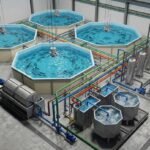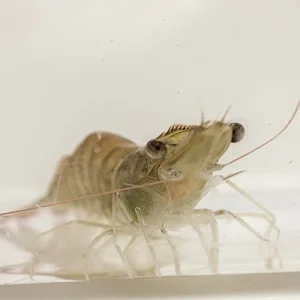
The Pacific white shrimp (Litopenaeus vannamei) has established itself as the cornerstone of global aquaculture, reaching a historic production peak exceeding 6.8 million tonnes in 2022. As the industry expands into Europe and North America via Recirculating Aquaculture Systems (RAS), a fundamental question arises: do current culture temperatures align with the species’ biological preferences?
Traditionally, thermal production parameters have been determined based on “thermal tolerance” (critical survival limits) or “optimal growth” (biomass maximization); however, a research team from the Universidade de Vigo and Swansea University has shifted this paradigm. Utilizing an innovative free-choice system, scientists have enabled the specimens to manifest their own environmental preferences, thereby prioritizing animal welfare.
- 1 Key Findings of the Study
- 2 Free-Choice Methodology: How Does the Shrimp Determine Its Thermal Comfort?
- 3 Disruptive Findings: A Demand for Greater Thermal Comfort
- 4 Critical Implications for Global Aquaculture Welfare and Health
- 5 Challenges and Considerations for Industrial Implementation
- 6 Conclusion: Redefining Biological Welfare in Aquaculture
- 7 Entradas relacionadas:
Key Findings of the Study
- Higher Preference: The Pacific white shrimp exhibits a mean thermal preference of 30.4 °C, which is notably higher than the 28–29 °C commonly maintained in commercial farms.
- Cold Avoidance: The specimens studied actively avoided temperatures below 30 °C.
- Size-Dependent Effect: Smaller shrimp (< 6.5 g) prefer significantly warmer waters than larger individuals (> 10 g).
- Individual Variability: A difference of up to 13.7 °C in thermal preferences exists between individuals, highlighting the complexity of establishing a single standardized parameter.
Free-Choice Methodology: How Does the Shrimp Determine Its Thermal Comfort?
To identify the preferred temperature, the scientific team implemented a volitional shuttle box (a free-choice shuttle system). This device consists of two circular units interconnected by a communication channel: as one compartment increases in temperature, the other gradually decreases. In this manner, the specimen acts as its own biological thermostat, regulating environmental conditions through autonomous displacement.
Experimental Protocol Specifications:
- Biological Sample: Thirty juvenile specimens were analyzed, with a weight range between 3.6 g and 16.1 g.
- Advanced Monitoring: Uninterrupted 24-hour tracking via high-resolution video capture and computational analysis software.
- Thermal Gradient: The evaluation spectrum ranged from 20 °C to 34 °C.
- Data Density: Processing of over 2.5 million records to ensure rigorous statistical precision in every movement pattern.
This dynamic model significantly surpasses conventional static methodologies, as it mitigates experimental bias by allowing the organism to manifest its preference without the constraints of predetermined fixed values.
Disruptive Findings: A Demand for Greater Thermal Comfort
The results of this study challenge current animal welfare guidelines and commercial production standards. While the Recirculating Aquaculture Systems (RAS) industry typically operates within a range of 28–29 °C, the specimens manifested a median preference of 30.4 °C, with an optimal threshold reaching 32.8 °C.
Ontogenetic Variability: The Size Factor
One of the most significant discoveries was the correlation between body mass and thermal preference. Specimens weighing less than 6.5 grams selected appreciably warmer environments compared to those exceeding 10 grams. This intensified thermal demand in early life stages is attributed to three critical factors:
- Metabolic Efficiency: An elevated metabolic rate that requires a greater input of thermal energy to maintain homeostasis.
- Surface-to-Volume Ratio: Due to their morphology, smaller individuals experience more rapid heat loss to the aquatic medium.
- Emotional Fever: It is postulated that social or handling-induced stress may lead more vulnerable specimens to actively seek heat—a biological mechanism analogous to the febrile response in mammals.
Critical Implications for Global Aquaculture Welfare and Health
Why is it imperative to adjust thermal parameters in commercial operations? The research warns that maintaining shrimp at ranges below their biological standard entails severe consequences that transcend mere environmental comfort.
Immune Competence and Pathogen Resistance
Mantente siempre informado
Stay Informed
Únete a nuestras comunidades para recibir al instante las noticias, informes y análisis más importantes del sector acuícola.
Join our communities to get instant access to the most important news, reports, and analysis from the aquaculture industry.
In invertebrates, temperature acts as the primary modulator of the immune system. The study highlights that thermal conditions below 30 °C compromise the organism’s ability to manage oxidative stress and protein metabolism. This immunological vulnerability exposes populations to pathogens with high economic impact, such as:
- White Spot Syndrome Virus (WSSV).
- Infectious Hypodermal and Hematopoietic Necrosis Virus (IHHNV).
- Bacterial agents responsible for white tail disease.
Physiological Development and Metabolic Efficiency
Cold-induced thermal stress triggers a pathological prolongation of the molting cycle (the ecdysis process essential for growth). Furthermore, it can induce apoptosis (programmed cell death) in the hepatopancreas—a vital organ for nutrient absorption and digestive enzyme synthesis. Consequently, inadequate thermal management compromises not only animal welfare but also the productive viability of the system.
Challenges and Considerations for Industrial Implementation
Despite conclusive evidence regarding the shrimp’s thermal preference, the research team acknowledges that transitioning toward these parameters in commercial settings poses significant operational and economic challenges:
- Dissolved Oxygen Dynamics: Increasing the temperature reduces oxygen solubility in water while simultaneously raising the specimens’ metabolic demand. This necessitates more efficient aeration and gas monitoring systems.
- Economic Viability and Sustainability: Maintaining Recirculating Aquaculture Systems (RAS) at 32 °C in temperate regions, such as Europe or North America, entails a substantial increase in energy consumption. Without the integration of renewable energy sources, this could compromise both profitability and the operation’s carbon footprint.
Nevertheless, the study’s premise is decisive: animal welfare protocols must evolve. The traditional approach, focused exclusively on survival limits, must be replaced by standards based on the species’ intrinsic biological preferences. Addressing these needs is not only an ethical imperative but also a competitive strategy to ensure the resilience and health of modern aquaculture.
Conclusion: Redefining Biological Welfare in Aquaculture
The study determines that current thermal standards in L. vannamei cultivation are insufficient, particularly during the juvenile stage, leading to latent risks for the health and welfare of the specimens. The implementation of advanced behavioral monitoring tools, such as the shuttle box, underscores an imperative need: animal welfare must be grounded in the individual’s biological preferences rather than being limited to critical survival thresholds. This paradigm shift is essential to align productive efficiency with the species’ physiological integrity.
This research was funded by the EU Horizon Europe program under the IGNITION Project (Grant Agreement No. 101084651).
Contact
Carlos Garcia de Leaniz
Centro de Investigaciones Marinas, Universidade de Vigo, Vigo, Spain
Email: carlos.garcia.de.leaniz@uvigo.gal
Reference (open access)
Van Eker, J., Weller, S., Overland, B., & Garcia de Leaniz, C. (2026). Whiteleg shrimp (Litopenaeus vannamei) may prefer warmer temperatures than commonly used in commercial farming: Implications for animal welfare. Aquaculture, 622, 744056. https://doi.org/10.1016/j.aquaculture.2026.744056

Editor at the digital magazine AquaHoy. He holds a degree in Aquaculture Biology from the National University of Santa (UNS) and a Master’s degree in Science and Innovation Management from the Polytechnic University of Valencia, with postgraduate diplomas in Business Innovation and Innovation Management. He possesses extensive experience in the aquaculture and fisheries sector, having led the Fisheries Innovation Unit of the National Program for Innovation in Fisheries and Aquaculture (PNIPA). He has served as a senior consultant in technology watch, an innovation project formulator and advisor, and a lecturer at UNS. He is a member of the Peruvian College of Biologists and was recognized by the World Aquaculture Society (WAS) in 2016 for his contribution to aquaculture.