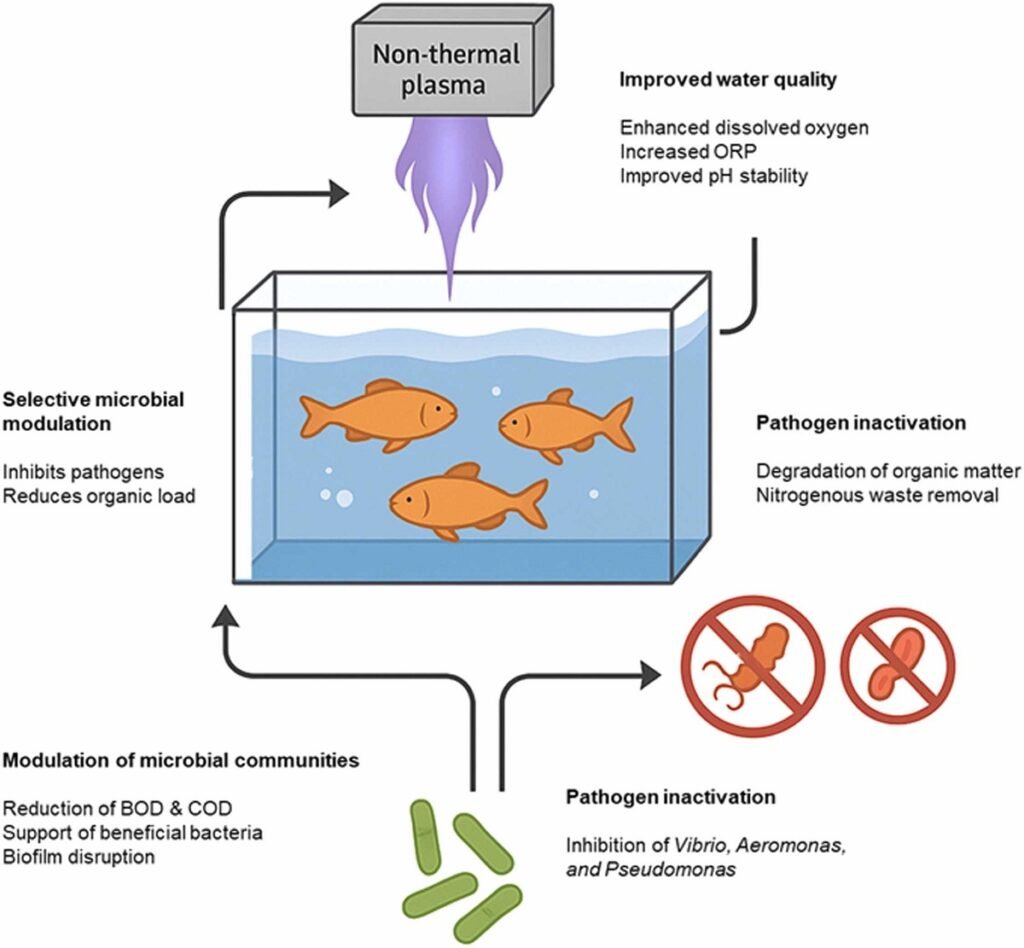
The exponential growth of global aquaculture has precipitated critical challenges that jeopardize its sustainability: the degradation of water quality, persistent epidemiological outbreaks, and an over-reliance on antibiotics. These factors not only compromise the health of farmed species but also drive the emergence of multi-drug resistant pathogens, posing a latent threat to both the industry and global public health.
In this context, non-thermal plasma (NTP) emerges as a transformative technological solution. Due to its capacity to purify the aquatic environment and optimize the biological response of fish without generating chemical residues, NTP is positioned as the new standard in the sanitary and productive management of the sector.
This comprehensive scientific review was published in the journal Aquaculture Reports by a team of researchers from the Functional Biomaterial Research Center, the Korea Research Institute of Bioscience and Biotechnology (KRIBB), the University of Science and Technology (UST), Daegu-Haany University, and Chosun University—all leading institutions in South Korea.
Key Study Highlights
- A Farewell to Antibiotics: Non-thermal plasma (NTP) provides a chemical-free alternative to combat antimicrobial resistance within aquaculture facilities.
- Ultra-Pure Water: This technology generates reactive oxygen and nitrogen species (RONS) that instantaneously oxidize ammonia, nitrites, and organic matter, radically enhancing water quality.
- Hormetic Effect: Controlled plasma dosages function as “training” for the fishes’ immune systems, significantly bolstering their resilience and growth rates.
- Post-Harvest Preservation: Applied during processing, plasma inactivates pathogens such as Vibrio and Salmonella, extending the shelf life of seafood without compromising flavor or texture.
What is Non-Thermal Plasma and its Mechanism of Action in Water?
Non-thermal plasma (NTP) is defined as a partially ionized gas state that operates at near-ambient temperatures. Upon contact with an aquatic medium, it induces a reaction that generates a potent amalgam of reactive molecules known as RONS (reactive oxygen and nitrogen species), which include hydroxyl radicals, hydrogen peroxide, ozone, and nitric oxide.
These reactive species intervene through three fundamental biotechnological processes:
- Broad-Spectrum Disinfection: They neutralize pathogens by disrupting cellular membranes and degrading the genetic material of bacteria (such as Vibrio and Aeromonas), viruses, and fungi.
- Oxidation of Organic Pollutants: They decompose complex organic molecules derived from metabolic waste and surplus feed, transforming them into innocuous byproducts such as water and carbon dioxide ().
- Nitrogen Cycle Regulation: They facilitate the conversion of toxic ammonia into nitrogen gas () or other non-harmful components, thereby stabilizing the chemical equilibrium of the aquatic ecosystem.

Table 1: Impact of NTP on Physicochemical Water Parameters.
| Parameter | NTP Effect | Mechanism of Action |
| Dissolved Oxygen | Increase | Optimization of the respiratory rate of organisms. |
| Ammoniacal Nitrogen | Reduction | Direct oxidation to nitrogen gas (). |
| Organic Load (BOD/COD) | Reduction | Accelerated degradation of waste and feed residues. |
| Bacterial Load | Inactivation | Fragmentation of cellular membranes and pathogenic DNA. |
Impact of NTP on Health and Productive Performance
Biological Synergy: From a Sterile Environment to a Biostimulant System
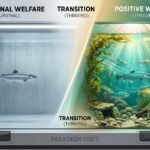
One of the most disruptive findings is that plasma-treated water not only achieves superior purity standards but also acts as a biostimulant agent. The reviewed research indicates that specimens reared in these optimized environments exhibit increased metabolic efficiency and significantly higher growth rates compared to conventional methods.
Immunomodulation and Resilience: The Hormetic Effect
Controlled exposure to moderate concentrations of RONS triggers a biological process known as hormesis. This phenomenon consists of a mild oxidative stress that serves as “training” for the organism, activating antioxidant defense mechanisms and stimulating the innate immune system, specifically through macrophages and lysozymes. This immunological bolstering prepares the fish to more successfully manage:
- Pathogenic Challenges: Enhanced resistance to bacterial and viral infections.
- Environmental Stress: Improved adaptation to thermal fluctuations and handling during transport.
Gastrointestinal Microbiota Optimization
Additionally, plasma technology promotes the proliferation of endogenous probiotics, such as Lactobacillus and Bacillus, within the digestive tract. This enhancement of the microbiota not only boosts nutrient absorption and feed efficiency but also consolidates the intestinal immunological barrier—the fish’s primary line of defense.
Mantente siempre informado
Stay Informed
Únete a nuestras comunidades para recibir al instante las noticias, informes y análisis más importantes del sector acuícola.
Join our communities to get instant access to the most important news, reports, and analysis from the aquaculture industry.
Perspectives and Challenges for Industrial Implementation
Despite its extraordinary potential, the transition of non-thermal plasma (NTP) toward a massive industrial scale faces strategic challenges. Initial equipment investment and energy consumption represent variables that require optimization to ensure profitability in large-scale facilities. Furthermore, standardization is vital: it is imperative to precisely define therapeutic dosages for each species, preventing excessive exposure from leading to cellular damage caused by oxidative stress.
The horizon of this technology is moving toward Aquaculture 4.0 through integration with Artificial Intelligence (AI) and the Internet of Things (IoT). This convergence would allow for real-time analytical monitoring of water, facilitating the automated adjustment of plasma intensity based on detected microbial load and animal welfare indicators.
Finally, this study was made possible through the support of the KRIBB Research Initiative Program (KGM1052612). Additionally, it received backing from the Regional Innovation System & Education (RISE) program via the Jeonbuk RISE Center (funded by the Ministry of Education and JeonBuk State) and the RISE Local Customized R&D program through the Gyeongbuk RISE Center (funded by the Ministry of Education and Gyeongsangbuk-do) of the Republic of Korea.
Contact
Dong-Sung Lee
Department of Pharmacy, College of Pharmacy, Chosun University, Gwangju 61452, South Korea
Email: dslee2771@chosun.ac.kr
Seung-Jae Lee
Functional Biomaterial Research Center, Korea Research Institute of Bioscience and Biotechnology (KRIBB), Jeongeup 56212, South Korea.
Email: seung99@kribb.re.kr
Reference (open access)
Chandimali, N., Bak, S. G., Bae, J., Lee, D., & Lee, S. (2026). Integrating non-thermal plasma technology into aquaculture and fisheries: A review of its potential for enhancing fish health, water quality, and post-harvest practices. Aquaculture Reports, 48, 103588. https://doi.org/10.1016/j.aqrep.2026.103588

Editor at the digital magazine AquaHoy. He holds a degree in Aquaculture Biology from the National University of Santa (UNS) and a Master’s degree in Science and Innovation Management from the Polytechnic University of Valencia, with postgraduate diplomas in Business Innovation and Innovation Management. He possesses extensive experience in the aquaculture and fisheries sector, having led the Fisheries Innovation Unit of the National Program for Innovation in Fisheries and Aquaculture (PNIPA). He has served as a senior consultant in technology watch, an innovation project formulator and advisor, and a lecturer at UNS. He is a member of the Peruvian College of Biologists and was recognized by the World Aquaculture Society (WAS) in 2016 for his contribution to aquaculture.