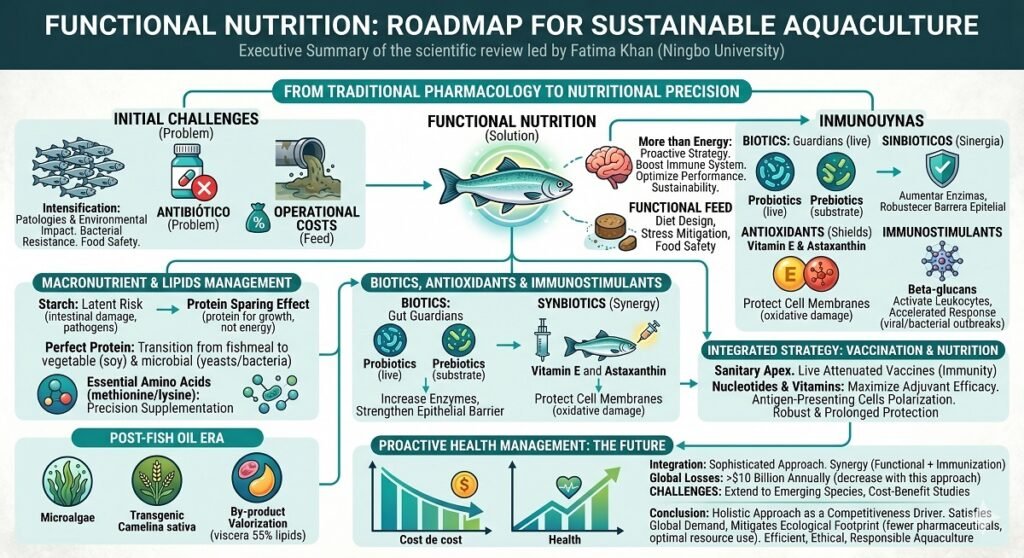
The intensification of aquaculture production has led to critical challenges, particularly regarding disease management and environmental equilibrium. Historically, the sector has relied on antibiotics to mitigate infectious outbreaks; however, this practice now triggers global concern due to antimicrobial resistance and food safety risks. In this context, functional nutrition is establishing itself not merely as an energy source but as a proactive strategy to bolster the aquatic immune system and optimize productive performance under sustainability criteria.
A recent scientific review led by Fatima Khan of Ningbo University establishes a definitive roadmap: the industry’s future depends not on pharmacology, but on nutritional precision—in other words, on how aquatic species are nourished.
The concept of ‘functional feed’ transcends the fulfillment of basic biological requirements. It is defined as the design of specialized diets aimed at enhancing immune response, neutralizing metabolic stress, and elevating the quality standards of the final product delivered to the consumer.
- 1 Key Study Highlights
- 2 The Macronutrient Dilemma: Why Basic Nutrition Is Insufficient
- 3 Lipids and the “Post-Fish Oil Era”: Toward Nutritional Autonomy
- 4 Biotics: The Guardians of Aquatic Gut Health
- 5 Antioxidants and Immunostimulants: Biological Shields Against Stress
- 6 Vaccination and Nutrition: Toward an Integrated Health Strategy
- 7 Toward Proactive Health Management: The Future of the Industry
- 8 Conclusion: The Holistic Approach as a Driver of Competitiveness
- 9 Entradas relacionadas:
Key Study Highlights
- Phasing Out Antibiotics: Functional feeds—specifically probiotics and prebiotics—emerge as the most viable alternative to the escalating antimicrobial resistance crisis.
- Gut Health as a Primary Driver: Microbiota modulation does more than improve digestion; it serves as the fish’s primary immunological line of defense.
- Sustainability in Ingredients: The integration of microalgae and transgenic oils aims to eliminate the historical dependence on wild-sourced fish oil.
- Economic Impact: With annual global losses of $10 billion due to disease, precision nutrition has become a financial imperative.
The Macronutrient Dilemma: Why Basic Nutrition Is Insufficient
To grasp the full scope of functional nutrition, one must first understand the pillars of the aquaculture diet—a sector that accounts for approximately 50% of total operational production costs.
The Starch Challenge
While starch serves as the most cost-effective energy source, its excessive use poses a latent risk. In high-value species such as Micropterus salmoides (largemouth bass), elevated starch concentrations degrade intestinal villi and foster the proliferation of pathogens like Vibrio. Current scientific research focuses on the “protein-sparing effect,” a strategy where carbohydrate optimization allows the fish to allocate protein exclusively for muscle development rather than metabolic energy production.
The Transition Toward Sustainable Protein
Fishmeal, historically regarded as the gold standard, now faces high cost and sustainability challenges. Consequently, the industry has initiated a shift toward plant-based proteins (such as soy) and microbial alternatives (yeasts and bacteria). However, this migration entails a technical hurdle: the deficiency of essential amino acids like methionine and lysine, which must be integrated through high-precision supplementation to prevent stunted growth rates.
Lipids and the “Post-Fish Oil Era”: Toward Nutritional Autonomy
One of the most significant structural obstacles to global aquaculture expansion is the growing scarcity of marine oils rich in long-chain fatty acids, specifically EPA and DHA. These compounds are vital: they not only guarantee the physiological health of the fish but also ensure the essential cardiovascular benefits for the final consumer.
In response to this deficit, scientific research proposes disruptive alternatives that are transforming the sector:
- Microalgae: Biomass and oleaginous extracts that naturally replicate the lipid profile of wild fish.
- Transgenic Camelina sativa: Genetically modified seed crops engineered to biosynthesize EPA and DHA levels comparable to conventional fish oil.
- By-product Valorization: The utilization of viscera and remnants from the processing industry allows for the recovery of up to 55% of usable lipids, reintegrating them into the value chain through circular economy principles.
Biotics: The Guardians of Aquatic Gut Health
Research is delving deeper into the implementation of probiotics (live microorganisms with beneficial effects) and prebiotics (non-digestible carbohydrate substrates that selectively stimulate beneficial bacteria). The strategic integration of these elements is fundamental to the resilience of aquaculture systems.
Mantente siempre informado
Stay Informed
Únete a nuestras comunidades para recibir al instante las noticias, informes y análisis más importantes del sector acuícola.
Join our communities to get instant access to the most important news, reports, and analysis from the aquaculture industry.
The Synergy of Synbiotics
The deliberate combination of both components gives rise to synbiotics, a formulation that exponentially increases the viability and survival of beneficial microorganisms within the digestive tract. It has been demonstrated that the use of Bacillus spp. and various yeast strains not only boosts the production of digestive enzymes but also reinforces the intestinal epithelial barrier. This action functions as a biological shield, effectively preventing the colonization and translocation of external pathogens.
Antioxidants and Immunostimulants: Biological Shields Against Stress
Oxidative stress stands as the “invisible enemy” of aquaculture production, triggered by critical factors such as fluctuations in water quality or high stocking densities. In this scenario, Vitamin E and astaxanthin play a decisive role in cellular protection.
Vitamin E: The Fat-Soluble Antioxidant
Its function transcends the prevention of clinical pathologies, such as muscular degeneration or fin hemorrhaging. Vitamin E acts as a potent fat-soluble antioxidant that neutralizes free radicals, safeguarding the integrity of cellular membranes against oxidative damage.
Immunostimulants: Priming the Defensive System
High-efficacy compounds, such as beta-glucans (derived from yeast cell walls), possess the ability to activate fish leukocytes. This stimulation primes the immune system for an accelerated and efficient response to potential viral or bacterial outbreaks, thereby minimizing mortality rates.
Vaccination and Nutrition: Toward an Integrated Health Strategy
The scientific review emphasizes that nutrition must not be managed as an isolated factor. On the contrary, the integration of functional feeds with immunization programs represents the vanguard of health management in modern aquaculture.
Currently, live-attenuated vaccines are being developed to replicate the conditions of a natural infection, enabling the simultaneous stimulation of both humoral and mucosal immunity. By converging this technology with diets enriched in nucleotides and vitamins, the efficacy of adjuvants is maximized. This synergy optimizes the polarization of antigen-presenting cells, ensuring more robust and prolonged immunological protection against pathogenic challenges.
Toward Proactive Health Management: The Future of the Industry
The global aquaculture industry faces economic losses exceeding $10 billion annually due to epidemiological outbreaks. In response, the convergence of functional feeds and immunization programs is establishing itself as the most sophisticated approach to health management. New-generation vaccines—particularly those based on live-attenuated pathogens—have demonstrated superior efficacy by replicating natural infection, achieving a significantly more robust cellular and humoral immune response.
Sector Challenges and Outlook
Despite technical advancements, critical gaps in scalability persist. Current scientific literature focuses predominantly on salmonids and tilapia, creating a knowledge vacuum regarding emerging species. Furthermore, it is imperative to develop comprehensive cost-benefit analyses to demonstrate the economic viability of these technologies, thereby facilitating their adoption in small and medium-scale farms.
Conclusion: The Holistic Approach as a Driver of Competitiveness
The adoption of an integrated nutritional model is mandatory to meet the rising global demand for high-quality, food-secure seafood. As concluded in the review by Fatima Khan, precision in functional feed formulation represents a paradigm shift: it not only guarantees animal health and welfare but also significantly mitigates the industry’s ecological footprint. By minimizing reliance on chemical agents and optimizing feed conversion, functional nutrition stands as the definitive tool for efficient, ethical, and environmentally responsible aquaculture.
Reference (open access)
Khan, F. (2026). Functional Feeds for Future Aquaculture: A Review of Nutritional Strategies for Fish Health. Haya: The Saudi Journal of Life Sciences, 11(4), 248-257. https://doi.org/10.36348/sjls.2026.v11104.002

Editor at the digital magazine AquaHoy. He holds a degree in Aquaculture Biology from the National University of Santa (UNS) and a Master’s degree in Science and Innovation Management from the Polytechnic University of Valencia, with postgraduate diplomas in Business Innovation and Innovation Management. He possesses extensive experience in the aquaculture and fisheries sector, having led the Fisheries Innovation Unit of the National Program for Innovation in Fisheries and Aquaculture (PNIPA). He has served as a senior consultant in technology watch, an innovation project formulator and advisor, and a lecturer at UNS. He is a member of the Peruvian College of Biologists and was recognized by the World Aquaculture Society (WAS) in 2016 for his contribution to aquaculture.