Harmful algal blooms (HABs)—responsible for environmental degradation, mass fish kills, economic crises, and even human fatalities—are increasing in frequency and severity as the Earth warms. While some computational models can forecast potential blooms, their precision is constrained by the diversity of algal species that proliferate under varying environmental triggers, as well as the intricate spatial and temporal overlap between different species.
However, an international research team has demonstrated that coupling three distinct models, while accounting for inter-species interactions, significantly enhances predictive accuracy. Led by Fumito Maruyama, a professor at Hiroshima University’s IDEC Institute, the team published their findings in the March edition of Ecological Informatics. “Harmful algal blooms are akin to ecological conversations, where inter-species interactions and environmental cues continuously shape outcomes, rather than being driven by a single dominant factor,” stated Maruyama. “This study illustrates that integrating physical processes, ecological interactions, and machine learning approaches can markedly improve forecasting precision.”
Key Conclusions
- Interaction-Based Prediction: Phytoplankton species do not thrive in isolation; biological interactions serve as critical indicators for predicting specific Pseudo-nitzschia blooms.
- Short-Term Modeling: For salmon and mussel producers, 1-to-2-week forecasts are the most pragmatic for planning preemptive harvests and safeguarding assets.
- EDM Effectiveness: Empirical Dynamic Modeling (EDM) achieved a correlation of 0.733 in predicting the P. seriata group in specific areas such as Metri.
- Essential Integration: No single model is definitive; success lies in coupling physical dispersion models with artificial intelligence and ecological dynamics.
Millions Lost to HABs Over the Last Decade
Algae, though microscopic, are a cornerstone of marine ecosystems, serving as the primary food source for plankton and other aquatic life. Nevertheless, excessive heat or nutrient loading from fertilizer runoff can trigger uncontrolled algal proliferation, depleting dissolved oxygen and destabilizing fragile ecosystems. This has incurred a profound economic toll on Chile—the world’s second-largest salmon producer and a leading mussel exporter. According to researchers, harmful algal blooms have ravaged the nation over recent decades, with estimated losses reaching USD 1 billion in the last 10 years alone.
“Aquaculturists are most likely to benefit from short-term HAB forecasts of one to two weeks, as the ability to secure fish pens before a bloom can protect stock and bolster profitability,” Maruyama explained. “However, there is a trade-off: false-positive predictions may lead to premature harvesting and subsequent revenue loss.”
Three Models to Shield the Chilean Patagonia
The SATREPS-MACH project emerged from a collaborative effort between Chile and Japan—which relies on Chile for three-quarters of its salmon imports—to enhance the understanding of blooms and mitigate food waste. Maruyama detailed the three models evaluated under this initiative:
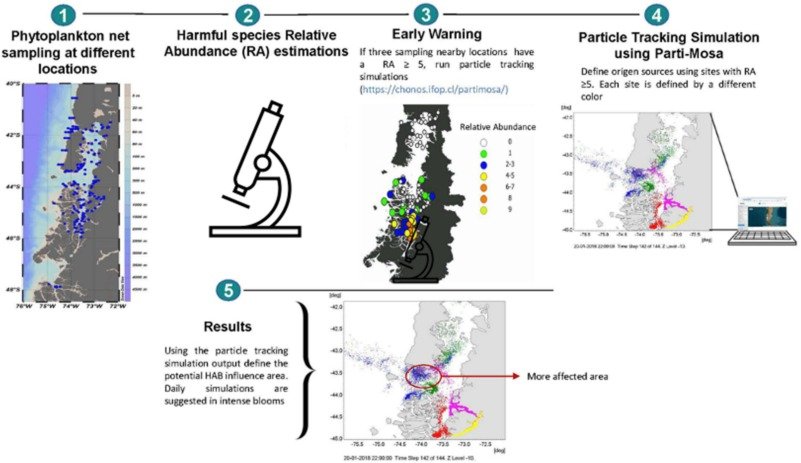
- Parti-MOSA (Physical Algal Tracking): A physical-oceanographic model that simulates cell transport via marine currents. Built upon the MOSA framework, it uses temperature, salinity, and wind data to calculate particle trajectories at 1 km resolution, serving as a vital tool for identifying potential zones of influence once critical abundance is detected.
- LSTM (AI and the “Holobiome”): This model employs Long Short-Term Memory (LSTM) neural networks trained on time-series monitoring data, including eDNA metabarcoding and environmental parameters. Preliminary results suggest this AI can accurately predict microeukaryotic species presence based solely on environmental conditions.
- EDM (Species Interaction Dynamics): Unlike traditional statistical models focusing only on environmental variables, Empirical Dynamic Modeling (EDM) centers on species-to-species interactions. Utilizing 30 years of data, the model identified genera such as Ceratium and Leptocylindrus as “sentinels” or predictors for the emergence of Pseudo-nitzschia.
Plankton Interactions Sharpen Predictive Accuracy

Utilizing over 30 years of observational data from three environmentally distinct sampling sites in Chile—Metri, Quellón, and Melinka—researchers evaluated the efficacy of these models with a focus on two Pseudo-nitzschia species groups. Although performance varied by location and species, accuracy improved significantly when including plankton inter-species interactions in the model data. For instance, the genera Ceratium and Leptocylindrus were identified as being commonly associated with Pseudo-nitzschia groups, serving as reliable biological indicators.
“Individual models may capture key aspects of HAB dynamics, yet each has its limitations,” Maruyama noted. “Together, these models address critical forecasting gaps within the complex and understudied environment of the Chilean Patagonia.”
Why Do Traditional Models Fail?
Historically, most HAB prediction models have focused on single species and abiotic variables (such as nitrogen or temperature). This study breaks that trend by demonstrating that the ocean is a dynamic system where competition and facilitation between species dictate community dominance. The “mirage correlation” phenomenon—where two variables appear linked but their relationship shifts over time—is an obstacle that EDM successfully overcomes by treating the ecosystem as a non-linear deterministic system.
The Future of Operational Monitoring
The team aims to refine this approach by incorporating additional environmental variables and extending the frameworks to broader regional contexts, including Japan’s coastal systems. The ultimate goal is to develop reliable, operational HAB forecasting tools for effective early warning and risk mitigation across the global aquaculture industry.
Mantente siempre informado
Stay Informed
Únete a nuestras comunidades para recibir al instante las noticias, informes y análisis más importantes del sector acuícola.
Join our communities to get instant access to the most important news, reports, and analysis from the aquaculture industry.
Conclusion
The development of this coupled modeling approach marks a milestone in ecological informatics. By combining the speed of physical models, the pattern recognition of AI, and the biological depth of EDM, Chile is building a data infrastructure capable of safeguarding its economy and global food security. Future integration of real-time imaging devices with these algorithms could minimize the lag between sampling and alerts, enabling preventive actions in hours rather than days.
Reference (open access)
Perera, I. U., Fujiyoshi, S., Kumakura, D., Medel, C., Yarimizu, K., Artal, O., Reche, P., Espinoza-González, O., Guzman, L., Tucca, F., Jaramillo-Torres, A., Acuña, J. J., Jorquera, M. A., Nakaoka, S., Nagai, S., & Maruyama, F. (2026). A prototype coupled modeling approach for predicting harmful algal blooms: A case study in Chile. Ecological Informatics, 94, 103615. https://doi.org/10.1016/j.ecoinf.2026.103615

Editor at the digital magazine AquaHoy. He holds a degree in Aquaculture Biology from the National University of Santa (UNS) and a Master’s degree in Science and Innovation Management from the Polytechnic University of Valencia, with postgraduate diplomas in Business Innovation and Innovation Management. He possesses extensive experience in the aquaculture and fisheries sector, having led the Fisheries Innovation Unit of the National Program for Innovation in Fisheries and Aquaculture (PNIPA). He has served as a senior consultant in technology watch, an innovation project formulator and advisor, and a lecturer at UNS. He is a member of the Peruvian College of Biologists and was recognized by the World Aquaculture Society (WAS) in 2016 for his contribution to aquaculture.