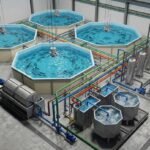
One of the most costly and persistent challenges in fish production using Recirculating Aquaculture Systems (RAS) is the emergence of unpleasant tastes, commonly described as “earthy” or “muddy” (off-flavor). These sensory defects are primarily caused by two microbial metabolites: geosmin (GSM) and 2-methylisoborneol (MIB).
Historically, the industry has combated this issue through expensive pre-harvest depuration (purging) processes or aggressive system disinfection between batches. However, a recent study published in the Journal of the World Aquaculture Society by researchers from The Conservation Fund’s Freshwater Institute and the Center for Aquaculture Technologies proposes a paradigm shift: the key lies not in eliminating the microbiome, but in allowing the system to “mature.”
Key Takeaways
- Mitigation in Mature Systems: RAS units operated continuously for 2.5 years maintained significantly lower levels of geosmin and MIB compared to those recently disinfected.
- Superior Fillet Quality: After two months of culture, geosmin concentration in salmon flesh was nearly three times lower in mature systems compared to immature ones.
- The Microbial Paradox: Although mature systems hosted a higher abundance of off-flavor-producing bacteria, these did not generate spikes in geosmin/MIB. This suggests that environmental stability takes precedence over mere bacterial presence.
- Critical Indicators: “True Color” (dissolved organic matter) and nitrites were identified as key predictors for geosmin accumulation.
The Experiment: “Immature” vs. “Mature” Systems
To determine if microbial maturity limits off-flavor, the team led by John Davidson designed a comparative experiment using market-size Atlantic salmon (Salmo salar). Two groups were established in triplicate:
- Immature RAS (iRAS): Systems pressure-washed and disinfected with chlorine before re-establishing nitrification (a typical industry “reset”).
- Mature RAS (mRAS): Systems in continuous operation for 30 months, preserving established microbial communities and biofilms.
GSM and MIB levels were monitored in both water and fillets, complemented by an exhaustive analysis of the microbiome (biofilms in tanks, biofilters, and drum filters) and water quality.
Results: Stability Outperforms Disinfection
The findings challenge the intuition that “cleaner and newer is better.” In immature systems, geosmin and MIB levels in the water spiked, reaching peaks of 35–40 ng/L. In contrast, mature systems kept these compounds consistently low, below 13 ng/L.
This difference directly impacted the final product. Fillets from immature systems averaged 696 ng/kg of geosmin, whereas the level in mature systems was only 247 ng/kg. These low levels could drastically reduce, or even eliminate, the need for pre-harvest depuration.
The Paradox of Producer Bacteria
Genetic analysis of the biofilms yielded a surprising result. Contrary to expectations, the abundance of off-flavor-producing bacteria (such as certain Cyanobacteria or Myxobacteria) was higher in mature systems, where the water actually tasted better.
The authors suggest that the production of these metabolites depends on environmental conditions that “switch on” or “switch off” their synthesis. In an immature and unstable ecosystem, opportunistic bacteria (r-strategists) produce these compounds due to stress or competition. Conversely, in a mature and stable system (K-strategists), production is inhibited despite bacterial presence.
Water Quality and Nitrification
The study linked biofilter efficiency to off-flavor outbreaks. Immature systems showed:
Stay Always Informed
Join our communities to instantly receive the most important news, reports, and analysis from the aquaculture industry.
- Higher levels of Total Ammonia Nitrogen (TAN) and Nitrites (NO2-N), signaling inefficient nitrification.
- Higher “True Color” and Total Suspended Solids (TSS).
Using Machine Learning models, “True Color” was identified as the most critical variable related to geosmin, suggesting that the accumulation of organic matter in unstable systems favors off-flavor.
Implications for the Industry
This study invites a reevaluation of management strategies in commercial fish farms:
- Rethink Total Disinfection: Emptying and disinfecting between cohorts could be counterproductive. A mature biofilter acts as a natural “biocontrol.”
- Depuration Efficiency: Maintaining low off-flavor levels during grow-out reduces purging times, saving water and energy while minimizing fish weight loss.
- Operational Consistency: A stable microbial community not only improves nitrification but ensures homogeneous product quality.
In conclusion, the RAS biofilter and microbiome should be viewed not merely as tools for ammonia removal, but as a complex ecosystem that, when managed toward maturity, becomes the best ally for the organoleptic quality of salmon.
Contact
John Davidson
The Freshwater Institute
1098 Turner Road, Shepherdstown, West Virginia 25443, USA.
Email: jdavidson@conservationfund.org
Reference (open access)
Davidson, J., Crouse, C., Lepine, C., Ranjan, R., Stangroom, J., Poley, J., & Good, C. (2025). Comparing off-flavor trends in freshwater recirculating aquaculture systems with microbially mature or immature biofilters while growing Atlantic salmon Salmo salar. Journal of the World Aquaculture Society, 56(6), e70067. https://doi.org/10.1111/jwas.70067

Editor at the digital magazine AquaHoy. He holds a degree in Aquaculture Biology from the National University of Santa (UNS) and a Master’s degree in Science and Innovation Management from the Polytechnic University of Valencia, with postgraduate diplomas in Business Innovation and Innovation Management. He possesses extensive experience in the aquaculture and fisheries sector, having led the Fisheries Innovation Unit of the National Program for Innovation in Fisheries and Aquaculture (PNIPA). He has served as a senior consultant in technology watch, an innovation project formulator and advisor, and a lecturer at UNS. He is a member of the Peruvian College of Biologists and was recognized by the World Aquaculture Society (WAS) in 2016 for his contribution to aquaculture.