Historically, aquaculture feeding was designed for population averages, assuming ideal conditions and optimal health states. However, this generalist approach ignores the subtleties of different cohorts, genetics, and environmental shifts.
Precision Nutrition (PN) emerges not merely as an evolution, but as a critical necessity for sustainability. By providing exact nutrients at the appropriate time, waste is minimized, costs are reduced, and animal welfare is drastically enhanced. In this regard, researchers from IFFO, University of Stirling, University of Guelph, Wittaya Aqua, Veramaris, Cargill Aqua Nutrition, LUCTA, Wageningen University, and Biomar AS published a study to explore and optimize the field of PN applied to aquaculture feeds. The work aims to define this concept and establish implementation strategies to capitalize on its benefits in animal production.
- 1 Key Points
- 2 The Net Energy (NE) Revolution
- 3 From “Ideal Protein” to Essential Nitrogen (ENC)
- 4 Omega-3 Dynamics: The Health Factor
- 5 Intake Control: Hedonic vs. Homeostasis
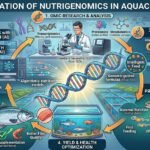
- 6 The Role of Digital Tools and AI
- 7 Challenges and Ethical Considerations
- 8 Conclusion: Toward Elite Aquaculture
- 9 Entradas relacionadas:
Key Points
- Metabolic Evolution: The sector is transitioning from gross energy-based formulas to Net Energy (NE) systems, allowing for surgical precision according to the species.
- Beyond Protein: The Essential Nitrogen Concept (ENC) replaces “crude protein,” optimizing the use of amino acids and nucleotides to maximize growth.
- Life-Cycle Customization: Omega-3 (EPA+DHA) requirements are not static; they fluctuate drastically based on animal weight, water temperature, and health challenges.
- Digital Twins and AI: Utilizing Big Data in populations of over 230 million fish allows for real-time diet adjustments, reducing mortality by 21%.
The Net Energy (NE) Revolution
The fundamental pillar of PN is understanding how fish utilize energy. Traditionally, diets were formulated on a Gross Energy (GE) basis, but modern science demands a finer breakdown:
- Digestible Energy (DE): Energy absorbed after subtracting fecal losses.
- Net Energy (NE): The most refined level, which accounts for the heat increment of feeding and urinary/branchial losses, representing the energy actually available for growth and maintenance.
Why does this shift matter? It has been proven that the efficiency with which a fish utilizes energy depends on its source (protein, fat, or carbohydrates). For instance, carnivorous species like the Barramundi have a significantly lower capacity to utilize carbohydrates compared to omnivorous species like the Nile Tilapia. An NE approach allows formulators to assign species-specific energy values, optimizing metabolic performance.
From “Ideal Protein” to Essential Nitrogen (ENC)
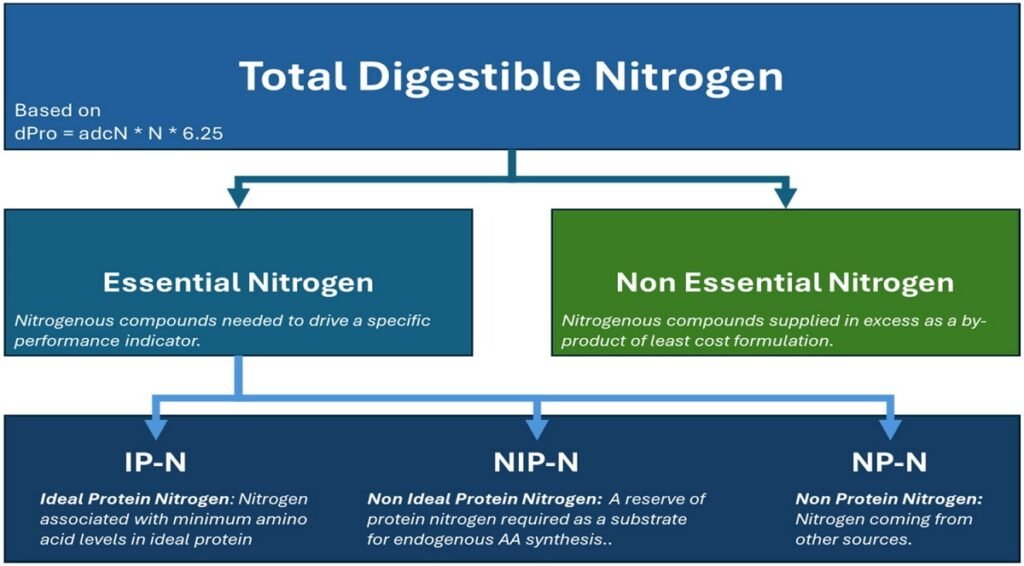
The era of formulating diets based simply on “crude protein” has ended; the new standard is the Essential Nitrogen Concept (ENC). This approach expands the “ideal protein” concept to include not only essential amino acids (such as lysine and methionine) but also the nitrogen required for the synthesis of non-essential amino acids and non-protein compounds like nucleotides and choline. ENC allows a shift away from the rigidity of digestible protein toward a vision where every nitrogenous compound fulfills a specific role in the animal’s Key Performance Indicators (KPIs).
Omega-3 Dynamics: The Health Factor
The requirement for long-chain fatty acids, such as EPA and DHA, is no longer viewed as a fixed dietary percentage. Research reveals that these needs are relative to total lipid intake and vary according to fish size and water temperature.
- Impact on Predictability: Big Data analysis in the Norwegian salmon industry demonstrated that higher EPA+DHA levels resulted in an 11% reduction in the Economic Feed Conversion Ratio (eFCR) and 21% lower mortality variability.
- New Sources: To reach these levels without depleting marine resources, the industry is integrating algal oils with EPA+DHA concentrations exceeding 60%, as well as genetically modified plant oils.
Intake Control: Hedonic vs. Homeostasis
High-precision feed is futile if the fish does not consume it. PN addresses intake through two pathways:
- Hedonic Pathway (Short-term): Regulated by the sensory system (taste, smell, sight). This is where palatants, such as protein hydrolysates and nucleotides, become essential—particularly when using plant-based proteins that fish often reject.
- Homeostatic Pathway (Long-term): Regulated by the animal’s internal energy state. Formula design must align with neuroendocrine signals indicating satiety or hunger.
The Role of Digital Tools and AI
The transition toward PN is driven by disruptive technologies that allow for real-time ingredient assessment:
- Near-Infrared Spectroscopy (NIRS): Enables near-instant prediction of the nutritional quality of each ingredient batch, adjusting the formula before the feed reaches the fish.
- Nutritional Modeling and Digital Twins: These mathematical models simulate how a group of animals will respond to a specific diet under variable environmental conditions, allowing for dynamic adjustments without the need for costly traditional empirical trials.
- IoT-based Feeding Systems: Sensors that monitor fish behavior in real-time to optimize ration delivery, improving feed efficiency and reducing environmental impact.
Challenges and Ethical Considerations
Despite these advances, PN faces barriers. Legislation varies by region (such as the use of processed animal proteins in Europe), and consumer acceptance of biotechnological ingredients remains a challenge. Furthermore, sustainability must be evaluated holistically through Life Cycle Assessment (LCA) to avoid “problem shifting,” where reducing the carbon footprint might inadvertently increase water consumption or biodiversity loss.
Stay Always Informed
Join our communities to instantly receive the most important news, reports, and analysis from the aquaculture industry.
Conclusion: Toward Elite Aquaculture
Precision Nutrition represents the clearest path toward efficient, ethical, and sustainable aquaculture. By integrating deep metabolic knowledge with artificial intelligence tools, the industry not only optimizes the use of finite resources but also guarantees the production of nutritionally high-quality food for a growing global population.
Contact
Brett Glencrossa
IFFO—the Marine Ingredients Organisation
London, UK
Email: bglencross@iffo.com
Reference (open access)
Glencross, B., Bureau, D., Carr, I., DeSantis, C., Morais, S., Schrama, J., & Zatti, K. (2026). Optimization of precision nutrition for aquaculture feed application. Critical Insights in Aquaculture, 2(1). https://doi.org/10.1080/29932181.2025.2610126

Editor at the digital magazine AquaHoy. He holds a degree in Aquaculture Biology from the National University of Santa (UNS) and a Master’s degree in Science and Innovation Management from the Polytechnic University of Valencia, with postgraduate diplomas in Business Innovation and Innovation Management. He possesses extensive experience in the aquaculture and fisheries sector, having led the Fisheries Innovation Unit of the National Program for Innovation in Fisheries and Aquaculture (PNIPA). He has served as a senior consultant in technology watch, an innovation project formulator and advisor, and a lecturer at UNS. He is a member of the Peruvian College of Biologists and was recognized by the World Aquaculture Society (WAS) in 2016 for his contribution to aquaculture.