The growth of the aquaculture industry brings the challenge of managing chemical residues hidden beneath the surface. When fish are given feed containing additives—such as vitamins, pigments, or preservatives—not all of the product is utilized by the animal. A portion is lost as uneaten feed waste, while another is excreted as feces.
Until now, accurately predicting where these substances end up in the vast and dynamic ocean was an overwhelmingly complex task. However, a consortium of institutions led by Akvaplan-niva has delivered a cutting-edge model to the European Food Safety Authority (EFSA), capable of formalizing and executing these predictions with unprecedented detail.
Key Highlights
- Predictive Precision: A new modular system allows for the high-resolution calculation of the Predicted Environmental Concentration (PEC) of chemical additives on the seabed.
- Real-World Data Integration: The model utilizes EU satellite and climate data (Copernicus and EMODnet) to simulate currents and temperatures specific to each farm location.
- Code Transparency: Developed entirely in open-source languages (Python and Fortran), the software is accessible to regulators and companies via GitHub.
- Food Safety Focus: This technical tool is essential for EFSA to assess the environmental risk of additives used in species such as salmon and sea bream.
A Four-Tier Technological Architecture
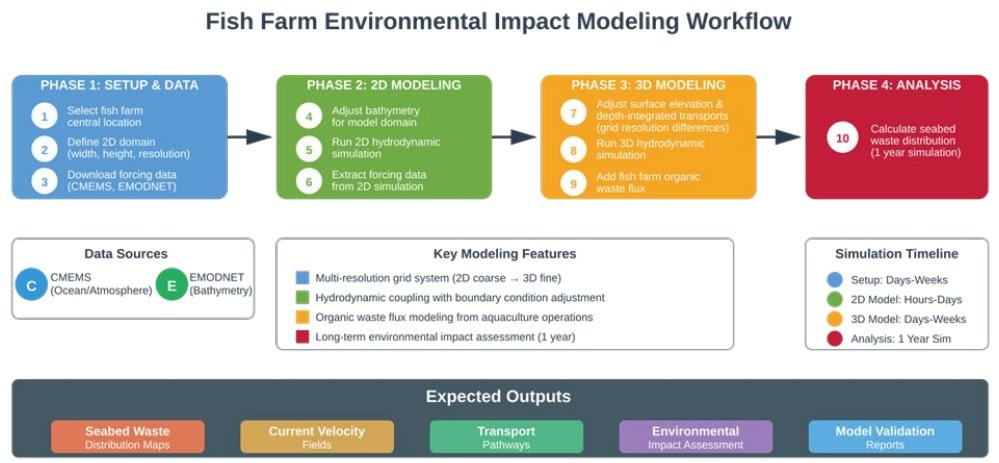
The success of this project lies in its modular structure. Rather than a rigid program, scientists have created a digital “assembly line” that processes information in four critical stages:
- The Cage Model Programmed in Python, this component simulates the entry of additives into the water. It accounts for production volume and additive concentration in the feed to determine how much chemistry is released via wasted pellets versus fish metabolism (feces).
- The Additive and Biogeochemistry Model Implemented within the Framework for Aquatic Biogeochemical Models (FABM), this module tracks the “life” of the chemical. It calculates processes such as sedimentation, degradation due to temperature or light (photolysis), and resuspension from the seabed back into the water column.
- The Physical Model (pyGETM) To function, the system must understand the underwater “climate.” It uses an adapted version of the General Estuarine Transport Model (pyGETM), which automatically downloads high-resolution current, salinity, and bathymetry data for any geographical point along European coasts.
- PEC Evaluation (Predicted Environmental Concentration) Finally, the system generates detailed maps of chemical accumulation in the sediment, allowing risk assessors to compare these levels against established safety thresholds.
Methodology: From Space to the Seafloor
The robustness of the model (technically designated as Task 1.3) relies on EU-funded data services that ensure long-term viability.
- CMEMS (Copernicus Marine Service): Provides data on ocean currents, temperature, and salinity.
- EMODnet: Supplies bathymetry (seafloor relief) with meter-level precision.
- ECMWF (ERA5): Offers critical atmospheric data, such as wind speed and air pressure, which influence surface currents.
Dynamic Downscaling
A major technical achievement is the “downscaling” capability. Global ocean models typically have resolutions measured in kilometers, which is insufficient for a fish farm spanning only a few hundred meters. The developed software automatically creates a high-resolution local domain (grids between 10 and 50 meters) around the farm, ensuring currents adapt to local capes, bays, and islands.
Case Studies: From Norwegian Fjords to the Aegean Sea
To validate the system, researchers tested the model in two radically different environments:
- Norway: The Deep Fjord Challenge At a site in Seiland National Park, the model proved its ability to handle steep bathymetry and tide-dominated currents. While the base model (Norkyst-800) was high-quality, the new pyGETM system revealed circulation details in small bays that were previously invisible.
- Greece: The Complexity of Archipelagos In Sofikos Bay, the model faced a greater challenge: islands so small they did not appear on Copernicus maps. The software successfully reconstructed these islands and simulated how water flow splits and accelerates between them—a critical factor in predicting chemical deposition.
Global Impact and the Future of Environmental Regulation
This advancement is more than an academic exercise; it has direct implications for legislation and ecosystem protection.
- “Worst-Case Scenario” Assessment: The model allows for virtual stress tests, simulating the impact of an additive under extreme conditions, such as low currents or high fish density.
- Industry Support: Feed producers now have a clear path to demonstrate the environmental safety of their products through EFSA-validated simulations.
- Towards Precision Aquaculture: Integrating this model into web applications (planned for future phases) will enable real-time management of a farm’s environmental footprint.
Limitations and Next Steps
While highly advanced, the authors note that short-term simulation results (such as 1-2 day tests) can vary significantly over a full year due to seasonal current variations. The next phase of the project (Tasks 1.4 and 1.5) will focus on long-term validation with real-market additives.
Reference (open access)
Bedington, M., Torres, R., Drivdal, M., Bruggeman, J., & Randelhoff, A. (2026). Model development to predict environmental concentrations of chemical substances in marine sediment when the substance is applied via feed in marine aquaculture: Task 1.3. Formalise and implement the pilot model. EFSA Supporting Publication 2026:EN-9914. https://doi.org/10.2903/sp.efsa.2026.ΕΝ-9914
Stay Always Informed
Join our communities to instantly receive the most important news, reports, and analysis from the aquaculture industry.

Editor at the digital magazine AquaHoy. He holds a degree in Aquaculture Biology from the National University of Santa (UNS) and a Master’s degree in Science and Innovation Management from the Polytechnic University of Valencia, with postgraduate diplomas in Business Innovation and Innovation Management. He possesses extensive experience in the aquaculture and fisheries sector, having led the Fisheries Innovation Unit of the National Program for Innovation in Fisheries and Aquaculture (PNIPA). He has served as a senior consultant in technology watch, an innovation project formulator and advisor, and a lecturer at UNS. He is a member of the Peruvian College of Biologists and was recognized by the World Aquaculture Society (WAS) in 2016 for his contribution to aquaculture.