The rapid evolution of intensive salmon farming has driven the development of increasingly robust production infrastructures. The transition toward offshore cages, semi-closed systems, and land-based tanks entails operating at high stocking densities that generate massive oxygen demands. In this scenario, maintaining optimal dissolved oxygen levels remains one of the most critical challenges. Available oxygen is a determining factor for the welfare of Atlantic salmon (Salmo salar); even brief periods of hypoxia can compromise their health, reduce appetite, or cause catastrophic mortalities.
To mitigate this risk, aquaculture science is advancing toward three-dimensional (3D) digital simulations that integrate bioenergetics and hydrodynamic models with environmental data. These cutting-edge tools allow for the prediction of hypoxia events and the optimization of farm design. However, the success of these ‘digital twins‘ depends on accurate estimations of the oxygen consumption rate (). Until now, the industry has relied on empirical formulas nearly three decades old, which underestimate the metabolic requirements of modern genetic lines.
Scientists affiliated with the Sustainable Aquaculture Laboratory Temperate and Tropical (SALTT) at Deakin University (Australia), the Department of Engineering Cybernetics at the Norwegian University of Science and Technology (Norway), and the Animal Welfare Research Group at the Institute of Marine Research (Norway) refined the traditional model for estimating oxygen consumption in salmon. The scientific paper was published by the prestigious journal Scientific Reports.
Key Points
- Optimized formula: The new mathematical model explains 80% of the observed variation in salmon oxygen consumption using only three easily measurable parameters: body weight, temperature, and swimming speed.
- Overcoming historical biases: It corrects the limitations of the classic Grøttum and Sigholt (1998) model, increasing overall predictive accuracy and raising the estimated baseline consumption by 29.4%.
- Massive database: Developed from robust measurements in fish groups (718 individuals in total), utilizing modern commercial strains with extended thermal acclimation periods.
- Commercial application range: It offers highly reliable estimations within standard industry operating ranges: fish from 0.2 to 3.4 kg, temperatures from 3 to 18 °C, and swimming speeds from 0.3 to 2.8 body lengths per second.
The Limitations of the Previous Paradigm
For nearly three decades, the model developed by Grøttum and Sigholt (1998) remained the undisputed reference standard in both scientific research and commercial production. Despite its undeniable historical value, this approach suffered from severe methodological constraints.
The original formula was designed by evaluating only six third-generation genetic selection specimens, which were exposed to abrupt thermal fluctuations and acclimation periods of barely 10 to 15 hours. In contemporary aquaculture, these estimations proved deficient, forcing simulation software developers to apply artificial statistical adjustments of an additional 30% to 50% to align digital projections with real-world farm metrics. Today’s salmon possess a markedly different growth rate and physiology, the result of more than ten generations of targeted genetic selection.
Methodological Innovation: A Group Behavior Based Strategy
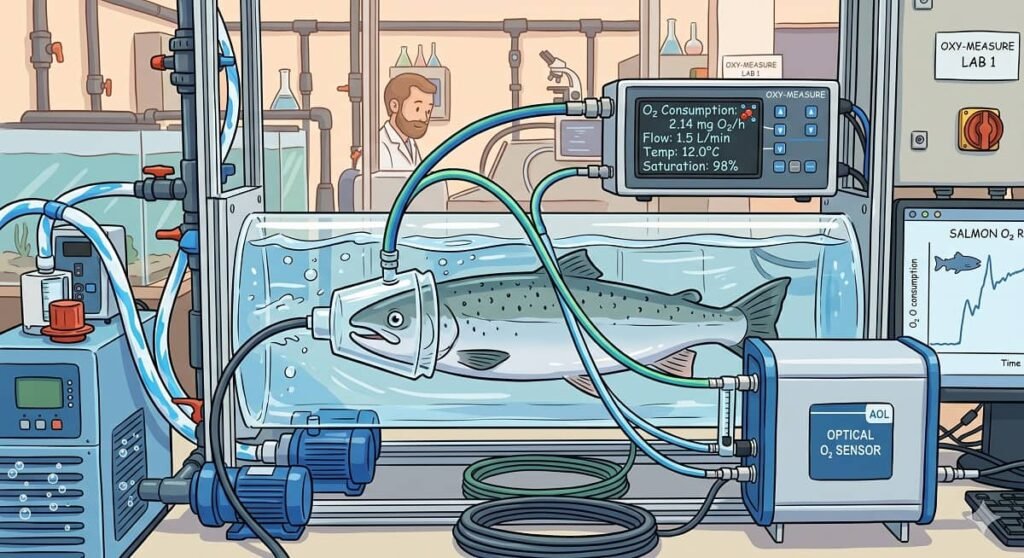
To resolve this production gap, the research team consolidated a database based on seven scientific studies conducted between 2017 and 2022. The information was obtained through rigorous group respirometry tests using a large-scale Brett-type swim tunnel. This state-of-the-art system allows for the evaluation of groups of salmon swimming simultaneously under controlled conditions, thereby capturing collective dynamics and stocking densities equivalent to those of the commercial industry ().
All analyzed specimens belonged to a modern domesticated strain (AquaGen). The trials implemented strict standardization criteria: full seawater salinity, normoxia, a minimum thermal acclimation protocol of three weeks, and a continuous feeding regime. After filtering the data to exclude terminal metabolic plateaus—near the animal’s critical endurance limits—a matrix of 76 highly consistent entries was structured. This database encompassed salmon between 0.2 and 3.38 kg, temperatures from 3 to 18 °C, and swimming speeds from 0.31 to 2.84 . Finally, the statistical analysis utilized a log-linear regression fitted using advanced nonlinear mixed-effects models.
The New Fundamental Model for Oxygen Consumption Prediction
The new mathematical equation validated for accurately projecting oxygen demand in Atlantic salmon is defined as follows:
Mantente siempre informado
Stay Informed
Únete a nuestras comunidades para recibir al instante las noticias, informes y análisis más importantes del sector acuícola.
Join our communities to get instant access to the most important news, reports, and analysis from the aquaculture industry.
When contrasting this new statistical framework with the classic model, the coefficients reveal highly relevant physiological and conceptual transformations:
- Weight Modulation and Allometry (W): The exponent associated with body weight was modified from -0.33 to -0.14, moderating the slope of the traditional negative exponential curve. This demonstrates that the specific oxygen consumption rate decreases less drastically as the salmon grows, contradicting predictions made by classic metabolic scaling theories in a resting state. In specimens undergoing active exercise (moderate to intense swimming), muscular energy demand tends to become more proportional to total mass due to the required mechanical power—a biological phenomenon properly supported by this new exponent of -0.14.
- Temperature Sensitivity (T): The thermal coefficient rose subtly to 1.04, which increases the factor (metabolic change per 10 °C increase in environmental temperature) from 1.34 to 1.45. This adjustment evidences a 32% higher thermal sensitivity in salmon properly acclimated over weeks compared to those exposed to acute thermal fluctuations. Nonetheless, the data reflect that when the fish swims actively, temperature exerts a smaller percentage impact on total than in a strict resting state, given that a larger portion of the energy budget is already allocated to locomotion.
- Relative Swimming Speed (U): The speed coefficient decreased from 1.79 to 1.63. This reduction responds to the incorporation of much faster and more realistic swimming speeds in the respirometry tunnels. Upon approaching elevated speeds, the salmon’s aerobic metabolism undergoes a transition toward anaerobic work, thereby recruiting glycolytic white muscle fibers and stabilizing net oxygen uptake.
Practical Guide and Industrial Application Limits of the Model
The new model demonstrates high reliability within the analyzed parameters, covering the most common scenarios of current salmon concessions. However, for its implementation in feeding management software, real-time environmental control systems, or fish farm engineering, the following technical recommendations must be considered:
- Biomass Projections and Low Temperatures: The model can safely project weights under 0.2 kg (such as post-smolt transfer to sea at ) and higher harvest weights (up to 4.25 kg or more), as biological resource distribution networks follow stable large-scale allometric principles. Similarly, its extrapolation toward temperatures close to 0 °C is biologically valid; salmon is a cold-adapted species that maintains stable metabolic rates in winter without recording anomalous drops.
- Critical Temperature and Current Thresholds: Utilizing the formula above 18 °C is discouraged. Near chronic thermal tolerance limits (21–23 °C), salmon oxygen consumption does not continue to rise exponentially but undergoes a physiological plateau due to severe cardiorespiratory limitations; exceeding 18 °C in the model will overestimate actual metabolic demand. Likewise, it should not be applied at speeds exceeding 2.8 , since above 80–90% of the critical swimming speed, effort is sustained through anaerobic pathways and oxygen consumption stabilizes.
- Behavior Under Hypoxic Conditions: In environments where dissolved oxygen drops below the Limiting Oxygen Saturation (LOS), the salmon’s metabolic rate becomes directly proportional to environmental gas availability, decreasing linearly. Under these oxygen-deficiency stress conditions, the model may overestimate actual consumption, as the fish is unable to uptake more gas than the physical medium effectively provides.
Conclusion
The formula developed by Morin and his team does not position itself as a unique and immutable solution to predict all the complexities of a farming ecosystem. Factors such as handling stress, digestive processes after feeding (Specific Dynamic Action), daily light cycles, or energy costs derived from parasitic infections (such as salmon lice) dynamically alter metabolism.
The true value of this equation lies in its robustness as a core structural building block. When integrated into advanced simulation platforms or “Networked Digital Twin” architectures, it allows for the modular addition of sub-models for behavior, feeding, and marine currents, establishing the methodological foundations for automated, real-time data-driven decision-making to optimize salmon welfare and global food industry sustainability.
Funding for the execution of this study was jointly provided by the Norwegian Seafood Research Fund under project code 901934-ProHav and by the Research Council of Norway through project code 328724-SusOffAqua.
References (open access)
Morin, A., Jacobsson, T., Dempster, T., Warren-Myers, F., Oppedal, F., & Hvas, M. (2026). A fundamental model for oxygen consumption of Atlantic salmon. Scientific Reports, 16(1), 16299. https://doi.org/10.1038/s41598-026-47328-6
Grøttum, J. A., & Sigholt, T. (1998). A model for oxygen consumption of Atlantic salmon (Salmo salar) based on measurements of individual fish in a tunnel respirometer. Aquacultural Engineering, 17(4), 241-251. https://doi.org/10.1016/S0144-8609(98)00012-0

Editor at the digital magazine AquaHoy. He holds a degree in Aquaculture Biology from the National University of Santa (UNS) and a Master’s degree in Science and Innovation Management from the Polytechnic University of Valencia, with postgraduate diplomas in Business Innovation and Innovation Management. He possesses extensive experience in the aquaculture and fisheries sector, having led the Fisheries Innovation Unit of the National Program for Innovation in Fisheries and Aquaculture (PNIPA). He has served as a senior consultant in technology watch, an innovation project formulator and advisor, and a lecturer at UNS. He is a member of the Peruvian College of Biologists and was recognized by the World Aquaculture Society (WAS) in 2016 for his contribution to aquaculture.