- 1 Key Takeaways
- 2 Why Feed Represents Modern Aquaculture’s Achilles’ Heel
- 3 FCR, RFI, and Key Metrics: Evaluating Feed Efficiency in Aquaculture
- 4 Is Feed Efficiency Heritable? The Scientific Evidence
- 5 Why the Top-Performing Genetic Line on One Farm May Underperform on Another
- 6 Traditional Selection: Field-Validated Zootechnical Outcomes
- 7 Genomic Selection: Decoding DNA to Optimize Broodstock Selection
- 8 CRISPR and the Transformative Potential of Gene Editing for Feed Efficiency
- 9 Scientific Gaps and Methodological Limitations: What Genetics Has Yet to Resolve
- 10 From Laboratory to Pond: Practical Implications for Aquaculture Decision-Making
- 11 Entradas relacionadas:
Key Takeaways
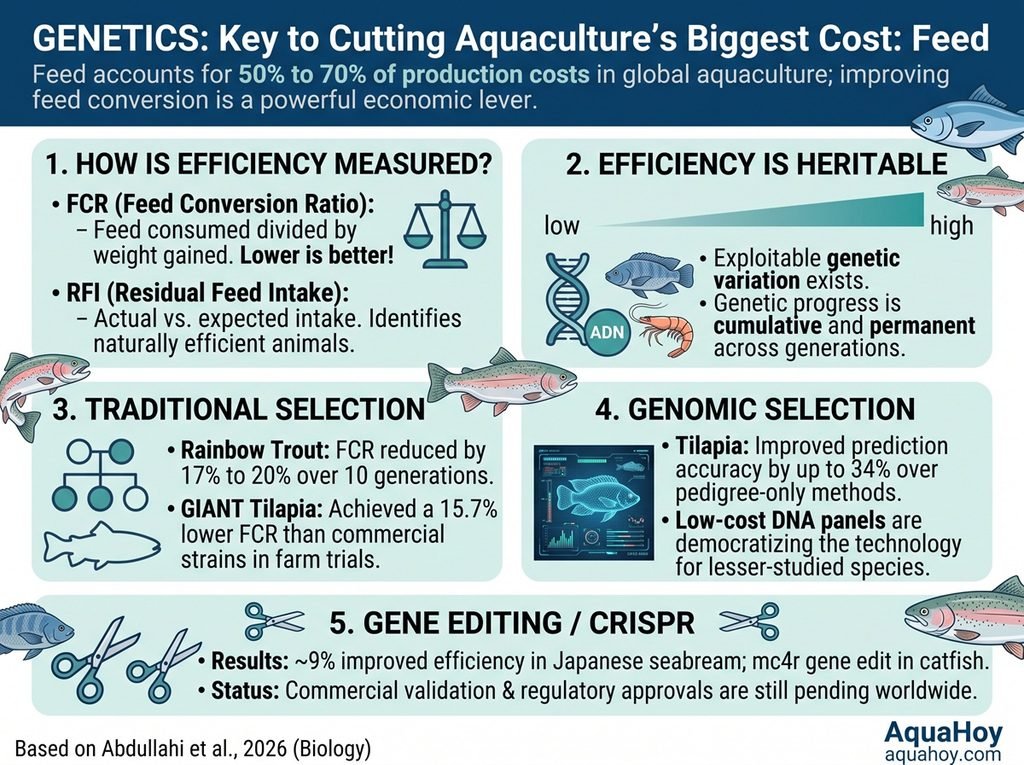
- Feed accounts for 50% to 70% of global aquaculture operating costs; therefore, optimizing the Feed Conversion Ratio (FCR) represents the industry’s most decisive driver of profitability.
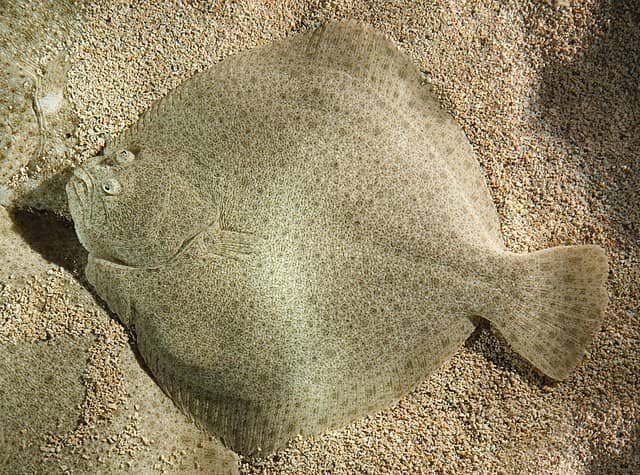
- Research across tilapia, Atlantic salmon, whiteleg shrimp, turbot, and abalone demonstrates actionable genetic variation, contingent upon the target species, dietary formulation, and phenotyping methodology.
- Following ten generations of phenotypic selection, rainbow trout achieved a 17% to 20% reduction in FCR; concurrently, the GIANT tilapia strain exhibited a 15.7% more efficient FCR than standard commercial lines on Egyptian farms.
- In tilapia breeding programs, genomic selection improved predictive accuracy by up to 34% over traditional pedigree records, while low-cost SNP/DNA panels are democratizing these genomic tools for emerging species.
- Although gene editing demonstrates promising breakthroughs in red sea bream, channel catfish, and zebrafish, it still demands commercial-scale validation and must navigate fragmented regulatory frameworks worldwide.
Before dawn, across various corners of the globe, the feeding routine begins. It unfolds in a tilapia farm along the banks of the Nile, in a shrimp pond in Southeast Asia or along the American Pacific, or within a marine salmon cage nestled in a Norwegian fjord. The gesture remains identical: opening the sack, broadcasting the feed pellets, and, at the week’s close, calculating the inevitable balance—how many kilograms of feed entered the system versus how many kilograms of biomass will reach the market.
Invariably, that calculation creates financial friction. Feed prices escalate, fishmeal becomes increasingly scarce, and a fraction of the invested capital dissipates at the pond bottom or dissolves into the water column as nitrogen and phosphorus discharge. Aquaculture operators have explored virtually every operational lever: calibrating feed charts, rotating suppliers, adjusting shifts, and upgrading automated feeders. Yet while every adjustment ekes out marginal gains, the scope for improvement seems to have plateaued.
A pivotal question arises, however—one rarely debated at the pond’s edge: what if a substantial portion of this dilemma lies within the animal’s intrinsic physiology? Is it plausible that certain fish and crustaceans possess an innate biological advantage in converting nutrient inputs into muscle tissue?
This core premise underpins a scientific review published in the journal Biology, conducted by researchers from Wuxi Fisheries College (Nanjing Agricultural University) and the Freshwater Fisheries Research Center of the Chinese Academy of Fishery Sciences. Led by Usman Abdullahi and co-authored by Yongkai Tang and Yongfeng Zhao, the team evaluated over a hundred publications to address a cross-cutting industry question: is it feasible to breed, generation after generation, broodstock that demand fewer feed inputs to sustain identical yield?
The evidence confirms that it is. Nonetheless, operational implementation demands rigorous scrutiny: while certain approaches are thoroughly proven in commercial settings, others remain confined to experimental trials, all governed by genotype-environment interactions that explain why an elite genetic line in one environment may underperform in another.
Why Feed Represents Modern Aquaculture’s Achilles’ Heel
Aquaculture currently supplies over half of the aquatic organisms consumed globally, rising from 51.2% in 2022 to 52.8% in 2024, according to FAO statistics cited in the review. With capture fisheries facing structural stagnation, future food security relies squarely on farming operations—whose viability hinges on a single critical input: commercial aquafeed.
The economic toll of feed varies by species, production system, and geography; for instance, feed accounts for 60% to 70% of total operating expenditures in Nigeria and exceeds 50% for Mandarin fish grow-out in China, exacerbated by mounting pressures on increasingly scarce fishmeal and fish oil commodities. Atlantic salmon illustrates the scale of this leverage: researchers estimate that a mere 2% to 5% gain in feed conversion efficiency would yield annual savings between €8 million and €20 million in Norway alone, where roughly 600,000 metric tons of aquafeed are consumed annually. Beyond financial gains lies a pivotal environmental dividend: metabolically efficient fish excrete less nitrogen and phosphorus, curbing eutrophication across coastal and freshwater ecosystems.
For decades, the industry addressed this bottleneck primarily through nutritional formulation and feed management—measures that, while effective, constitute recurring operational costs incurred cycle after cycle. In contrast, genetic selection offers a transformative paradigm: its gains are cumulative and permanent, locking in biological efficiencies across successive generations.
FCR, RFI, and Key Metrics: Evaluating Feed Efficiency in Aquaculture
Every fish farmer is familiar with FCR (Feed Conversion Ratio)—the kilograms of feed delivered divided by batch biomass gain—where the foundational rule remains immutable: the lower the ratio, the higher the biological efficiency.
Mantente siempre informado
Stay Informed
Únete a nuestras comunidades para recibir al instante las noticias, informes y análisis más importantes del sector acuícola.
Join our communities to get instant access to the most important news, reports, and analysis from the aquaculture industry.
However, geneticists increasingly prioritize RFI (Residual Feed Intake), which models nutritional expenditure much like fuel economy in transport: it contrasts an individual’s actual feed consumption against its expected metabolic requirements based on body weight and growth trajectory, meaning a negative or low RFI isolates specimens that thrive on fewer nutrient inputs.
Importantly, the review authors raise a decisive methodological caveat: calculating RFI mathematically independent of growth does not guarantee genomic dissociation, as demonstrated by the fact that RFI selection barely altered growth rates in whiteleg shrimp and turbot, whereas in tilapia, favorable RFI was positively correlated with superior weight gain, underscoring that this genetic correlation must be empirically validated across specific species and breeding populations.
Is Feed Efficiency Heritable? The Scientific Evidence
To evaluate the feasibility of selecting for a commercial trait, geneticists estimate its heritability (): the proportion of phenotypic variation attributable to additive genetic factors transmissible to progeny, scaled from 0 to 1. The data synthesized across the review fall within a moderate-to-high range:
- Nile tilapia: 0.32 for FCR, determined via computer video tracking in group-housed individuals.
- Atlantic salmon: 0.08 to 0.23 for FCR depending on developmental life stage, utilizing digital X-radiography to quantify individual feed intake.
- Whiteleg shrimp (Litopenaeus vannamei): 0.74 for RFI on all-plant diets; however, the authors advise caution, as the trial could not decouple common environmental tank effects.
- Turbot: 0.43 for RFI.
- Pacific abalone: 0.32 to 0.40 across two consecutive evaluation periods.
The overall picture is promising: sufficient additive genetic variance exists to implement selective breeding programs. Nonetheless, researchers stress that direct cross-study comparisons remain inaccurate due to divergent sampling protocols, dietary formulations, sample sizes, and culture systems.
Concurrently, a favorable dynamic emerges for biomass-focused breeding programs: in tilapia, the genetic correlation between FCR and daily weight gain reached −0.69, indicating that fish genetically predisposed to rapid growth tend to exhibit superior feed conversion. Nevertheless, because this biological synergy is not universal across all aquatic taxa, selecting solely for weight gain does not guarantee optimal metabolic efficiency.
Why the Top-Performing Genetic Line on One Farm May Underperform on Another
This constitutes, perhaps, the most actionable finding of the scientific review and the one most frequently overlooked: the production environment redefines which families emerge as elite performers. In quantitative genetics, this phenomenon is termed genotype-by-environment () interaction.
In whiteleg shrimp, the genetic correlation of RFI between an all-plant dietary formulation and a fishmeal-based regimen stood at 0.646. Operationally speaking, the ranking of families exhibiting superior feed efficiency remains broadly similar across both dietary regimes, yet they do not fully coincide. Consequently, a lineage selected under conventional diets risks underperforming if the commercial grow-out facility transitions toward plant-based inputs, insect meals, or microbial single-cell biomass.
Thermal gradients exert an analogous effect. In large yellow croaker, researchers evaluated identical cohorts across 15, 19, and 24 °C, identifying distinct genetic markers associated with metabolic efficiency at each temperature regimen. Selecting broodstock at 24 °C, therefore, provides no guarantee of optimal performance at 15 °C—a decisive operational factor for regions characterized by pronounced seasonality or for commercial enterprises procuring genetic strains bred in differing climatic latitudes.
Culture infrastructure exerts an equally substantial impact. In penaeid shrimp, the heritability of body weight reached 0.68 in earthen ponds versus 0.37 in intensive tanks, accompanied by only moderate genetic correlations (0.60–0.65) between the two rearing systems.
The technical conclusion is unequivocal: selective breeding programs must benchmark candidate broodstock within production environments strictly aligned with commercial operational conditions, testing them against the precise nutritional formulations that will be deployed in the field.
Traditional Selection: Field-Validated Zootechnical Outcomes
Family-based selective breeding remains the aquaculture industry’s most empirically supported methodology, frequently relying on family means or correlated proxy traits—such as visceral fat deposition—to circumvent the high logistical costs of measuring individual feed intake.
Long-term evaluations demonstrate substantial progress: following ten generations of multi-trait selection in rainbow trout, FCR achieved a cumulative reduction of 17% to 20%, while Egypt’s improved GIANT tilapia strain exhibited roughly 28% faster growth in trials alongside a 15.7% more efficient commercial FCR than conventional stocks.
Genomic Selection: Decoding DNA to Optimize Broodstock Selection
Genomic selection introduces a quantum leap in accuracy. Rather than relying solely on pedigree records, this biotechnology assays thousands of molecular markers distributed across each candidate’s genome. The methodology operates in two sequential stages: first, a “reference population” is extensively phenotyped and genotyped; subsequently, this predictive framework estimates the genetic merit of related candidates that were not individually evaluated. The principle parallels calibrating an instrument against certified standards to measure unknown samples with rigorous precision. Nevertheless, this approach demands continuous recalibration: the reference population must be periodically phenotyped to prevent prediction accuracy from decaying across successive generations.
In Nile tilapia, genomic modeling boosted prediction accuracy by up to 34% over pedigree-based evaluations, depending on the evaluated trait. In European seabass (Dicentrarchus labrax), the reliability of estimated breeding values increased by 10% to 125%, with the actual phenotypic response of a cohort selected for individual feed efficiency already documented.
Regarding the recurring question of whether “master efficiency genes” exist, the review’s compiled evidence is unequivocal: single genes with major effects remain absent. A trial conducted on 700 Atlantic salmon identified nine chromosomal regions linked to feed intake and conversion, yet all exhibited marginal effect sizes. Metabolic efficiency follows a strictly quantitative, polygenic architecture: thousands of loci contribute minute fractions of phenotypic variation—akin to a lake replenished by hundreds of small tributaries rather than a single river. Consequently, genomic selection—by appraising the entire genome simultaneously—substantially outperforms isolated marker-assisted selection or single-QTL tracking.
For underfunded or emerging aquaculture species, the practical horizon lies in low-density SNP panels: arrays featuring 1,000 to 5,000 markers coupled with genotype imputation algorithms to dramatically lower analytical costs. This strategy has proven successful in Atlantic salmon, turbot, common carp, and Pacific oyster. Furthermore, a 1,000-marker panel has already been validated in tambaqui (Colossoma macropomum), a strategically vital neotropical fish for freshwater farming. This technological democratization paves the way for genomics to transcend beyond a handful of elite commercial species.
CRISPR and the Transformative Potential of Gene Editing for Feed Efficiency
While gene editing represents aquaculture’s most disruptive biotechnological frontier, researchers approach its prospective gains with calculated caution, as evidenced by initial proof-of-concept trials: myostatin knockout in red sea bream enhanced early feed conversion by roughly 9%, mc4r disruption in channel catfish improved nominal FCR from 1.57 to 1.18 (though lacking statistical power due to limited replicates), and pomc ablation in zebrafish accelerated biomass accretion while optimizing feed conversion. However, commercial deployment remains strictly contingent on navigating fragmented global regulatory frameworks—ranging from Japan’s commercial authorizations to the European Union’s precautionary restrictions—alongside consumer acceptance and critical biosecurity measures designed to preclude hybridization with wild conspecifics.
Scientific Gaps and Methodological Limitations: What Genetics Has Yet to Resolve
Much of the strength of this review lies in its transparent account of current knowledge gaps. Most identified candidate genes are grounded in statistical associations, still lacking direct functional validation of causality. Furthermore, phenotyping individual feed intake remains costly and logistically demanding, although tools such as Near-Infrared Spectroscopy (NIRS) and digital X-radiography pave the way toward larger-scale evaluations. Concurrently, numerous commercial species still lack high-quality reference genome assemblies, while unmanaged selection pressure solely for metabolic efficiency risks escalating inbreeding rates if effective population sizes and broodstock genetic diversity are not strictly maintained.
The researchers themselves explicitly disclose the methodological limitations of their systematic review: literature screening was conducted by a single reviewer, restricted strictly to English-language publications, and omitted a formal meta-analysis. Following an initial screening of 468 records, the final corpus comprised 107 sources of empirical evidence. Such scientific rigor allows the study’s conclusions to be weighted with the appropriate methodological balance.
From Laboratory to Pond: Practical Implications for Aquaculture Decision-Making
Returning to the opening scene: the fish farmer who, across any latitude, routinely calculates the ratio between delivered feed and harvested biomass. The scientific review does not promise a silver-bullet organism for the forthcoming production cycle; instead, it delivers solid empirical evidence demonstrating that a substantial fraction of that feed conversion metric is encoded within the stock’s genome and remains amenable to cumulative genetic gain.
This principle carries immediate operational imperatives. When procuring fingerlings or postlarvae, operators must audit whether seedstock originates from structured selective breeding programs and under what precise environmental conditions candidates were benchmarked: dietary formulations, thermal ranges, and rearing infrastructure (e.g., earthen ponds versus intensive tank systems). An elite lineage evaluated under divergent conditions will rarely replicate its genetic potential in local commercial environments. For producer cooperatives, regional associations, and R&D centers working with emerging species, low-density SNP panels democratize in-house breeding programs, dismantling the cost barriers that historically restricted genomics to large corporate enterprises.
Zootechnical progress, the authors conclude, will not emerge from an isolated intervention, but from the deliberate convergence of high-throughput phenotyping, quantitative genetics, genomic tools, and field validation tailored to each species and rearing model. It represents a cumulative endeavor that matures across successive generations; yet, over the long term, it constitutes the most reliable pathway to tilt the economic balance in favor of the farmer whose day begins before dawn.
Reference (open access)
Abdullahi, U.; Kandeh, I.; Li, J.; Xu, Y.; Tang, Y.; Zhao, Y. Genetic Improvement Strategies for Enhancing Feed Efficiency in Aquaculture. Biology 2026, 15, 1849. https://doi.org/10.3390/biology15201849

Editor at the digital magazine AquaHoy. He holds a degree in Aquaculture Biology from the National University of Santa (UNS) and a Master’s degree in Science and Innovation Management from the Polytechnic University of Valencia, with postgraduate diplomas in Business Innovation and Innovation Management. He possesses extensive experience in the aquaculture and fisheries sector, having led the Fisheries Innovation Unit of the National Program for Innovation in Fisheries and Aquaculture (PNIPA). He has served as a senior consultant in technology watch, an innovation project formulator and advisor, and a lecturer at UNS. He is a member of the Peruvian College of Biologists and was recognized by the World Aquaculture Society (WAS) in 2016 for his contribution to aquaculture.