Key Study Highlights
- The toxic cyanobacterium Nodularia spumigena proliferated spontaneously in white shrimp (Penaeus vannamei) biofloc systems, persisting despite prior water chlorination.
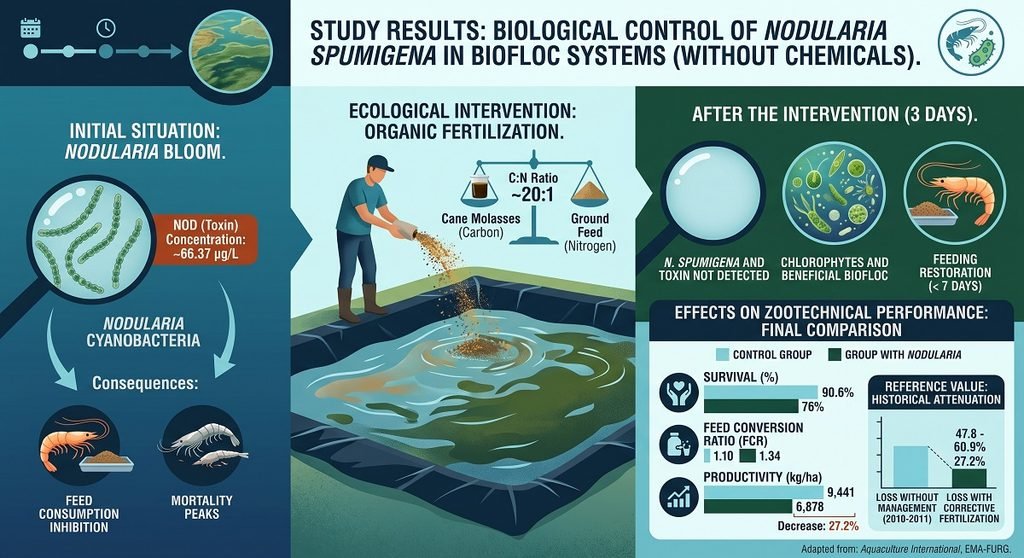
- Water column concentrations of nodularin (NOD), a potent hepatotoxin, peaked at 66.37 µg/L, inhibiting feed intake and triggering mortality spikes during the second culture week.
- Rather than deploying harsh chemicals such as hydrogen peroxide, researchers implemented a cost-effective biological protocol: fertilizing with sugarcane molasses and pulverized feed to enhance nitrogen availability.
- The intervention succeeded: following three consecutive days of fertilization, both microalgal density and toxin concentrations dropped below detection thresholds, restoring feeding rates within a week.
- Despite successful bioremediation, the initial setback impaired zootechnical performance: treated ponds recorded 76% survival compared to 90.6% in the control group, resulting in a yield loss of roughly 2,500 kg/ha.
The shrimp culture cycle begins under optimal conditions: vigorous juveniles of approximately one gram, active biomass, and mechanical aeration finely calibrated during the second week. However, during routine inspection of feeding trays, feed remains virtually untouched—the shrimp have ceased feeding. Hours later, initial mortalities emerge at the pond bottom and the water shifts to an opaque, dense green hue, an unequivocal sign of severe microbial dysbiosis.
This scenario reflects the silent impact of harmful algal blooms (HABs). Cyanobacteria proliferate imperceptibly, and by the time they are visually detected, toxins are already circulating throughout the system. In southern Brazil, the Marine Aquaculture Station (EMA) at the Federal University of Rio Grande (FURG) has documented over a decade of contending with a recurring microorganism: Nodularia spumigena. This filamentous species can fix atmospheric nitrogen and synthesize nodularin—a lethal hepatotoxin—forming dense blooms when favorable environmental parameters align.
Addressing this recurrent challenge, FURG researchers posited an ecological hypothesis: if Nodularia spumigena gains a competitive edge through atmospheric nitrogen fixation in nitrogen-limited environments, what happens if that advantage is neutralized by saturating the system with bioavailable nitrogen for the wider microbiome? Their findings, published in the scientific journal Aquaculture International, offer the shrimp farming sector an accessible, cost-effective biological management alternative to mitigate toxic blooms without compromising the system’s ecological integrity.
Why Nodularia Is so Challenging to Eradicate from Shrimp Ponds
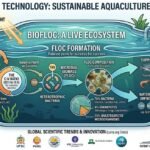
Biofloc system operators understand that production stability relies entirely on microbial community balance. Heterotrophic bacteria and microalgae both purify the water and serve as supplementary nutrition for shrimp within a dynamic, living ecosystem rather than a sterile medium. This dynamic presents a fundamental operational dilemma: conventional cyanobacterial treatments, such as hydrogen peroxide, act indiscriminately without distinguishing pathogens from beneficial microbiota, risking nitrifying collapse and ecological disruption.
Furthermore, the physiological resilience of Nodularia spumigena is formidable: in the evaluated trial, it colonized ponds despite rigorous disinfection with 12 ppm active chlorine. The researchers’ prevailing hypothesis points to akinete differentiation—metabolically dormant resting cells that endure harsh stressors and germinate once optimal environmental conditions return—meaning preventive chlorination fails to guarantee complete eradication as latent propagules resurface weeks later.

Nevertheless, this cyanobacterium’s primary evolutionary advantage doubles as its critical vulnerability. Its ability to fix atmospheric nitrogen provides competitive dominance under dissolved-nitrogen deficits where chlorophytes and associated microbes are resource-limited; conversely, abundant bioavailable nitrogen actively suppresses this fixation machinery, stripping away the ecological edge that enables it to monopolize the system.
The Experiment: Molasses, Pulverized Feed, and Patience
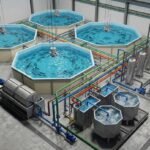
Conducted at commercial scale under real-world pond conditions, the 15-week trial utilized six 600 m³ geomembrane-lined units stocked with Penaeus vannamei at 70 shrimp/m². Because the bloom arose spontaneously rather than artificially, ponds were categorized into two distinct triplicates: a bloom-free control group (“without Nodularia“, WN) and a bloom-impacted treatment group (“with Nodularia“, N).
During week three—synchronized with the cyanobacterium’s exponential growth phase observed under microscopy—researchers deployed a three-day biological protocol combining sugarcane molasses and finely milled commercial aquafeed formulated to achieve a carbon-to-nitrogen (C:N) ratio near 20:1. Pellet pulverization deliberately accelerated nutrient leaching into the water column, where it was broadcast across the pond surface alongside diluted molasses to immediately stimulate heterotrophic and chlorophyte growth.
This ecological manipulation avoided harsh chemical shocks, altering nutrient stoichiometry instead to outcompete and displace Nodularia spumigena through competitive exclusion driven by beneficial microbiota, microalgae, protozoans, and rotifers.
Mantente siempre informado
Stay Informed
Únete a nuestras comunidades para recibir al instante las noticias, informes y análisis más importantes del sector acuícola.
Join our communities to get instant access to the most important news, reports, and analysis from the aquaculture industry.
Nodularin Dynamics and Shrimp Zootechnical Performance
The findings reveal an undeniable trend: nodularin was detected in the water column of the impacted cohort solely during initial sampling—peaking at 66.37 µg/L—which directly triggered feed cessation and acute mortality events. Following organic fertilization, both nodularin concentrations and Nodularia spumigena cell counts plunged below analytical detection thresholds across all subsequent monitoring intervals, while control ponds remained entirely bloom-free throughout the trial.
Feeding behavior and growth rates clearly demonstrate the severity of the initial setback; between weeks two and four, impacted shrimp exhibited substantial growth stunting, gaining merely 0.11 g compared to 0.77 g in the control group. However, feeding resumed on sampling trays approximately 96 hours post-fertilization, fully normalizing within a fortnight as phytoplankton community structure converged toward chlorophyte dominance in both treatments to confirm successful ecological remediation.
Despite biological recovery, early-stage physiological stress compromised final zootechnical performance: the treated group achieved 76% survival versus 90.6% in control ponds, a poorer feed conversion ratio (FCR of 1.34 vs. 1.10), and lower final yield (6,878 kg/ha vs. 9,441 kg/ha), representing an overall 27.2% productivity shortfall despite prompt corrective action. Crucially, historical benchmarking demonstrates the protocol’s real value: unmanaged blooms in 2010 and 2011 incurred 47.8% to 60.9% yield losses, with survival dropping to ~56%, proving that corrective organic fertilization successfully mitigated a catastrophic crash into a manageable production variance.
What This Means for Your Shrimp Farm
Prudence demands transparency regarding the study’s scope: this was a commercial-scale observational trial with triplicated ponds, and the authors emphasize that further validation is essential before establishing a standardized prescription. Crucially, the bloom was an opportunistic field occurrence rather than a controlled induction; nevertheless, the underlying implications remain powerful and actionable.
For producers contending with Nodularia—or analogous diazotrophic cyanobacteria—within biofloc systems, this protocol offers a viable alternative to harsh oxidizers without destabilizing the critical microbial consortia. Sugarcane molasses and ground aquafeed represent accessible, on-farm inputs, yet operational success hinges on precision timing: intervening during the exponential onset rather than after dense blooms establish. Fundamentally, this strategy does not aim to chemically eradicate cyanobacteria, but rather to nutritionally empower competing beneficial microbiota, thereby neutralizing the pathogen’s competitive niche.
Revisit that sobering scene during week two—the untouched feeding trays and initial bottom mortalities that historically heralded severe crop failure. This evidence demonstrates that a timely, three-day regimen of molasses and finely pulverized feed can alter that trajectory: prompting feed resumption within days and preserving a harvest that, while partially compromised, remains commercially viable.
Contact
Andrezza Carvalho
Marine Shrimp Culture Laboratory, Federal University of Rio Grande-FURG, Institute of Oceanography
Rio Grande, RS, Brazil
Email: andrezzachagas@hotmail.com
Reference (open access)
Zemor, J.C., Carvalho, A., Costa, L.D.F. et al. Effect of organic fertilization on the occurrence of Nodularia spumigena blooms in Penaeus vannamei shrimp ponds under a biofloc system. Aquacult Int 34, 264 (2026). https://doi.org/10.1007/s10499-026-02668-y

Editor at the digital magazine AquaHoy. He holds a degree in Aquaculture Biology from the National University of Santa (UNS) and a Master’s degree in Science and Innovation Management from the Polytechnic University of Valencia, with postgraduate diplomas in Business Innovation and Innovation Management. He possesses extensive experience in the aquaculture and fisheries sector, having led the Fisheries Innovation Unit of the National Program for Innovation in Fisheries and Aquaculture (PNIPA). He has served as a senior consultant in technology watch, an innovation project formulator and advisor, and a lecturer at UNS. He is a member of the Peruvian College of Biologists and was recognized by the World Aquaculture Society (WAS) in 2016 for his contribution to aquaculture.